
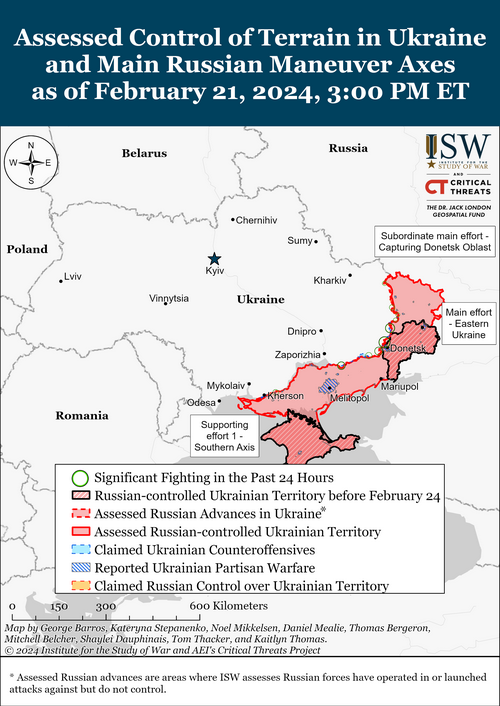
From The Institute for the Study of War:
Russian Offensive Campaign Assessment, February 21, 2024
Kateryna Stepanenko, Christina Harward, Grace Mappes, Angelica Evans, George Barros, Amin Soltani, Alexandra Braverman, Brian Carter, Kitaneh Fitzpatrick, and Frederick W. Kagan
February 21, 2024, 8:30pm ET
Click here to see ISW’s interactive map of the Russian invasion of Ukraine. This map is updated daily alongside the static maps present in this report.
Click here to see ISW’s 3D control of terrain topographic map of Ukraine. Use of a computer (not a mobile device) is strongly recommended for using this data-heavy tool.
Click here to access ISW’s archive of interactive time-lapse maps of the Russian invasion of Ukraine. These maps complement the static control-of-terrain map that ISW produces daily by showing a dynamic frontline. ISW will update this time-lapse map archive monthly.
Note: The data cut-off for this product was 1:30pm ET on February 21. ISW will cover subsequent reports in the February 22 Russian Offensive Campaign Assessment.
Prominent independent Russian milblogger Andrei Morozov reportedly committed suicide on February 21 after refusing the Russian military command’s orders to delete his reports about high Russian casualty rates around Avdiivka.[1] Morozov (also known under the alias Boytsovskiy Kot Murz) was a sergeant in the Russian 4th Separate Motorized Rifle Brigade (2nd Luhansk People’s Republic’s [LNR] Army Corps) and an avid critic of the Russian military command and the Ministry of Defense (MoD). Morozov published a lengthy suicide note in which he stated that an unnamed Russian colonel ordered him on February 20 to remove his February 19 report that claimed that 16,000 Russian personnel died in combat during Russian offensive operations in Avdiivka.[2] The colonel reportedly threatened to cut off ammunition and military equipment supplies to Morozov’s unit if he did not delete his reports about the Russian military’s heavy losses in seizing Avdiivka and told Morozov that he would not be able to change the current situation on the battlefield and that only presidential elections could trigger some changes. Morozov claimed that the colonel was likely following orders from the Russian military command, political leadership, and Russian propagandists such as Vladimir Solovyov, who had sought to eliminate Morozov even prior to full-scale invasion. Morozov proclaimed that he tried to expose the truth about Russian battlefield realities and could no longer serve under this abusive colonel who assumed command over a “decapitated” brigade operating on a critical frontline and whose poor leadership made the situation worse for Russian forces. Morozov also implied that Russian authorities may have conspired to murder or arrest him and noted that he no longer saw the point in continuing his under-resourced fight against the incompetent Russian military bureaucracy.
Morozov used his suicide note to further discuss Russian military failures in Avdiivka and Donetsk Oblast. Morozov accused Russian generals of wastefully sacrificing thousands of servicemen to advance their military careers and implied that most Russian journalists lie about battlefield realities. Morozov also observed that the Russian military command had been increasingly using mobilized personnel as barrier forces (specialized units that shoot their own forces who retreat or refuse to attack) and amplified a formal complaint from a mobilized Russian serviceman of the 1487th Regiment (a mobilized unit under the command of the 1st Donetsk People’s Republic’s [DNR] Army Corps), which the Russian military prosecutor’s office rejected in early February. The mobilized serviceman complained that the 1487th Regiment was reduced to less than 30 percent of its strength due to the regiment’s lack of reinforcements and rotations since the regiment’s deployment in mid-January 2023.[3] The serviceman added that the commander of the 1st Army Corps, nicknamed “Krym” (Crimea), transferred 300 servicemen from the 1487th Regiment to the command of the Russian “Veterany” private military company (PMC) in November 2023 – most of whom died or were injured in the Avdiivka direction. The mobilized serviceman accused the “Veterany” PMC – which is reportedly staffed with convicts, drug addicts, and looters – of using mobilized personnel as barrier troops and refraining from participating in assaults. The mobilized serviceman added that his battalion completely lacked grenade launchers, mortars, and vehicles necessary for offensive operations. The mobilized serviceman also observed that Russian military medical staff refused to treat shellshocked servicemen and sent them back to the frontlines without medical examinations and that these issues systematically plague other Russian units.
The Russian information space, apart from select Russian propagandists and Kremlin-controlled milbloggers, largely mourned Morozov’s death and blamed various military and political actors for his demise. Russian propagandist Yuliya Vityazeva implied that Morozov’s suicide was the fault of his friends who failed to help him and are using his death to throw shade at the Russian MoD to profit off social media attention.[4] One Kremlin-affiliated milblogger acknowledged Morozov’s humanitarian aid contributions to the Russian military but noted that Morozov’s criticism of the Russian military command was so extremely negative that it helped Ukraine.[5] The milblogger added that it is unfortunate that Russia’s enemies and “hostile” Telegram channel networks will use the news of Morozov’s death to overshadow the Russian capture of Avdiivka. Wagner Group-affiliated milbloggers accused Solovyov and other propagandists of persecuting Morozov and mocking his death.[6] Supporters of the imprisoned Russian officer and ardent critic of the Russian military command, Igor Girkin, also condemned Morozov’s harassment and highlighted his years-long commitment to supplying Russian forces with equipment and exposing Russian military failures.[7] Several milbloggers blamed Morozov’s suicide on Russia’s inability to value and internalize different opinions in pursuit of the common goal.[8]
Morozov’s reported suicide will likely further the Kremlin’s and the Russian MoD’s efforts to consolidate a monopoly over the Russian information space. Morozov was one of the few remaining independent ultranationalist milbloggers who openly criticized the Russian military command and government after the Kremlin and the Russian MoD began to consolidate control over prominent Russian milbloggers in July 2023. Morozov, for example, previously warned about severely degraded Russian forces that were around Izyum, Kharkiv Oblast, in May-June 2022 – months prior to a successful Ukrainian counteroffensive in the area in September 2022.[9] Russian officials have been increasingly targeting radical milbloggers and have arrested several milbloggers who have expressed critiques similar to Morozov’s complaints.[10] ISW observed that many Russian milbloggers have drastically suppressed their critiques against Russian military command since the failed Wagner mutiny and reported pressure against Morozov may encourage more critical milbloggers to refrain from discussing Russian military failures. The Kremlin began an effort to co-opt pliant milbloggers in November 2022.[11]
A Ukrainian official denied a recent New York Times (NYT) report that Russian forces may have captured “hundreds” of Ukrainian soldiers during Ukraine’s withdrawal from Avdiivka, Donetsk Oblast.[12] Ukrainian Tavriisk Group of Forces Spokesperson Dmytro Lykhovyi acknowledged on February 21 that Russian forces did capture some Ukrainian soldiers during Ukrainian forces’ withdrawal from Avdiivka, but stated that reports about “hundreds” of Ukrainian soldiers being taken prisoner or otherwise being unaccounted for are false.[13] Lykhovyi suggested that the NYT’s February 20 report is an extension of Russian information operations aimed at demoralizing the Ukrainian military and noted that Russian propagandists would have shared footage of large numbers of Ukrainian prisoners of war (POWs) if Russia had actually captured that many Ukrainian soldiers. Lykhovyi noted that Russian media widely shared footage of large numbers of Ukrainian POWs after Russian forces seized Azovstal in Mariupol, Donetsk Oblast in 2022.[14] ISW recently noted that “unaccounted for” personnel include those killed, wounded, and missing in action as well as captured, and ISW has still not observed any open-source evidence of Russian forces taking large numbers of Ukrainian forces prisoner.[15] ISW will continue to monitor the information space for evidence and will adjust its assessment as more evidence becomes available.
Russian Chief of the General Staff Army General Valery Gerasimov claimed that Russian forces seized Avdiivka within a “fairly short time.” The Russian Ministry of Defense (MoD) published footage on February 21 of Gerasimov presenting state awards to Russian servicemen who distinguished themselves during the seizure of Avdiivka and meeting with Russian Central Grouping of Forces Commander Colonel General Andrei Mordvichev to discuss plans for future Russian operations in the Avdiivka direction.[16] This video is Gerasimov’s first public appearance since December 29, 2023.[17] Gerasimov stated during his briefing with Mordvichev that Russian forces seized Avdiivka “in a fairly short time” that was preceded by a “long period of preparation.”[18] Russian Defense Minister Sergei Shoigu similarly attempted to downplay heavy Russian losses and the difficulty of seizing of Avdiivka during a meeting with Russian President Vladimir Putin on February 20, portraying the seizure of Avdiivka as an astounding success with minimal losses despite the fact that the four-month-long operation resulted in an estimated 16,000 to 47,000 Russian personnel losses.[19] Ukrainian Tavriisk Group of Forces Commander Brigadier General Oleksandr Tarnavskyi stated on February 21 that Russian forces lost 212 tanks in the Tavriisk direction (Avdiivka through western Zaporizhia Oblast) between January 1 and February 20, and a significant portion of Russian tank losses in the Tavriisk direction are likely the result of the Russian operation of seize Avdiivka.[20] Russian Deputy Defense Minister Viktor Goremykin also presented state awards to members of the Russian 90th Tank Division (41st Combined Arms Army, Central Military District) for their role in the seizure of Avdiivka.[21] Putin credited elements of the 90th Tank Division with seizing Avdiivka under Mordvichev’s leadership on February 17.[22]
A Ukrainian HIMARS strike against an undefended Russian training ground near occupied Volnovakha, Donetsk Oblast likely inflicted significant casualties, triggering a point of neuralgia for the Russian ultranationalist milblogger community. Ukrainian forces struck the Trudivske Training Ground east of Volnovakha on February 20, where at least three companies of the Russian 36th Motorized Rifle Brigade (29th Combined Arms Army, Eastern Military District) had been training.[23] BBC Russian Service reported that the strike killed “dozens” of Russian military personnel and may have killed up to 60 personnel, which is consistent with publicly available photos reportedly documenting the aftermath of the strike.[24] Zabaykalsky Krai Head Aleksandr Osipov, where the 36th Motorized Rifle Brigade is based, claimed that reports of over 60 dead from the strike are “exaggerated.”[25] Russian ultranationalist milbloggers reiterated their standard complaints about poor Russian decision-making following the strike, criticizing the Russian military command for concentrating Russian military personnel in a near-rear area despite suffering the consequences of previous Ukrainian strikes against Russian military concentrations within Ukrainian strike range.[26]
Zaporizhia Oblast occupation governor Yevgeny Balitsky openly admitted that Russian authorities are forcibly deporting Ukrainian citizens who oppose Russia’s invasion of Ukraine or “insult” Russia and possibly alluded to Russian occupation forces’ summarily executing Ukrainian citizens. Balitsky stated in an interview published on February 20 that Russian occupation authorities “expelled a large number of families…who did not support the ‘special military operation’” or who “insulted” Russia, including the Russian flag, anthem, or [Russian President Vladimir Putin].”[27] Balitsky justified these activities, which would constitute war crimes, claiming that the forcible deportation of Ukrainian families was for their own benefit, as occupation authorities would have had to “deal” with them in an even “harsher” way in the future, or other pro-Russian citizens would have killed them. Balitsky stated that occupation authorities “gave [the deported families] the opportunity to leave” but deported some by force after “giving them a water bottle” at the border. Balitsky also stated that occupation authorities had to make some “extremely harsh decisions that [he] will not be talking about” – a possible allusion to Russian occupation forces conducting summary executions of Ukrainian citizens. ISW has extensively reported on Russia’s forced deportation of Ukrainian citizens, including children, and continues to assess that Russia is attempting to eliminate the Ukrainian language, culture, history, ethnicity, and identity, including through activities that appear to violate the Convention on the Prevention and Punishment of the Crime of Genocide.[28] Balitsky’s statements about Russian deportations of Ukrainian citizens critical of the Russian occupation indicate that Russian deportation campaigns in part intend to Russify populations in occupied Ukraine through coercion and fear. Balitsky’s willingness to openly discuss – and even defend – Russian occupation authorities’ unlawful treatment of Ukrainian citizens in a publicized interview highlights the extent to which Russian authorities are supporting and promoting such policies.
Iranian sources told Reuters on February 21 that Iran provided hundreds of short-range ballistic missiles (SRBM) to Russia in early January.[29] The three unspecified Iranian sources said that Iran provided roughly 400 SRBMs to Russia, including the Fateh-110 and the Zolfaghar. The sources said that Iran has sent at least four SRBM shipments to Russia since Iran and Russia concluded a missile sale agreement in late 2023. One Iranian official said that Iran will continue to ship missiles to Russia because Iran is “allowed to export weapons to any country” it wishes, given the October 2023 expiration of UN missile restrictions on Iran under UNSC Resolution 2231. UNSC Resolution 2231 suspended nuclear-related UN sanctions and established sunset dates for missile and other arms-related sanctions on Iran. A Kremlin-affiliated Russian milblogger said on February 21 that Iran began missile shipments to Russia in early January, following the UN missile restrictions expiration.[30]
Iran’s arms sales to Russia are part of Iran’s efforts to generate revenue to support its deteriorating economy.[31] CTP-ISW previously assessed that Iran could seek to acquire cash from Russia in return for supplying Russia with missiles.[32] The Prana Network hacker group published documents on February 4 alleging that Russia is paying Iran roughly $4.5 billion per year to import the Iranian Shahed series drones.[33] Iran’s provision of these missile systems could improve Russia’s ability to penetrate Ukrainian air defenses. A Kremlin-affiliated milblogger claimed on February 21 that the acquisition of Iranian missile systems enables Russian forces to hit “remote Ukrainian targets.”[34] The Ukrainian Air Force Spokesperson Colonel Yuriy Ihnat said on February 21 that possible Russian acquisition of the ballistic missiles is a “serious threat for Ukraine.”[35] This Russo-Iranian military exchange is part of the deepening military and security relationship between the two states that CTP has covered extensively.[36] The expansion of these ties accelerated especially after Iran began providing military support to Russia for its invasion of Ukraine in February 2022.[37]
Russian authorities detained a dual US-Russian citizen in Yekaterinburg on suspicion of raising money for the Ukrainian war effort.[38] Kremlin newswire TASS released footage of the woman in Russian custody, and the Russian Federal Security Service (FSB) described the woman as a 33-year-old resident of Los Angeles, California.[39] Western media reported on February 21 that the woman’s name is Ksenia Khavana and that Russian authorities may have detained Khavana for donating $51 to a Ukrainian-American 501(c)(3) charity on February 24, 2022.[40]
Key Takeaways:
- Prominent independent Russian milblogger Andrei Morozov reportedly committed suicide on February 21 after refusing the Russian military command’s orders to delete his reports about high Russian casualty rates around Avdiivka.
- A Ukrainian official denied a recent New York Times (NYT) report that Russian forces may have captured “hundreds” of Ukrainian soldiers during Ukraine’s withdrawal from Avdiivka, Donetsk Oblast.
- Russian Chief of the General Staff Army General Valery Gerasimov claimed that Russian forces seized Avdiivka within a “fairly short time.”
- A Ukrainian HIMARS strike against an undefended Russian training ground near occupied Volnovakha, Donetsk Oblast likely inflicted significant casualties, triggering a point of neuralgia for the Russian ultranationalist milblogger community.
- Zaporizhia Oblast occupation governor Yevgeny Balitsky openly admitted that Russian authorities are forcibly deporting Ukrainian citizens who oppose Russia’s invasion of Ukraine or “insult” Russia and possibly alluded to Russian occupation forces’ summarily executing Ukrainian citizens.
- Iranian sources told Reuters on February 21 that Iran provided hundreds of short-range ballistic missiles (SRBM) to Russia in early January.
- Russian authorities detained a dual US-Russian citizen in Yekaterinburg on suspicion of raising money for the Ukrainian war effort.
- Russian forces made confirmed advances near Avdiivka, Donetsk City, Robotyne, and Krynky.
- Belarusian and Kazakh companies are reportedly helping Russia circumvent international sanctions intended to deprive the Russian defense industrial base (DIB) of Western components and machines.
- Russian occupation administrations continue to foster patronage networks with Russian federal subjects.
Go here to read the rest. Lack of good information about casualties makes following this War like viewing episodes from a baseball game and having no idea what the score is. Judging from the continual efforts by Putin to find troops anywhere he can, from mercenaries, prison and foreign nations, I can only assume that the traditional Russian tactic of drowning the enemy in rivers of Russian blood is still in effect.


Putin is getting more bellicose. Russian state news says he took a ride in their nuclear bomber yesterday. Probably a follow up to his threat last week to use nuclear weapons to prevent defeat in Ukraine.