
From The Institute for the Study of War:
Russian Offensive Campaign Assessment, February 2, 2024
Riley Bailey, Angelica Evans, Christina Harward, Grace Mappes, George Barros, and Fredrick W. Kagan
February 2, 2024, 7:50pm ET
Click here to see ISW’s interactive map of the Russian invasion of Ukraine. This map is updated daily alongside the static maps present in this report.
Click here to see ISW’s 3D control of terrain topographic map of Ukraine. Use of a computer (not a mobile device) is strongly recommended for using this data-heavy tool.
Click here to access ISW’s archive of interactive time-lapse maps of the Russian invasion of Ukraine. These maps complement the static control-of-terrain map that ISW produces daily by showing a dynamic frontline. ISW will update this time-lapse map archive monthly.
Note: The data cut-off for this product was 1:45pm ET on February 2. ISW will cover subsequent reports in the February 3 Russian Offensive Campaign Assessment.
Russian President Vladimir Putin evoked a wide Russian social and economic mobilization reminiscent of the Soviet Union’s total mobilization during the Second World War during a February 2 speech despite the fact that Russia is undertaking a far more gradual but nonetheless effective mobilization of its defense industrial base (DIB). Putin attended the “Everything for Victory” event at the Tulatochmash plant in Tula Oblast on February 2 and promoted Russian efforts to expand its DIB to an audience of 600 representatives of various professions from across Russia.[1] “Everything for Victory” is a Soviet-era slogan that Soviet authorities first used during the Russian Civil War and then extensively during the Second World War to promote the widespread mobilization of Soviet industry and society.[2] Putin stated that defense industrial workers in Tula Oblast are currently working under this slogan just as their grandfathers and great-grandfathers did.[3] Putin asserted that modern Russian defense industrial workers have proven themselves worthy of these ”ancestors,” who won the industrial battle against Nazi Germany and Europe‘s defense industry to create the Soviet victory of 1945.[4] Putin followed his Soviet predecessors in ignoring the critical role the US defense industry played in facilitating the Soviet victory through the Lend-Lease program. The Kremlin has previously appealed to the mythos of the Great Patriotic War (Second World War) to reassure the Russian public that the Russin war effort will bring to bear overwhelming manpower and materiel for victory in Ukraine as the Soviet Union did for the Red Army against Nazi Germany.[5] Putin’s allusion to the Soviet Union’s total mobilization during the Second World War does not necessarily indicate that he intends to bring Russia to such a wartime footing, although he may be engaging in such rhetorical overtures to gauge domestic reactions and prepare the Russian public for a wider economic or military mobilization.
Putin claimed that Russia’s DIB is significantly expanding and sufficiently supporting the war effort in Ukraine. Putin claimed that 6,000 Russian enterprises and 3.5 million workers are part of Russia’s DIB and that 10,000 more enterprises are connected to the DIB in auxiliary or supporting roles.[6] Putin stated that in the previous 16 months, Russia’s DIB has created 520,000 new jobs; has increased the production of armored protection for personnel by a factor of 2.5; and has increased the production of armored vehicles and other equipment for combined arms warfare by an unspecified percentage.[7] Putin claimed that Russian enterprises are fulfilling the entirety of the state defense order and that the Kremlin significantly increased and fully funded the 2024 state defense order.[8] Putin also repeatedly stressed that Russia is expanding its DIB with technological innovation and adaptation as a priority, alleging that all of Russia’s latest weapons are superior to weapons produced by NATO countries.[9] Putin added that whoever is quicker to find new ways to suppress their enemy’s means of destruction, reconnaissance, and suppression will win, echoing sentiments that Ukrainian Commander-in-Chief General Valerii Zaluzhnyi expressed in his February 1 essay detailing a strategy to seek advantage over the Russian military through technological innovation and adaptation.[10]
Russia has been gradually mobilizing its DIB in an effort to fulfill operational requirements in Ukraine without causing widespread disruptions to Russia’s already beleaguered economy.[11] This effort, while well below total mobilization, has addressed many Russian requirements for sustaining Russian operations in Ukraine.[12] The Russian effort has achieved this effect in part through Russia’s ability to procure equipment from its partners and retool Russia’s economy for military production purposes.[13] Russia has yet to expand its DIB to the point where it will be able to stop relying on partner countries to source critical materiel, however. It remains unclear how much further Russia can mobilize its DIB without taking significant and possibly unpopular actions given Russia’s persistent economic and human capital constraints. The longer Russia maintains the battlefield initiative in Ukraine, however, the more the Russian military will have the option to tailor operations to optimize Russia’s production and consumption of certain materiel in a sustainable and scalable way. Retaining the battlefield initiative may also allow the Kremlin to choose to expand Russia’s DIB over conducting a large-scale offensive effort that would require substantial materiel.
Russian Defense Minister Sergei Shoigu stated on February 2 that Russian forces retain the “strategic initiative” along the entire frontline in Ukraine, a notable departure from Shoigu’s previous characterization of Russian operations as “active defense.”[14] Shoigu claimed during a conference call with the Russian military leadership that Russian forces are advancing and improving their positions along the frontline.[15] Russian President Vladimir Putin claimed on January 16 that Russian forces “completely” have the initiative in Ukraine following a failed Ukrainian counteroffensive.[16] Shoigu and Putin consistently downplayed localized Russian offensive operations in October and December 2023, characterizing Russian operations in Ukraine as “active defense.”[17] ISW assessed at that time that Russian authorities may have been attempting to temper expectations about the Russian military’s ability to make operationally significant advances, particularly around Avdiivka where Russian forces launched a localized offensive in October 2023.[18] Putin’s and Shoigu’s rhetorical shift suggests that Russian authorities may be gaining confidence in the Russian military’s ability to achieve operationally significant advances. Russian authorities could also be rhetorically posturing ahead of the March 2024 Russian presidential elections. ISW continues to assess that Russian forces have regained the initiative throughout most of the Ukrainian theater but have not seized the battlefield initiative in Kherson Oblast.[19]
Open-source investigations indicate that Russian forces are benefitting from Ukraine’s ammunition shortage and inability to conduct sufficient counterbattery warfare. Ukraine-based open-source organization Frontelligence Insight stated on February 1 that Russian forces previously established stationary artillery firing positions for long periods of time from late 2022 to early 2023 when ammunition shortages limited Ukrainian counterbattery warfare capabilities.[20] Frontelligence stated that Russian forces began to concentrate their artillery in a similar way in January 2024, suggesting that Ukrainian forces are again running low on artillery ammunition. Frontelligence stated that Ukrainian forces can sometimes strike Russian artillery but overall lack adequate ammunition for effective counterbattery fire. Frontelligence stated that the lack of Ukrainian counterbattery fire allows Russian artillery to largely destroy settlements, making it nearly impossible for Ukrainian forces to defend the settlements. Frontelligence stated that many of Ukraine’s FPV drones lack the range to strike the numerous Russian artillery pieces deployed 15 to 24 kilometers from the frontline. Western and Ukrainian officials have recently highlighted Ukraine’s need for artillery ammunition.[21] ISW continues to assess that artillery shortages and delays in Western security assistance will create uncertainty in Ukrainian operational plans and likely prompt Ukrainian forces to husband materiel, which may force Ukrainian forces to make tough decisions about prioritizing certain sectors of the front over sectors where limited territorial setbacks are least damaging.[22]
US State Department Spokesperson Matthew Miller reiterated on February 1 that Russian President Vladimir Putin has repeatedly indicated that he has not changed his aims to capture and subjugate Ukraine. Miller dismissed Russian President Vladimir Putin’s January 31 suggestion of creating a “demilitarized zone” in Ukraine as disingenuous during a press conference on February 1.[23] Miller stated that it would be “kind of tough” to have a demilitarized zone in Ukraine when Russian forces continue to operate in Ukraine and that Putin has made it clear over and over again” that he has not abandoned his maximalist objects in Ukraine, which ISW assesses are tantamount to complete Ukrainian and Western capitulation. Miller stated that if Russia “really wanted to show interest” in a demilitarized zone in Ukraine, it should begin by demilitarizing the areas of occupied Ukraine where there are currently Russian forces.[24] Putin emphasized the idea of a ”demilitarized” or ”buffer zone” during a meeting on January 31 and stated that Russian forces’ most important goal across the theater is pushing the frontline deeper into Ukraine to place Russian territory – including occupied Ukraine – out of the range of Ukrainian frontline artillery systems and Western-provided long-range systems.[25]
Russian milbloggers and ultranationalist figures continue to present themselves as impartial and constructive critics of the Russian military in juxtaposition to official Kremlin sources in the Russian information space. A prominent Russian milblogger claimed on February 2 that Russian authorities should amend the Russian Criminal Code to punish Russian citizens and military personnel who “misinform [Russian] authorities and military command.” Former Roscosmos (Russian space agency) head and Zaporizhia Oblast occupation senator Dmitry Rogozin announced in response that he will prepare a bill to amend the Russian Criminal Code.[26] Russian milbloggers have frequently criticized Russian battlefield commanders for lying to the Russian military command, including by submitting inaccurately positive reports to their superiors, resulting in the Russian military command flaunting false or premature claims of success while routinely committing Russian forces to costly assaults.[27] Kremlin propagandist Vladimir Solovyov accused Russian milbloggers on February 2 of highlighting Russian battlefield losses and shortcomings by amplifying footage published on January 30 showing Ukrainian forces destroying a company-sized column of advancing Russian vehicles and tanks near Novomykhailivka, Donetsk Oblast.[28] Several Russian milbloggers criticized Solovyov in response, advocating for milbloggers to be allowed to share constructive criticism of Russian operations in Ukraine in order to prevent unnecessary deaths.[29] The Kremlin has actively censored some Russian milbloggers in recent months for criticizing Russian operations in Ukraine, likely to encourage and enforce self-censorship among Russian sources.[30]
Kremlin affiliates reportedly launched an information campaign wherein prominent social media influencers promote the Russian Orthodox Church. A Russian insider source claimed on February 1 that a recent uptick of young and rich Russian social media influencers promoting the Russian Orthodox Church, its head Patriarch Kirill, and related symbols is part of a dedicated campaign by Igor Sechin, head of the Russian state oil company Rosneft, and former Rosneft Head Eduard Khudainatov, both of whom are affiliated with Russian President Vladimir Putin.[31] Sechin is reportedly Putin’s ”de facto deputy” and reportedly leads a Kremlin faction that clashes with a faction led by Russian Security Council Secretary Dmitry Patrushev.[32] A dedicated social media campaign by a Kremlin faction member, if reports are true, aimed at promoting conservative ideals through the Russian Orthodox Church may be an attempt to forward Putin’s ”Year of the Family” ideology and curry favor with Putin. The Kremlin may also seek to promote the Russian Orthodox Church to Russian youth and young adults to increase its broader control over Russian society. The Kremlin has been using the Russian Orthodox Church to consolidate control over occupied Ukraine and eliminate Ukrainian culture and identity in occupied areas.[33]
Key Takeaways:
- Russian President Vladimir Putin evoked a wide Russian social and economic mobilization reminiscent of the Soviet Union’s total mobilization during the Second World War during a February 2 speech despite the fact that Russia is undertaking a far more gradual but nonetheless effective mobilization of its defense industrial base (DIB).
- Russian Defense Minister Sergei Shoigu stated on February 2 that Russian forces retain the “strategic initiative” along the entire frontline in Ukraine, a notable departure from Shoigu’s previous characterization of Russian operations as “active defense.”
- Open-source investigations indicate that Russian forces are benefitting from Ukraine’s ammunition shortage and inability to conduct sufficient counterbattery warfare.
- US State Department Spokesperson Matthew Miller reiterated on February 1 that Russian President Vladimir Putin has repeatedly indicated that he has not changed his aims to capture and subjugate Ukraine.
- Russian milbloggers and ultranationalist figures continue to present themselves as impartial and constructive critics of the Russian military in juxtaposition to official Kremlin sources in the Russian information space.
- Kremlin affiliates reportedly launched an information campaign wherein prominent social media influencers promote the Russian Orthodox Church.
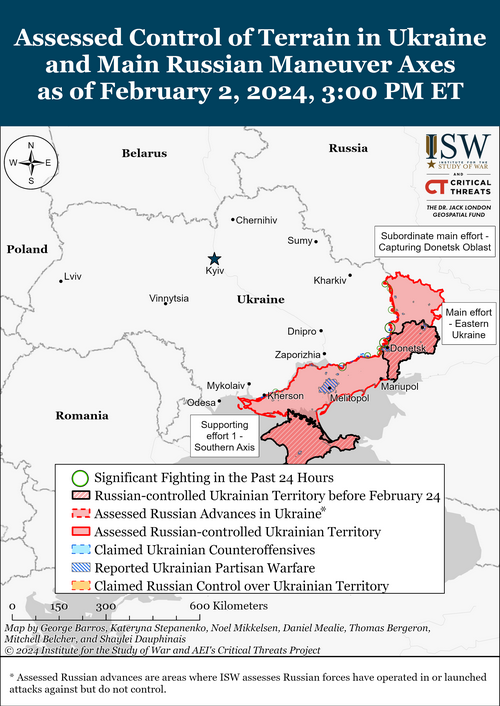
- Russian forces recently made confirmed advances near Avdiivka and in the Donetsk-Zaporizhia Oblast border area amid continued positional engagements along the entire line of contact on February 2.
- Russian outlet Izvestiya stated on February 2, citing sources within the Russian military, that the Russian Ministry of Defense (MoD) is forming air defense units as part of assault units to defend Russian infantry against Ukrainian drones, frontline air strikes, and shelling.
- Ukrainian and Canadian officials announced a new coalition to return Ukrainian children from Russia to Ukraine.
Go here to read the rest. Putin, among his other delusions, seems sometimes to think that he is leading the old Soviet Union, a superpower, rather than a regional power which is having difficulty trying to subdue a weak neighbor.

