
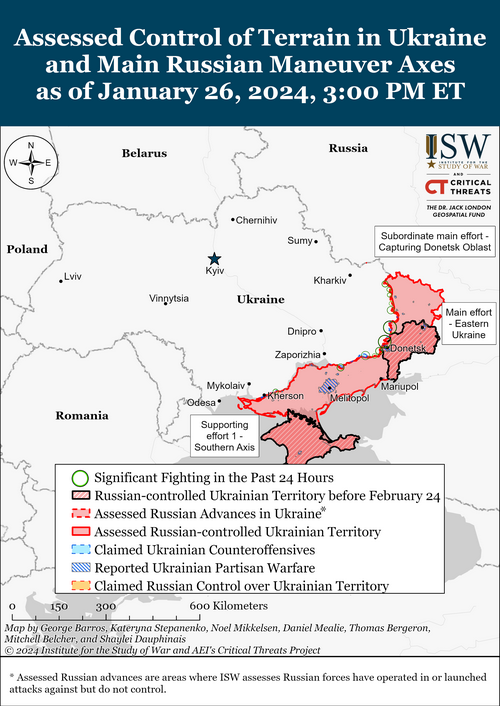
From The Institute for the Study of War:
Russian Offensive Campaign Assessment, January 26, 2024
Riley Bailey, Christina Harward, Angelica Evans, Grace Mappes, George Barros, and Frederick W. Kagan
January 26, 2024, 8:10pm ET
Click here to see ISW’s interactive map of the Russian invasion of Ukraine. This map is updated daily alongside the static maps present in this report.
Click here to see ISW’s 3D control of terrain topographic map of Ukraine. Use of a computer (not a mobile device) is strongly recommended for using this data-heavy tool.
Click here to access ISW’s archive of interactive time-lapse maps of the Russian invasion of Ukraine. These maps complement the static control-of-terrain map that ISW produces daily by showing a dynamic frontline. ISW will update this time-lapse map archive monthly.
Note: The data cut-off for this product was 2:00pm ET on January 26. ISW will cover subsequent reports in the January 27 Russian Offensive Campaign Assessment.
The Kremlin and US officials rejected rumors about Russian President Vladimir Putin’s willingness to engage in meaningful negotiations amid continued indications from the Kremlin that Russia seeks nothing less than full Ukrainian and Western capitulation. Bloomberg reported on January 25 that two unspecified sources close to the Kremlin stated that Putin signaled to senior US officials through indirect channels that Putin is open to negotiations, including those that would provide “security arrangements” for Ukraine.[1] Bloomberg reported that an unidentified intermediary “conveyed signals” to US officials in December 2023 that Putin may be willing to drop his insistence on Ukraine’s “neutral status” and even may ultimately abandon his opposition to Ukraine’s NATO accession.[2] This report may refer to the same supposed backchannel communications reported by the New York Times in late December 2023 about Putin’s supposed interest in a ceasefire.[3] Kremlin Spokesperson Dmitri Peskov denied Bloomberg’s report on January 26, stating that reports about Russian readiness to give up its demands that Ukraine not join NATO are ”incorrect“ and “untrue.“[4] Bloomberg reported that US National Security Council Spokesperson Adrienne Watson stated that US officials are not aware of these alleged overtures, and US Secretary of State Antony Blinken stated on January 19 that he does not see any indication that Putin is serious about looking for a way to end the fighting in Ukraine.[5]
Putin and Kremlin officials have increasingly stressed in recent weeks that Russia has no interest in negotiating with Ukraine in good faith, that Russia’s maximalist objectives in Ukraine remain the same, and that Putin continues to pursue his overarching objective to weaken and dismantle NATO.[6] Former White House Official Fiona Hill told Bloomberg on January 26 that Russian actors want the West to create the idea of such a channel in order to scare Ukraine and frame the US as the only other relevant actor in Ukraine besides Russia.[7] Kremlin officials routinely frame the Russian war in Ukraine as a struggle against the West in order to deny Ukraine’s agency in potential negotiations and to set conditions that seek to convince the West to ignore centering Ukraine’s interests in any negotiations.[8]
Russian demands for Ukrainian “neutrality” and a moratorium on NATO expansion have always been and continue to be one of Putin’s central justifications for his invasion of Ukraine, and any hypothetical concession on these demands would represent a major strategic and rhetorical retreat on Putin’s behalf that Putin is extremely unlikely to be considering at this time. Russian calls for Ukrainian “neutrality” are demands that Ukraine amend its constitution to remove commitments to seeking NATO membership and to commit itself permanently not to join NATO or the European Union (EU).[9] Demands for this ”neutral status” are a nested goal within Putin’s decades-long effort to demand changes to the NATO alliance that would weaken the alliance to the point where it would be unable to deter or defeat future Russian aggression in eastern Europe.[10] Putin has long highlighted a permanent moratorium on NATO expansion as one of those goals, which would require a change in NATO’s charter that would, in turn, require a new treaty between member states and effectively grant Russia a veto over future NATO membership.[11] Any Kremlin concessions on these demands would also amount to a significant Russian defeat, as Putin has increasingly used public appearances to reiterate that the invasion’s initial objectives remain the same and to frame the war in Ukraine as a larger geopolitical confrontation with the collective West.[12] These concessions would also be inconsistent with the Kremlin’s apparent growing public confidence about Russian prospects in Ukraine and the attainability of Putin’s maximalist war objectives.[13] Putin is highly unlikely to offer these concessions as he will not stop pursuing his objective to control Ukraine and weaken NATO, barring a decisive defeat.[14]
Russian actors may be feigning interest in offering concessions on Ukraine’s place in Western institutions in an effort to prompt preemptive Western concessions on Ukraine’s territorial integrity. Reports about Putin’s openness to negotiations through back channels have not mentioned Russian openness to relinquishing any occupied Ukrainian territory. Russian officials continue to indicate that Putin’s maximalist objectives do not exclude Russia’s annexation of occupied Ukrainian territories or additional territorial conquests in Ukraine.[15] Ukraine’s accession into the EU and NATO are long processes that would not unfold in the immediate aftermath of any negotiated ceasefire, and Russia may seek to temporarily feign acquiescing on these demands to more immediately solidify control of occupied territories. ISW continues to assess that any ceasefire would benefit Russia, giving it time to reconstitute and regroup for future offensive campaigns in pursuit of the same maximalist objectives and further territorial conquest in Ukraine.[16] There is no reason to assess that Putin would not renege on any commitment to permit Ukraine to integrate into Western political, economic, and military institutions as long as the Russian military can pursue his objectives to prevent Ukraine from doing so. Putin has already violated Russia’s previous commitments not to violate Ukraine’s sovereignty and territorial integrity, including Crimea, made in 1991 and 1994.
Russian President Vladimir Putin reiterated boilerplate Kremlin narratives that blame Ukraine for the war while also highlighting Russian forces in the Soledar direction. Putin continued to claim on January 26 during a meeting with students at the St. Petersburg State Maritime Technical University who fought in the war in Ukraine that Ukraine “refused” to implement the Minsk Agreements, Ukraine committed “genocide” against Russians in “[Russia’s] historical territories” in Ukraine, and the West “deceived” Russia multiple times by expanding NATO – all of which he claimed forced Russia to invade Ukraine in 2022.[17] Putin’s comments continue to indicate that the Kremlin is framing NATO expansion and Ukraine‘s existence as an independent, sovereign state as existential threats to Russia that Russia must eliminate with force. Putin further falsely claimed that Russia’s full-scale invasion was a “response to [Ukraine’s] use of armed force” after Ukraine ”started the war in Donbas in 2014” and that Russia had to “protect [its] interests.”
Putin highlighted Russian forces fighting in the Soledar direction in Ukraine during a conversation with a veteran who reportedly fought in the area. Putin claimed that Ukrainian forces are unsuccessfully counterattacking from all sides in the Soledar direction and that Russian forces are advancing ”almost every day, little by little.” Putin claimed that Russian units in the area work ”harmoniously [and] confidently.” The Russian Ministry of Defense (MoD) published footage of elements of the 106th Airborne (VDV) Division participating in the capture of Vesele in the Soledar direction on January 18, and Putin was likely trying to keep attention on recent Russian successes in the area.[18] Putin’s comment that units in the Soledar direction are ”harmonious” is also possibly an attempt to suppress recent claims of mistreatment within the 106th Division’s 119th VDV Regiment and the subsequent allegations that a faction of Putin’s inner circle organized these public claims of mistreatment as part of an ongoing ”clan war” with another Kremlin faction.[19]
The circumstances of the January 24 crash of a Russian Il-76 military transport aircraft in Belgorod Oblast remain unclear. Ukrainian officials continued to warn that Russia is attempting to use the Il-76 crash to reduce Western support for Ukraine and noted that Russia has not provided any new evidence from the crash site.[20] Ukrainian Main Military Intelligence Directorate (GUR) Spokesperson Andriy Yusov stated that Russian authorities rejected the creation of an international commission to investigate the circumstances of the crash.[21] Russian President Vladimir Putin reiterated Russian allegations that Ukrainian authorities knew about the presence of Ukrainian prisoners of war (POWs) on the Il-76 aircraft prior to shooting the plane down and stated that the Russian Investigative Committee will publicize all details of the crash in the coming days.[22] The Russian Investigative Committee stated that its preliminary investigation confirmed initial reports that a Ukrainian anti-aircraft missile launched from Liptsy, Kharkiv Oblast, downed the aircraft, and Russian media reported that investigators are decrypting the Il-76’s black boxes.[23] UN Deputy Secretary-General Rosemary DiCarlo stated on January 25 that the UN cannot verify Russian or Ukrainian reports about the circumstances of the Il-76 crash.[24]
The European Union (EU) will provide Ukraine with an additional five billion euros to meet “urgent military needs” in the near future. EU High Representative for Foreign Affairs and Security Policy Joseph Borrell announced on January 26 that EU member states should reach an agreement to provide an additional five billion euros ($5.4 billion) from the European Peace Fund to Ukraine in the coming days.[25] Borrell added that the EU will discuss the use of frozen Russian assets to aid Ukraine before the next EU Council on Foreign Affairs meeting in early 2024. The 50 billion euros would reportedly be dispensed over 2024-2027.[26]
The Russian Ministry of Defense (MoD) continues efforts to expand Russia’s influence and subsume previous Wagner Group operations in Africa. The Russian MoD-controlled Africa Corps stated on January 26 that a Russian MoD delegation arrived in Ouagadougou, Burkina Faso.[27] A prominent Kremlin-affiliated milblogger claimed that the MoD delegation will discuss the rights and powers of the Russian military contingent in Burkina Faso and future cooperation between Burkina Faso and Russia.[28] The milblogger claimed that Burkina Faso will likely become the “main coordination center” between Sahel Alliance members Burkina Faso, Niger, and Mali and that the formalization of Russia’s military presence in the Sahel suggests that this relationship will likely last for years.[29] The milblogger also claimed that Russian media is also operating in Burkina Faso to “compete with French media” and “create a loyal information space.”[30]
The Russian Officers’ Union for International Security (OUIS) Director Alexander Ivanov told Kremlin newswire TASS that several hundred Russian military personnel in the Central African Republic (CAR) would be “sufficient and effective.”[31] Ivanov claimed that such a Russian military contingent would strengthen Russia’s position in CAR and the region and would show that cooperation between CAR and Russia is ”of a strategic long-term nature.” Ivanov labeled previous claims by a CAR presidential advisor that the Russian military base in CAR could accommodate 10,000 personnel “a clear exaggeration.”[32] Russian Ambassador to CAR Alexander Bikantov told Russian outlet RIA Novosti that the creation of a Russian military base in CAR will protect CAR’s national sovereignty.[33] Bikantov stated that the Russian and Central African Republic MoDs are discussing the base’s location and have yet to determine the timing of the Russian military contingent’s arrival and the number of Russian personnel. The US Treasury Department sanctioned OUIS and Ivanov on January 26, 2023 for acting as a Wagner Group front company operating in CAR, and Ivanov’s statements to Russian state media about future Russian MoD forces in CAR suggest that the Russian MoD has been successful in co-opting some former Wagner Group structures in CAR.[34]
Russia reportedly imported $1.7 billion worth of advanced microchips and semiconductors in 2023, primarily from the West, skirting Western sanctions intended to deprive Russia of such technology. Bloomberg reported on January 25 that classified Russian customs service data shows that Russia imported over one billion dollars worth of advanced US and European-produced chips and that more than half of the semiconductors and integrated circuits that Russia imported in early 2023 were manufactured in the US and Europe.[35] Bloomberg’s report does not definitively indicate whether Western companies violated sanctions or provide identities of the likely intermediaries that trafficked the technology to Russia. Russia reportedly imported $2.5 billion worth of Western-made microchips and semiconductors in 2022 and Russia’s demand for this technology would have likely increased during 2023, given Russia’s ongoing efforts to expand its military equipment and weapons production capabilities, particularly for drone and missile production.[36] Western sanctions are likely the driving force behind Russia’s decreased import of microchips and semiconductors despite ongoing Russian efforts to evade such sanctions. ISW previously assessed that China, Iran, Belarus, and Commonwealth of Independent States (CIS) and Eurasian Economic Union (EAEU) member states have likely been heavily involved in various Russian sanctions evasion schemes.[37]
Key Takeaways:
- The Kremlin and US officials rejected rumors about Russian President Vladimir Putin’s willingness to engage in meaningful negotiations amid continued indications from the Kremlin that Russia seeks nothing less than full Ukrainian and Western capitulation.
- Russian demands for Ukrainian “neutrality” and a moratorium on NATO expansion have always been and continue to be one of Putin’s central justifications for his invasion of Ukraine, and any hypothetical concession on these demands would represent a major strategic and rhetorical retreat on Putin’s behalf that Putin is extremely unlikely to be considering at this time.
- Russian President Vladimir Putin reiterated boilerplate Kremlin narratives that blame Ukraine for the war while also highlighting Russian forces in the Soledar direction.
- The circumstances of the January 24 crash of a Russian Il-76 military transport aircraft in Belgorod Oblast remain unclear.
- The European Union (EU) will provide Ukraine with an additional five billion euros to meet “urgent military needs” in the near future.
- The Russian Ministry of Defense (MoD) continues efforts to expand Russia’s influence and subsume previous Wagner Group operations in Africa.
- Russia reportedly imported $1.7 billion worth of advanced microchips and semiconductors in 2023, primarily from the West, skirting Western sanctions intended to deprive Russia of such technology.
- Russian forces advanced near Avdiivka amid continued positional engagements throughout the theater.
- Elements of Moscow Mayor Sergei Sobyanin’s alleged personal private military company (PMC) may have deployed to Ukraine.
- Russian opposition media reported on January 26 that Viktor Filonov, a Russian soldier in the 234th Airborne Regiment (76th VDV Division) serving in Ukraine, adopted a Ukrainian child from occupied Donetsk Oblast.
Go here to read the rest. A private military company of the Mayor of Moscow? Putin still looks for elements outside of the Russian Army for his cannon fodder.

