
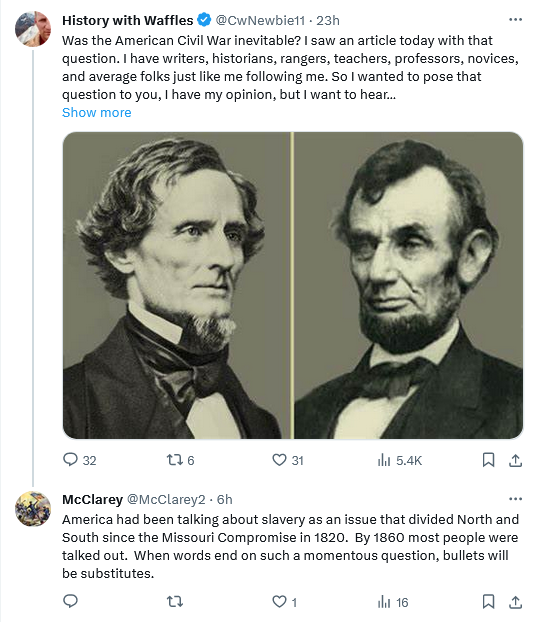
Yes, I think so. Slavery had been the snake under the table since the formation of the country. Almost all the Founding Fathers thought that slavery was an inefficient labor system that would soon die out. Advances in technology made slavery pay, and it soon had advocates who defended slavery as a positive good. From 1820 on slavery was an issue that loomed ever larger. The Union stumbled along through the compromises of 1820 and 1850, with no agreement possible between North and South as to whether slavery was good or bad, and whether it should be allowed to spread into the territories.
In a speech which he later did his best to repudiate, Senator Seward of New York in 1858 summed up where the nation was:
It is an irrepressible conflict between opposing and enduring forces, and it means that the United States must and will, sooner or later, become either entirely a slaveholding nation, or entirely a free-labor nation. Either the cotton and rice fields of South Carolina and the sugar plantations of Louisiana will ultimately be tilled by free labor, and Charleston and New Orleans become marts of legitimate merchandise alone, or else the rye-fields and wheat-fields of Massachusetts and New York must again be surrendered by their farmers to slave culture and to the production of slaves, and Boston and New York become once more markets for trade in the bodies and souls of men. It is the failure to apprehend this great truth that induces so many unsuccessful attempts at final compromises between the slave and free States, and it is the existence of this great fact that renders all such pretended compromises, when made, vain and ephemeral. Startling as this saying may appear to you, fellow-citizens, it is by no means an original or even a modern one. Our forefathers knew it to be true, and unanimously acted upon it when they framed the constitution of the United States. They regarded the existence of the servile system in so many of the States with sorrow and shame, which they openly confessed, and they looked upon the collision between them, which was then just revealing itself, and which we are now accustomed to deplore, with favor and hope. They knew that one or the other system must exclusively prevail.
And the War came in Lincoln’s immortal phrase. When it did, it was a culmination of a long series of events that took no great brilliance to conclude would end in War. One of the saddest features of life in this Vale of Tears is how frequently we can discern a great disaster coming, and realize that we can do nothing to avert it.


Don- you say One of the saddest features of life in this Vale of Tears is how frequently we can discern a great disaster coming, and realize that we can do nothing to avert it.
I agree. God help us all.
Not much is inevitable until it actually happens. (I’m not seeing the logic in Seward’s assertion, either).
Sometimes events are inevitable. Everyone expected the Great War in Europe for example, decades before it occurred. The Roman Republic was manifestly dying for a half century before it did. Predictions of the collapse of Communism in Russia were made before the event by Reagan, Thatcher and many others who could see that the economy of the Soviet Union was terminal.
In regard to Seward’s speech, he made it in light of the Dred Scot decision, Bleeding Kansas, the Kansas Nebraska Act, growing resistance to the Fugitive Slave Law in the North, and many other events which demonstrated that the division between North and South on slavery was increasingly intolerable and that the conflict was going to be resolved, one way or another.
The surprise was how quickly it slid to inevitability.
The Compromise of 1850 had grudgingly been accepted by both sides, seemingly working the same uneasy magic as that of 1820.
And then the Kansas-Nebraska Act started the avalanche of recrimination, distrust, then hatred and violence which only ended at Appomattox.
Dale-
It didn’t end at Appomattox. It took a lot longer. I worked at a Virginia golf club in the waning years of the 20th Century. Had an older member say (and only three-quarters in jest) “You’re alright, but you’re still a Yankee”.
There are things that don’t come back quickly and some don’t come back at all. Consider all the tangible and intangible differences pre and post 1914.
Dale “It didn’t end at Appomattox. It took a lot longer.”
This “Yankee” joined the Navy in 1952 and the recruiters told me I shouldn’t/couldn’t go into the mess area because it was loaded with BLLacks. Then in 1956 as I was about to get discharged, the first non-white was assigned to our boiler room and some of the nicest southern guys, I loved as my team, went bonkers. I couldn’t understand it, but then, Jacksonville, our home port still had separate drinking fountains etc. in 1952.
Unfortunately, despite the war, New York and Boston are once again markets for the bodies and souls of men.
The founders tolerated slavery at the beginning in order to keep the slave states in the new US. Quite correct that they expected it would eventually die of its own weight in a society and so simply left it out of any constitutional mention. Unfortunately, the invention of the cotton gin which encouraged large scale planting of the crop, along with the necessity of cheap labor, kept slavery in existence beyond its projected life span. A few other crops such as rice and indigo provided additional support to the system and made compromise to eventually end it, much more difficult if not impossible. The South thought they had a strong enough society to go it alone, completely ignoring the already expanding industrial revolution in the North. The growing moral opposition to slavery, though not the initial cause of the Civil War as propounded by the North, became a primary driver after Antietam. War became inevitable when both sides ran out of compromises. It has been that way since the beginning of organized nations.
Our Founding Principles: The Declaration of Independence and our Constituion tell us who we are and where we are. Sometimes I think our political leaders do not know how to read. Surely Jefferson Davis never read The Declaration of Independence or our Constitution.
“It didn’t end at Appomattox. It took a lot longer.”
You’re not wrong, but there is a bigger picture.
Namely, the United States was not haunted by guerilla warfare for long after the War. While the mistreatment of freed men and women was an atrocious national failure, white Southerners only raised the sword on behalf of the Union thereafter. When you had Confederate soldiers fighting under the Old Flag against Spain and the sons of Confederate soldiers fighting for America in the First and Second World Wars, something had fundamentally changed. More had to happen to fully reconcile the South to modern America, but that has happened and it happened without the same effusion of blood.
While the mistreatment of freed men and women was an atrocious national failure, white Southerners only raised the sword on behalf of the Union thereafter. When you had Confederate soldiers fighting under the Old Flag against Spain and the sons of Confederate soldiers fighting for America in the First and Second World Wars, something had fundamentally changed. More had to happen to fully reconcile the South to modern America, but that has happened and it happened without the same effusion of blood.
Comment of the week Dale! Take ‘er away Sam!
https://www.youtube.com/watch?v=eXeIxtI–uc&t=5s
https://www.youtube.com/watch?v=RAYbLdpghRA
[…] Banks to Search Private Transactions for Terms like ‘MAGA,’ ‘Trump’ – B. Singman Was the Civil War Inevitable? – Donald R. McClarey, Esq., at The American Catholic 4 Years After Biden Laptop From Hell […]
Inevitable? Maybe.
I think we too-often see these concerns through the lens of what actually happened. North and South had each professed distinctive points of view before the Revolution; they often did not mesh well. Both sides had “radical” and “moderate” voices; both sides failed to truthfully understand the legitimate concerns raised by the other side.
Then again, both sides assumed the other side would be forced to surrender within weeks, maybe a few months. Such view likely inflamed willingness to fight.
If either side had considered how severe the war might become, they might have chosen different means.
Perhaps, although the success of the Revolution was constantly cited by the Confederates during the War. When a nation comes into existence as a result of a victorious war, it tends to give a hopeful view of a future resort to arms:
https://www.youtube.com/watch?v=oaBa0Rb8zRI