
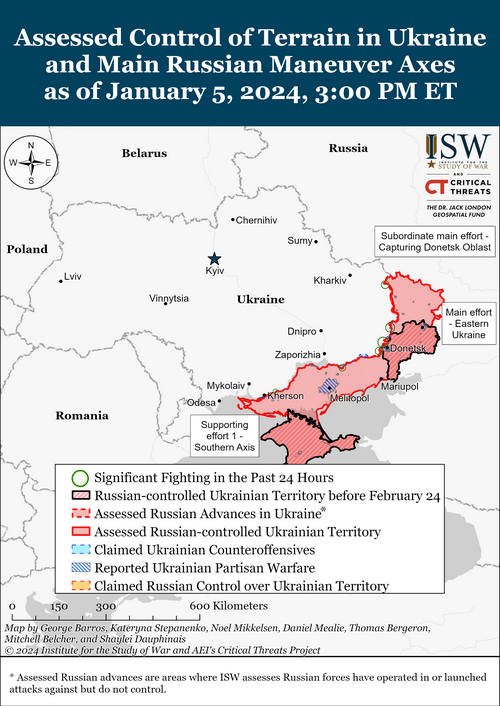
From The Institute For The Study of War:
Russian Offensive Campaign Assessment, January 5, 2024
Nicole Wolkov, Riley Bailey, Grace Mappes, Karolina Hird, George Barros, and Frederick W. Kagan
January 5, 2024, 7:30pm ET
Click here to see ISW’s interactive map of the Russian invasion of Ukraine. This map is updated daily alongside the static maps present in this report.
Click here to see ISW’s 3D control of terrain topographic map of Ukraine. Use of a computer (not a mobile device) is strongly recommended for using this data-heavy tool.
Click here to access ISW’s archive of interactive time-lapse maps of the Russian invasion of Ukraine. These maps complement the static control-of-terrain map that ISW produces daily by showing a dynamic frontline. ISW will update this time-lapse map archive monthly.
Note: The data cut-off for this product was 12:45pm ET on January 5. ISW will cover subsequent reports in the January 6 Russian Offensive Campaign Assessment.
Russian forces may intensify efforts to capture Kupyansk, Kharkiv Oblast, in the coming weeks and have a grouping of forces in the area that appears to be less degraded than Russian groupings responsible for offensive efforts elsewhere in eastern Ukraine. Russian forces appear to have conditions conducive to intensifying operations in the Kupyansk direction (Kharkiv-Luhansk oblast area) with the intent of making territorial gains in areas that are more operationally significant than other areas that Russian forces are currently attempting to seize. Ukrainian officials have stated that Russian forces aim to capture Kupyansk and Borova (35km west of Svatove) during winter 2024.[1] Russian seizure of those towns would likely force Ukrainian forces off the east bank of the Oskil River in Kharkiv Oblast and set conditions for future Russian offensive operations along the Kupyansk-Svatove-Kreminna line. The tempo of Russian operations in the Kupyansk direction and the apparent configuration of Russian forces in occupied Luhansk and Kharkiv oblasts overall does not indicate an impending Russian offensive effort along the entire Kupyansk-Lyman line (Kharkiv-Luhansk-northeastern Donetsk oblast area), similar to the failed Russian offensive effort in northeastern Ukraine in winter-spring 2023. Russian forces likely have not accumulated enough forces in Belgorod Oblast to support launching large-scale offensive operations elsewhere in northern or northeastern Kharkiv Oblast as of this writing.[2]
Ukrainian officials have not publicly reported any sudden buildup of Russian forces in the Kupyansk direction indicating that a large-scale offensive to advance to the Oskil River is imminent. Russian forces appear to have gradually reconstituted units badly degraded during the Ukrainian counteroffensive in September 2022 and Russia’s failed winter-spring 2023 offensive, and the Russian command likely intends these relatively well-rested and reconstituted units to intensify localized offensive operations that Russian forces started in the area in October 2023.[3] Russian forces operating in the Kupyansk direction appear not yet to have committed a substantial force to current offensive operations in the area and thus have been able to sustain localized ground attacks without suffering losses similar to those that Russian forces have suffered in operations around Avdiivka and in southern Ukraine.[4] Russian forces operating in the Kupyansk direction, comprised largely of the 1st Guards Tank Army (GTA) and 6th Combined Arms Army (CAA) (both of the Western Military District [WMD]), have not heavily participated in large offensive operations since the culmination of the Russian winter-spring 2023 offensive in April 2023.[5] 1st GTA and 6th CAA elements have likely reconstituted to a considerable degree through the incorporation of manpower generated by Russia’s September 2022 partial mobilization and continued crypto-mobilization efforts.[6] Russian forces may be deploying new forces to the Kupyansk direction at a rate roughly equal to Russian losses in the area as they have done throughout Ukraine, although these elements are likely poorly trained Storm-Z and Storm-V assault detachments and not more combat-effective regular elements of the 6th CAA and 1st GTA.[7] These elements likely do not need to reconstitute their kit to full doctrinal end strength to support new offensive operations because current Russian offensive operations in the Kupyansk direction rely heavily on dismounted infantry assaults and only sporadically use small mechanized assaults.[8] Russian regular forces in the Kupyansk direction are drawn primarily from the Western Military District and thus benefit from a degree of organizational coherence unlike Russian forces in other parts of Ukraine, which are often thrown together from various military districts and airborne (VDV) units.[9] The relative coherence of the WMD force grouping in the Kupyansk direction likely generates relatively more effective command and control (C2) among these forces, although it remains unclear if these WMD elements are able to conduct large-scale assaults that would be significantly more effective than the disorganized and costly Russian offensive operations around Avdiivka.
UK outlet the Telegraph reported on January 4 that an unspecified source ”close“ to the Ukrainian military stated that Russian forces may conduct a ”ground offensive” as early as January 15.[10] Ukrainian Ground Forces Command Spokesperson Lieutenant Colonel Volodymyr Fityo responded to the Telegraph article on January 5 and stated that the Ukrainian military has not observed a change in the composition of Russian forces in Kharkiv Oblast or in Russia bordering Kharkiv Oblast and that Russian forces continue offensive operations near Synkivka with the aim of capturing Kupyansk.[11] Ukrainian Kharkiv Oblast Head Oleh Synehubov also responded to the Telegraph noting that Russian forces are not concentrating in Kharkiv Oblast in preparation for a large-scale offensive and that the intensity of Russian attacks in the Kupyansk direction has decreased in the past three days due to bad weather conditions.[12] Synehubov noted that Russian forces are using the slower tempo of operations caused by poor weather conditions to deploy reinforcements to the frontline and to train and coordinate units.[13] Fityo and Synehubov’s comments are consistent with ISW’s assessment that Russian forces may intensify offensive operations, though not launch a full-scale offensive operation, with the existing grouping of forces in the Kupyansk direction. Russian forces may have conducted a gradual buildup of forces since Ukrainian officials reported that the Russian military concentrated over 100,000 personnel in the Kupyansk and Lyman directions as of October 2023.[14]
Ukrainian forces reportedly conducted a series of drone and missile strikes against Russian targets in occupied Crimea and Krasnodar Krai on the night of January 4 to 5. The Ukrainian Armed Forces Center for Strategic Communications (StratCom) stated on January 5 that Ukrainian forces struck Russian ammunition warehouses near Pervomaiske (82km north of Simferopol) in occupied Crimea.[15] The Russian Ministry of Defense (MoD) claimed that Russian forces downed 36 Ukrainian drones over Crimea, a drone in Krasnodar Krai, and a Ukrainian Neptune missile in the northwestern part of the Black Sea.[16] Saky occupation head Aleksandr Ovdyenko claimed that Russian forces successfully repelled a large Ukrainian drone attack along the Saky-Yevpatoria coast on the evening of January 4.[17] Russian milbloggers claimed that Ukrainian drones and missiles targeted Yevpatoria, the Russian airfield in Saky, the Kerch Strait Bridge, and Novorossiysk in Krasnodar Krai.[18] ISW has not observed visual confirmation of Ukrainian strikes hitting Russian targets on the night of January 4 to 5. These Ukrainian strikes follow Ukrainian strikes near Uyutne (west of Yevpatoria) and Yevpatoria on January 4, which reportedly struck at least one Russian command post.[19] The Ukrainian Crimean-based ”Atesh” partisan group claimed that Ukrainian forces struck a Russian air defense radar system and a communications center in Yevpatoria responsible for coordinating Russian air defense operations in occupied Crimea on January 4.[20]
Russian forces conducted Shahed 131/136 drone strikes and missile strikes against frontline areas in Ukraine overnight on January 5. The Ukrainian Air Force reported that Russian forces launched two waves of Shahed drones at frontline areas in Kherson and Mykolaiv oblasts and that Ukrainian forces shot down 21 of the 29 drones.[21] Ukrainian Air Force Spokesperson Colonel Yuriy Ihnat stated that Russian forces targeted frontline areas of southern Ukraine, particularly Kherson Oblast, where it is more difficult for Ukrainian forces to intercept the drones.[22] Kharkiv Oblast Military Administration Head Oleh Synehubov stated that Russian forces launched 10 S-300 missiles at Liptsi, Kharkiv Oblast on the night of January 4 to 5.[23]
Germany announced a new military assistance package to Ukraine on January 4.[24] The package includes 10 Marder infantry fighting vehicles, two demining tanks, 30 drone detection systems, 155mm artillery ammunition, missiles for Patriot and IRIS-T air defense systems, and a Skynex air defense system.
The United Nations Security Council (UNSC) will convene on January 10 and discuss Russia’s reported use of North Korean ballistic missiles in Ukraine, a likely violation of UNSC resolutions. US Ambassador to the UN Linda Thomas-Greenfield stated on January 4 that US officials will raise the issue of the reported ballistic missile use at a January 10 UNSC briefing on Ukraine.[25] US National Security Council Spokesperson John Kirby stated on January 4 that Russian forces launched ballistic missiles acquired from North Korea at targets in Ukraine on December 30, 2023, and January 2, 2024.[26] Ukrainian officials stated on January 5 that Russian forces have used foreign-made ballistic missiles in strikes against Ukraine but that Ukrainian officials have yet to identify the country of origin.[27] North Korea has reportedly begun transferring an unspecified number of short-range ballistic missiles to Russia in recent weeks.[28]
UNSC resolutions on North Korea specifically call for North Korea to suspend all ballistic missile activities and prohibits member states from exporting and importing weapons to and from North Korea.[29] The UNSC resolutions also prohibit any trade with North Korea that can contribute to nuclear, ballistic missile, or weapons of mass destruction (WMD)-related activities.[30] Russian Ambassador at Large Oleg Burmistrov stated on October 15, 2023, that Russia ”strictly adheres to its international obligations towards [North Korea] through the UNSC.”[31] Russia’s increasing procurement of ammunition and weapons systems from North Korea materially violates the UNSC resolutions on North Korea, however. UNSC resolutions do not commit member states to enforce any secondary sanctions against third parties trading with North Korea, but the US Treasury Department’s Office of Foreign Asset Control (OFAC) has wide sanctions enforcement powers to sanction any entity trading goods or services with North Korea and any foreign financial institution knowingly facilitating transactions with North Korea.[32]
Chechen Republic Head Ramzan Kadyrov strangely offered to exchange 20 Ukrainian prisoners of war (POWs) for lifting sanctions against his family members. Kadyrov’s oddly public offer to negotiate with the Ukrainian government for personal gain follows indicators that the Kremlin may be engaging in POW negotiations to offset reports of Russian abuses of Ukrainian POWs and posture Russia as interested in operating within the bounds of international law and norms.[33] Kadyrov’s proposal undermines this larger Kremlin posturing. Russian milblogger and Kremlin Human Rights Council member Alexander “Sasha” Kots criticized Kadyrov for “dispos[ing] of prisoners [of war] as goods for personal purposes.”[34] Kadyrov likely negotiated with the Ukrainian government independently from the Kremlin for personal gain when he claimed to have paid Ukrainian special services for the return of his racehorse, Zazu, in May 2023.[35]
The Moscow Arbitration Court ordered Google to unblock four YouTube channels belonging to Russian state-affiliated channel 5TV on January 5, likely as part of an ongoing effort to consolidate control over the Russian information space ahead of the March presidential elections. Mocow’s Arbitration Court upheld a previous ruling that Google must unblock 5TV’s YouTube channels or pay a 100,000 ruble (roughly $1,094) fine for each day Google refuses to reinstate the channels.[36] YouTube blocked access to channels associated with Russian state-funded media in February and March 2022 to enforce a policy that ”prohibit[s] content denying, minimizing, or trivializing well-documented violent events” including the Russian full-scale invasion of Ukraine.[37] The Kremlin has likely been attempting to force Google to cease operations in Russia by imposing increasing fines for failing to comply with Russian censorship and data privacy laws.[38] A Moscow court fined Google 4.6 billion rubles (roughly $50.3 billion) on December 20, 2023, for refusing to comply with Russian censorship laws and remove ”fake” information about the Russian war in Ukraine.[39] Reuters reported on January 3 that Russian fines against Google, YouTube, Meta, TikTok, and Telegram ”appear to have been settled” as they no longer appear as debtors on the Russian Federal Bailiff Service‘s database, but the reason for this omission is unclear.[40]
Key Takeaways:
- Russian forces may intensify efforts to capture Kupyansk, Kharkiv Oblast, in the coming weeks and have a grouping of forces in the area that appears to be less degraded than Russian groupings responsible for offensive efforts elsewhere in eastern Ukraine.
- Ukrainian forces reportedly conducted a series of drone and missile strikes against Russian targets in occupied Crimea and Krasnodar Krai on the night of January 4 to 5.
- Russian forces conducted Shahed 131/136 drone strikes and missile strikes against frontline areas in Ukraine overnight on January 5.
- Germany announced a new military assistance package to Ukraine on January 4.
- The United Nations Security Council (UNSC) will convene on January 10 and discuss Russia’s reported use of North Korean ballistic missiles in Ukraine, a likely violation of UNSC resolutions.
- Chechen Republic Head Ramzan Kadyrov strangely offered to exchange 20 Ukrainian prisoners of war (POWs) for lifting sanctions against his family members.
- The Moscow Arbitration Court ordered Google to unblock four YouTube channels belonging to Russian state-affiliated channel 5TV on January 5, likely as part of an ongoing effort to consolidate control over the Russian information space ahead of the March presidential elections.
- Russian forces made a confirmed advance near Avdiivka as positional engagements continued along the entire frontline.
- International sanctions are reportedly impeding Russia’s Su-34 aircraft production.
- The Kremlin continues to solidify federal administrative oversight of local and regional occupation administrations in occupied Ukraine.
Go here to read the rest. The first week of the new year looks much like the last week of the old year. The War enters another repetitive phase.

