
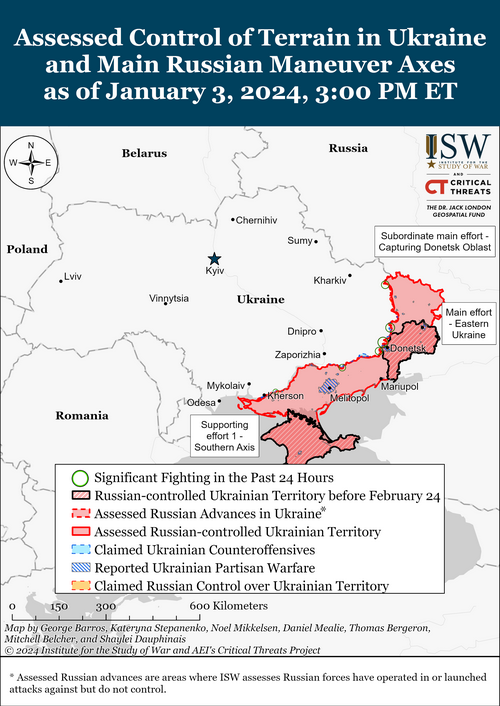
From The Institute for the Study of War:
Russian Offensive Campaign Assessment, January 3, 2024
Karolina Hird, Christina Harward, Grace Mappes, Angelica Evans, George Barros, and Frederick W. Kagan
January 3, 2024, 5:45pm ET
Click here to see ISW’s interactive map of the Russian invasion of Ukraine. This map is updated daily alongside the static maps present in this report.
Click here to see ISW’s 3D control of terrain topographic map of Ukraine. Use of a computer (not a mobile device) is strongly recommended for using this data-heavy tool.
Click here to access ISW’s archive of interactive time-lapse maps of the Russian invasion of Ukraine. These maps complement the static control-of-terrain map that ISW produces daily by showing a dynamic frontline. ISW will update this time-lapse map archive monthly.
Note: The data cut-off for this product was 12:15 pm ET on January 3. ISW will cover subsequent reports in the January 4 Russian Offensive Campaign Assessment.
Russia and Ukraine conducted a prisoner of war (POW) exchange on January 3 in what was the largest POW exchange of the war to date and the first official POW exchange since August 2023. Ukrainian President Volodymyr Zelensky announced that over 200 Ukrainian soldiers and civilians returned to Ukraine from Russian captivity, including personnel of the Ukrainian Armed Forces, National Guard, Navy, and State Border Guard Service.[1] Ukrainian Verkhovna Rada Commissioner for Human Rights Dmytro Lubinets later clarified that 230 Ukrainian personnel returned to Ukraine in the 49th POW exchange since the beginning of Russia’s full-scale invasion of Ukraine.[2] Lubinets and Zelensky noted that many of the Ukrainian POWs fought and were captured on Snake Island and in Mariupol, suggesting that these soldiers had been in Russian captivity for nearly two years.[3] The Russian Ministry of Defense (MoD), in turn, stated that 248 Russian military personnel returned to Russia as part of the exchange, and notably thanked the United Arab Emirates (UAE) for its role in mediating the exchange.[4] Russian sources disagreed on the exact number of Ukrainians returned in the exchange, with some claiming that it was 173 and others claiming that it was “up to 230.”[5] Russian milbloggers generally praised the Russian MoD for securing the return of a greater ratio of Russian POWs to Ukrainian POWs, which Russian sources claimed was long overdue following a deeply unpopular POW exchange in September 2022 that swapped 215 Ukrainian POWs, including captured leaders of the Azov Regiment whom Russia had initially pledged to imprison at least until the end of the war, for 55 Russian POWs and political prisoners including Putin’s personal friend, pro-Russian Ukrainian oligarch Viktor Medvechuk.[6]
The timing of Russia’s apparent willingness to participate in the largest POW exchange since the beginning of the war, and the first exchange in nearly five months, is noteworthy. Representative of the Ukrainian Coordination Headquarters for the Treatment of Prisoners of War Petro Yatsenko stated on November 17, 2023, that Russia implemented a freeze on POW exchanges over summer 2023 for an unspecified reason.[7] As ISW has recently reported, there have been several incidents over the past few weeks of Russian forces using Ukrainian POWs in apparent violations of the Geneva Convention on POWs, including using a battalion of former Ukrainian POWs in active combat, using Ukrainian POWs as human shields, and summarily executing surrendered Ukrainian POWs who were clearly hors de combat.[8] The Russian leadership may have chosen to engage in such a large POW exchange at this time to undermine reports of Russian abuses of Ukrainian POWs and posture Russia as interested in operating within the bounds of international law and norms. ISW has frequently assessed that senior Russian officials are often very invested in portraying Russia as adhering to humanitarian and other legal guidelines, and the timing of this POW exchange may be part of this wider informational effort.[9]
Ukrainian Prime Minister Denys Shmyhal stated on January 3 that Ukraine plans to increase its defense industrial base (DIB) output six-fold in 2024.[10] Shmyhal reiterated Ukrainian President Volodymyr Zelensky’s December 27 statement that Ukraine’s DIB production capacity tripled in 2023 compared to 2022 and highlighted the importance of additional drones, shells, ammunition, and armored vehicles for Ukrainian forces.[11] Shmyhal stated that the Ukrainian government has allocated more than 760 billion hryvnia (roughly $20 billion) for payments to military personnel and more than 265 billion hryvnia (roughly $7 billion) for the purchase, production, and repair of weapons in 2024.[12] Shmyhal also advocated for the reported Western plan to use frozen Russian assets to fund Ukraine’s future reconstruction.[13] Shmyhal’s comments come after several days of large-scale Russian strikes that reportedly primarily targeted Ukrainian DIB facilities and military infrastructure.[14] ISW previously assessed that reported Russian strikes against Ukrainian industrial facilities likely aim to prevent Ukraine from developing key capacities to sustain operations for a longer war effort.[15]
Ukrainian Foreign Minister Dmytro Kuleba announced on January 3 that the NATO-Ukraine Council (NUC) will hold an emergency meeting in response to Russia’s recent mass air strikes against Ukraine.[16] Kuleba called the upcoming meeting a “sign of Euro-Atlantic unity in the face of Russian terror” and noted that strengthening Ukraine’s air defense will be one of the meeting’s key topics.[17] The NUC met for the first time on November 29, 2023, to discuss the roadmap to full Ukrainian interoperability with NATO and steps to increase weapons and ammunition production.[18]
NATO member states continue initiatives to support Ukrainian operations in the air domain. Norwegian Defense Minister Bjørn Arild Gram announced on January 3 that Norway is providing two F-16 fighter jets and 10 instructors to train Ukrainian military personnel in Denmark.[19] Gram stated that Ukraine’s partners will work “day and night” to establish a lasting and modern Ukrainian air force.[20] NATO also announced in a statement on January 3 that NATO’s Support and Procurement Agency will support a coalition of member states, including Germany, the Netherlands, Romania, and Spain to purchase up to 1,000 Patriot missiles to strengthen the member states’ air defenses, additionally noting that NATO partners have previously supplied Ukraine with Patriot systems.[21] It is unclear if Ukraine will receive any of the 1,000 Patriot missiles, or on what timeline. The $5.5 billion contract will support the establishment of a Patriot missile production facility in Germany, increasing the available supply of Patriot missiles and replenishing member states’ stockpiles.[22] Ukrainian Commander-in-Chief General Valerii Zaluzhnyi stated on January 2 that Western-provided Patriot systems enabled Ukrainian forces to down a record number of 10 Kinzhal hypersonic missiles during Russian strikes overnight on January 1-2 and during the day on January 2.[23]
Kremlin-affiliated mouthpieces may be setting information conditions to blame the West for a potential future conflict in the Arctic. A prominent Russian milblogger, whom the Kremlin and Russian Ministry of Defense (MoD) have recently rewarded for service to the Russian Armed Forces and whose channel has recently fixated on the Arctic region, amplified a post wherein another milblogger responded to comments from the Danish Foreign Ministry about how Denmark’s chairmanship of the Nordic Defense Cooperation (NORDEFCO) will focus on Arctic security after reports from the Danish Defense Intelligence Service and NATO’s 2022 Strategic Concept listed Russian activity in the region as a possible cause of future regional instability.[24] The milblogger claimed that despite Danish statements about Denmark’s hopes to keep the Arctic a region of low tension, Denmark views Russia as the main threat in the Arctic, suggesting that the milblogger views Denmark’s response to Russian actions in the Arctic as unnecessary and inconsistent with other Danish signaling. Russian Chief of the General Staff Army General Valery Gerasimov claimed on December 21, 2023, that Russia deployed forces to the Arctic not as a demonstration of military force but to ensure Russian economic development in the region, whereas Kremlin officials, including Russian President Vladimir Putin, have increasingly blamed Western countries for preparing Arctic countries for a confrontation against Russia and claimed that Russia has been forced into responding by reforming the Leningrad Military District (LMD) in Russian’s northwest to counter supposed threats from Finland and other NATO states.[25] Recent Kremlin and MoD statements and the Russian MoD-affiliated milblogger’s post may be part of Kremlin efforts to set information conditions for Russia to blame Denmark and other Western Arctic countries for any future conflicts with Russia in the Arctic. These narratives are in line with Putin’s declaration on January 2 that the West is Russia‘s “enemy” and his further implication that the war in Ukraine is an existential war for Russia against the West.[26]
Efforts driven by Kremlin mouthpieces to set such information conditions may be permeating the larger Russian information space. Another prominent Russian milblogger, who has previously amplified Kremlin narratives about Russia’s maximalist goals of imperial reconquest in Ukraine, amplified a post claiming that the next regional “flare up” will be the Baltics and Nordic countries.[27] The post vaguely claimed that an unspecified actor, possibly the West, is preparing the Baltic and Nordic peoples for a confrontation with Russia and that the Baltic and Nordic countries have lacked sovereignty for a long time – echoing Kremlin narratives about how states that are not great powers – like Ukraine – do not have full sovereignty.[28] These informational lines are disturbingly similar to the justifications the Kremlin used to invade Ukraine in 2022 and to continue the invasion. There are no indications that Russia will seek conflict with NATO in the very near future, but Moscow began running similar information operations in Ukraine many years before Russian invasions in 2014 and 2022.
Kazakhstan President Kassym-Jomart Tokayev characterized Russia as Kazakhstan’s “main partner and ally” in an interview published on January 3 despite recent efforts to distance Kazakhstan from Russia. Tokayev emphasized the strength of current Russian-Kazakh relations and Russia’s position on the world stage, claiming that “no problem in the world can be solved” without Russia’s participation.[29] Tokayev’s statement comes after Kazakhstan took over chairmanship of the Russia-led Collective Security Treaty Organization (CSTO) on January 1.[30] Tokayev has recently sought to balance maintaining friendly relations with Russia against allowing Kazakhstan to fall too far under Russian influence, likely reflecting an increase in tension that Russia’s war in Ukraine has caused. Russia previously deployed airborne (VDV) elements to Kazakhstan as CSTO peacekeeping forces to help quell domestic anti-government protests in January 2022, but Tokayev reportedly refused to help Putin quell the Wagner PMC’s June 2023 rebellion.[31] Tokayev also refused to recognize Russia’s claimed independence of the Donetsk and Luhansk People’s republics (DNR and LNR) following the start of the full-scale invasion in February 2022 and subsequently refused to recognize Russia’s illegal annexation of the DNR, LNR, and Zaporizhia and Kherson oblasts in September 2022.[32] Russian society has also recently intensified violence towards, and disenfranchisement of, Central Asia migrant communities living in Russia, including Kazakh migrants. This has likely become a growing point of neuralgia in Russia’s relationship with its Central Asian neighbors, especially as Russia has massively mobilized Central Asian migrants to fight in Ukraine. A Kazakh court recently sentenced a Kazakh citizen for mercenarism for fighting with the Wagner Group in Ukraine, suggesting that Kazakh authorities feel discomfort around the idea of their citizens affiliating with Russia militarily.[33] Despite these evident frictions, Tokayev recently emphasized the extent of friendly Russian-Kazakh relations at the 19th Russian-Kazakh Regional Cooperation Forum in Ankara, Turkey on November 9, 2023, also likely to maintain strong ties with Russia while remaining relatively independent.[34]
Key Takeaways:
- Russia and Ukraine conducted a prisoner of war (POW) exchange on January 3 in what was the largest POW exchange of the war to date and the first official POW exchange since August 2023.
- Ukrainian Prime Minister Denys Shmyhal stated on January 3 that Ukraine plans to increase its defense industrial base (DIB) output six-fold in 2024.
- Ukrainian Foreign Minister Dmytro Kuleba announced on January 3 that the NATO-Ukraine Council (NUC) will hold an emergency meeting in response to Russia’s recent mass air strikes against Ukraine.
- NATO member states continue initiatives to support Ukrainian operations in the air domain.
- Kremlin-affiliated mouthpieces may be setting information conditions to blame the West for a potential future conflict in the Arctic.
- Kazakhstan President Kassym-Jomart Tokayev characterized Russia as Kazakhstan’s “main partner and ally” in an interview published on January 3 despite recent efforts to distance Kazakhstan from Russia.
- Russian forces made confirmed advances near Avdiivka and Donetsk City as positional engagements continued along the entire line of contact.
- The Donetsk People’s Republic’s (DNR) “Vostok” Battalion stated on January 3 that the unit will continue to operate subordinated to Rosgvardia and will not be impacted by the Russian military’s reported dissolution of the “Kaskad” operational combat tactical formation of the DNR’s Internal Affairs Ministry (MVD).
- Russian authorities continue efforts to integrate occupied Ukraine into Russia using infrastructure projects and social outreach programs.
Go here to read the rest. And the new year in theWar thus far is much like the old year.

