
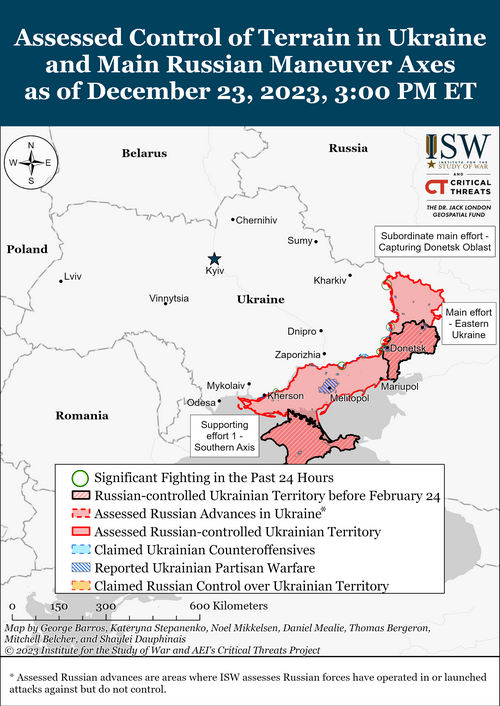
Russian Offensive Campaign Assessment, December 23, 2023
Angelica Evans, Kateryna Stepanenko, Karolina Hird, Christina Harward, and Frederick W. Kagan
December 23, 2023, 8:30pm ET
Click here to see ISW’s interactive map of the Russian invasion of Ukraine. This map is updated daily alongside the static maps present in this report.
Click here to see ISW’s 3D control of terrain topographic map of Ukraine. Use of a computer (not a mobile device) is strongly recommended for using this data-heavy tool.
Click here to access ISW’s archive of interactive time-lapse maps of the Russian invasion of Ukraine. These maps complement the static control-of-terrain map that ISW produces daily by showing a dynamic frontline. ISW will update this time-lapse map archive monthly.
Note: The data cut-off for this product was 1:30pm ET on December 23. ISW will cover subsequent reports in the December 24 Russian Offensive Campaign Assessment.
The New York Times (NYT) – citing former and current senior Russian, US, and international officials – reported that Russian President Vladimir Putin is using back channels and intermediaries to signal his interest in a ceasefire, despite Putin’s recent public statements to the contrary.[1] NYT reported that Western officials have been picking up renewed signals through backchannels since September 2023 that Putin is interested in a ceasefire that freezes the current frontlines, but noted that Western officials warned the backchannels could be “Kremlin misdirection” and may not reflect a “genuine willingness” to negotiate.[2] NYT suggested several possible motivations Putin may have for his reported interest in a ceasefire: the upcoming March 2024 Russian presidential election, a desire to “keep his options open” regarding the war’s resolution and take advantage of perceived waning Western support for Ukraine, and the “distraction” of the Israel-Hamas war.[3] All these motivations reflect temporary reasons why Putin might pursue a temporary ceasefire that would benefit Russia by allowing Russia the time to prepare for renewed aggression against Ukraine, as ISW has routinely assessed. The NYT noted that Putin’s public rhetoric, which has recently reasserted Russia’s maximalist objectives that are tantamount to full Ukrainian and Western surrender, is at odds with Putin’s reported private desire to “declare victory and move on.”[4] Neither the NYT nor its sources offered any reason to believe Putin’s backchannel communications would be more reflective of his goals than his public speeches addressing domestic, Ukrainian, and international audiences. The NYT report also failed to make clear whether Putin’s alleged interest in a ceasefire is for a temporary pause or a permanent end to the war.
Kremlin Spokesperson Dmitry Peskov told the NYT that “Russia continues to be ready [for negotiations], but exclusively for the achievement of its own goals” in response to a question about Russia’s willingness to negotiate a ceasefire on the current lines.[5] Putin has recently reiterated that his maximalist objectives in Ukraine – “denazification,” “demilitarization,” and the imposition of a “neutral status” on Ukraine – remain unchanged, and Putin and senior Kremlin officials have increasingly expressed expansionist rhetoric indicating that Putin’s objectives do not preclude further Russian territorial conquests in Ukraine.[6]
The timing of Putin’s reported interest in a ceasefire is more consistent with Russia’s ongoing efforts to delay and discourage further Western military assistance to Ukraine, than with a serious interest in ending the war other than with a full Russian victory. ISW observed similar Kremlin efforts to mislead Western policymakers into pressuring Ukraine to negotiate with Russia in winter 2022-2023, and effectively redirecting Western focus onto hypothetical negotiations rather than ensuring that Ukraine has sufficient materiel before its spring-summer counteroffensive.[7] The Kremlin is likely using backchannels to achieve a similar effect amidst Western debates for further military aid to Ukraine.
Russian Airborne Forces (VDV) Commander Colonel General Mikhail Teplinsky obliquely indicated that VDV forces are under significant pressure to conduct rapid offensive operations near Bakhmut and repel Ukrainian attacks on the east (left) bank of Kherson Oblast. Teplinsky published a prerecorded commencement speech on December 23 to congratulate the winter graduates of the Ryazan Higher Airborne Command School in which he outlined the VDV’s involvement in ongoing combat operations in Donetsk, Zaporizhia, and Kherson oblasts.[8] Teplinsky claimed that VDV forces repelled the Ukrainian counteroffensive in Zaporizhia Oblast throughout the summer and fall of 2023 and added that elements of the Russian 98th Guards VDV Division and 106th Guards VDV Divisions began offensive operations on the Soledar-Bakhmut direction in November. Teplinsky carefully caveated his discussion of VDV operations with the observation that the VDV is deliberately maintaining a slow tempo of attacks in the Bakhmut direction to avoid high casualty rates and to prioritize attriting Ukrainian forces over pushing them out from their positions. Teplinsky’s emphasis on slow advances may be an attempt to message to the highest echelon of the Russian military command – such as Chief of the Russian General Staff Army General Valery Gerasimov – that the command’s expectations of rapid advances near Bakhmut are unrealistic without significant VDV casualties and sacrifices. Teplinsky released a similar video in February 2023 in which he condemned the higher military command for committing VDV troops to senseless attacks to achieve minor tactical gains at a high manpower cost, likely in reference to VDV involvement in battles for Soledar in January 2023.[9]
Teplinsky also stated that elements of the newly formed 104th VDV Division are tirelessly fighting to repel Ukrainian forces from the east bank of the Dnipro River in occupied Kherson Oblast, despite the fact that these elements are not as combat effective as other (more experienced) VDV forces. Teplinsky stated that despite the VDV’s efforts Ukrainian forces are continuing to deploy additional reinforcements to the east bank but claimed that Russia’s victory is only a matter of time. ISW observed Russian President Vladimir Putin single out the tactical and operational situation in Krynky on the east bank during his “Direct Line” forum on December 14, which may have reflected Putin’s sensitivity to continued Russian information space neuralgia about Russian operations in the area.[10] ISW assessed that Putin’s comment highlighting Russian forces’ inability to oust Ukrainian forces from the east bank was likely also a critique of Teplinsky, whom he appointed to command Russian “Dnepr” Grouping of Forces in late October 2023.[11] Teplinsky has repeatedly weaponized the Russian information space to his advantage and may have used this commencement speech to respond to the pressure from the Russian military command and the Kremlin.[12] Teplinsky specifically uses greeting videos addressed to Russian military personnel to indirectly voice his problems with the Russian military command, and the Russian Ministry of Defense (MoD) notably even removed his August 2 VDV Day greeting after he revealed the total number of VDV casualties since February 2022.[13] Teplinsky may also be setting information conditions to retain support from other commentators who have repeatedly voiced concern about Russia’s inability to push Ukrainian forces to the west (right) bank of the Dnipro River in Kherson Oblast.[14]
Teplinsky also implied that the Russian military command is deploying new VDV officers and troops promptly to the frontlines without having them complete pre-combat training. Teplinsky stated that “unfortunately” the April graduates of the Ryazan Higher Airborne Command School deployed to combat zones before their intended unspecified autumn deployment date. While Teplinsky did not specify why the April graduates deployed significantly earlier than their slated deployment date, it is likely that these VDV forces were meant to undergo some advanced individual or unit-wide training over a six-month period – a requirement that the Russian military command evidently neglected. Teplinsky added that April graduates have already suffered casualties on the frontlines in November in an unspecified direction. Teplinsky stated that many of the December graduates will join the ranks of the 104th VDV Division in the Kherson direction and noted that the graduates have hard work ahead of them to “speed up” Ukraine’s defeat. Teplinsky may have explicitly observed that the 104th VDV Division is less combat effective to resurface the issue of the Russian command sending recent graduates of military command schools to the frontlines. ISW has long assessed that the Russian military command is committing all available forces to immediately reinforce its war effort in Ukraine at the expense of combat effectiveness and long-term capacity building, and Teplinsky’s account further demonstrates that similar issues also plague formerly elite forces such as the VDV.[15]
Russia’s Black Sea Fleet’s 810th Naval Infantry Brigade confirmed that it is deliberately using chemical weapons against Ukrainian forces in an apparent violation of the Chemical Weapons Convention, to which Russia is a party. The 810th Naval Infantry Brigade published a long post to its Telegram channel on December 22 detailing a “radical change in tactics” that the brigade is using against Ukrainian forces in Krynky (on the eastern bank of Kherson Oblast).[16] The post claimed that elements of the 810th Naval Infantry Brigade rotated into the Krynky area and are applying the new tactic of “dropping K-51 grenades from drones” onto Ukrainian positions to smoke Ukrainian forces out of their positions and expose them to fire from various arms.[17] The 810th Naval Infantry Brigade additionally published footage that apparently shows such a K-51 drop on a Ukrainian position, presumably in Krynky.[18] K-51 aerosol grenades are filled with irritant CS gas (2-Chlorobenzalmalononitrile), a type of tear gas used for riot control (also known as a Riot Control Agent [RCA]).[19] The Chemical Weapons Convention (CWC) prohibits the use of RCAs as a method of warfare, and Russia has been a state party to the CWC since 1997.[20] ISW previously observed that Russian forces used K-51 grenades against Ukrainian positions in Donetsk Oblast in November 2022.[21]
Russian forces conducted a series of Shahed-136/131 drone strikes against Ukraine on the night of December 22-23. Ukrainian military officials reported that Russian forces launched nine Shahed drones from Balaklava, occupied Crimea and Primorsko-Akhtarsk, Krasnodar Krai on the night of December 22 to 23 and that Ukrainian forces shot down all of the drones.[22]
Recent analysis by OSINT analyst MT Anderson confirms that while Russian forces have moved the bulk of Black Sea Fleet (BSF) assets away from occupied Sevastopol, the BSF maintains a limited naval presence in Sevastopol.[23] Anderson posted high-resolution satellite imagery from December 20 showing that two Bora-class corvettes, two Ropucha-class landing ships, one Krivak-class frigate, and the Matros Koshka bulk carrier remain at the otherwise empty BSF frigate pier in southern Sevastopol.[24] Anderson noted that it appears that Russian forces have rebuilt many of the defenses at the entrance of Sevastopol Harbor following a powerful Black Sea cyclone at the end of November.[25] Anderson also posted satellite imagery of the BSF headquarters in Sevastopol and noted that it does not appear to be undergoing renovations following a massive Ukrainian strike on the headquarters on September 22.[26] The satellite imagery additionally shows that one Ropucha-class landing ship, one Natya-class minesweeper, one Alexandrit-class minesweeper, and the Ivan Khurs Ivanov-class intelligence ship remain at the pier at Pivdenna Bay, but that the submarine pen is empty.[27] The satellite imagery confirms the absence of several major BSF naval assets, including specialized Kalibr cruise missile carriers, from the docks at Sevastopol, which supports ISW’s assessment that Russia has moved many major BSF assets out of Sevastopol to Novorossiysk on an enduring basis.[28]
The Russian information space exploited news of a Ukrainian journalist’s decision not to return to Ukraine after an assignment abroad to amplify ongoing Russian information operations about resistance to full mobilization efforts in Ukraine that purposefully ignore the much more substantial Russian resistance to Russia’s partial mobilization of reservists in September 2022. Russian state media and milbloggers amplified news that a Ukrainian television journalist decided to stay in Brussels after covering the EU Summit there from December 14 to 15.[29] Russian milbloggers claimed that the Ukrainian journalist stayed in Brussels to avoid mobilization.[30] Russian outlets naturally did not mention that at least 700,000 Russians immediately left Russia when Russian President Vladimir Putin announced the “partial mobilization” of 300,000 reservists on September 21, 2022.[31] The unpopularity of Russia’s partial mobilization and ensuing mass emigration led Russian authorities to engage in crypto-mobilization efforts that continue today, including recruiting volunteers and forcibly conscripting migrants and newly naturalized Russian citizens.[32] Resistance to mobilization is to be expected in a protracted and bloody war, and the disproportionate amplification of a singular prominent Ukrainian citizen’s behavior is part of ongoing Russian information operations that attempt to paint a picture of widespread resistance to the full mobilization in Ukraine made necessary by Russia’s invasion.
Russian milbloggers used the granting of Russian citizenship to Palestinian refugees on December 23 to promote the idea of Russia’s “compatriots abroad” – an oft-used Kremlin justification for its war in Ukraine. Dagestani authorities granted 45 Palestinian refugees, including seven minors, Russian citizenship on December 23, after the refugees reportedly evacuated to Dagestan from Gaza.[33] Select Russian milbloggers, including Kremlin-appointed Russian Human Rights Council member Alexander “Sasha” Kots, expressed shock at the speed and ease of the refugees’ citizenship process and called for Russian authorities to apply this expedited citizenship process to the whole country and to Russian “compatriots” abroad who are “risking everything” to support Russia.[34] The Kremlin has intentionally and broadly defined “compatriots” as ethnic Russians and Russian speakers living in the Russian sphere of influence, which is not limited to those with Russian citizenship or residing in Russia.[35] Russian President Vladimir Putin has recently renewed his rhetoric about the concept of “compatriots abroad” when discussing Russia’s “sovereignty,” the fiction of a “genocide in Donbas,” and Russia’s duty to protect these “compatriots” as part of justifications for Russia’s maximalist objectives in Ukraine.[36] The fact that Kots, who is notably one of the “trusted persons” who can campaign on Putin’s behalf, invoked the narrative about “compatriots abroad” in connection with news about Palestinian refugees – as opposed to other Kremlin narratives more directly related to the Israel-Hamas war, such as Putin’s recent anti-Israel rhetoric – suggests that the “compatriots abroad” narrative may be of particular importance to the Kremlin, or is perceived as such at least by important voices in the Russian information space.[37] Select Russian information space actors may continue to seize on the issue of Palestinian refugees in Russia to advocate for a more maximalist and holistic approach to Putin’s Russian World (Russkiy Mir) ideology and the intensified integration of Russian “compatriots” into the Russian world.
Key Takeaways:
- The New York Times (NYT) – citing former and current senior Russian, US, and international officials – reported that Russian President Vladimir Putin is using back channels and intermediaries to signal his interest in a ceasefire, despite Putin’s recent public statements to the contrary.
- The timing of Putin’s reported interest in a ceasefire is more consistent with Russia’s ongoing efforts to delay and discourage further Western military assistance to Ukraine, than with a serious interest in ending the war other than with a full Russian victory.
- Russian Airborne Forces (VDV) Commander Colonel General Mikhail Teplinsky obliquely indicated that VDV forces are under significant pressure to conduct rapid offensive operations near Bakhmut and repel Ukrainian attacks on the east (left) bank of Kherson Oblast.
- Teplinsky also implied that the Russian military command is deploying new VDV officers and troops promptly to the frontlines without having them complete pre-combat training.
- Russia’s Black Sea Fleet’s 810th Naval Infantry Brigade confirmed that it is deliberately using chemical weapons against Ukrainian forces in an apparent violation of the Chemical Weapons Convention, to which Russia is a party.
- Recent analysis by OSINT analyst MT Anderson confirms that while Russian forces have moved the bulk of Black Sea Fleet (BSF) assets away from occupied Sevastopol, the BSF maintains a limited naval presence in Sevastopol.
- The Russian information space exploited news of a Ukrainian journalist’s decision not to return to Ukraine after an assignment abroad to amplify ongoing Russian information operations about resistance to full mobilization efforts in Ukraine that purposefully ignore the much more substantial Russian resistance to Russia’s partial mobilization of reservists in September 2022.
- Russian milbloggers used the granting of Russian citizenship to Palestinian refugees on December 23 to promote the idea of Russia’s “compatriots abroad” – an oft-used Kremlin justification for its war in Ukraine.
- Russian forces made recent confirmed advances near Kupyansk and Kreminna, northeast of Bakhmut, southwest of Donetsk City, and in east (left) bank Kherson Oblast and continued positional engagements along the entire line of contact.
- Russian state-owned defense conglomerate Rostec subsidiary United Aircraft Corporation (UAC) Head Yuri Slyusar stated during a television interview on December 19 that UAC will increase its production of combat aircraft in 2024 and 2025, including its production of new types of aircraft.
- Russian occupation authorities are building out electoral infrastructure in occupied Ukraine to set conditions for the upcoming presidential election.
Go here to read the rest. These war reports will be on Christmas hiatus until December 26, 2023.

