
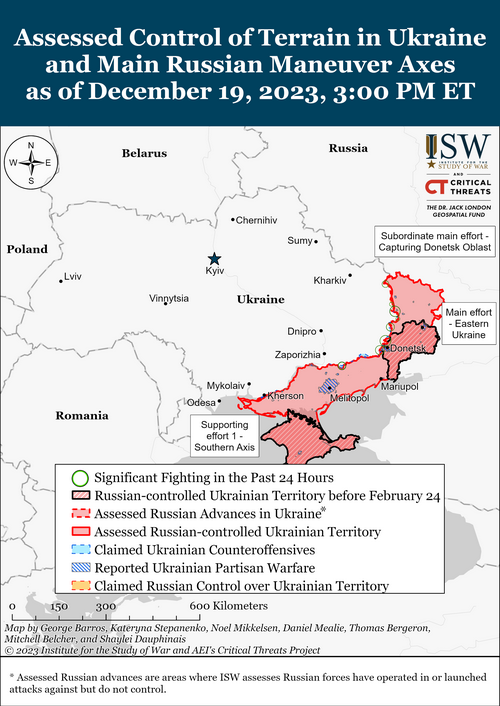
From The Institute for the Study of War:
Russian Offensive Campaign Assessment, December 19, 2023
Karolina Hird, Kateryna Stepanenko, Nicole Wolkov, Christina Harward, George Barros, and Frederick W. Kagan
December 19, 2023, 8:15pm ET
Click here to see ISW’s interactive map of the Russian invasion of Ukraine. This map is updated daily alongside the static maps present in this report.
Click here to see ISW’s 3D control of terrain topographic map of Ukraine. Use of a computer (not a mobile device) is strongly recommended for using this data-heavy tool.
Click here to access ISW’s archive of interactive time-lapse maps of the Russian invasion of Ukraine. These maps complement the static control-of-terrain map that ISW produces daily by showing a dynamic frontline. ISW will update this time-lapse map archive monthly.
Note: The data cut-off for this product was 3:15pm ET on December 19. ISW will cover subsequent reports in the December 20 Russian Offensive Campaign Assessment.
Russian President Vladimir Putin is increasingly invoking the Kremlin’s pre-invasion pseudo-historical rhetoric to cast himself as a modern Russian tsar and framing the invasion of Ukraine as a historically justified imperial reconquest. Putin addressed the Russian Ministry of Defense (MoD) Collegium on December 19 and largely reiterated boilerplate Kremlin rhetoric on the war in Ukraine by blaming NATO and the collective West for encroaching on Russia’s borders and exculpated himself for issues faced by the Russian Armed Forces in Ukraine by deflecting the blame towards the Russian MoD bureaucracy.[1] Putin additionally lauded Russian battlefield operations and Russia’s defense industrial base’s net output in 2023, furthering several of his standard talking points. Putin once again invoked the concept of “compatriots abroad” when discussing residents in “southeastern Ukraine” who, he asserted, have historical, cultural, and linguistic attachments to Russia, in order to justify the invasion of Ukraine on ideological grounds. ISW previously assessed that Putin rhetorically contextualized Russia’s maximalist objectives in Ukraine within a wider framing of Russian “sovereignty” at Putin’s “Direct Line” event on December 14.[2] Putin notably claimed that while Russia is the sole guarantor of Ukraine’s sovereignty and territorial integrity, Russia will also not interfere in “territorial disputes” in western Ukraine, where he claimed that many residents want to return to either Poland, Romania, or Hungary, concluding that “history will put everything in its place.”
Putin’s claim that Russia can be the only true guarantor of Ukraine’s sovereignty is not a new narrative. In a 2021 essay entitled “On the Historical Unity of Russians and Ukrainians,” Putin similarly claimed that “true sovereignty of Ukraine is possible precisely in partnership with Russia.”[3] In the same essay, Putin also utilized a pseudo-historical framework of Ukraine’s and Russia’s relationship that essentially defines the lands of modern, sovereign Ukraine as either part of Malorossiya (Little Russia), Novorossiya (New Russia), or fragments of other historical empires.[4] This essay dismissed Ukraine’s historical claim to its own sociocultural development, historical sovereignty, and territorial integrity, which the Russian Federation formally recognized and, indeed, guaranteed, in 1994.[5] During the December 19 Collegium Address, Putin further engaged with this pseudo-historical framing to suggest that western Ukraine is also not truly Ukrainian and claimed that Soviet dictator Joseph Stalin “gave it away” to Ukraine from pieces of Poland, Romania, and Hungary following the Second World War.[6] Putin baselessly claimed that people living in western Ukraine want to return to their “historical homeland,” suggesting that western Ukraine could feasibly return to 17th-century conceptions of state borders and become parts of Poland, Romania, or Hungary. This statement suggests that Putin is selectively weaponizing facets of Eastern and Central European history as they suit his ideological line to further rhetorically strip Ukraine of its internationally recognized sovereignty.
Putin’s MoD Collegium claims are rife with rhetorical contradictions and are dependent on tenuous historical allegories that fall apart when considered in different historical contexts. During a November 28 speech at the World Russian People’s Council, Putin defined the concept of the “Russian World” (Russkiy Mir) as “all other peoples who have lived and are living in [Russia],” geographically defined as what belonged to Ancient Rus (Kyivan Rus), the Kingdom of Muscovy, the Russian Empire, the Soviet Union, and the contemporary Russian Federation, which suggests that Putin was broadly including parts of eastern European states such as Poland and Romania in this conception of the Russian World.[7] During the December 19 Collegium Address, however, Putin appeared to diverge from this maximalist interpretation of the Russian World by differentiating Poland, Romania, and Hungary as having their own historical claims to western Ukraine.[8] These contradictions emphasize the fact that Putin relies on historical narratives that intentionally ignore contemporary contexts when they are suitable to the Kremlin narrative. The contradictions also exhibit another known characteristic of Russian information operations, which is that Russian information operations often are not necessarily internally consistent with each other. Based on Putin’s interpretation of eastern European history, the modern map of Europe could also ridiculously be redrawn with Poland and Sweden controlling the Baltic States and parts of Belarus and Russia, and the Russian borders extending to Alaska and the California coast.[9] One could also make an absurd and nonsensical argument that a revived Kingdom of Poland and Lithuania has rights to most of eastern Europe and parts of western Russia. Putin’s selective references to convenient historical “claims” reflect the facile nature of his narrative.
Russian Defense Minister Sergei Shoigu stated during the Russian MoD Collegium on December 19 that the Russian MoD will prioritize continuing the war in Ukraine and training newly formed units and formations in 2024, while also reiterating threats against Finland and the wider NATO alliance. Shoigu stated that the Russian military is undergoing work to expand its combat power to 1.32 million personnel from 1.15 million in accordance with Putin’s December 1 decree.[10] ISW previously assessed that Russian this decree was likely a formal recognition of the Russian military’s current end strength and not an order to immediately increase the number of Russian military personnel, and Shoigu appears to be merely reamplifying Putin’s original statement as opposed to outlining major changes in Russian end strength.[11] Shoigu stated that the Russian military formed two fully-equipped armies (likely in reference to the newly formed 18th and 25th Combined Arms Armies), a mixed aviation corps, four divisions, including 50 other units and formations of lower echelons, 18 brigades, and 28 regiments in 2023.[12] Shoigu initially outlined the creation of these new formations on paper at the MoD Collegium in December of 2022, the establishment of several of which ISW has independently confirmed.[13] It is highly unlikely that any of these new formations are “fully equipped” or operating at their doctrinal end strengths at this time, however.[14]
Shoigu reiterated that the Russian military is forming the Leningrad Military District (LMD) and Moscow Military District (MMD) in connection with Finland’s accession to NATO and the upcoming accession of Sweden.[15] Shoigu also announced that Russia will prioritize implementing operational and combat training measures to combat the “threats of further NATO expansion east” in 2024.[16] Shoigu’s attempt to present the creation of the LMD and MMD as a response to alleged “NATO expansion” echoes an ongoing Russian information operation aimed at shifting responsibility for the war in Ukraine away from Russia to the West by framing Russia’s actions as reactive. Finland and Sweden only applied to join NATO shortly after Russia’s full-scale invasion of Ukraine, likely fearing further Russian aggression on their borders.[17] Russia’s decision to reform the Western Military District (WMD) into the LMD and MMD is part of a long-term restructuring and expansion effort that aims to prepare Russia for a potential future large-scale conventional war against NATO while balancing the Russian operational requirements in Ukraine.[18]
Ukrainian President Volodymyr Zelensky gave an end-of-the-year press conference on December 19 during which he commented on Russia’s continued unwillingness to negotiate, his confidence in future Western aid provisions, Ukrainian domestic weapons production, and possible future mobilization in Ukraine. Zelensky stated that the Kremlin did not achieve its military objectives in Ukraine in 2023, likely referring to Russia’s inability to occupy the entirety of its illegally annexed territory, particularly by failing to reach the administrative borders of Luhansk and Donetsk oblasts.[19] Zelensky stated that Ukraine is working on a peace formula at international summits to possibly present to Russia in the future but that the issue of negotiations with Russia is currently “irrelevant” as Putin’s recent statements about Russia’s unchanged goals in Ukraine indicate that Putin does not want peace. (ISW has long assessed that Russia is unwilling to negotiate with Ukraine in good faith.)[20] Zelensky expressed confidence that the US and EU will provide aid to Ukraine in the near future.[21] Zelensky noted that Ukraine will domestically produce one million drones and increase production of artillery in 2024, and that Ukraine is working to produce unspecified projectiles and create the infrastructure needed to deliver domestically produced weapons to the front. Zelensky stated that financing issues have prevented him from making a decision on the Ukrainian General Staff’s proposal to mobilize an additional 450,000–500,000 military personnel. Zelensky also emphasized that he would not sign a possible future bill on the mobilization of women but that he may lower the mobilization age to 25.[22] Zelensky answered a question about the possible dismissal of Ukrainian Commander-in-Chief General Valerii Zaluzhnyi, stating that he and Zaluzhnyi have a “working relationship.”[23] Russian sources have increasingly been promoting reports about internal Ukrainian political-military tension in an effort to discredit Ukrainian leadership, sow domestic distrust between Ukrainian citizens and the government, and weaken Western support for Ukraine.[24]
Russian Prime Minister Mikhail Mishustin discussed Russian and Chinese economic cooperation and bilateral relations with Chinese Premier Li Quang in Beijing on December 19.[25] Mishustin claimed that Russia and China have “completely gotten rid of third-country currencies in mutual transactions” in 2023 and that both countries are strengthening their business contacts and increasing the share of national currencies in mutual transactions. Mishustin added that one of Russia’s most important strategic objectives is to bring the trade and investment between Russia and China to a higher level.[26] Mishustin arrived in Beijing to attend the 28th regular meeting of heads of the Russian and Chinese governments and will also meet with Chinese President Xi Jinping over the next two days.[27]
Key Takeaways:
- Russian President Vladimir Putin is increasingly invoking the Kremlin’s pre-invasion pseudo-historical rhetoric to cast himself as a modern Russian tsar and framing the invasion of Ukraine as a historically justified imperial reconquest.
- Russian Defense Minister Sergei Shoigu stated during the Russian MoD Collegium on December 19 that the Russian MoD will prioritize continuing the war in Ukraine and training newly formed units and formations in 2024, while also reiterating threats against Finland and the wider NATO alliance.
- Ukrainian President Volodymyr Zelensky gave an end-of-the-year press conference on December 19 during which he commented on Russia’s continued unwillingness to negotiate, his confidence in future Western aid provisions, Ukrainian domestic weapons production, and possible future mobilization in Ukraine.
- Russian Prime Minister Mikhail Mishustin discussed Russian and Chinese economic cooperation and bilateral relations with Chinese Premier Li Quang in Beijing on December 19.
- Russian forces made confirmed advances northeast of Kupyansk, north of Bakhmut, and southwest of Avdiivka, and continued positional meeting engagements along the entire line of contact.
- Russian Defense Minister Sergei Shoigu stated that the Russian military intends to recruit up to 745,000 contract personnel by the end of 2024 at the Russian Ministry of Defense (MoD) Collegium on December 19.
- Russian authorities continued attempts to use military conscription in occupied Ukraine to augment force generation efforts and legitimize Russia’s illegal annexation of Crimea.
Go here to read the rest. So long as Putin remains in control of Russia there will be war. If he wins in Ukraine he will find some other part of the old Soviet Union to attempt to conquer. Ukraine, next to Russia, is the strongest successor state of the Soviet Union. Putin’s project to breath life into the ghost of the Soviet Union will cease only with his death or his fall from power.

