
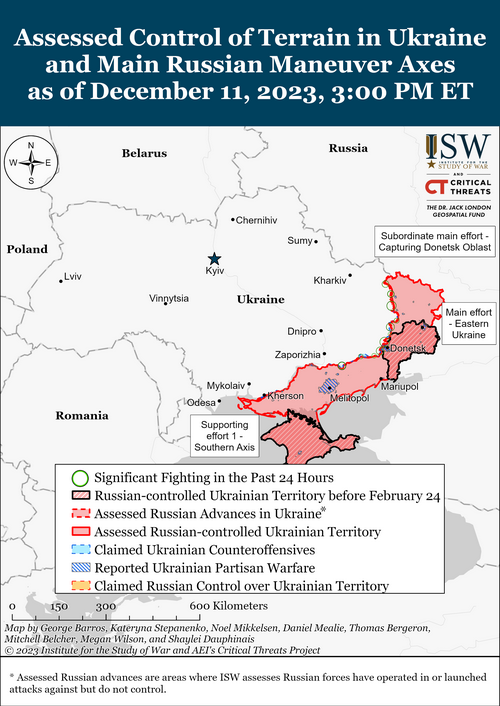
From The Institute For The Study of War:
Russian Offensive Campaign Assessment, December 11, 2023
Grace Mappes, Nicole Wolkov, Christina Harward, Riley Bailey, and Mason Clark
December 11, 2023, 5:50pm ET
Click here to see ISW’s interactive map of the Russian invasion of Ukraine. This map is updated daily alongside the static maps present in this report.
Click here to see ISW’s 3D control of terrain topographic map of Ukraine. Use of a computer (not a mobile device) is strongly recommended for using this data-heavy tool.
Click here to access ISW’s archive of interactive time-lapse maps of the Russian invasion of Ukraine. These maps complement the static control-of-terrain map that ISW produces daily by showing a dynamic frontline. ISW will update this time-lapse map archive monthly.
Note: The data cut-off for this product was 12:15pm ET on December 11. ISW will cover subsequent reports in the December 12 Russian Offensive Campaign Assessment.
The Russian Central Election Commission (CEC) announced on December 11 that Russia will conduct voting for the 2024 presidential election in occupied Ukraine, likely in an attempt to legitimize the Russian occupation and Russian President Vladimir Putin’s rule.[1] The CEC reported that it made the decision to hold the election in occupied territories – all of which except Crimea are under martial law – in consultations with the Russian Ministry of Defense (MoD), the Federal Security Service (FSB), and occupation authorities.[2] Russian law notably requires the CEC to consult with these agencies when considering holding elections in areas under martial law, including occupied Ukraine.[3] Russia will likely use the March 2024 presidential election to further establish a veneer of legitimacy for its occupation of Ukraine as it has done during the illegal 2022 annexation referenda and the 2023 regional elections.[4] Russian CEC Chairperson Ella Pamfilova stated on December 7 that elections in occupied Donetsk, Luhansk, Zaporizhia, and Kherson oblasts “will differ somewhat” in procedure from elections in Russia and occupied Crimea.[5] The CEC will likely use these differing procedures to falsify votes in Putin’s favor and claim a high voter turnout while falsely portraying occupied Ukraine’s participation in the election as legitimate to the international community.
Russian forces conducted a series of missile and drone strikes against Ukraine on the night of December 10 to 11. Ukrainian military sources reported that Russian forces launched 18 Shahed-131/136 drones from occupied Cape Chauda and Belbek, Crimea and eight ballistic missiles from Bryansk Oblast targeting Kyiv Oblast.[6] Ukrainian military sources reported that Ukrainian forces downed all 18 Shaheds and all eight ballistic missiles.[7] Ukrainian Eastern Air Command reported that Ukrainian forces shot down a Kh-59 cruise missile over Kryvyi Rih Raion, Zaporizhia Oblast on December 11.[8]
The United Kingdom (UK) and Norway will lead a coalition aimed at providing short-term and long-term assistance to the Ukrainian Navy as the UK announced additional maritime aid provisions to Ukraine. The UK announced on December 11 that the UK and Norway would lead the Maritime Capability Coalition to provide short-term assistance to Ukraine and help in long-term efforts aimed at making the Ukrainian navy more interoperable with NATO.[9] The Norwegian Defense Ministry reported that the Maritime Capability Coalition is one of several “Capability Coalitions” discussed during the most recent meeting of the 50-nation strong Ukraine Contact Group on November 22.[10] Ukrainian Navy Commander Oleksiy Neizhpapa stated that the coalition is designed to last until at least 2035.[11] UK Defense Minister Grant Shapps announced that the UK will provide Ukraine with 20 Viking amphibious armored vehicles and 23 raiding boats.[12] Shapps also announced that the UK transferred two Sandown-class minehunter vessels to Ukraine as part of a plan that predated Russia’s full-scale invasion of Ukraine.[13] Neizhpapa stated that the two minehunters are currently in the UK and cannot yet be brought to Ukraine due to the Montreux Convention.[14] Turkey has used the Montreux Convention since February 28, 2022, to deny access to the Russian warships wishing to pass through the Bosphorus and Dardanelles straits per Article 19 which stipulates that “vessels of war belonging to belligerent Powers shall not…pass through the Straits.”[15] Russia has reportedly relied on civilian ships to bypass the Turkish use of the Montreux Convention to transport war materiel through the straits.[16]
Russian President Vladimir Putin expressed his intention to expand Russian naval capabilities in areas well beyond Ukraine and Eastern Europe, likely in an effort to strengthen and expand Russia’s ability to threaten the West. Putin attended the flag-raising ceremony for two nuclear-powered strategic missile submarine carriers, the cruise missile carrier Krasnoyarsk (Yasen-M class submarine) and the intercontinental ballistic missile carrier Emperor Alexander III (Borei-A Class submarine), at the Sevmash shipbuilding plant in Severodvinsk, Arkhangelsk Oblast, on December 11.[17] Putin stated that the two new submarines would join the Russian Pacific Fleet (Eastern Military District) to defend Russia’s far eastern borders.[18] Putin stated that Russia plans to quantitatively strengthen the Russian navy and strengthen Russian naval power in the Arctic and Far East and in the Black, Baltic, and Caspian seas.[19] Putin claimed that the Sevmash plant intends to transfer three more Borei-A class submarines and five more Yasen-M class submarines to the Russian navy in the coming years.[20] The construction and launch of new naval craft are expensive and time-consuming undertakings, and Putin’s interest in expanding Russian naval capabilities in all areas where Russia has naval basing suggests that the Russian leadership may intend to include naval expansion as part of its long-term force expansion effort.[21]
The Russian military’s long-term restructuring and expansion effort aims to prepare Russia for a future-large scale conventional war against NATO, and the commitment of expensive naval resources to areas beyond Ukraine and Eastern Europe likely aims to threaten NATO and its allies across multiple regions.[22] The Kremlin has routinely stressed that Russia is a Pacific naval power in its pursuit of an equal defense partnership with China, and Russia engaged in naval posturing in the Sea of Okhotsk in May 2023 aimed at deterring further Japanese support for Ukraine.[23] Putin further emphasized Russian strategic interest in the Arctic later on December 11 at a meeting on the economic development of Russia’s Arctic zone, a region in which Russia may intend to strengthen naval capabilities given Finland’s recent NATO accession and Sweden’s pending NATO accession.[24] It is unclear whether Russian naval manufacturers will be able to produce strategic naval craft at the Kremlin’s desired scale and quality in the coming years, although Russia continues efforts to gradually mobilize its defense industrial base (DIB) and may decide to focus these efforts on Russian naval manufacturers.
The Russian State Duma approved amendments allowing Russian courts to fine or assign compulsory work to foreigners who are convicted of crimes in Russia, likely as part of ongoing efforts to coerce migrants into Russian military service. The Russian State Duma Committee on State Construction and Legislation approved amendments that would allow Russian judges to issue 40,000 to 50,000 rubles (about $440 to $550) in fines or 150 to 200 hours of compulsory work to migrants convicted of a crime in place of deportation.[25] The amendment will allow Russian judges to determine if deportation is an “excessive” or “disproportionate” punishment based on the criminal record of the foreigner convicted.[26] The amendment likely aims to reduce the number of deportations so that Russia can continue to benefit from migrant labor amid labor shortages and continue wider efforts to coerce migrants, both with and without Russian citizenship, into Russian military service. Russian authorities have increasingly conducted mass detentions of migrants, during which Russian authorities have served those with Russian citizenship military summonses and have threatened to revoke Russian citizenship from naturalized migrants if they refuse to serve in the Russian military.[27] Russian authorities have also targeted migrants without Russian citizenship in crypto-mobilization efforts by proposing restrictions on the actions and job opportunities of foreign citizens in Russia, advertising Russian military contract service in Central Asian languages, and coercing migrants into contract service in exchange for Russian citizenship.[28] ISW assesses that the Russian government continues to struggle to reconcile the incoherent and competing objectives of exploiting migrant labor to alleviate Russian labor shortages and prioritizing crypto-mobilization efforts to send migrants to the frontline.[29] Russian authorities are also likely using these measures to appease Russian ultranationalists who generally oppose the inclusion of migrants into the Russian economy and society.
Russian National Security Council Deputy Chairperson Dmitry Medvedev announced on December 11 that the Russian government will make “targeted changes” to the Russian constitution. Medvedev emphasized that the Russian government must make amendments to the constitution very carefully and that there is currently no reason to discuss a new constitution altogether.[30] Medvedev did not specify what these “targeted changes” will be, and the nature and degree of these changes are currently unclear.[31] Russian Investigative Committee Head Alexander Bastrykin called on November 22 for Russia to codify an unspecified state ideology, which would legally require an amendment to the Russian constitution, as Article 13 of the Russian constitution forbids Russia from proclaiming a state ideology and commits the Russian state to recognize ideological diversity.[32] Russian state TV channel Rossiya 1 reported on December 10 that Russian President Vladimir Putin will meet with Russian Constitutional Court judges in the coming week. Putin may use this meeting to articulate to the judges or publicly announce the specific constitutional changes Medvedev was referencing.[33]
Ukrainian President Volodymyr Zelensky will meet with US government officials in Washington, D.C. on December 12. Zelensky will meet with US President Joe Biden and members of Congress, including House of Representatives Speaker Mike Johnson.[34] ISW will cover these events on December 12.
Imprisoned Russian opposition figure Alexei Navalny’s team reported that Navalny has gone missing as of December 11, just days after Russian President Vladimir Putin’s 2024 presidential election campaign announcement. Navalny’s Press Secretary Kira Yarmysh reported on December 11 that authorities at Russian penal colony no.6 in Vladimir Oblast stated that Navalny is no longer registered to the penal colony after preventing Navalny’s lawyers from visiting him on December 8 and 11.[35] Yarmysh reported that authorities at penal colony no.7, also in Vladimir Oblast, told Navalny’s lawyers that Navalny is also not at penal colony no 7, and Yarmysh stated that Navalny’s current location is unknown.[36] Yarmysh reported that Navalny was in ill health when his lawyers last visited him.[37] ISW has no independent confirmation of Yarmysh’s statements. Navalny’s reported disappearance comes just days after Putin’s December 8 presidential campaign announcement and the Navalny team’s December 9 announcement of a presidential campaign strategy, which several other Russian opposition figures endorsed.[38]
Key Takeaways:
- The Russian Central Election Commission (CEC) announced on December 11 that Russia will conduct voting for the 2024 presidential election in occupied Ukraine, likely in an attempt to legitimize the Russian occupation and Russian President Vladimir Putin’s rule.
- Russian forces conducted a series of missile and drone strikes against Ukraine on the night of December 10 to 11.
- The United Kingdom (UK) and Norway will lead a coalition aimed at providing short-term and long-term assistance to the Ukrainian Navy as the UK announced additional maritime aid provisions to Ukraine.
- Russian President Vladimir Putin expressed his intention to expand Russian naval capabilities in areas well beyond Ukraine and Eastern Europe, likely in an effort to strengthen and expand Russia’s ability to threaten the West.
- The Russian State Duma approved amendments allowing Russian courts to fine or assign compulsory work to foreigners who are convicted of crimes in Russia, likely as part of ongoing efforts to coerce migrants into Russian military service.
- Russian National Security Council Deputy Chairperson Dmitry Medvedev announced on December 11 that the Russian government will make “targeted changes” to the Russian constitution.
- Russian forces conducted offensive operations along the Kupyansk-Svatove-Kreminna line, near Bakhmut, near Avdiivka, west and southwest of Donetsk City, and in western Zaporizhia Oblast on December 11 and advanced in some areas.
- Ukrainian military officials indicated that Russian forces recently intensified mechanized offensive operations near Avdiivka.
- A Russian law went into effect on December 11 likely aimed at preventing Russian conscripts from fleeing military service.
- Russia continued to illegally deport children from occupied Ukraine to Russia under the guise of rehabilitation and medical programs as Kremlin-appointed Children’s Rights Commissioner Maria Lvova-Belova continued attempts to dispute this practice.
Go here to read the rest. Then Russian focus is clearly now on the president election in March rather than on the War in Ukraine.


I have not heard anything about Radio Free Europe or Radio Liberty broadcasting the facts about the war to the Russian people. Are these operations still functioning? Seems this would be a appropriate time to highlight the actual costs and consequences of this war to the Russian people.