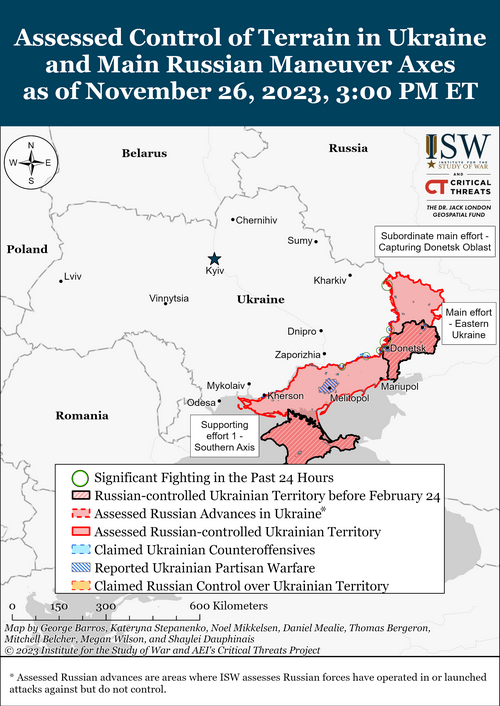
From The Institute For The Study of War:
Russian Offensive Campaign Assessment, November 26, 2023
Nicole Wolkov, Christina Harward, Grace Mappes, Kateryna Stepanenko, George Barros, and Frederick W. Kagan
November 26, 2023, 6:30pm ET
Click here to see ISW’s interactive map of the Russian invasion of Ukraine. This map is updated daily alongside the static maps present in this report.
Click here to see ISW’s 3D control of terrain topographic map of Ukraine. Use of a computer (not a mobile device) is strongly recommended for using this data-heavy tool.
Click here to access ISW’s archive of interactive time-lapse maps of the Russian invasion of Ukraine. These maps complement the static control-of-terrain map that ISW produces daily by showing a dynamic frontline. ISW will update this time-lapse map archive monthly.
Note: The data cut-off for this product was 2:15pm ET on November 26. ISW will cover subsequent reports in the November 27 Russian Offensive Campaign Assessment.
Russian forces conducted a series of Shahed drone strikes on Ukraine on the night of November 25-26. Ukrainian military officials reported that Russian forces launched nine Shahed-136/131 from Primorsko-Akhtarsk direction and that Ukrainian air defenses shot down eight drones.[1] Ukrainian Joint Forces Commander Lieutenant General Serhiy Nayev, like other Ukrainian officials on November 25, continued to praise the actions of Ukrainian mobile fire groups in intercepting Russian drones.[2] Nayev stated that mobile fire groups will receive foreign-made man-portable air-defense systems (MANPADS) in the near future.[3]
The Ukrainian Main Military Intelligence Directorate (GUR) reportedly conducted a large-scale drone strike on Russian territory, and Russian occupation officials accused Ukrainian forces of launching a strike on occupied Donetsk Oblast that resulted in widespread power outages. The Russian Ministry of Defense (MoD) claimed that Russian air defenses shot down 24 Ukrainian drones over Moscow, Tula, Kaluga, Bryansk, and Smolensk oblasts on the night of November 25-26 and on the morning of November 26.[4] Tula Oblast Governor Alexei Dyumin stated that one drone crashed into an apartment building in Tula City after Russian air defenses shot it down.[5] Ukrainian outlet Suspilne, citing its own unnamed sources, reported that the overnight Ukrainian drone strike on Russia was a GUR special operation.[6] Russian sources, including Donetsk People’s Republic (DNR) Head Denis Pushilin, also claimed that Ukrainian forces conducted a large artillery and HIMARS strike on power distribution substations in occupied Donetsk Oblast overnight, causing electricity outages in many settlements and cities, including Donetsk City, Mariupol, and Manhush.[7]
Russian forces reportedly complained about the vulnerability of Russian ground lines of communication (GLOCs) in the east (left) bank of Kherson Oblast amid continued complaints about weak Russian capabilities on the east bank. A Russian milblogger claimed on November 26 that personnel of the Russian 70th Motorized Rifle Division (of the newly formed 18th Combined Arms Army) often write to him complaining about the vulnerability of Russian logistics in the east bank of Kherson Oblast near Krynky (30km northeast of Kherson Oblast and 2km from the Dnipro River) to Ukrainian drone strikes.[8] The milblogger also agreed with another Russian milblogger’s previous claims that Russian forces in this area struggle with unit coordination as well as commanders’ negligence at the company and battalion levels.[9] The milblogger suggested that Russian forces near Krynky should create a separate anti-drone company staffed by personnel of the separate reconnaissance battalion of the 70th Motorized Rifle Division to protect Russian GLOCs.[10] Russian GLOCs on left bank Kherson Oblast, such as the E58 Antonivka-Sahy highway (about 5-8km away from the Dnipro River), are located close to the Dnipro River shoreline, making them vulnerable to Ukrainian interdiction. ISW previously reported that Russian milbloggers have repeatedly complained about Russian forces near Krynky suffering from problems, such as insufficient fire support, unit coordination, electronic warfare (EW), counterbattery, and air defense, but has observed that these reported problems do not always translate into significant battlefield effects.[11] Russian sources have continually claimed that Russian forces are unable to push Ukrainian forces out of Krynky and that Ukrainian forces are currently unable to make operationally significant advances in the east bank area.[12]
Russia continues to face skilled and unskilled labor shortages amid inconsistent and contradictory Kremlin policies that disincentivize Russians who fled Russia and migrant workers from working in Russia while simultaneously trying to increase Russian industrial capacity and force generation. Russian State Duma Chairperson Vyacheslav Volodin claimed on November 25 that many Russians who left Russia because of the full-scale invasion of Ukraine are returning to Russia because they could not find work abroad.[13] Volodin warned that Russia is not “waiting with open arms” to accept returning Russians and claimed that they “committed treason against Russia, relatives, and friends.”[14] A prominent Kremlin-affiliated Russian milblogger agreed with Volodin’s statements on November 26 but noted that Russia continues to face severe skilled labor shortages and characterized the number of returning Russians as “catastrophically small.”[15] The milblogger added that the labor shortages have increased the number of migrants seeking jobs in Russia and criticized Russian authorities for their “open door policy” on migration.[16] The Russian government appears to be struggling to reconcile incoherent and competing objectives by prioritizing crypto-mobilization efforts to send manpower to the frontline at the expense of Russia’s national labor force while simultaneously enforcing policies that restrict migrants’ prospects to work in Russia.[17] Russian law enforcement agencies are also coercing migrants both with and without Russian citizenship into Russian military service, further reducing the migrants’ ability to augment Russia’s labor force.[18] The Kremlin’s incoherent and contradictory policies seek to achieve mutually exclusive objectives of reducing negative shocks to Russia’s domestic labor force, while disincentivizing migrants from working in Russia and enticing Russians to return from abroad while not providing them opportunities to work and trying to recruit them into a war they fled. The poor implementation of these policies has not generated any apparent or imminent threats to the Russian economy or war effort at this time, however.
Key Takeaways:
- Russian forces conducted a series of Shahed drone strikes on Ukraine on the night of November 25-26.
- The Ukrainian Main Military Intelligence Directorate (GUR) reportedly conducted a large-scale drone strike on Russian territory, and Russian occupation officials accused Ukrainian forces of launching a strike on occupied Donetsk Oblast that resulted in widespread power outages.
- Russian forces reportedly complained about the vulnerability of Russian ground lines of communication (GLOCs) in the east (left) bank of Kherson Oblast amid continued complaints about weak Russian capabilities on the east bank.
- Russia continues to face skilled and unskilled labor shortages amid inconsistent and contradictory Kremlin policies that disincentivize Russians who fled Russia and migrant workers from working in Russia while simultaneously trying to increase Russian industrial capacity and force generation.
- Russian forces continued attacks along the Kupyansk-Svatove-Kreminna line, near Bakhmut, near Avdiivka, west and southwest of Donetsk City, in the Donetsk-Zaporizhia Oblast border area, and in western Zaporizhia Oblast and advanced in some areas.
- The Russian Supreme Court ruled that certain Russian mobilized individuals have the right to serve in the Russian Alternative Civil Service (AKS) rather than on the front lines.
- Russian occupation officials continue to establish programs aimed at indoctrinating Ukrainian children in occupied Ukraine into Russian national and cultural identities.
Go here to read the rest.
From Strategy Page:
In late 2023, advancing Ukrainian forces were close enough to the narrow isthmus connecting Crimean to the mainland that the only Russian rail line carrying supplies to occupied Crimea was within range of GMLRS missile attacks. These NATO supplied missiles were carried and launched from HIMARS vehicles. They had a range of 80 kilometers and were a constant threat to Russian supply lines, including ports and ships in the Black Sea.
Ukraine had already disabled the other rail supply route to Crimea, which used the Kerch Strait bridge. Ukraine used various types of UAVs, USVs and novel UUVs (unmanned underwater vessels) to do this, as well as destroy Russian air defenses in Crimea and drive the remaining ships of the Black Sea fleet to port on the east coast of the Black Sea. The largest of these eastern Black Sea ports is Novorossiysk, which had a small naval base facility added in 2012. Now it is being used to host the surviving remnants of the Black Sea Fleet. While Novorossiysk is mainly a commercial port, exporting oil and other goods produced in the area and handling most of the imports, most of that has been halted because of the Ukrainian unmanned weapons that now make the Black Sea a dangerous place for Russian ships of any type. Ukraine did this without a fleet of its own. The Russians were still able to launch missile attacks on Ukrainian ports using submarine launched cruise missiles as well as land-based missiles. These Russian attacks became less frequent as the Ukrainians advanced closer to the roads and railroads that supplied Crimea.
Go here to read the rest. The Black Sea is becoming a key vulnerability for Russia and the Ukrainians are exploiting this weakness.