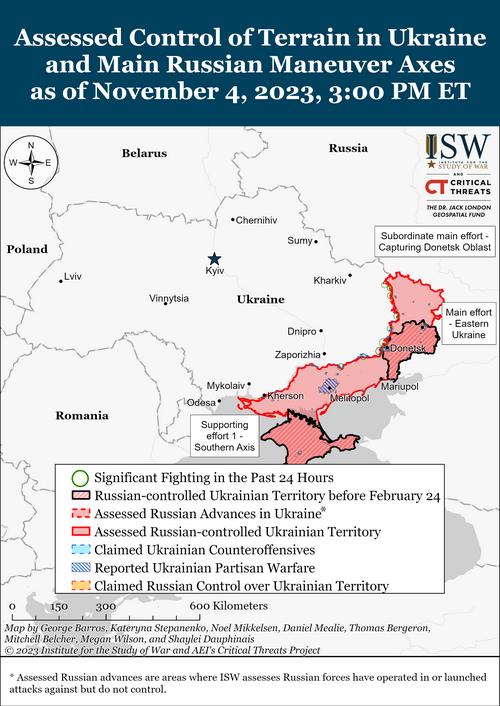
From The Institute For The Study of War:
Russian Offensive Campaign Assessment, November 4, 2023
Kateryna Stepanenko, Grace Mappes, Angelica Evans, Christina Harward, and Frederick W. Kagan
November 4, 2023, 7:15pm ET
Click here to see ISW’s interactive map of the Russian invasion of Ukraine. This map is updated daily alongside the static maps present in this report.
Click here to see ISW’s 3D control of terrain topographic map of Ukraine. Use of a computer (not a mobile device) is strongly recommended for using this data-heavy tool.
Click here to access ISW’s archive of interactive time-lapse maps of the Russian invasion of Ukraine. These maps complement the static control-of-terrain map that ISW produces daily by showing a dynamic frontline. ISW will update this time-lapse map archive monthly.
Note: The data cut-off for this product was 2:30pm ET on November 4. ISW will cover subsequent reports in the November 5 Russian Offensive Campaign Assessment.
Ukrainian President Volodymyr Zelensky emphasized that the war in Ukraine is not a “stalemate” in a comment to the media about Ukrainian Commander-in-Chief General Valerii Zaluzhnyi’s essay on the positional nature of warfare in Ukraine.[1] Zelensky stated during a joint press conference with European Commission President Ursula von der Leyen on November 4 that the current situation on the frontlines is “not a stalemate” even if “time has passed” and “people are tired.” Zelensky emphasized that Ukraine prioritizes the safety of its servicemen and needs US F-16 fighter aircraft and air defenses to gain an advantage over Russian forces. Zelensky recalled that many observers were quick to call the battlefield situation in 2022 “a stalemate,” but that Ukrainian forces with several “tricks, tactics, [and] military operations” were able to liberate Kharkiv Oblast and west (right) bank Kherson Oblast. Zelensky added that Russian President Vladimir Putin will not stop at Russia’s currently occupied lines and noted that Ukraine “has no right to even think about giving up.” Zelensky’s statements largely mirror the main arguments in Zaluzhnyi’s essay entitled, “Modern Positional Warfare and How to Win It.”
Zaluzhny’s long essay, “Modern Positional Warfare and How to Win It,” outlines Zaluzhnyi’s consideration of the changes Ukraine must make to overcome the current “positional” stage of the war more clearly than the shorter op-ed and the Economist article it accompanied. Zaluzhnyi wrote that the war “is gradually moving to a positional form” and noted that Ukraine needs to gain air superiority; breach mine barriers in depth; increase the effectiveness of counter-battery; create and train the necessary reserves; and build up electronic warfare (EW) capabilities to overcome positional warfare.[2] Positional warfare refers to military operations that do not result in rapid or dramatic changes to the frontline despite both sides‘ continuing efforts to improve their positions. Zaluzhnyi notably did not say that the war was stalemated in his essay or suggest that Ukraine could not succeed. His essay focused, rather, on explaining that the current positional character of the war was a result of technological-tactical parity on the battlefield and the widespread use of mine barriers by Russian and Ukrainian troops. Zaluzhnyi considered the opportunities presented to Ukraine by Russia’s challenges, including the significant losses suffered by Russian aviation; Ukrainian use of Western missile and artillery weapons; and Russia’s failure to take advantage of its human mobilization resources due to political, organizational, and motivational issues. Zaluzhnyi argued that to avoid World War I-style “trench war” and move to maneuver warfare, Ukraine must develop new approaches including technological and other changes, some of which depend on Western support and others require adaptations within the Ukrainian military, state, and society. Zaluzhnyi concluded that positional warfare benefits Russia as it prolongs the war and could allow Russia to achieve superiority in certain areas. Zaluzhnyi argued that Ukraine or Russia could return to rapid maneuver warfare under the right circumstances, which for Ukraine must include Western-provided military resources. Zaluzhnyi’s essay was all about how to restore maneuver to a positional war, not an argument that the war has reached a stalemate.
Zelensky also denied Western reports that US and European officials are pressuring Ukrainian officials to discuss the possibility of peace negotiations. NBC, citing current and former US officials, reported on November 3 that US and European officials have been “quietly” discussing the prospects of peace negotiations with Ukrainian officials.[3] NBC’s sources stated that these discussions took place during a meeting of the Ukraine Defense Contact Group in the past month and were the result of Ukrainian acknowledgment of Western concerns that the war has reached a “stalemate.” Zelensky stated during the press conference on November 4 that, as the leader of Ukraine, he can attest that no one in Europe or the United States is pressuring him to discuss peace negotiations.[4] Von der Leyen also expressed her support for Ukraine’s sovereignty.
NBC added that US officials have no indication that Russian President Vladimir Putin is willing to negotiate with Ukraine or doubts that Russia can continue its war until Western aid for Ukraine falters.[5] ISW has also not observed any indications that Russia is prepared to enter peace negotiations with Ukraine in good faith. Kremlin spokesperson Dmitry Peskov expressed the Kremlin’s disagreement with the characterization of the war in Ukraine as a “stalemate” on November 2, stating that the war in Ukraine “has not reached a dead end” and that the Russian military continues to conduct offensive operations.[6] Russia’s offensive operations around Avdiivka indicate that the Kremin continues to believe that it is possible to achieve its objectives with military force and is unlikely to enter peace negotiations with Ukraine, except to buy time to reconstitute for future offensive operations. Pressure on Ukraine to negotiate an end to the war will likely remain meaningless if not harmful as long as Putin believes that he can achieve his objectives on the battlefield.
The Russian Ministry of Defense (MoD) allegedly used claims that the Syrian government agreed to supply weapons to Iranian-backed Lebanese Hezbollah to subsume remnants of the Wagner Group in Syria and seize their air defense systems. A Kremlin-affiliated milblogger claimed on November 4 that Israel communicated information via diplomatic channels to Russia a few weeks ago about Syrian President Bashar al-Assad’s alleged agreement to supply Iranian-backed Lebanese Hezbollah with weapons.[7] The milblogger claimed that remnants of the Wagner Group were operating in Syria under an agreement with the Syrian government and that the Russian MoD used this alleged information to pressure the Syrian government to allow the Russian MoD to force Wagner fighters in Syria to transfer their weapons to and sign contracts with the Russian MoD. The milblogger claimed that the Russian MoD seized a Pantsir-S1 air defense system from Wagner personnel near Palmyra, Syria. CNN previously reported that Assad agreed to provide the Russian air defense systems to Hezbollah and tasked Wagner with their delivery.[8] The milblogger did not specify whether the allegations about Assad’s agreement with Hezbollah were true and instead claimed that the truth of that matter is not as important as the fact that the Russian MoD used it as a pretext to make demands of Wagner. The Russian MoD has consistently pursued efforts to subsume Wagner operations abroad recently and is likely concerned about air defense systems in Wagner’s possession because Wagner forces used air defense systems to shoot down multiple Russian aircraft during the June 24 rebellion.[9]
Russian forces conducted a series of missile and drone strikes against Ukraine on November 3 and 4. The Ukrainian General Staff reported that Ukrainian air defenses downed two Shahed-131/136 drones targeting Sumy Oblast on the night of November 3 to 4 and three Iskander-K cruise missiles targeting Dnipropetrovsk and Poltava oblasts on the evening of November 4.[10] The Russian MoD claimed that Russian forces struck a Ukrainian weapons and ammunition arsenal in Pryluky, Chernihiv Oblast.[11] Russian milbloggers claimed that Russian forces also targeted Ukrainian rear areas, including the Kanatove airfield, Kirovohrad Oblast; Myrhorod, Poltava Oblast; Kharkiv City, Kharkiv Oblast; Dnipro City, Dnipropetrovsk Oblast; Ivano-Frankivsk Oblast; Odesa Oblast; and Lviv Oblast.[12]
Ukrainian forces continued offensive operations near Bakhmut and in western Zaporizhia Oblast on November 4. The Ukrainian General Staff reported that Ukrainian forces continued offensive operations in the Melitopol (western Zaporizhia Oblast) and Bakhmut directions.[13] Russian milbloggers claimed that Ukrainian forces advanced along the forest line north of Klishchiivka (7km southwest of Bakhmut) and are gaining a foothold in the area.[14]
English-language Russian outlet the Moscow Times reported that the Russian government dismissed TASS General Director Sergei Mikhailov on July 5 due to TASS’s failure to align with Kremlin narratives while reporting on the Wagner Group rebellion. The Moscow Times cited anonymous Russian government officials, including from the presidential administration and the State Duma, as stating that the Kremlin dismissed Mikhailov because TASS’s coverage of the Wagner rebellion did not paint Russian authorities in a favorable light and did not include enough pro-Kremlin coverage.[15] Russian government officials stated that Mikhailov was fired because “TASS covered [the Wagner rebellion] in too much detail and promptly” and that “they [TASS employees] had forgotten that their main task is not to report the news [but] to create an ideologically correct narrative for the Kremlin.” A source admitted that the news outlet’s “neutrality” is useless with the war in Ukraine ongoing and the upcoming Russian presidential elections, which Putin “must win on record.” A TASS source stated that Mikhailov adhered to the “basic rules of journalism” and claimed that Russian state media outlet RIA Novosti, in contrast, is similar to a tabloid. ISW previously assessed that Mikhailov had rebranded TASS into a modern publication since his appointment in 2012 and that his dismissal may indicate that the Kremlin was unhappy with the media coverage of the Wagner rebellion and highlighted the continued importance of loyalty to Putin over professional achievement.[16] Putin previously awarded Mikhailov the Order of Friendship in 2021 for his professional successes and “many years of conscientious work.”[17]
The Russian government is testing an electronic voting system ahead of the 2024 presidential elections, likely to further support efforts to manipulate the results in favor of Russian President Vladimir Putin. Russian opposition outlet Meduza reported on November 4 that the Russian government services portal Gosuslugi sent letters inviting Russian citizens, including Meduza employees, to test the remote electronic system on November 15-17. The letters also stated that all adult Russian citizens are eligible to participate in the test.[18] The Russian government officially announced the tests on October 31, and Meduza reported that a government source stated that the Russian government intends to have as many Russian federal subjects utilize electronic voting as possible in the presidential election.[19] These public election preparations are notable as Putin has not announced his official campaign and Russian state media has not yet begun posturing Putin as the only viable candidate.
Key Takeaways:
- Ukrainian President Volodymyr Zelensky emphasized that the war in Ukraine is not a “stalemate” in a comment to the media about Ukrainian Commander-in-Chief General Valerii Zaluzhnyi’s essay on the positional nature of warfare in Ukraine.
- Zaluzhny’s long essay, “Modern Positional Warfare and How to Win It,” outlines Zaluzhnyi’s consideration of the changes Ukraine must make to overcome the current “positional” stage of the war more clearly than the shorter op-ed and Economist article it accompanied.
- Zelensky also denied Western reports that US and European officials are pressuring Ukrainian officials to discuss the possibility of peace negotiations.
- NBC added that US officials have no indication that Russian President Vladimir Putin is willing to negotiate with Ukraine or doubts that Russia can continue its war until Western aid for Ukraine falters.
- The Russian Ministry of Defense (MoD) allegedly used claims that the Syrian government agreed to supply weapons to Iranian-backed Lebanese Hezbollah to subsume remnants of the Wagner Group in Syria and seize their air defense systems.
- Russian forces conducted a series of missile and drone strikes against Ukraine on November 3 and 4.
- Ukrainian forces continued offensive operations near Bakhmut and in western Zaporizhia Oblast on November 4.
- English-language Russian outlet the Moscow Times reported that the Russian government dismissed TASS General Director Sergei Mikhailov on July 5 due to TASS’s failure to align with Kremlin narratives while reporting on the Wagner Group rebellion.
- The Russian government is testing an electronic voting system ahead of the 2024 presidential elections, likely to further support efforts to manipulate the results in favor of Russian President Vladimir Putin.
- Russian forces continued offensive operations along the Kupyansk-Svatove-Kreminna line, north and south of Bakhmut, around Avdiivka, west and southwest of Donetsk City, near Vuhledar, in the Donetsk-Zaporizhia Oblast border area, and in eastern and western Zaporizhia Oblast, and advanced in various sectors of the front.
- The BBC and Russian opposition media outlet Mediazona confirmed that at least 35,780 Russian servicemen have died in the war in Ukraine since February 24, 2022, as of November 3, 2023, including 923 deaths in the past two weeks.
- Russian authorities continue efforts to settle Russian citizens in occupied Ukraine.
Go here to read the rest.
From Strategy Page:
November 5, 2023: Russia expects its 2024 government revenue to be a record $349 billion. There are plans to sustain this level of revenue by keeping Russian military spending at record level. This means more purchases of weapons and equipment from Russian suppliers as well as continuing generous death and disability payments to soldiers or their families. The impact of these payments is obvious on poor regions of Russia that have a lot of men in the military. So many local men have been killed or disabled that the families of the dead are now relatively wealthy and spending money on new cars or upgrading their housing and lifestyles in general. This is intentional because the government is desperate to avoid large-scale dissatisfaction with the war effort.
The Russian defense budget is now a wartime budget. For the first time since the Soviet Union collapsed the defense budget will be six percent of GDP and exceed spending for social welfare programs. Russia plans to maintain this higher defense spending until they win the Ukraine war. That is unlikely to happen because the Ukrainian war effort is subsidized by weapons and military equipment supplied by NATO countries. Collectively, NATO nations account for about half the global GDP. Despite the fact that NATO is far wealthier than Russia, the Russians believe the massive NATO support for Ukraine won’t last as long as the Russian determination to prevail. Russia notes that NATO has 31 member states. Not all these nations agree on long-term policy or how much should be spent on continuing support for Ukraine. At the same time, NATO members agree that Ukraine should be allowed to join NATO. That can only happen when the war with Russia is over. At the moment the Ukrainian forces are better armed and equipped than the Russian invaders. That is one reason why Russian forces are largely on the defensive and suffering much higher casualties and equipment losses than the Ukrainians.
By spending so much on military production and social welfare, Russia expects to maintain popular support for the war effort. The problem is that Russia does not have enough income to sustain a wartime economy. Spending too much on defense was a major reason why the Soviet Union went bankrupt and collapsed in 1991. It was later discovered that the Soviet government had inadequate financial controls and lacked a realistic financial plan. This was revealed to the world, and most Russians, after 1991. Up until 1991 Russia was spending about 15 percent of GDP on defense and not enough on more urgent matters like managing the economy prudently in order to avoid a financial collapse. Russian leaders did not believe national bankruptcy would cause the collapse of the Soviet Union. Misunderstanding or ignoring a problem won’t solve that problem or eliminate the consequences.
Most of the current Russian leaders consider the collapse of the Soviet Union a great tragedy. The war in Ukraine is seen as a step towards putting back together the empire the Soviet Union presided over. The 1991 collapse of the Soviet Union created 15 independent nations, including Russia and Ukraine. Most of these former Soviet Union subjects believe inept leadership by the Russian dominated Soviet government was the cause of the problems that lead to the bankruptcy and dissolution of the Soviet Union. While many other nations still consider the Russians clever, those who live in Russia or nations that were once part of the Soviet Union are less admiring. This includes China, which regards Russian leaders as prone to making poor decisions. Publicly, the Chinese profess their admiration of and friendship with Russia. Privately, the Chinese are less admiring of the Russian leadership. China does not discuss this with the Russian government because China wants to maintain good relations with its large nuclear-armed neighbor. China has not forgotten the 1960s rumors about Russia suggesting that the United States cooperate with them in destroying China with a joint nuclear attack. While Russia fears growing Chinese military power, the Chinese fear Russia making another dumb mistake that will not benefit China.
Go here to read the rest. Both Ukraine and Russia face clocks: the Ukraine it is Western impatience with the ongoing War; with the Russians it is two clocks: the life span of a likely ailing Putin and economic collapse.