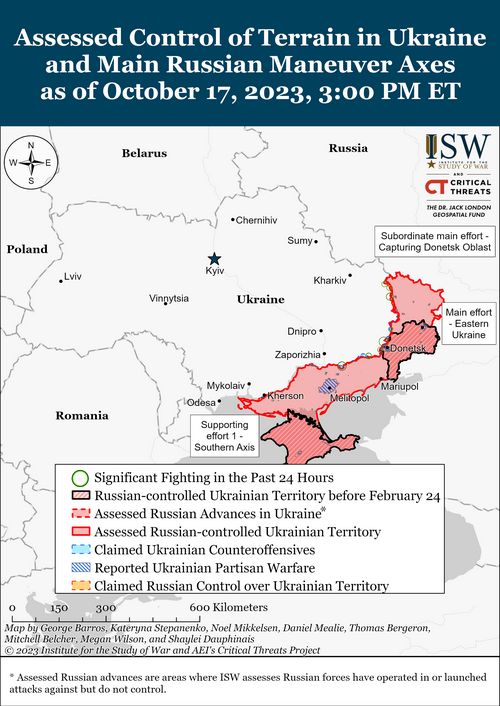
From The Institute For The Study of War:
Russian Offensive Campaign Assessment, October 17, 2023
Karolina Hird, Riley Bailey, Angelica Evans, and Mason Clark
October 17, 2023, 6:30pm ET
Click here to see ISW’s interactive map of the Russian invasion of Ukraine. This map is updated daily alongside the static maps present in this report.
Click here to access ISW’s archive of interactive time-lapse maps of the Russian invasion of Ukraine. These maps complement the static control-of-terrain map that ISW produces daily by showing a dynamic frontline. ISW will update this time-lapse map archive monthly.
Note: The data cut-off for this product was 1:00pm ET on October 17. ISW will cover subsequent reports in the October 18 Russian Offensive Campaign Assessment.
Ukraine used US-provided ATACMS long-range missiles to strike Russian targets in occupied Ukraine for the first time on October 17. The Wall Street Journal and other Western media outlets confirmed on October 17 that the US “secretly” provided Ukraine with ATACMS with a range of 165km in recent days and reported that Ukrainian forces already used ATACMS to strike Russian-controlled airfields in occupied Berdyansk, Zaporizhia Oblast and Luhansk City, Luhansk Oblast.[1] Ukrainian President Volodymyr Zelensky also stated in his nightly address on October 17 that ATACMS “have proven themselves” but did not directly confirm ATACMS were used in these strikes, and multiple Russian sources claimed Ukrainian forces used ATACMS in the Berdyansk strike.[2] Various Russian sources amplified images reportedly of ATACMS M74 cluster submunitions found at the site of the strike in Berdyansk.[3] The US likely transferred the ATACMS systems in secret to provide Ukrainian forces operational surprise, and the overall shock in the Russian information space suggests that Ukraine achieved the desired effect. Ukrainian Special Operations Forces Command did not specify that Ukrainian forces used ATACMS in the strikes but stated that the strikes destroyed nine Russian helicopters of various models, other unspecified special equipment, an anti-aircraft missile launcher, an ammunition warehouse, and damaged runway infrastructure.[4] Footage reportedly from the Berdyansk airfield shows heavy fires and explosions due to the continued detonation of ammunition in an ammunition depot.[5] NASA Fire Information for Resource Management (FIRMS) data from October 17 also confirms heat signatures following explosions in Berdyansk but has not yet confirmed heat signatures at the Luhansk airfield.[6]
The Ukrainian ATACMS strikes on operationally significant Russian airfields in Ukraine will likely prompt the Russian command to disperse aviation assets and withdraw some aircraft to airfields further from the frontline. Russian forces notably operated rotary-wing aircraft from the Berdyansk airfield in the early months of the ongoing Ukrainian counteroffensive in western Zaporizhia Oblast to great effect against large mechanized Ukrainian assaults.[7] Previous satellite imagery of the Berdyansk airfield showed that Russian forces dispersed aircraft across the airfield, and Ukrainian forces were likely only able to conduct strikes on individual aircraft with previously available long-range missiles.[8] The cluster munition–armed version of the ATACMS long range missiles will allow Ukrainian forces to conduct strikes on Russian airfields that can more widely destroy Russian aircraft and other assets. Russian milbloggers immediately drew parallels between the Ukrainian strikes on the Berdyansk and Luhansk City airfields and a series of Ukrainian HIMARS strikes on the Chornobaivka airfield in Kherson Oblast during the 2022 Kherson counteroffensive.[9] The arrival of Western-provided HIMARS allowed Ukrainian forces to conduct repeated strikes on the Chornobaivka airfield, which caused significant Russian aviation losses, and Russian command withdrew military equipment and aviation from the airfield due to their inability to combat Ukrainian HIMARS strikes.[10] Russian milbloggers noted that Russian forces adapted their airfields to Ukrainian long-range strike capabilities but that ATACMS are a new missile threat which will similarly force the Russian command to adapt once again.[11] The Russian military has consistently shown it can adapt to new Ukrainian strike capabilities — but only after suffering initial and pronounced losses from Ukrainian capabilities Russian commanders realistically should have prepared for.
The likely dispersal of Russian aircraft at airfields throughout occupied Ukraine and the relocation of aviation assets further away from the frontline will likely disrupt Russian aviation support for defensive efforts and localized offensive operations. The relocation of aircraft to airfields further in the rear will likely impact the loitering time that Russian aviation will have to support operations. This will likely be particularly significant for Russian rotary-wing aircraft, which operated in relatively small sections of the frontline for long periods of time to degrade advancing mechanized Ukrainian forces at the beginning of the counteroffensive in June and July of 2023.[12] The dispersal of aviation assets at a larger number of airfields will also likely present the Russian Aerospace Forces (VKS) greater coordination and sustainment challenges.
The arrival of ATACMS long-range missiles also poses a significant threat to Russian ammunition depots in rear areas and will likely force the Russian command to choose between fortifying existing depots or further dispersing depots throughout occupied Ukraine. The arrival of HIMARS to Ukraine in June 2022 allowed Ukrainian forces to conduct an operationally significant interdiction campaign in support of counteroffensive operations in Kherson and Kharkiv oblasts, part of which targeted overly concentrated Russian ammunition depots.[13] The Russian command reluctantly moved away from using highly concentrated ammunition depots, extending Russian logistics along longer ground lines of communications (GLOCs), which ultimately complicated the provision of ammunition and supplies to the frontline to a certain degree.[14] ATACMS will likely present Russian forces with a similar challenge, and Russian forces can either focus on fortifying existing depots or create an even more dispersed and therefore over-extended logistics system for ammunition.
The Russian information space expressed widespread fear over the use of ATACMS, and Russian concerns over the possibility of future strikes will likely impact Russian decision-making beyond the current Ukrainian ability to sustain regular ATACMS strikes. Russian sources bemoaned the strikes on the Berdyansk and Luhansk City airfields as one of the most devastating Ukrainian strikes on a Russian target since the start of Russia’s full-scale invasion of Ukraine.[15] Russian sources particularly credited the use of ATACMS for the severity of the strike and expressed fears that the Russian command would not adapt quickly enough to the new missile threat.[16] The Russian command will likely have to consider the potential Ukrainian use of ATACMS when making operational and tactical decisions about the placement of military assets regardless of the frequency of such strikes, and the current level of Russian concern suggests that this calculation may be particularly pronounced in the coming weeks. Ukraine has likely only received a limited number of ATACMS, however, and will need more if it is to sustain and amplify these initial effects.[17]
Ukrainian forces continued counteroffensive operations and advanced near Bakhmut and in western Zaporizhia Oblast. The Ukrainian General Staff reported that Ukrainian forces continued counteroffensive actions south of Bakhmut and had partial success west of Verbove (10km east of Robotyne in western Zaporizhia Oblast).[18] Geolocated footage posted on October 16 also indicates that Ukrainian forces advanced northwest of Zaliznyanske (9km northwest of Bakhmut).[19]
The US confirmed on October 17 that all 31 previously pledged American M1 Abrams main battle tanks have arrived in Ukraine.[20] US Army Europe and Africa (USAREUR-AF) Spokesperson Colonel Martin O’Donnell reported that all of the Ukrainian servicemembers who trained on the tanks alongside US forces in Germany have also returned to Ukraine.[21] US military officials noted that it will likely take some time for Ukraine to deploy the Abrams to the frontline.
The Russian Ministry of Defense (MoD) posted footage on October 17 of Russian forces operating the new TOS-2 “Tosochka” thermobaric artillery system in Ukraine.[22] The Russian MoD claimed that Central Military District (CMD) Radiation, Chemical, and Biological Defense Troops used the TOS-2 system to strike a Ukrainian fortified area in an unspecified area of the front, potentially in reference to Avdiivka, where some CMD elements have recently deployed to support offensive operations north of Donetsk City.[23] Russian media responded to the MoD’s footage and noted that the TOS-2 is a modernized and improved version of the TOS-1A “Solntsepek” system that Russian forces have heavily employed across the theater in Ukraine.[24] Thermobaric artillery systems such as the TOS-1A and TOS-2 are military district–level assets, and their commitment to certain sectors of the front may be indicative of Russian operational prioritization of certain areas.[25]
The Russian Ministry of Internal Affairs (MVD) reportedly issued an informal warning to a prominent Russian milblogger who is often critical of the Ministry of Defense’s conduct of the war on October 16 for discrediting the Russian military, the latest in a series of government efforts to gain further control over the Russian information space. The milblogger claimed on October 17 that he writes candidly about the situation on the front to better inform Russian military leadership about the issues on the front that local commanders are unwilling to report.[26] The milblogger claimed that MVD is targeting Russian milbloggers who helped publicize the mistreatment of elements of the Russian 205th Separate Motorized Rifle Brigade (49th Combined Arms Army, Southern Military District) in the Kherson direction in late August 2023, which ultimately resulted in the removal of the brigade’s commander.[27] The milblogger articulated a list of 14 other channels that “speak the truth and are not afraid,” some of which ISW has observed be critical of the Russian military.[28] The milblogger likely shared this list of channels to coalesce support for targeted milbloggers, and the list does not indicate that these channels are part of an organized group.
Russia continues to set various legislative conditions to prepare the information space for the March 2024 presidential elections. The Russian State Duma adopted a bill in its first reading on October 17 that clarifies provisions on the Russian law on presidential elections and stipulates that campaign materials cannot be shown on sites restricted by the Russian Federal Service for Supervision of Communications, Information Technology and Mass Media (Roskomnadzor).[29] The bill will also ban people from taking photographs and videos at polling stations, require registered candidates to submit information to their electoral commission if they have a criminal record, and establish a cost limit for the production of campaign materials.[30] Several of these provisions already exist in laws governing basic electoral rights, but these provisions will clarify the specific law on presidential elections in advance of the March 2024 election cycle.
Key Takeaways:
- Ukraine used US-provided ATACMS long-range missiles to strike Russian targets in occupied Ukraine for the first time on October 17.
- The Ukrainian ATACMS strikes on operationally significant Russian airfields in Ukraine will likely prompt the Russian command to disperse aviation assets and withdraw some aircraft to airfields further from the frontline.
- The Russian military has consistently shown it can adapt to new Ukrainian strike capabilities — but only after suffering initial and pronounced losses from Ukrainian capabilities Russian commanders realistically should have prepared for.
- The arrival of ATACMS long-range missiles also presents a significant threat to Russian ammunition depots in rear areas and will likely force the Russian command to choose between fortifying existing depots or further dispersing depots throughout occupied Ukraine.
- The Russian information space expressed widespread fear over the use of ATACMS, and Russian concerns over the possibility of future strikes will likely impact Russian decision-making beyond the current Ukrainian ability to sustain regular ATACMS strikes.
- Ukrainian forces continued counteroffensive operations and advanced near Bakhmut and in western Zaporizhia Oblast.
- The Russian Ministry of Internal Affairs (MVD) reportedly issued an informal warning to a prominent Russian milblogger who is often critical of the Ministry of Defense’s conduct of the war on October 16 for discrediting the Russian military.
- Russian forces continued offensive operations along the Kupyansk-Svatove-Kreminna line, near Bakhmut, near Avdiivka, southwest of Donetsk City, in the Donetsk-Zaporizhia Oblast border area, and in western Zaporizhia Oblast, and advanced in certain areas of the front.
- Russia continues to take steps to codify the inclusion of volunteer formations within Rosgvardia.
- The Russian Orthodox Church (ROC) continues efforts to consolidate control of orthodox diocese in occupied areas of Ukraine.
- Russian President Vladimir Putin held bilateral negotiations with Hungarian President Viktor Orban and Mongolian President Ukhnaagiin Khurelsukh in Beijing on October 17.
Go here to read the rest. The advent of ATACMS long-range missiles demonstrates that a fair amount of the best US technology has not yet arrived in the Ukrainian War. It also helps with the Ukrainian lack of air power.