
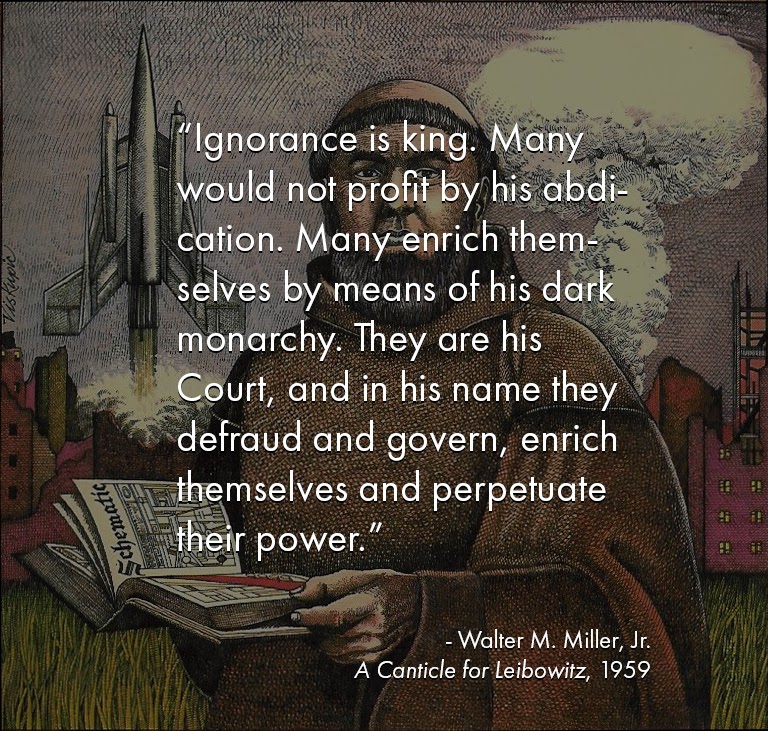
“The closer men came to perfecting for themselves a paradise, the more impatient they became with it, and with themselves as well. They made a garden of pleasure, and became progressively more miserable with it as it grew in richness and power and beauty; for then, perhaps, it was easier to see something was missing in the garden, some tree or shrub that would not grow. When the world was in darkness and wretchedness, it could believe in perfection and yearn for it. But when the world became bright with reason and riches, it began to sense the narrowness of the needle’s eye, and that rankled for a world no longer willing to believe or yearn.”
Walter M. Miller, Jr., A Canticle for Leibowitz
A writer can be considered a grand success if he manages to write something that will endure long after he is gone. In that case poor, tortured Walter M. Miller, Jr., who ended his life by suicide, was a successful writer. After participating as an air crew member in the bombing of the abbey at Monte Cassino in the Italian campaign, Miller converted to Catholicism. During the fifties he wrote science fiction short stories. In 1955, 1956 and 1957 he wrote three novellas which were combined into the novel A Canticle for Leibowitz which was published in 1959. He won the Hugo award for this novel. He never published another novel or story in his life after this novel, as he descended into mental illness and left the Faith. Towards the end of his life he worked with Terry Bisson on a dreadful novel, Saint Leibowitz and the Wild Horse Woman, published after his death and which is best forgotten.
Spoilers warning for those who have not read A Canticle for Leibowitz:
The novel is divided into three sections and focuses on the monks at the Monastery of Saint Leibowitz in the American Southwest. Saint Leibowitz was the Jewish Isaac Edward Leibowitz, an electrical engineer working for the US military. Following a nuclear holocaust that kills off most of mankind, Leibowitz converts to Catholicism, and founds an order dedicated to preserving books from pre-Holocaust times. He is eventually martyred by a mob, part of the Simplification movement around the world dedicated to stamping out any learning, blaming such learning for the nuclear death that destroyed their world. Before he is lynched, Leibowitz asks for water and is given a cup of fuel oil instead. He smiles, blesses it and drinks it, some legends saying that the fuel oil was transformed into wine. He is then hung and his body is set aflame. Leibowitz dies, but the Order and the Church live on, preserving fragments of civilization as mankind careens into a Black Age.
The first section occurs in the twenty-sixth century, six centuries after the nuclear war, which in the book is known as the Flame Deluge, and focuses upon a novice at the Abby who uncovers documents belonging to Leibowitz, which eventually lead to the canonization of Leibowitz. Throughout, the book skillfully mixes comedy, “Forgive me Father, I ate a lizard.” and drama. The first book shows the Church as virtually the only source of learning in the world, a fact that the broader world, wallowing in the ignorance of a shattered world, still almost entirely turns its back on.
In the second part of the novel, a Renaissance is starting in 3174, as secular rulers, through their officials who now begin to understand the scientific power contained within many of the books preserved by the Order of Saint Leibowitz, begin to make use of the knowledge contained therein. It is obvious however that Man has learned little from the nuclear destruction wreaked more than eleven centuries before and that old mistakes will likely be made with the rediscovered knowledge.
The final section of the novel in 3781 sees mankind with advanced technology, starships and colonies beyond our solar system. Alas, the wisdom of Man, as usual, lags far behind his technical expertise, and the world goes down in a second nuclear conflagration worse than the first. The Order of Saint Leibowitz sends to the stars a bishop and monks and nuns, assuring the survival of the Church as they bring the Faith to scattered humanity.
This bare bones outline does the novel no justice. While vastly entertaining, the novel is an extremely profound meditation on the Church, the State and History and should be read by all Catholics and all who simply enjoy fine writing and very deep thinking. Mr. Miller’s life was a sad tale overall, but it had this bright gleam of gold in it. May it have been to his benefit when He stood before God for his judgment.


The final scene, with the world again awaiting nuclear destruction, as the young brother is ordained a bishop, on the starship containing young children, in its mission to Alpha Centauri, speaks of hope. Where is our starship to Alpha Centauri?
We will have one eventually Bob.
“Where is our starship to Alpha Centauri?”
Speaking of which, one of Catholic author Michael D. O’Brien’s more recent (published in 2017) novels is titled “Voyage to Alpha Centauri”.
https://ignatius.com/voyage-to-alpha-centauri-vacp/
A book that stays with you after you put it down, in the best possible way. May God grant Walter Miller the mercy I ask and hope for myself.
Caelum caeli Domini, terram autem dedit filiis hominum.
Ad Bernonensem:
Sed Dominus non prohibuit homines ad astra commeare. Etiam caelum Dei non est spatium inter astra sed extra spatium et tempus.
There’s rarely such a thing as tortured idiocy.
Read the book in high school. As I recall it was not part of the curriculum. Maybe I should read it again.
Yes, CAM, read it again
Don’t depend on that high schooler’s recollection of it. 😉
Good advice for anything worthwhile we read then…
[…] Crux Do You Struggle with the Rosary? St. Therese Did Too – Emily Berns at Catholic365 A Canticle For Leibowitz – Donald R. McClarey, Esq., at The American Catholic All Nations Deceived: On the Future of […]