From The Institute For The Study of War:
Russian Offensive Campaign Assessment, September 7, 2023
Karolina Hird, Riley Bailey, Grace Mappes, Angelica Evans, and Mason Clark
September 7, 2023, 5:15pm ET
Click here to see ISW’s interactive map of the Russian invasion of Ukraine. This map is updated daily alongside the static maps present in this report.
Click here to access ISW’s archive of interactive time-lapse maps of the Russian invasion of Ukraine. These maps complement the static control-of-terrain map that ISW produces daily by showing a dynamic frontline. ISW will update this time-lapse map archive monthly.
Note: The data cut-off for this product was 1pm ET on September 6. ISW will cover subsequent reports in the September 7 Russian Offensive Campaign Assessment.
Ukrainian forces continued offensive operations near Bakhmut and in western Zaporizhia Oblast on September 7 and made further gains on both sectors of the front. Geolocated footage published on September 7 indicates that Ukrainian forces have made further advances northwest of Verbove (18km southwest of Orikhiv) in western Zaporizhia Oblast.[1] A prominent Russian milblogger claimed that Ukrainian forces made further advances in the area and other milbloggers claimed that Ukrainian forces temporarily advanced to the northwestern outskirts of Verbove on September 6, likely indicating further recent Ukrainian advances northwest of the settlement.[2] Satellite imagery collected on September 6 shows burning foliage in a tree line roughly a kilometer northwest of Verbove, suggesting that Russian forces are firing on advancing Ukrainian forces in the area.[3] Geolocated footage published on September 7 indicates that Ukrainian forces have made marginal gains northwest of Klishchiivka (7km southwest of Bakhmut).[4] The Ukrainian General Staff reported that Ukrainian forces achieved unspecified successes south of Bakhmut and near Robotyne (10km south of Orikhiv) and Verbove in western Zaporizhia Oblast.[5]
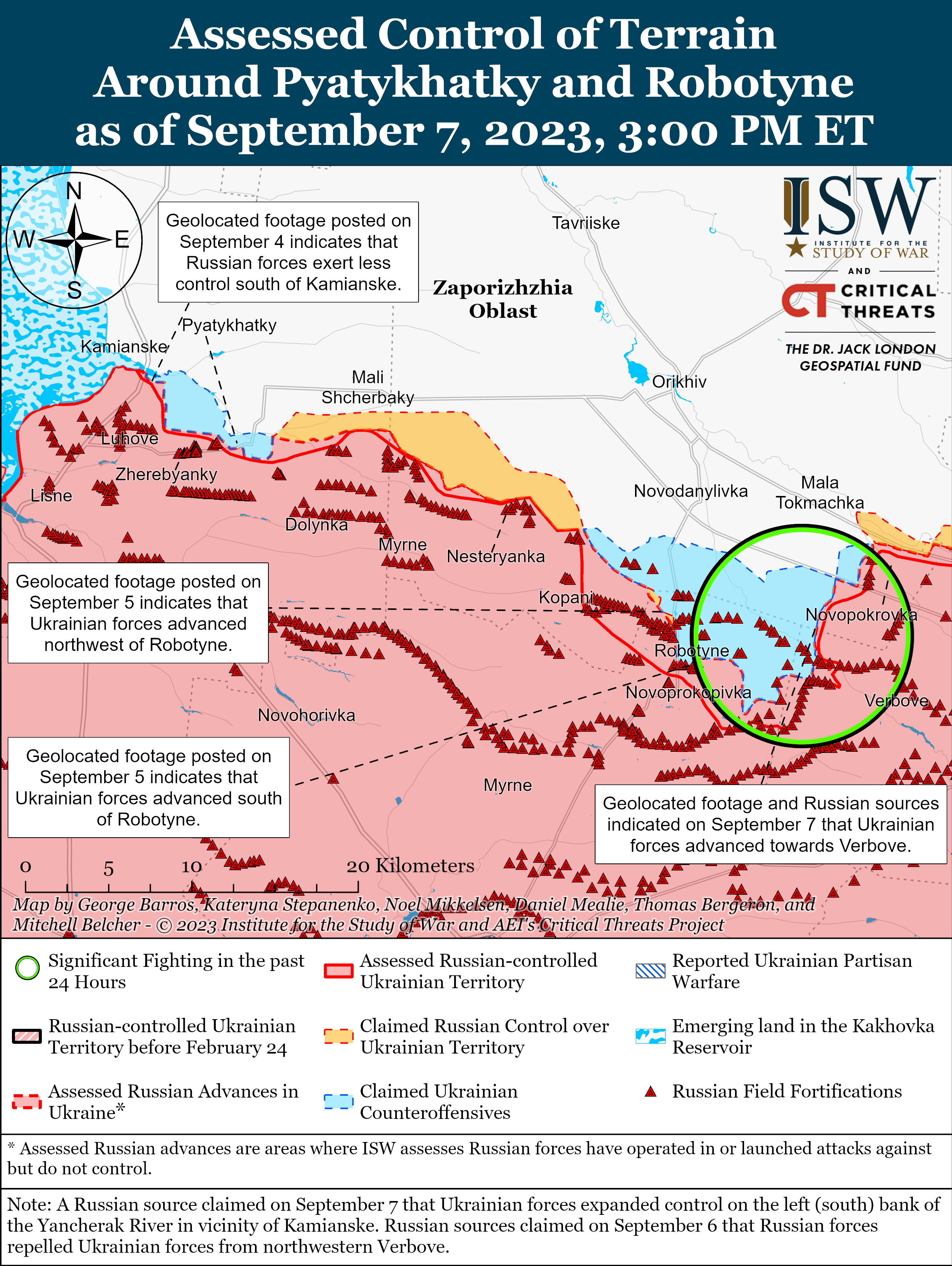
US Defense Intelligence Agency (DIA) Director of Analysis Trent Maul stated that there is a “realistic possibility” that Ukrainian forces will break through the entire Russian defense in southern Ukraine by the end of 2023, while a Ukrainian source suggested that upcoming Russian defensive positions are weaker than those Ukrainian forces have previously breached. Maul stated on September 6 in an interview with the Economist that the recent Ukrainian breach of the “first” of three Russian defensive layers in southern Ukraine gives Ukrainian forces a “realistic possibility” to break through the remaining series of Russian defensive positions by the end of 2023.[6] Maul stated that Ukrainian forces have also advanced into the “second” Russian defensive layer, likely referring to recent advances by light Ukrainian infantry past the series of Russian defensive positions that run northwest of Verbove to north of Solodka Balka (20km south of Orikhiv) in western Zaporizhia Oblast.[7] Former Ukrainian Aidar Battalion Commander Yevhen Dykyi stated on September 4 that battles are already ongoing at these Russian defensive positions but that Ukrainian forces have not yet broken through them.[8] Dykyi stated that the minefields ahead of the upcoming Russian defensive layer are not continuous, consistent with previous Ukrainian statements suggesting that Ukrainian forces have already advanced through the densest minefields.[9] Dykyi stated that Russia’s “third” defensive layer in southern Ukraine is primarily comprised of command posts, communication points, and warehouses and mainly acts as a support line for the Russian defensive positions further north.[10] Dykyi argued that Russian forces will not be able to hold back Ukrainian advances at this “third“ series of Russian defensive positions, implying that a definitive Ukrainian breach of the current Russian defensive layer would be operationally decisive. However, Maul notably stated that the bulk of Russian reinforcements are deployed to the “third” Russian defensive layer, contradicting Dykyi’s suggestion that these positions are merely supportive in nature.[11] The subsequent series of Russian defensive positions may be weaker, less mined, and less manned than the defensive layer that Ukrainian forces have breached. Russian defenses are not uniform across the front in southern Ukraine, however, and assessments of the strength of subsequent Russian defensive positions may be extrapolations based on limited information from small sectors of the front. Ukrainian forces are making tactical gains and successfully attriting defending Russian forces and ISW continues to assess Ukraine’s counteroffensive may achieve operational successes in 2023, but subsequent series of Russian defensive positions still pose significant challenges for Ukrainian forces and may in sections be strongly held.
Russian forces conducted another large-scale Shahed-136/131 drone attack against Sumy and Odesa oblasts overnight on September 6-7. Ukrainian Air Force Command stated that Russia launched 33 Shaheds in several groups from the northern, southeastern, and southern directions, predominantly aimed at grain infrastructure in Odesa Oblast, and that Ukrainian forces destroyed 25 of the drones.[12] Geolocated footage posted on September 7 shows the aftermath of the Shahed strike on port infrastructure in Kiliya, Odesa Oblast.[13] Ukrainian Southern Command Spokesperson Captain First Rank Nataliya Humenyuk noted that Russia is increasingly using such loitering munitions because they are cheaper to manufacture than missiles and are available in larger quantities.[14]
Moscow Oblast authorities detained the commander of the 1st Special Purpose Air and Missile Defense Army on bribery and corruption charges amidst continued and escalating drone attacks on Moscow. Russian media reported on September 7 that the Moscow Garrison Military Court detained Major General Konstantin Ogienko for bribery and noted that 4th Air Defense Division Commander Major General Dmitry Belatsky organized the allocation of state defense property to an unnamed civilian organization in collusion with Ogienko.[15] The 1st Special Purpose Air and Missile Defense Army, including its 4th Air Defense Division, is notably responsible for the air defense of Moscow City and the surrounding oblast. Drone strikes on Moscow Oblast have recently become more prevalent, and it is likely that command changes resulting from a bribery case against top commanders of one of the most elite elements of Russia’s domestic air defense could further complicate Moscow’s ability to defend against such attacks. While ISW has not observed evidence to suggest that Ogienko was detained for reasons other than bribery charges, Russian sources have recently complained that Russian air defense elements are responsible for failing to curb increased drone attacks on Moscow, and Ogienko’s removal could be a response to such allegations.[16]
Russian President Vladimir Putin promoted three Russian generals, including Central Military District (CMD) and Russian Central Grouping of Forces in Ukraine Commander Colonel General Andrey Mordvichev, on September 6. Putin promoted Mordvichev and 8th Combined Arms Army (Southern Military District) Commander Gennady Alashkin to the rank of colonel general, and Ministry of Defense (MoD) Main Armored Directorate Head Alexander Shestakov to the rank of lieutenant general.[17] The Central Grouping of Forces is primarily committed in Ukraine on the Kupyansk-Svatove-Kreminna line, and the 8th CAA is currently deployed near Bakhmut and on the Avdiivka-Donetsk City line. [18]These promotions award each general with a rank that corresponds with his current command and are not necessarily unusual. Putin likely awarded these promotions now to reward loyalty and obedience to the senior Russian military command, rather than to recognize battlefield performance or particular responsibilities. Putin has previously publicly lauded Mordvichev, indicating that Mordvichev may hold more of Putin’s favor than other military district commanders, as ISW has previously assessed.[19]
Russian sources accused Armenian authorities of detaining a pro-Russian blogger in Goris, Armenia, on September 6. Head of Rossotrudnichestvo (Russian Federal Agency for the Commonwealth of Independent States Affairs, Compatriots Living Abroad, and International Humanitarian Cooperation) Yevgeny Primakov claimed that “unknown masked men” abducted pro-Russian blogger Mikayel Badalyan in Goris on the night of September 6.[20] Primakov noted he had interviewed Badalyan on a Radio Sputnik segment the day before and that Badalyan criticized the Armenian government for its “anti-Russian policy.”[21] Sputnik Armenia also noted that Armenian authorities also detained columnist Ashot Gevorgyan in Goris.[22] Badalyan’s and Gevorgyan’s alleged arrests occurred against the backdrop of increasing tensions between Armenia and Russia, with Armenia beginning to deliver humanitarian aid to Ukraine for the first time, preparing for joint military exercises with the US, and Armenian Prime Minister Nikol Pashinyan publicly questioning Armenia’s historical reliance on Russia for security guarantees.[23] Russian Foreign Ministry Spokesperson Maria Zakharova responded to the incident and called it a “provocation” aimed at further spoiling the relationship between Russia and Armenia.[24]
The Russian Central Election Commission (CEC) cancelled regional elections in some areas in Russia near the Ukrainian border for the first time. Russian CEC Head Ella Pamfilova announced on September 7 the cancellation of local elections in Shebekino Raion and the village of Zhigailovsky in Belgorod Oblast due to the “high alert” regime in the area.[25] Russian authorities previously passed a law in May 2023 authorizing the CEC to cancel elections in certain areas under martial law.[26] The CEC likely cancelled these elections due to prior criticism of evacuations from Shebekino and the possibility that there may not be enough civilians remaining in Shebekino to portray these elections as legitimate.[27]
Key Takeaways:
- Ukrainian forces continued offensive operations near Bakhmut and in western Zaporizhia Oblast on September 7 and made further gains on both sectors of the front.
- US Defense Intelligence Agency (DIA) Director of Analysis Trent Maul stated that there is a “realistic possibility” that Ukrainian forces will break through the entire Russian defense in southern Ukraine by the end of 2023, while a Ukrainian source suggested that upcoming Russian defensive positions are weaker than those Ukrainian forces have previously breached.
- Ukrainian forces are making tactical gains and successfully attriting defending Russian forces and ISW continues to assess Ukraine’s counteroffensive may achieve operational successes in 2023, but subsequent series of Russian defensive positions still pose significant challenges for Ukrainian forces and may in sections be strongly held.
- Russian forces conducted another large-scale Shahed-136/131 drone attack against Sumy and Odesa oblasts overnight on September 6-7.
- Moscow Oblast authorities detained the commander of the 1st Special Purpose Air and Missile Defense Army on bribery and corruption charges amidst continued and escalating drone attacks on Moscow.
- Russian forces continued offensive operations along the Kupyansk-Svatove-Kreminna line, in the Bakhmut direction, along the Avdiivka-Donetsk City line, and in the Donetsk-Zaporizhia Oblast border area but did not make any confirmed advances on September 7.
Go here to read the rest. A disaster is beginning to shape up for the Russians around Robotyne, with the vital land bridge between Crimea and Russia an increasingly realistic goal for the Ukrainians. Stay tuned.
OK, fine. How does it end? Korea/Vietnam?
Follow the money.
OK, fine. How does it end?
With Putin dead, one way or another.