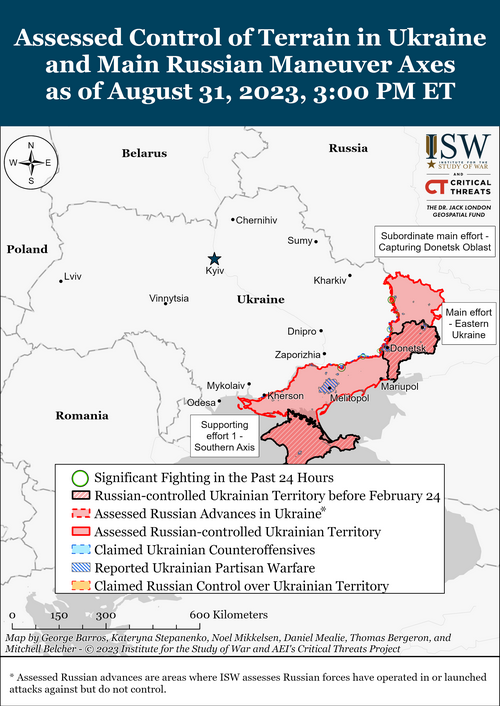
From The Institute For The Study of War:
Grace Mappes, Riley Bailey, Christina Harward, Angelica Evans, and Mason Clark
August 31, 2023, 6:15 pm ET
Click here to see ISW’s interactive map of the Russian invasion of Ukraine. This map is updated daily alongside the static maps present in this report.
Click here to access ISW’s archive of interactive time-lapse maps of the Russian invasion of Ukraine. These maps complement the static control-of-terrain map that ISW produces daily by showing a dynamic frontline. ISW will update this time-lapse map archive monthly.
Note: The data cut-off for this product was 1:30pm ET on August 31. ISW will cover subsequent reports in the September 1 Russian Offensive Campaign Assessment.
Ukrainian forces continued counteroffensive operations near Bakhmut in Donetsk Oblast and in western Zaporizhia Oblast on August 31 and reportedly advanced in both sectors of the front. The Ukrainian General Staff and Ukrainian Deputy Defense Minister Hanna Malyar reported that Ukrainian forces continued offensive operations in the Bakhmut and Melitopol (western Zaporizhia Oblast) directions and achieved unspecified success in the direction of Novodanylivka-Novoprokopivka (5km to 13km south of Orikhiv) in western Zaporizhia Oblast.[1] Malyar also stated that Ukrainian forces achieved unspecified success in the Bakhmut direction.[2] Ukrainian Chief of the Main Directorate of Missile Forces and Artillery and Unmanned Systems of the General Staff Brigadier General Serhiy Baranov stated that Ukrainian forces have reached parity in counterbattery capabilities with Russian forces.[3] Baranov stated that NATO-provided artillery systems with ranges of 30km to 40km allow Ukrainian forces to destroy Russian artillery systems and force Russian forces to move their artillery further from the frontline.[4] Ukrainian officials previously made statements in late July indicating that Ukraine’s interdiction campaign is successfully degrading Russian counterbattery capabilities.[5] Russian sources have repeatedly expressed concerns since mid-July over the lack of Russian counterbattery artillery capabilities, particularly in southern Ukraine.[6]
Ukrainian President Volodymyr Zelensky highlighted Ukraine’s domestic production of long-range missiles on August 31, likely as part of a coordinated Ukrainian campaign promoting increased Ukrainian strike capabilities against Russian deep rear areas. Zelensky stated that a Ukrainian-produced long-range weapon successfully hit a target 700 kilometers away, but did not provide further details about the strike or the weapon.[7] Ukrainian National Security and Defense Council Secretary Oleksiy Danilov previously stated on August 26 that a new but unspecified Ukrainian-made missile struck a Russian S-400 air defense system in Crimea on August 23, and Ukrainian Main Military Intelligence Directorate (GUR) Head Major General Kyrylo Budanov stated on August 24 that Ukrainian forces have the ability to strike any part of occupied Crimea.[8]
Russian authorities arrested a notable fringe ultranationalist Russian milblogger on accusations of discrediting the Russian military, likely as part of centralized efforts to silence some critical milblogger voices without prompting a general backlash. Russian authorities arrested Andrei Kurshin, who reportedly runs the Telegram channel “Moscow Calling,” on August 31 but did not specify what content Kurshin posted that prompted the charges.[9] The “Moscow Calling” channel routinely criticizes Russian President Vladimir Putin and the Russian Ministry of Defense (MoD) and notably commonly attacks many aspects of Russia’s military conduct of the war in Ukraine while supporting the ultranationalist goals underpinning the war itself. The wider Russian ultranationalist information space welcomed Kurshin’s arrest and noted that he routinely discredited the Russian military by mocking Russian military deaths and writing ”vile” thoughts about the Russian war effort.[10] ”Moscow Calling” also regularly supports imprisoned Russian ultranationalist Igor Girkin, likely generating further Kremlin opposition towards Kurshin.[11] Elements of the wider Russian ultranationalist community revealed Kurshin’s previously anonymous identity in April after he joked about the assassination of Russian milblogger Maksim Fomin (Vladlen Tatarsky), and at the time milbloggers called on Russian authorities to punish Kurshin for fostering anti-government attitudes online.[12] Kurshin and Girkin’s arrests suggest that the Kremlin may be arresting prominent ultranationalist voices that the wider community largely reviles to avoid backlash as the Kremlin intensifies its effort to increase its long-term control over the Russian information space.[13] Kurshin’s arrest does not necessarily portend wider repression of more mainstream Russian milbloggers. Milblogger reactions, including those who have been outright critical of the Russian military leadership, additionally suggest that the milblogger community has been and is willing to establish unofficial guidelines for what is permissible criticism of the war and the Russian leadership. The Kremlin likely benefits from and encourages this self-policing, to a certain degree, among milbloggers – tolerating some criticism while cultivating key milbloggers and seeking to silence particularly critical voices.
Russian military authorities allegedly ordered the detention of three Russian milbloggers who have recently criticized the Russian MoD – a move that sparked a backlash in only a small corner of the Russian information space. Russian milbloggers claimed that the commander of the 205th Separate Motorized Rifle Brigade (49th Combined Arms Army, Southern Military District) and possibly a high-level Russian military official ordered Russian Military Counterintelligence to detain the three Russian milbloggers who have recently been critical of the Russian MoD’s handling of issues within the 205th Separate Motorized Rifle Brigade.[14] Reactions to the detention orders were largely isolated to the small community that has been perpetuating discussions about the 205th Separate Motorized Rifle Brigade since August 25, indicating that the Russian MoD is likely choosing targets whose punishment will not have significant repercussions in the Russian information space and this discussion is unlikely to last in the wider milblogger space.[15]
Imprisoned Russian ultranationalist Igor Girkin and his associates conducted likely futile political maneuvers intended to coalesce into a coherent and meaningful political opposition group. Girkin announced on August 31 that he intends to run for president in the 2024 Russian presidential elections, but primarily used the announcement to reiterate his longstanding critiques of Russian President Vladimir Putin.[16] Girkin’s theoretical “campaign” will have little to no impact and should not be construed as a direct political threat to the Kremlin. Girkin criticized Putin for being an ineffective military leader, failing to remove inept senior officials, and for prioritizing rich billionaires and longtime friends over the needs of Russia – all of which are longstanding rhetorical points from Girkin.[17] Girkin’s announcement is not a serious presidential bid (and the Kremlin will not allow it to be one) but rather an attempt to bring attention to Girkin’s imprisonment, his longtime criticisms of Putin, and his attempts to form a political movement. Kirill Fedorov, member of the Girkin-run Angry Patriots Club, stated that Girkin’s presidential announcement is a surprise and that the Angry Patriots Club had previously decided against Girkin or other members participating in the coming electoral cycle after Girkin’s arrest, and did not discuss the possibility of Girkin running for president during a recent meeting.[18] The Russian Movement in Support of Strelkov (Igor Girkin) announced on August 30 that it formed the ”Russian Strelkov Movement” and unanimously elected Girkin as its head, one of many recent political announcements likely aimed at preventing the movement from fracturing without Girkin’s leadership and voice to hold the movement together.[19] Girkin’s August 31 announcement prompted limited reactions in the Russian ultranationalist information space that largely centered around confusion, sarcastic support, and criticism of the alleged presidential bid due to Girkin‘s and Russia‘s current political situations.[20] Prior announcements about the formation of political movements from Girkin’s associates have not resulted in any significant reaction, and the Angry Patriots Club is likely desperate to maintain relevance and cohesion with Girkin imprisoned.[21]
Key Takeaways:
- Ukrainian forces continued counteroffensive operations near Bakhmut in Donetsk Oblast and in western Zaporizhia Oblast on August 31 and reportedly advanced in both sectors of the front.
- Ukrainian President Volodymyr Zelensky highlighted Ukraine’s domestic production of long-range missiles on August 31, likely as part of a coordinated Ukrainian campaign promoting increased Ukrainian strike capabilities against Russian deep rear areas.
- Russian authorities arrested a notable fringe ultranationalist Russian milblogger on accusations of discrediting the Russian military, likely as part of centralized efforts to silence some critical milblogger voices without prompting a general backlash.
- Russian military authorities allegedly ordered the detention of three Russian milbloggers who have recently criticized the Russian MoD – a move that sparked a backlash in only a small corner of the Russian information space.
- Imprisoned Russian ultranationalist Igor Girkin and his associates conducted likely futile political maneuvers intended to coalesce into a coherent and meaningful political opposition group.
- Russian forces continued offensive operations along the Kupyansk-Svatove-Kreminna line, near Bakhmut, along the Avdiivka-Donetsk City line and unsuccessfully counterattacked in the Donetsk-Zaporizhia Oblast border area and in western Zaporizhia Oblast on August 31.
- Russian occupation authorities continue to forcibly deport Ukrainian children to Russia and Russify Ukrainian youth.
Go here to read the rest.
From Strategy Page:
August 31, 2023: Russia continues its tradition of declaring reports of military failures as state secrets. Those who violate this policy are often punished. If many reveal or discuss openly these problems, the government backs off and promises that attention will be paid and changes made. This is especially true if critics use the Internet to communicate about the problems. A current example is the deplorable state of Russian forces in Ukraine. Russian commanders there are often corrupt and dedicated to enriching themselves at the expense of their troops. This often means commanders ignore their military duties and allow the enemy to take advantage of that.
This is currently happening in Ukraine. Russian troops have seen their supplies and transport destroyed or blocked by Ukrainian missile attacks and more effective use of artillery, armored vehicles and infantry. Russian use of poorly trained troops and shortages of supplies and modern weapons means the Ukrainian forces are more effective. This has helped the Ukrainians succeed during their current counteroffensive in southern Ukraine. That means Russian forces are facing better trained, equipped and led Ukrainian units which advance against even prepared Russian defenses because the Russian troops defending these fortified zones are equipped with less capable artillery and shortages of ammunition. The Ukrainians have more capable and more effectively used artillery that prevents Russian artillery from disrupting the Ukrainian advance through Russian minefields and around Russian fortifications.
Ukrainians locate and destroy Russian electronic systems that jam Ukrainian communications and disrupt use of Ukrainian UAVs to locate and destroy Russian artillery and supplies. NATO military aid included equipment to handle the Russian jamming, along with technical advisers to make equipment adjustments as needed. Russia had a limited number of jamming systems and once the Ukrainians figured out how to detect, locate and destroy them, the jamming became much less of a problem. This meant more accurate Ukrainian artillery fire against Russian forces.
Russian military commanders insist that their artillery personnel are capable of finding and accurately firing at Ukrainian artillery. In practice this is rarely true because most Russian artillerymen are not receiving much training before going to Ukraine and, once there, are expected to learn on-the-job. That can work in peacetime but not in a very active combat zone. Moreover, the modern Western artillery used by Ukrainian forces is more capable than the older artillery weapons the Russians have in Ukraine. This puts the Russian artillery at a disadvantage and the Ukrainians are taking advantage of it.
Go here to read the rest. Russia is inherently a far stronger country than Ukraine but the Russians are close to losing the war. Russian governments have traditionally reacted to bad news by shooting the messenger and a lot of other people to forestall unrest. Putin lacks the political strength or will to pull a Stalin. Thus we see ineffective steps to whip the Russians behind Putin’s policy in Ukraine.