Cradle Catholic. Active in the pro-life movement since 1973. Father of three, one in Heaven, and happily married for 43 years. Small town lawyer and amateur historian. Former president of the board of directors of the local crisis pregnancy center for a decade.
The people who say “trust the science” have no knowledge of the history of science, of the conflicts, the back and forth over the last 500 years. Instead of teaching children how to solve physics problems and balance chemistry equations, they should be taught the history of science. But teachers aren’t (generally) knowledgeable enough to do that.
The Bruised Optimist
Wednesday, August 30, AD 2023 8:03am
Bob-
If they saw how the sausage was made, they might think twice before swallowing it.
My time spent in a college anthropology class was instrumental in my rejecting the religion of secularism. Contrary to her intention, that professor taught me that the conclusions derived from scant evidence that sre presented as fact were far from persuasive.
Piltdown Man and those who invented him are not confined to our past.
Tom Byrne
Wednesday, August 30, AD 2023 9:39am
Bob:
The older texts usually presented physics and chemistry in roughly the historical order of discovery, and that’s certainly how I taught both. I talked about the struggle between the followers of Dalton and Bertholet over the atomic theory, for example, and how the charges of positive and negative came from a convention established by Franklin almost on a whim. I spoke about climate classification deriving from Tsarist Russia’s desire to know what crops were best for different lands in the Russian East. I used to emphasize that until after WWII the scientific establishment was small and localized in a handful of European and eastern US universities, which gave one or two dominant researchers tremendous influence to guide the narrative (for good and ill). Some of us tried.
John Flaherty
Wednesday, August 30, AD 2023 2:10pm
Bob, Tom, I think you both are right…and wrong.
Learning the history of science would better instruct people about the amount of time required to clarify science principles and how they relate to each other. ..Thus why society didn’t develop technologies much sooner.
Yet we can’t fail to teach solving physics or chemistry problems. Engineers and chemists who can’t calculate one thing or another…can’t do their job. One must know both the principles AND how they interact mathematically. ..I recall being amazed at how much of college physics was…applied algebra.
I had not realized the crucial nature of early moral teaching til I attended a secular university. Once there, poorly catechized people could easily be deflected from moral virtue.
In consequence, I shudder at our education system today. Too many don’t learn either the Ten Commandments OR the Golden Rule, nor do they learn science principles or how they interact. Often enough, not even basic math needed for business purposes.
At times, I marvel that we have not already collapsed from the degree of sheer incompetence we tolerate. Or foment.
John F, you’re correct that engineers and scientists need to know basic science. Musicians need to know about harmony, in all its gory detail. The rest of us don’t need that. Nevertheless all of us who are not musicians (even the tone deaf?) can benefit from a class in music appreciation.
[…] J.D., at The American Catholic Performative Catholicism – Anne Hendershott at Crisis Magazine It’s Just – Donald R. McClarey, J.D., at The American Catholic The Ongoing Debate Over Dignitatis […]
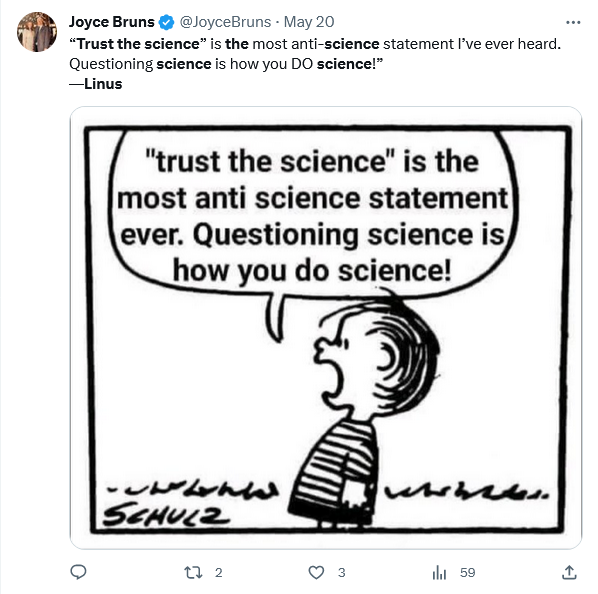






The people who say “trust the science” have no knowledge of the history of science, of the conflicts, the back and forth over the last 500 years. Instead of teaching children how to solve physics problems and balance chemistry equations, they should be taught the history of science. But teachers aren’t (generally) knowledgeable enough to do that.
Bob-
If they saw how the sausage was made, they might think twice before swallowing it.
My time spent in a college anthropology class was instrumental in my rejecting the religion of secularism. Contrary to her intention, that professor taught me that the conclusions derived from scant evidence that sre presented as fact were far from persuasive.
Piltdown Man and those who invented him are not confined to our past.
Bob:
The older texts usually presented physics and chemistry in roughly the historical order of discovery, and that’s certainly how I taught both. I talked about the struggle between the followers of Dalton and Bertholet over the atomic theory, for example, and how the charges of positive and negative came from a convention established by Franklin almost on a whim. I spoke about climate classification deriving from Tsarist Russia’s desire to know what crops were best for different lands in the Russian East. I used to emphasize that until after WWII the scientific establishment was small and localized in a handful of European and eastern US universities, which gave one or two dominant researchers tremendous influence to guide the narrative (for good and ill). Some of us tried.
Bob, Tom, I think you both are right…and wrong.
Learning the history of science would better instruct people about the amount of time required to clarify science principles and how they relate to each other. ..Thus why society didn’t develop technologies much sooner.
Yet we can’t fail to teach solving physics or chemistry problems. Engineers and chemists who can’t calculate one thing or another…can’t do their job. One must know both the principles AND how they interact mathematically. ..I recall being amazed at how much of college physics was…applied algebra.
I had not realized the crucial nature of early moral teaching til I attended a secular university. Once there, poorly catechized people could easily be deflected from moral virtue.
In consequence, I shudder at our education system today. Too many don’t learn either the Ten Commandments OR the Golden Rule, nor do they learn science principles or how they interact. Often enough, not even basic math needed for business purposes.
At times, I marvel that we have not already collapsed from the degree of sheer incompetence we tolerate. Or foment.
Tom, you did well. But not many did that. If they did now, they’d lose their jobs.
John F, you’re correct that engineers and scientists need to know basic science. Musicians need to know about harmony, in all its gory detail. The rest of us don’t need that. Nevertheless all of us who are not musicians (even the tone deaf?) can benefit from a class in music appreciation.
[…] J.D., at The American Catholic Performative Catholicism – Anne Hendershott at Crisis Magazine It’s Just – Donald R. McClarey, J.D., at The American Catholic The Ongoing Debate Over Dignitatis […]