Donald R. McClarey
Cradle Catholic. Active in the pro-life movement since 1973. Father of three, one in Heaven, and happily married for 43 years. Small town lawyer and amateur historian. Former president of the board of directors of the local crisis pregnancy center for a decade.
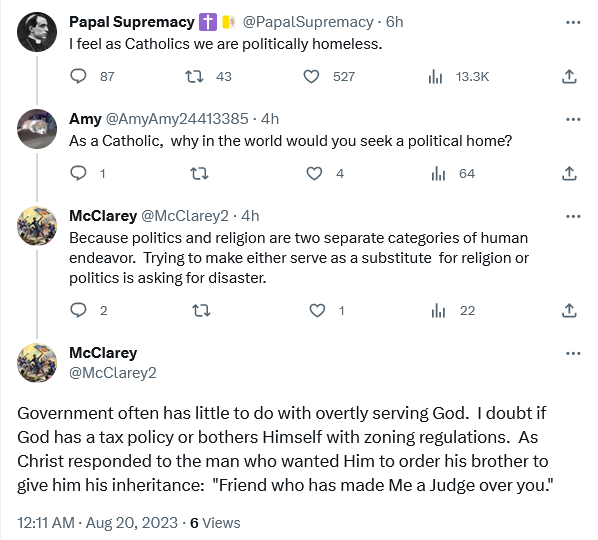




Here in the USA, I would say that we are only “politically homeless” in the sense that our supposed shepherds have, as a group and for at least the past 75 years or so, failed to stand up strongly, if at all, for the precepts of Christian life. When they have not simply stayed silent, they have issued ambiguous and generally cowardly “guidance” to the faithful that, in my experience, do more harm than good, such as the execrable “voter’s guides” published in recent years by the USCCB, which were widely cited by Catholics as supporting voting for people like Obama and Biden. Individual bishops have stated public opinion on political issues ranging from outright Marxist “liberation theology” to orthodox Christian teachings, thus leaving ample room for just about any political viewpoint to claim endorsement by “the Church.” Statements and actions appearing to be against long-standing doctrines, as well as blatant, unambiguous dissent, have gone without effective, public rebuke by the Holy See for so long that no one is even surprised any more when bishops promote heresies, such as primacy of subjective “conscience” over Divine revelation. One potential, partial solution might be to get rid of the tax exemption for religious institutions so that government can no longer hold loss of the exemption over the heads of churches to keep them from expressing support of parties or candidates. Then “all” we would need to do would be to restore actual Catholic teaching to our seminaries, to form clergy properly for their role as teachers of the Faith. I doubt I will live to see that happen, but one never knows.
I would say the last 60 years or so, not the last 75 years, though there were problems before then.
As for the ‘tax exemption’, philanthropic bodies have no shareholders and only engage in business transactions on the side. Employees of philanthropic bodies pay income and payroll taxes like everyone else.
You could levy value-added taxes on the business transactions of philanthropic bodies (as you can and should for government corporations), exempting sales of discarded, donated, and salvaged property. (Which you would do to avoid VAT liability on everyone’s yard sale).
In re corporation taxes, you might have two systems. For business corporations, you might simplify such levies by giving corporations a choice between a fixed % of their global revenues or a fixed% of their outstanding shares. For philanthropic bodies and government corporations – religious congregations and others – you could make corporation tax liability a function of the compensation paid to the 12% or so of their employees who are most lushly compensated (or the compensation paid to their 50 most lushly compensated employees for those concerns which employed more than 400 people). These senior employees could be sorted between an outer circle, an inner circle, and the top man and an expected compensation for each determined by a formula which had the number of the concern’s total employees (FTE), the number in the circle assessed, and the mean compensation per worker in the jurisdiction in question. The concern would owe taxes if they paid some segment of their senior employees in excess of ‘expected’ compensation. Otherwise, the concern would have no liability.
In regard to property taxes, you might have a system wherein philanthropic bodies take out a line of credit and pay property taxes to municipal government, county government, school districts, and other special district authorities. After having done this, they apply to the state treasury for full re-imbursement. The state would be obligated to re-imburse in full unless they could demonstrate the corporation’s primary activity was providing services which compete with commercial vendors (as country clubs do, but hospitals and churches do not).
[…] What Happened to the Survivors of Carrhae?– Donald R. McClarey, J.D./The American Catholic Catholics & Politics – Donald R. McClarey, J.D., at The American […]
Presumably Catholics interested in politics are morally based, informed conservative voters or politicians. Nowadays, all too many of them seem to have made an idol of Trump, who more and more acts as deranged, amoral ranter, a sort of secularized Baalzebub. If Catholics want to be taken seriously in the political context, they really must act in a more responsible and informed manner.
Compared to Biden, Trump is Honest Abe come back to life. Politics is always the art of comparison.