
From The Institute For The Study of War:
Russian Offensive Campaign Assessment, July 11, 2023
Riley Bailey, Kateryna Stepanenko, George Barros, Angelica Evans, and Frederick W. Kagan
July 11, 2023, 8:15pm ET
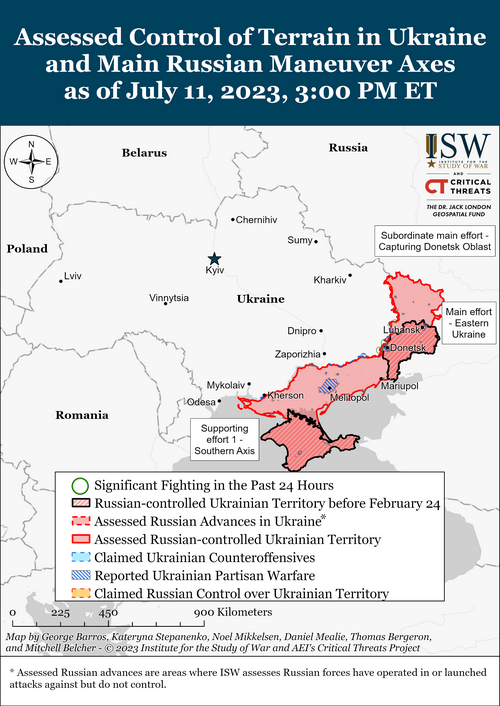
Click here to see ISW’s interactive map of the Russian invasion of Ukraine. This map is updated daily alongside the static maps present in this report.
Click here to access ISW’s archive of interactive time-lapse maps of the Russian invasion of Ukraine. These maps complement the static control-of-terrain map that ISW produces daily by showing a dynamic frontline. ISW will update this time-lapse map archive monthly.
Note: The data cutoff for this product was 2:00pm ET on July 11. ISW will cover subsequent reports in the July 12 Russian Offensive Campaign Assessment.
Russian forces conducted a series of Shahed 131 and 136 drone strikes across Ukraine on July 11, likely in a demonstrative response to the 2023 NATO Summit in Vilnius and to threaten the Black Sea grain deal. The Ukrainian General Staff reported that Ukrainian forces shot down 26 of the 28 Russian Shahed 131 and 136 drones launched from the Primorsk-Akhtarsk (Krasnodar Krai) direction.[1] The Ukrainian Southern Operational Command reported that Russian forces tried to strike the grain terminal in Odesa Oblast, and that two drones struck an administrative building at a port facility.[2] Ukrainian Southern Operational Command Spokesperson Captain First Rank Nataliya Humenyuk stated that Russian forces targeted port infrastructure to disrupt the Black Sea Grain deal.[3] Russia’s drone strikes on port infrastructure also coincide with the first day of the NATO summit in Vilnius and are likely intended to discourage NATO members from providing more military aid to Ukraine. Russia may be threatening the Black Sea grain deal to message the deal’s original broker, Turkish President Recep Tayyip Erdogan, that his recent statement of support for Ukraine’s NATO membership and the return of the five Ukrainian Azovstal commanders on July 7 has not gone unnoticed and is not appreciated by the Kremlin.[4]
Germany and France pledged to provide Ukraine more weapons systems during the first day of the 2023 NATO Summit in Vilnius on July 11. German Defense Minister Boris Pistorius stated that Germany will provide Ukraine with two Patriot air defense launchers, 40 Marder infantry fighting vehicles, 25 Leopard 1A5 main battle tanks, and five Bergepanzer 2 armored recovery vehicles over an unspecified time period.[5] France will reportedly send Ukraine Storm Shadow missiles. French President Emmanuel Macron stated that he decided to send Ukraine weapons to allow Ukrainian forces to conduct deep strikes.[6] Reuters reported that a French diplomatic source said that France will provide Ukraine with about 50 SCALP missiles (the French name for Storm Shadow missiles) with a range of 250km.[7]
A coalition of 11 states signed a memorandum with Ukraine outlining the terms for training Ukrainian pilots on the F-16 aircraft at the 2023 NATO Summit in Vilnius on July 11. Ukrainian Defense Minister Oleksii Reznikov announced on July 11 that 11 partner states signed a memorandum on the terms for the coalition to train Ukrainian pilots on the F-16.[8] Reznikov noted that the training program may include other fighter aircraft types and expressed his thanks to Denmark and the Netherlands for their ”outstanding leadership” in the process.[9]
The Kremlin’s and Russian milbloggers’ reactions to the first day of the NATO Summit were relatively muted. Kremlin spokesman Dmitry Peskov took a predictably dim view of the NATO Summit’s first day, complaining that the summit has a ”pronounced, concentrated anti-Russian character.”[10] Peskov reiterated boilerplate rhetoric about how the West’s continued security assistance to Ukraine and Ukraine’s promised future membership in NATO would result in grave consequences.[11] Russian milbloggers expressed general discontent about new weapons deliveries to Ukraine but have not voiced any major reactions at the time of this publication.[12] The milbloggers are likely waiting to react to the main events that will occur on the summit’s second day when Ukrainian President Volodymyr Zelensky will meet with US President Joe Biden and NATO Secretary General Jens Stoltenberg on July 12.
Russian Defense Minister Sergei Shoigu attempted to portray the Ukrainian counteroffensive as a failed effort against the backdrop of the NATO Summit. Shoigu implausibly claimed on July 11 that Ukrainian forces have lost 26,000 servicemembers and 1,244 tanks and infantry fighting vehicles since starting counteroffensive operations on June 4.[13] Shoigu also tried to present possible Ukrainian interdiction efforts in southern Ukraine as similarly ineffective by claiming that Russian air defenses have intercepted 176 HIMARS rockets and 27 Storm Shadow cruise missiles since the start of the counteroffensive.[14] ISW assesses that Russian MoD reporting on Ukrainian losses is likely highly inflated, and even Russian milbloggers have recently accused the MoD of counting strikes on already damaged and destroyed vehicles as new Ukrainian equipment losses.[15] Shoigu’s rhetoric about the Ukrainian counteroffensive notably contradicts the Kremlin’s reported media guidance instructing Russian state media not to downplay the counteroffensive or overstate Russian successes.[16] Shoigu may be increasingly ignoring established Kremlin guidance on covering the counteroffensive in a renewed effort to portray the MoD as an effective manager of the war in Ukraine following the Wagner Group’s rebellion.
Ukrainian forces conducted counteroffensive operations on at least three sectors of the front on July 11 and made gains in some areas. The Ukrainian General Staff reported that Ukrainian forces continued offensive operations in the Melitopol (western Zaporizhia Oblast) and Berdyansk directions (Zaporizhia Oblast-Donetsk Oblast border area), and Ukrainian Eastern Group of Forces Spokesperson Colonel Serhiy Cherevaty stated that Ukrainian forces are continuing counteroffensive operations around Bakhmut.[17] Geolocated footage published on July 10 indicates that Ukrainian forces advanced northeast of Robotyne (15km south of Orikhiv).[18] A Russian milblogger also claimed that Ukrainian forces established control over new positions northwest of Klishchiivka (7km southwest of Bakhmut) and advanced up to 1.5km near Rozdolivka (19km northeast of Bakhmut).[19]
A Ukrainian Storm Shadow missile strike reportedly killed Deputy Commander of the Russian Southern Military District (SMD) Lieutenant General Oleg Tsokov at the command post of the 58th Combined Arms Army (CAA) in occupied Berdyansk, Zaporizhia Oblast.[20] Russian milbloggers and Ukrainian sources reported Tsokov’s death on July 11, and social media users reported that Tsokov died in a strike on a local hotel according to preliminary information.[21] Zaporizhia Oblast occupation official Vladimir Rogov published footage purportedly showing smoke plumes resulting from Ukrainian missile strikes on Berdyansk but did not offer any information regarding Tsokov’s death.[22] Tsokov was previously wounded during a Ukrainian strike on Svatove, Luhansk Oblast, in late September 2022 when he commanded the 144th Motorized Rifle Division of the 20th Combined Arms Army of the Western Military District (WMD).[23] A Kremlin-affiliated milblogger claimed that locals knew about Tsokov’s arrival and noted that Ukrainian forces have been systematically targeting Russian-occupied infrastructure in Zaporizhia and Kherson oblast – specifically recreation centers that Russian forces use as headquarters and command posts.[24] Ukrainian military officials have repeatedly signaled that Ukrainian forces are conducting an interdiction campaign as part of their counteroffensives to disrupt Russian logistics and command.[25] ISW has observed the 58th CAA‘s 42nd Motorized Rifle Division operating south of Orikhiv and the 58th CAA‘s 19th Motorized Rifle Division operating southwest of Orikhiv.[26] Tsokov’s presence at the reported command post of the 58th CAA suggests that he was personally overseeing the army responsible for repelling Ukrainian counteroffensives in key sectors of western Zaporizhia Oblast stretching from near Polohy (90km southeast of Zaporizhzhia City) to the Kakhovka Reservoir.
Russian milbloggers criticized the Russian military command for failing to defend against Ukrainian strikes on Russian headquarters. One milblogger claimed that Russia lacks professional military analysts who would improve the Russian military command’s decision-making processes and adequately analyze information to develop risk assessments.[27] Another milblogger claimed that Russian forces continue to underestimate Ukrainian intelligence capabilities that set conditions for the strike.[28] The Kremlin-affiliated milblogger complained that Russian officers have poor operational security procedures despite knowing about the dangers of operations in occupied southern Ukraine.[29]
Chief of the Russian General Staff Army General Valery Gerasimov reportedly fired Commander of the 58th CAA Major General Ivan Popov after Popov voiced his concerns over the need for troop rotations in western Zaporizhia Oblast amidst Ukrainian counteroffensives.[30] A source reportedly affiliated with the Russian security services claimed that Popov notified Gerasimov that elements of the 58th CAA – which are attempting to prevent Ukrainian advances in western Zaporizhia Oblast – are in need of rotation after fighting in combat for a long time and suffering significant casualties.[31] Gerasimov reportedly accused Popov of alarmism and blackmailing the Russian military command. The source added that Gerasimov dismissed Popov and sent him to forward positions after Popov threatened to appeal to Russian President Vladimir Putin with his complaint. Another Russian source who appears to be in contact with Russian forces in occupied Zaporizhia Oblast stated that his sources confirmed Popov’s dismissal after he raised a ”real” question about the lack of rotations in Polohy Raion on the Orikhiv frontline.[32] These reports, if true, may support ISW’s previous assessments that Russian forces lack operational reserves that would allow them to carry out rotations of personnel defending against Ukrainian counteroffensives and that Russian defensive lines may be brittle.[33]
An unknown actor killed the Krasnodar City Deputy Head for Mobilization, Captain Stanislav Rzhitsky, on July 10.[34] Russian media reported that an unknown person shot Rzhitsky several times in Krasnodar and then fled the scene.[35] The Investigative Committee of Russia posted footage of Russian authorities detaining a man in Kurban, Krasnodar Krai on July 11 on suspicion of murdering Rzhitsky.[36] A Russian citizen previously attempted to kill a Russian officer at a recruitment office in Irkutsk shortly following the start of partial mobilization in Russia in late September 2022.[37] Rzkitsky’s killing could be associated with continued discontent with mobilization, but ISW cannot definitively identify the motivation behind his killing at this time. Russian milbloggers claimed without offering evidence that Ukrainian operatives conducted the killing and compared it to previous high-profile killings of Russian ultranationalist figures in Russia.[38]
Key Takeaways:
- Russian forces conducted a series of Shahed 131 and 136 drone strikes across Ukraine on July 11, likely in a demonstrative response to the 2023 NATO Summit in Vilnius and to threaten the Black Sea grain deal.
- Germany and France pledged to provide Ukraine more weapons systems during the first day of the 2023 NATO Summit in Vilnius on July 11.
- A coalition of 11 states signed a memorandum with Ukraine outlining the terms for training Ukrainian pilots on the F-16 aircraft at the 2023 NATO Summit in Vilnius on July 11.
- The Kremlin’s and Russian milbloggers’ reactions to the first day of the NATO Summit were relatively muted.
- Russian Defense Minister Sergei Shoigu attempted to portray the Ukrainian counteroffensive as a failed effort against the backdrop of the NATO Summit.
- Ukrainian forces conducted counteroffensive operations on at least three sectors of the front on July 11 and made gains in some areas.
- A Ukrainian Storm Shadow missile strike reportedly killed Deputy Commander of the Russian Southern Military District (SMD) Lieutenant General Oleg Tsokov at the command post of the 58th Combined Arms Army (CAA) in occupied Berdyansk, Zaporizhia Oblast.
- Russian milbloggers criticized the Russian military command for failing to defend against Ukrainian strikes on Russian headquarters.
- Chief of the Russian General Staff Army General Valery Gerasimov reportedly fired Commander of the 58th CAA Major General Ivan Popov after Popov voiced his concerns over the need for troop rotations in western Zaporizhia Oblast amidst Ukrainian counteroffensives.
- An unknown actor killed the Krasnodar City Deputy Head for Mobilization, Captain Stanislav Rzhitsky, on July 10.
- Russian forces are conducting offensive operations along the Svatove-Kreminna line and made territorial gains.
- Ukrainian forces continued counteroffensive operations on Bakhmut’s northern and southern outskirts.
- Russian forces launched assaults on Ukrainian positions on the Donetsk City-Avdiivka frontline.
- Russian and Ukrainian forces continued ground attacks along the administrative border between Zaporizhia and Donetsk oblasts.
- Ukrainian forces continued counteroffensive operations south of Orikhiv in western Zaporizhia Oblast.
- The Kremlin continues measures to gradually mobilize Russia’s defense industrial base (DIB) to meet Russian military demands in Ukraine without conducting a wider economic mobilization.
- The Ukrainian Resistance Center reported on July 11 that the All-Russia State Television and Radio Broadcasting Company (VGTRK) is struggling to establish regional branches in occupied territories in Ukraine.
Go here to read the rest. Rotation of their troops from the front has become a sensitive issue for the Russians, perhaps indicating that they have insufficient reserves to do rotations, which will be very bad for Russian troop morale if that is the case.

