
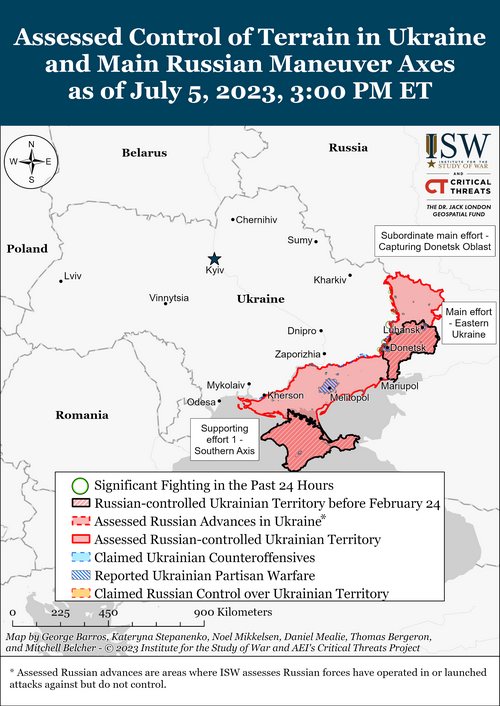
From The Institute For The Study of War:
Russian Offensive Campaign Assessment, July 5, 2023
Riley Bailey, Kateryna Stepanenko, Grace Mappes, Angelica Evans, George Barros, and Frederick W. Kagan
July 5, 2023, 8:25pm ET
Click here to see ISW’s interactive map of the Russian invasion of Ukraine. This map is updated daily alongside the static maps present in this report.
Click here to access ISW’s archive of interactive time-lapse maps of the Russian invasion of Ukraine. These maps complement the static control-of-terrain map that ISW produces daily by showing a dynamic frontline. ISW will update this time-lapse map archive monthly.
Note: The data cutoff for this product was 1:30pm ET on July 5. ISW will cover subsequent reports in the July 6 Russian Offensive Campaign Assessment.
Ukrainian forces reportedly conducted counteroffensive operations in five sectors of the front on July 5 and made gains in some areas. Geolocated footage posted on July 5 shows that Ukrainian forces have advanced southwest of Berkhivka (6km northwest of Bakhmut), west of Yahidne (2km north of Bakhmut), and southwest of Bakhmut.[1] The Ukrainian General Staff reported that Ukrainian forces conducted offensive operations south and north of Bakhmut, and Ukrainian Deputy Defense Minister Hanna Malyar stated that Ukrainian forces are advancing in an unspecified area on Bakhmut’s southern flank.[2] Ukrainian MP Yuriy Mysyagin stated that Ukrainian forces established a new position north of Opytne (6km northwest of the outskirts of Donetsk City) along the Avdiivka-Donetsk City front.[3] Russian sources claimed that Ukrainian forces conducted assaults in the Lyman direction, the Bakhmut direction, along the Avdiivka-Donetsk City front, on the border between Zaporizhia and Donetsk oblasts, and in western Zaporizhia Oblast.[4] Ukrainian Deputy Chief of the Main Operational Department of the General Staff General Oleksii Hromov reported on July 5 that Ukrainian forces have advanced 7.5km into Russian-controlled territory in western Zaporizhia Oblast and along the administrative border between the Zaporizhia and Donetsk oblasts.[5] Hromov stated that Ukrainian forces have liberated nine settlements and 160 square kilometers of territory since the start of the Ukrainian counteroffensive on June 4.[6]
Ukrainian forces reportedly conducted a series of missile strikes targeting Russian rear positions along the entire front overnight and during the day on July 5. Geolocated footage published on July 4 indicates that Ukrainian forces struck an ammunition depot in Makiivka, Donetsk Oblast (6km northeast of Donetsk City).[7] A Russian milblogger claimed that Ukrainian forces struck a Russian fuel and lubricants depot in Makiivka and that Ukrainian forces are regularly launching missile strikes against rear Russian targets in Ukraine.[8] Geolocated images published on July 5 also show apparent Ukrainian strikes on Russian positions near Debaltseve (52km northeast of Donetsk City).[9] Geolocated footage published on July 5 also shows the aftermath of an alleged Ukrainian strike on a railway station in Yasynuvata (6km northeast of Donetsk City).[10] Geolocated images published on July 5 shows the aftermath of an alleged HIMARS rocket strike on a Russian occupation administration building in Volnovakha, Donetsk Oblast (35km southwest of Donetsk City).[11] Russian milbloggers claimed that Ukrainian forces struck Russian positions near Yakymivka (16km southwest of Melitopol) and attempted to strike Berdyansk in Zaporizhia Oblast with Storm Shadow Cruise missiles.[12] Russian sources claimed that Russian air defense systems shot down a Ukrainian missile in the vicinity of Berdyansk.[13] A local Kherson Oblast Telegram channel also claimed that Russian air defenses were activated near Skadovsk, Kherson Oblast (60km southeast of Kherson City).[14]
The footage and claims of these Ukrainian strikes suggest that Ukrainian forces launched a coordinated series of strikes aimed at degrading Russian logistics and ground lines of communication (GLOCs) throughout the theater. United Kingdom Chief of the Defense Staff Admiral Sir Antony David Radakin stated on July 4 that Ukrainian forces are conducting an operation to “starve, stretch, and strike” Russian forces to break down Russian defensive lines.[15] A widespread strike series targeting Russian GLOCs and logistics would be an appropriate element of such a strategy and is partially reminiscent of the interdiction campaign that Ukrainian forces conducted as a part of the Kherson counteroffensive.[16] ISW previously assessed that Ukrainian forces appear to be focusing on creating an asymmetrical attrition gradient that conserves Ukrainian manpower at the cost of a slower rate of territorial gains, while gradually wearing down Russian manpower and equipment.[17] A possible Ukrainian interdiction campaign supporting this effort would have cumulative effects, and its results would not be immediately evident.
Ukrainian and Russian officials maintained their heightened rhetoric regarding the situation at the Zaporizhzhia Nuclear Power Plant (ZNPP) on July 5 following significant claims of a possible attack against the plant overnight on July 4-5.[18] Russia likely continues setting informational conditions for a possible false flag attack against the ZNPP but remains unlikely to cause a radiological incident at this time. Ukrainian Deputy Defense Minister Hanna Malyar stated that Russia may attack the ZNPP to either accomplish its military goals in the area — presumably deterring any possible Ukrainian counteroffensive near the Kakhovka Reservoir — or to intimidate and blame Ukrainian forces for any attacks against the ZNPP.[19] Ukrainian Deputy Chief of the General Staff’s Main Operational Department, Oleksii Hromov stated that the situation at the ZNPP is not new and that Ukrainian forces have the necessary equipment to handle radiological incidents.[20] Kremlin Spokesperson Dmitry Peskov claimed that there is a “great threat” that Ukraine may sabotage the ZNPP with “catastrophic consequences.”[21] ISW continues to assess that Russian statements accusing Ukraine of imminent sabotage against the ZNPP are likely part of a broader information operation aimed at undermining support for Ukraine ahead of the upcoming NATO summit and dissuading Ukrainian forces from counteroffensive operations in Zaporizhia Oblast.[22]
International Atomic Energy Agency (IAEA) Director General Rafael Grossi stated on July 5 that IAEA experts at the ZNPP have requested access to nuclear reactors no. 3 and 4 and other areas at the ZNPP following Ukrainian statements that Russian forces placed explosives on the reactors’ outer roofs.[23] Grossi’s statement on the importance of accessing certain areas of the ZNPP — along with consistent prior statements to the same effect — indicates that Russian authorities are denying the IAEA contingent access to various critical areas at the ZNPP and are unlikely to allow access in the future.[24] Russian authorities may refuse access to reactors no 3. and 4 to prevent the IAEA from investigating the Ukrainian reports on these reactors. Satellite imagery published on July 5 shows unknown objects on the roofs of one of the ZNPP reactor containment units, reportedly reactor no. 4, placed there after July 3.[25] Though the exact nature of these objects is unknown, their presence on the reactor containment unit roof, recent Ukrainian reports, and significant alarm over the ZNPP underscore the importance of Russia’s refusal to give the IAEA access to critical ZNPP areas to investigate possible threats to the plant.
Ukrainian officials reported that Russia continues to procure Iranian-made Shahed drones and is setting conditions to manufacture these drones in Russia with Iran’s assistance. Ukrainian Deputy Chief of the Main Operational Department of the General Staff General Oleksii Hromov stated that Russia received up to 1,800 drones from Iran – of which 1,600 are of the Shahed-type and 200 of unspecified types.[26] Hromov added that Iran consistently replenishes Russian stocks of Iranian drones, and that Russia reached an agreement with Iran to produce drones in the Republic of Tatarstan. The Ukrainian Resistance Center reported that Russian and Iranian officials are planning to set up the production of Iranian Shahed drones on the territory of Yelabuga in the Republic of Tatarstan given that this settlement is the provisional headquarters of the Yelabuga Free Economic Zone.[27] Russia previously used Yelabuga Free Economic Zone exclusively for civilian industrial and economic projects before turning the project into a key focus of Russia’s military industry. The Resistance Center reported that Iran will provide Russia with necessary components that will then be assembled in Russia. The Resistance Center, citing open-source intelligence, reported that Russian leadership intends to train Yelabuga specialists in Iran to assemble Shaheds and transfer the production of some Shahed components to the territory of the Yelabuga Free Economic Zone. The Resistance Center added that Russia wants to establish an automated production line.
The Kremlin continues to show concern over the risk of a potential armed rebellion in Russia after Wagner Group’s rebellion on June 24. A pro-Kremlin online outlet reported that the Moscow Oblast police will train in urban combat tactics, light machine gun shooting, grenade throwing, and tactical medicine to improve skills in the aftermath of Wagner’s armed rebellion.[28] Such training indicates that the Kremlin is attempting to improve the ability of security forces in Moscow to defend the regime against potential future threats. Russian Ministry of Internal Affairs is unlikely to adequately prepare the Moscow Oblast police for urban combat given that some police elements are already expressing disinterest with the new training plans among many other problems with this plan. The outlet stated that Moscow Oblast’s female police officers are also trying to avoid the training.
The Financial Times (FT) reported that Chinese President Xi Jinping personally warned Russian President Vladimir Putin against threatening to use nuclear weapons in Ukraine during his visit to Moscow in late March.[29] FT reported, citing unnamed former Chinese government officials, that Xi told Putin not to use nuclear weapons and noted that China’s stance against the use of nuclear weapons was included in its position paper on peace in Ukraine. FT reported that Xi’s warning to Putin was likely part of China’s efforts to bolster its relationships with the European Union. Western security officials also noted that Putin was disappointed after Xi’s visit to Moscow did not secure any important gains for Russia such as the approval of the Power of Siberia-2 pipeline. ISW previously assessed that Xi may have played a role in pressuring the Kremlin to reduce its nuclear threats in November 2022 and that Putin was unable to secure the desired no-limits bilateral partnership with China during Xi’s visit to Moscow.[30]
Russian Prime Minister Mikhail Mishustin dismissed Sergei Mikhailov from his position as General Director of TASS state newswire and replaced him with Andrey Kondrashov.[31] Mikhailov took over TASS in 2012 and rebranded the news agency into the modern publication it is today.[32] Kondrashov has previously made documentaries about the annexation of Crimea and Putin’s life and was the press secretary for Putin’s campaign headquarters in 2018.[33] Ukrainian sources suggested that Kondrashov’s appointment might indicate that the Kremlin is unhappy with the media coverage of the Wagner Group’s armed rebellion and highlights the continued importance of loyalty to Putin over professional achievement.[34]
Key Takeaways:
- Ukrainian forces reportedly conducted counteroffensive operations in five sectors of the front on July 5 and made gains in some areas.
- Ukrainian forces reportedly conducted a series of missile strikes targeting Russian rear positions along the entire front overnight and during the day on July 5.
- Ukrainian and Russian officials maintained their heightened rhetoric regarding the situation at the Zaporizhzhia Nuclear Power Plant (ZNPP) on July 5 following significant claims of a possible attack against the plant overnight on July 4-5. Russia likely continues setting informational conditions for a possible false flag attack against the ZNPP, but remains unlikely to cause a radiological incident at this time.
- Ukrainian officials reported that Russia continues to procure Iranian-made Shahed drones and is setting conditions to manufacture these drones in Russia with Iran’s assistance.
- The Kremlin continues to show concern over the risk of a potential armed rebellion in Russia after Wagner Group’s rebellion on June 24.
- The Financial Times (FT) reported that Chinese President Xi Jinping personally warned Russian President Vladimir Putin against threatening to use nuclear weapons in Ukraine during his visit to Moscow in late March.
- Russian Prime Minister Mikhail Mishustin dismissed Sergei Mikhailov from his position as General Director of TASS state newswire and replaced him with Andrey Kondrashov.
- Russian forces continued offensive operations along the Kupyansk-Svatove line, and Russian and Ukrainian forces continued skirmishing around Kreminna.
- Ukrainian forces conducted successful offensive operations in the Bakhmut area, and Russian milbloggers reported that Ukrainian forces liberated an important height near Klishchiivka (7km southwest of Bakhmut).
- Russian and Ukrainian forces continued ground attacks along the Avdiivka-Donetsk City line.
- Ukrainian forces continued ground attacks in the western Donetsk Oblast-eastern Zaporizhia Oblast border area and in western Zaporizhia Oblast.
- A Ukrainian official confirmed that Ukrainian forces maintain positions in east (left) bank Kherson Oblast.
- Ukrainian officials reported that Russia’s hybrid cryptomobilization and contract service recruitment campaigns have failed to produce large numbers of recruits, contrary to Russian claims.
- Russian officials are setting information conditions to postpone regional elections in occupied Ukraine likely out of concerns for successful Ukrainian counteroffensives.
Go here to read the rest. The Russians still have the problem with manpower that they have had since the beginning of the war, exacerbated by the fact that they can no longer rely on the Wagner mercenaries.


If the Russians will blow a dam that harmed themselves, they will certainly blow up 2 nuclear reactors.