
From The Institute For The Study of War:
Russian Offensive Campaign Assessment, June 22, 2023
Kateryna Stepanenko, Riley Bailey, Grace Mappes, Nicole Wolkov, Angelica Evans, and Mason Clark
June 22, 2023, 7:20pm ET
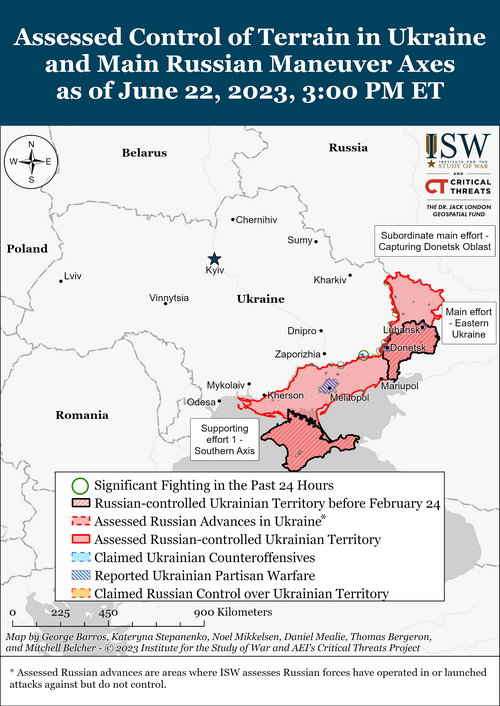
Click here to see ISW’s interactive map of the Russian invasion of Ukraine. This map is updated daily alongside the static maps present in this report.
Click here to access ISW’s archive of interactive time-lapse maps of the Russian invasion of Ukraine. These maps complement the static control-of-terrain map that ISW produces daily by showing a dynamic frontline. ISW will update this time-lapse map archive monthly.
Note: The data cutoff for this product was 12:30pm ET on June 22. ISW will cover subsequent reports in the June 23 Russian Offensive Campaign Assessment.
Ukrainian forces continued counteroffensive operations in at least three sectors of the front and reportedly made gains on June 22. The Ukrainian General Staff reported that Ukrainian forces conducted offensive operations in the Kreminna area in Luhansk Oblast, in western Zaporizhia Oblast, and on the administrative border between Zaporizhia and Donetsk oblasts.[1] Ukrainian Deputy Defense Minister Hanna Malyar reported that Ukrainian forces in the Kreminna area achieved partial successes and consolidated themselves in new positions.[2] Ukrainian Tavrisk Group of Forces Spokesperson Captain Valeriy Shershen reported that Ukrainian forces advanced up to one kilometer in western Zaporizhia Oblast and on the administrative border between Zaporizhia and Donetsk oblasts.[3] Shershen added that these Ukrainian advances were tactical measures aimed at improving Ukrainian positions along the front.[4] The Russian Ministry of Defense (MoD) claimed that Ukrainian forces also conducted unsuccessful offensive operations along the Avdiivka–Donetsk City front.[5] Ukrainian Prime Minister Denys Shmyhal stated on June 21 that Ukrainian forces have liberated eight settlements and over 113 square kilometers of territory since starting counteroffensive operations on June 4.[6]
Senior Kremlin officials continue to publicly address the Ukrainian counteroffensive in a cohesive manner and acknowledge Ukrainian forces will conduct further operations, while continuing to inflate Russian successes. Russian Defense Minister Sergei Shoigu claimed at a Russian Security Council meeting on June 22 that Ukrainian forces are regrouping and restaffing to prepare for further offensive operations in a single unspecified direction after “suffering significant losses.”[7] Shoigu claimed that both Russian and Ukrainian forces are preparing for further offensive operations. Security Council Secretary Nikolai Patrushev claimed that Russian forces destroyed a heavily exaggerated amount of Ukrainian military equipment, including Western-provided equipment. Wagner Group financier Yevgeny Prigozhin claimed that his reporting on Ukrainian gains differs from official reports because Shoigu and Chief of the Russian General Staff Valery Gerasimov lie and exaggerate.[8] Prigozhin claimed on June 13 that Ukrainian forces have likely liberated over 100 square kilometers since the start of the counteroffensive, in stark contrast to the Russian MoD’s continual denial of Ukrainian territorial gains.[9]
Russian Defense Minister Sergei Shoigu announced that the Russian Ministry of Defense (MoD) will form a “reserve army” by the end of June, form a new army corps, and reinforce key Western Military District (WMD) formations as part of intended force restructuring. Shoigu told Russian President Vladimir Putin that Russia is forming reserves for an unnamed army corps and an unspecified “reserve army” and adding five regiments to the 1st Guard Tank Army and the 20th Guards Combined Arms Army — both part of the WMD.[10] Shoigu noted that the five regiments are already 60 percent staffed and equipped as of June 22. Shoigu’s announcement likely confirms ISW’s previous reports that the Russian military command is forming the 25th Combined Arms Army with recruits from the Russian Far East and is establishing the 40th Army Corps as part of the Southern Military District (SMD).[11] The 20th Combined Arms Army is based on the northeast Ukrainian border and the 1st Guards Tank Army was (prior to February 2022) Russia’s highest quality army, making these formations the logical first recipients of new regiments. Shoigu previously outlined Russian efforts to conduct large-scale military reforms between 2023 and 2026 to optimize Russian Armed Forces for large-scale conventional warfare and expand Russian conventional forces on January 17, though as ISW assessed at the time Russia will struggle to fully staff and equip these large formations using existing force-generation processes.[12]
The Russian MoD likely seeks to mitigate this force-generation challenge at least in part with volunteer formations.[13] Shoigu claimed that Russia recruited 114,000 servicemen for contract service and 52,000 volunteers — noting that 1,336 people sign contracts with the Russian MoD each day and that Russia can form a regiment every 24 hours. This statement is not to be taken literally though since Russian regiments typically contain over 2,000 personnel.[14] Shoigu added that Russia is not committing volunteers because “there is no urgent need” to deploy these forces to the battlefield. ISW previously observed residents of the Russian Far East receiving messages inviting men to join the 25th Combined Arms Army, indicating that the Russian MoD seeks to directly recruit volunteers to staff its formations.[15] Shoigu also ordered Russian volunteer formations on June 10 to sign military contracts with the Russian MoD by July 1, which will also formally provide additional forces to the Russian MoD for its large-scale military reforms.[16] Russia’s previous attempt to form a volunteer-based 3rd Army Corps in summer of 2022 did not establish a combat-effective force, however.[17]
The Russian MoD is unlikely to fully formalize Russian volunteer formations by its stated July 1 deadline. The Russian MoD claimed on June 22 that four additional volunteer formations signed contracts with the MoD and that more than 20 volunteer formations have done so since the MoD began the effort to have all volunteers sign contracts.[18] The MoD previously claimed on June 10 that more than 40 volunteer formations are currently active.[19] The MoD may nominally have all volunteer formations sign contracts before July 1, but the extent of actual command ties is unclear. ISW previously assessed that the MoD’s formalization efforts intend to centralize control over Russian irregular personnel and supplies to respond to Ukraine’s counteroffensive as well as restrict the influence of figures outside of the MoD.[20] It is unclear why a significant portion of volunteer formations have yet to sign contracts with the MoD, although Prigozhin’s criticism that MoD subordination could adversely impact command and control within irregular formations may be reflective of widespread concerns among these irregular Russian forces.[21] The signing of contracts is the first phase of formalizing volunteer formations, and it is unclear if the MoD will be able to quickly, or at all, establish practical and effective control once these formations are de jure subordinated to the MoD, and the scale of implementation will vary between units.
Ukrainian President Volodymyr Zelensky stated that Ukrainian intelligence indicates that Russian forces are preparing to conduct a possible sabotage attack at the Zaporizhzhia Nuclear Power Plant (ZNPP). A Russian-created radiological incident at the ZNPP remains unlikely but not impossible. Zelensky stated that the planned attack would release radiation from the ZNPP, and announced that Ukrainian officials will widely share their intelligence on the planned attack with partners and international organizations in the coming days.[22] Ukrainian Main Military Intelligence Directorate (GUR) Head Kyrylo Budanov reported on June 20 that Russian forces had mined additional areas at the ZNPP, including the facility’s cooling pond.[23] The International Atomic Energy Agency (IAEA) stated on June 21 that its representatives have not observed any mines at the cooling pond, although it did acknowledge that Russian forces have mined areas in and around the ZNPP.[24] Russian forces would not be able to control the consequences of an intentional radiological incident at the ZNPP, which could impact their forces more than Ukrainian forces across the Kakhovka Reservoir given conditions at the time of the incident. An intentional radiological incident could also leave many areas in occupied southern Ukraine uninhabitable and ungovernable, further degrading Russia’s ability to cement its occupation of southern Ukraine, and the destruction of the power plant would be a drastic act. Russian forces may be signaling that they are preparing to sabotage the ZNPP in order to dissuade Ukrainian forces from conducting counteroffensive operations in the area. The Kremlin has routinely employed threats of nuclear escalation and warned of (largely Russian imposed) threats to the safety of the ZNPP in an attempt to pressure Ukraine to constrain its military actions and prevent further Western security assistance to Ukraine.[25] However, the destruction of the Nova Kakhovka dam also harmed Russian forces, and possible Russian plans to sabotage the ZNPP cannot be ruled out and should be prepared for by Ukraine and its partners.
Ukrainian forces may be intensifying efforts to strike Russian ground lines of communication (GLOCs) in southern Ukraine. Ukrainian Melitopol Mayor Ivan Fedorov reported on explosions in Melitopol and Yakymivka in Zaporizhia Oblast and Chonhar in Crimea on June 22.[26] Russian sources claimed that Ukrainian forces conducted a Storm Shadow strike on the Chonhar Bridge, along the E105 highway connecting Russian-occupied Kherson Oblast and Crimea.[27] Some Russian sources claimed that Ukrainian forces also struck a bridge across Lake Syvash.[28] Ukrainian forces may be intensifying their efforts to strike rear areas and vulnerable areas along GLOCs to disrupt Russian supply routes.[29] Widespread Russian milblogger outrage and concern about the strike could indicate that Russian forces may be increasingly concerned over their ability to secure GLOCs in southern Ukraine.[30]
Ukrainian President Volodymyr Zelensky acknowledged that Western partners have different expectations for Ukraine’s counteroffensive and stated that Ukrainian forces will perform operations as Ukraine sees fit independent of pressure from another country.[31] CNN reported on June 22 that senior US and other Western officials stated the Ukrainian counteroffensive thus far has failed to live up to expectations, but the officials acknowledged that the counteroffensive is still in the early phases and Western states remain hopeful that Ukrainian forces will make significant gains.[32] ISW continues to assesses that the slow pace of current Ukrainian counteroffensive operations is not emblematic of Ukrainian forces’ overall offensive potential and that Ukrainian forces are likely setting conditions for a future main counteroffensive effort which will take time to conduct.[33]
Key Takeaways
- Ukrainian forces continued counteroffensive operations in at least three sectors of the front and reportedly made gains on June 22.
- Senior Kremlin officials continue to publicly address the Ukrainian counteroffensive in a cohesive manner and acknowledge Ukrainian forces will conduct further operations, while continuing to inflate Russian successes.
- Russian Defense Minister Sergei Shoigu announced that the Russian Ministry of Defense (MoD) will form a “reserve army” by the end of June, form a new army corps, and reinforce key Western Military District (WMD) formations as part of intended force restructuring.
- The Russian MoD is unlikely to fully formalize Russian volunteer formations by its stated July 1 deadline.
- Ukrainian President Volodymyr Zelensky stated that Ukrainian intelligence indicates that Russian forces are preparing to conduct a possible sabotage attack at the Zaporizhzhia Nuclear Power Plant (ZNPP). A Russian-created radiological incident at the ZNPP remains unlikely but not impossible.
- Ukrainian forces may be intensifying efforts to strike Russian ground lines of communication (GLOCs) in southern Ukraine.
- Ukrainian President Volodymyr Zelensky acknowledged that Western partners have different expectations for Ukraine’s counteroffensive and stated that Ukrainian forces will perform operations as Ukraine sees fit independent of pressure from another country.
- Russian and Ukrainian forces continued ground attacks near the Kupyansk-Svatove line.
- Ukrainian forces continued counteroffensive operations near Kreminna.
- Russian forces conducted limited ground attacks near Bakhmut.
- Russian and Ukrainian forces conducted limited ground attacks along the Avdiivka-Donetsk City line.
- Ukrainian and Russian forces continued offensive operations on the administrative border between Donetsk and Zaporizhia oblasts.
- Ukrainian forces continued counteroffensive operations in western Zaporizhia Oblast.
- Ukrainian officials reported that Russian forces are transferring GRU Spetsnaz units to Kursk and Bryansk oblasts to fight Russian partisans.
- Russian sources claimed that the Russian Federal Security Service (FSB) arrested a group of saboteurs in occupied Melitopol that allegedly planned the assassination of unnamed Zaporizhia Oblast occupation officials and sabotage against railroads.
Go here to read the rest. Interesting behind the lines attacks by the Ukrainians.

