
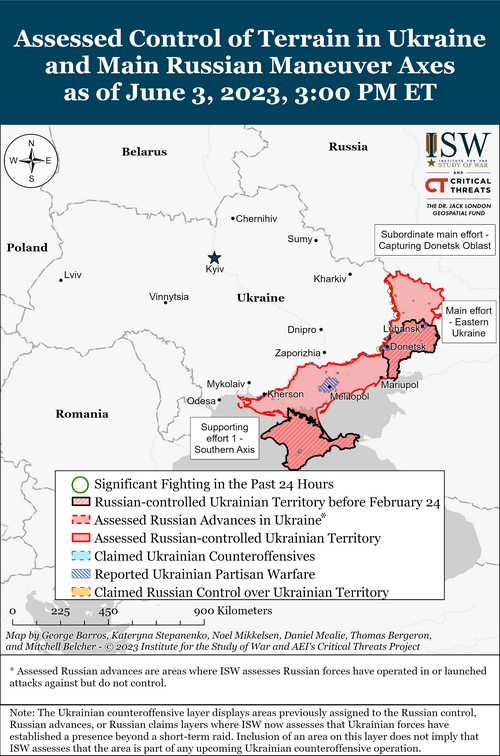
From The Institute For The Study of War:
Riley Bailey, Grace Mappes, Karolina Hird, and Fredrick W. Kagan
June 3, 2023, 4:30 pm ET
Click here to see ISW’s interactive map of the Russian invasion of Ukraine. This map is updated daily alongside the static maps present in this report.
Click here to access ISW’s archive of interactive time-lapse maps of the Russian invasion of Ukraine. These maps complement the static control-of-terrain map that ISW produces daily by showing a dynamic frontline. ISW will update this time-lapse map archive monthly.
Note: The data cutoff for this product was 1 pm ET on June 3. ISW will cover subsequent reports in the June 4 Russian Offensive Campaign Assessment.
Ukrainian officials continue to signal that Ukrainian forces are prepared to start counteroffensive operations. Ukrainian President Volodymyr Zelensky stated in a June 3 interview with the Wall Street Journal that Ukraine is ready to launch a counteroffensive.[1] Zelensky stated that Ukraine “would like to have certain things, but … can’t wait for months” to start counteroffensive operations.[2] Ukrainian Deputy Defense Minister Hanna Malyar stated on June 3 that “military plans love silence” and that she will “discuss something else” in the meantime, likely acknowledging that Ukrainian officials have started to more strictly enforce a regime of informational silence about operations in preparation for upcoming counteroffensives.[3] Ukrainian Minister of Internal Affairs Ihor Klymenko stated on June 3 that Ukraine has formed all nine brigades of the “Offensive Guard” and that these formations are ready to take part in hostilities at Zelensky’s and Ukrainian Commander in Chief General Valeriy Zaluzhnyi’s orders.[4]
Wagner Group financier Yevgeny Prigozhin escalated his feud with the Russian Ministry of Defense (MoD), likely hoping to draw criticism back to the Russian military leadership and downplay his ongoing conflict with Chechen Republic Head Ramzan Kadyrov. Prigozhin alleged on June 2 that representatives of the MoD placed anti-tank mines and other explosive devices along routes that Wagner forces were using to withdraw from Bakhmut.[5] Prigozhin asserted that these charges were placed in rear areas with no Ukrainian activity and that the MoD likely meant for Wagner forces to detonate the explosives in order to give Wagner a “public flogging.”[6] Prigozhin also further responded to a concerted attack that Chechen commanders launched against him on June 1 and stated on June 3 that he and Kadyrov settled the conflict.[7] Prigozhin claimed that he called Kadyrov on June 1 and the two agreed to let the “whole story” about the conflict dissipate.[8] Prigozhin suggested that a group in the Kremlin may have started the conflict between Kadyrov’s forces and Wagner and insinuated that the Kremlin often plays ”dangerous games” that could destabilize interethnic relations within Russia.[9] Kadyrov has yet to publicly address the conflict between Chechen forces and Wagner.
Prigozhin has not yet responded to Kadyrov or the Chechen commanders who started the attack in an antagonistic manner typical of his usual approach to responding to critiques.[10] The claimed private phone call between Prigozhin and Kadyrov would suggest that Prigozhin is concerned that this typical public response might further antagonize Kadyrov and Chechen commanders and that Prigozhin is concerned about having another prominent silovik figure like Kadyrov aligned against him. Prigozhin likely accused the MoD of trying to kill Wagner forces and the Kremlin of creating the conflict with the Chechen commanders to quickly reorient Russian discussion back to his usual targets of ire, the Russian military and political leadership. Prigozhin is also likely aiming to rally pro-war ultranationalist groups, specifically Kadyrov and Chechen commanders, to join him in criticizing those targets as he has done before.
Prigozhin’s flamboyant allegations are also likely an attempt to retain his heightened initiative within the Russian information space following the capture of Bakhmut. Prigozhin has consistently shaped discussions within the Russian information space leading up to the capture of Bakhmut and following the end of Wagner’s effort in the city by engaging in a near-daily series of public outbursts and demonstrative actions.[11] Prigozhin has used his heightened profile following the capture of Bakhmut to intensify his attacks against the Russian military establishment and elites and bolster his attempt to solidify himself as the central figure of the Russian ultranationalist community.[12] The concerted attack from Chechen commanders represents the first instance since the capture of Bakhmut that Prigozhin has not been the one to initiate larger conversations about himself and the Wagner Group within the Russian information space. Prigozhin’s desire to retain Kadyrov as a potential ally has likely constrained Prigozhin’s regular approach to shaping the Russian information space. Prigozhin has routinely used Wagner’s claimed responsibility for tactical gains to legitimize his pursuit of influence and his criticism of others, and he is likely also concerned that he may soon lose his current ability to dominate discussions about himself and Wagner as Wagner Group forces withdraw to rear areas to replenish and reconstitute.[13] Prigozhin’s dramatic accusation against the MoD aims to remove any constraints resulting from his conflict with Kadyrov, shift the conversation back to criticizing his opponents in the MoD, and allow Prigozhin to continue determining how he and Wagner are portrayed.
Prigozhin seized on general Russian discontent with security on the Belgorod Oblast border to threaten that Wagner Group forces may operate in Russian territory without approval from the Russian military command.[14] Prigozhin claimed that Wagner will not wait for an invitation or permission from the MoD to defend Belgorod Oblast if the MoD does not curb security threats to the region. Prigozhin justified his threat of insubordination by claiming that Wagner aims to protect the Russian people, implying that Wagner will assume the role of border defender that the MoD should already occupy. Prigozhin’s threats capitalize on complaints from other prominent information space voices that Russian authorities have not done enough to protect border areas from the impacts of the war and reflect Prigozhin‘s current loss of informational initiative.[15]
Prigozhin’s threats also indicate that he may aim for Wagner forces to assume primary or sole responsibility for an axis in the Ukrainian theater now that Wagner forces have withdrawn from that role in the Bakhmut area. Prigozhin may see the Belgorod-Ukraine border as an easy enough front line to defend as the raids into Russia have thus far occurred on an extremely limited scale. Deploying Wagner forces to the Belgorod border would allow Prigozhin to maintain his position as a commander of frontline forces without the grueling demands of conducting human wave-style frontal assaults against a heavily fortified Ukrainian city. Prigozhin’s apparent threat to undertake military operations, even defensive ones, on Russian territory without the permission of the Russian MoD is astonishing if it is anything other than flamboyant rhetoric. It implies that Prigozhin regards himself as able to use large military forces loyal to him at his own discretion and beyond the control of the actual Russian military. Russian President Vladimir Putin would have to have tremendous confidence in Prigozhin’s personal loyalty to himself to be at all comfortable with such a situation.
A Russian Duma Deputy stated during a public forum on June 1 that Russia has failed to accomplish any of its articulated goals for the “special military operation” in Ukraine. First Duma Deputy Chairman of the Committee on Commonwealth of Independent States (CIS) Affairs Konstantin Zatulin emphasized that of Russia’s officially declared goals at the beginning of the invasion of Ukraine — “denazification, demilitarization, the neutrality of Ukraine, and the protection of the inhabitants of the Donetsk and Luhansk People’s Republics”—none have actually been met.[16] Zatulin further noted that as the war has worn on, these goals have ceased to hold actual meaning and suggested that Russian forces should have been more aggressive in efforts to push Ukrainian forces back from the borders of Donetsk and Luhansk oblasts. Zatulin’s critical observations are noteworthy considering that he is a contributor to the Kremlin-affiliated Valdai Discussion Club, which famously upholds views complementary to Russian President Vladimir Putin and the official Kremlin propaganda line.[17] Zatulin’s apparent views of the war represent an absolute minority within the Russian domestic political environment, as self-censorship and general information space repressions are commonplace. However, such statements coming from a relatively mainstream and well-platformed official suggest that a small subset of the predominant pro-war Russian political faction may feel somewhat empowered to voice discontent and advocate for escalated goals as the war continues.
Key Takeaways
- Ukrainian officials continue to signal that Ukrainian forces are prepared to start counteroffensive operations.
- Wagner Group financier Yevgeny Prigozhin escalated his feud with the Russian Ministry of Defense (MoD), likely hoping to draw criticism back to the Russian military leadership and downplay his ongoing conflict with Chechen Republic Head Ramzan Kadyrov. Prigozhin’s flamboyant allegations are also likely an attempt to retain his heightened initiative within the Russian information space following the capture of Bakhmut.
- Prigozhin seized on general Russian discontent with security on the Belgorod Oblast border to threaten that Wagner Group forces may operate in Russian territory without approval from the Russian military command.
- A Russian Duma Deputy stated during a public forum on June 1 that Russia has failed to accomplish any of its articulated goals for the “special military operation” in Ukraine.
- Russian forces continued limited offensive operations along the Kupyansk-Svatove line and northwest and south of Kreminna.
- Regular Russian forces have likely largely relieved Wagner Group forces in Bakhmut amid a low offensive tempo in the area as of June 3.
- Russian forces focused offensive operations on the Avdiivka-Donetsk City line near Marinka.
- Russian sources claimed that Ukrainian forces continued limited ground attacks in western Donetsk Oblast.
- Russian forces continued efforts to establish defensive positions in Kherson Oblast.
- The Russian military leadership is attempting to create and staff new military formations.
- Likely Ukrainian partisans assassinated a Russian collaborator in occupied Zaporizhia Oblast.
Go here to read the rest. June provides excellent campaigning weather in Ukraine.

