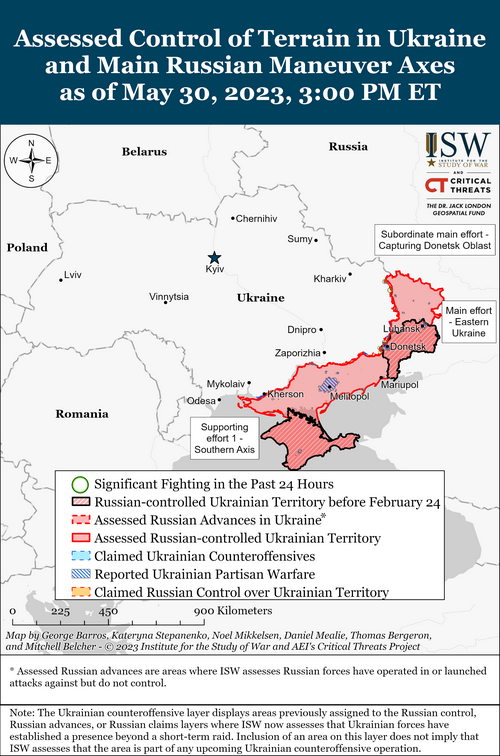
From The Institute For The Study of War:
Russian Offensive Campaign Assessment, May 30, 2023
Kateryna Stepanenko, Grace Mappes, Nicole Wolkov, George Barros, and Fredrick W. Kagan
May 30, 2023, 8pm ET
Click here to see ISW’s interactive map of the Russian invasion of Ukraine. This map is updated daily alongside the static maps present in this report.
Click here to access ISW’s archive of interactive time-lapse maps of the Russian invasion of Ukraine. These maps complement the static control-of-terrain map that ISW produces daily by showing a dynamic frontline. ISW will update this time-lapse map archive monthly.
Note: The data cutoff for this product was 3pm ET on May 30. ISW will cover subsequent reports in the May 31 Russian Offensive Campaign Assessment.
Russia claimed that Ukraine conducted a series of drone strikes against Moscow on May 30 as Russia again targeted Ukraine with Iranian-made Shahed drones. The Russian Ministry of Defense (MoD) accused Ukraine of attacking Moscow with eight drones on the morning of May 30, and claimed that Russian forces shot down five of the drones and suppressed three drones with electronic warfare systems.[1] Russian propagandist Vladimir Solovyev, however, claimed that Ukraine launched 32 drones of which some targeted the prestigious neighborhood of Rublyovka in Moscow Oblast.[2] A Russian independent outlet claimed that the drone strikes predominantly targeted areas near Russian President Vladimir Putin’s residence in Novo-Ogaryovo and other elite neighborhoods in Moscow Oblast.[3] Moscow Mayor Sergei Sobyanin stated that several buildings in Moscow suffered minor damage, and Russian sources amplified footage of a minor explosion in the Novaya Moskva neighborhood.[4] A Russian milblogger claimed that drones flying over Moscow resembled Ukrainian attack drones.[5] Geolocated footage shows Russian forces shooting down drones identified as Ukrainian by OSINT accounts in several different areas of Moscow and Moscow Oblast.[6] Ukrainian presidential aide Mykhailo Podolyak denied that Ukraine was directly involved in the drone strike but forecasted that there could be an increase in such attacks in the future.[7]
Russian forces conducted another Shahed 131 and 136 drone strike against Kyiv overnight on May 29 to May 30. The Ukrainian General Staff reported that Ukrainian forces shot down 29 of 31 Russian Shahed 131 and 136 drones that targeted Kyiv.[8] Senior Russian officials claimed that Russian forces struck high profile targets in Kyiv during recent strikes, likely to appear successful in retaliation for the recent Belgorod Oblast incursion.[9] Russian Defense Minister Sergey Shoigu claimed that Russian forces struck a Patriot air defense system in recent days.[10] Ukrainian Air Forces Spokesperson Colonel Yuriy Ihnat denied Shoigu’s claim, however.[11] Russian milbloggers’ recent complaints about the perceived lack of Russian escalation in response to the Belgorod border raid and Moscow drone strikes do not give Russian forces credit for the unprecedented scale of their air campaign against Kyiv. Many milbloggers, including high-profile voices like former Russian officer Igor Girkin and Wagner Group financier Yevgeny Prigozhin have frequently and recently complained about the lack of full scale general and economic mobilization in Russia, the only feasible measure likely to satisfy the broader information space outcry.[12]
Russian President Vladimir Putin attempted to downplay the drone attack on Moscow to avoid exposing the limited options he has to retaliate against Ukraine. Putin claimed that Russian forces struck the Ukrainian military intelligence headquarters “two [to] three days ago” and claimed that the Russian Armed Forces continue to respond to Ukraine’s “war against Donbas” by striking Ukrainian military infrastructure.[13] Putin insinuated that the drone strike on Moscow was Kyiv’s response to Russian strikes, and the Russian MoD conveniently claimed on May 30 that Russian forces carried out “a group of strikes with long-range high-precision air-launched weapons at main decision-making centers” in Ukraine.[14] The Russian MoD did not claim that it had struck the Ukrainian military intelligence headquarters recently and there is no available confirmation of Putin’s claim.[15] Putin stated that Ukraine is trying to provoke a response and make Russia “mirror” its actions. Putin’s emphasis on past and ongoing missile strikes is likely an attempt to signal that Russia is already actively retaliating and does not need to respond to further Ukrainian provocations. Putin has consistently retaliated against genuine and purported Ukrainian actions by ordering massive missile and drone campaigns, likely due to Russian forces’ inability to achieve any decisive effects on the battlefield.[16]
Putin additionally pushed numerous Kremlin boilerplate narratives aimed at maintaining domestic support for the Russian war effort and villainizing the West. Putin also noted that, while the Moscow air defense systems “worked normally,” Russia still needs to “work” on improving these systems – a notable attempt to preempt criticism from Russian ultra-nationalists who have been criticizing Russia’s ineffective air defense systems in Moscow and along the Russian border regions with Ukraine.[17] Putin also accused Ukraine of threatening to destabilize the Zaporizhzhia Nuclear Power Plant (ZNPP) and using “dirty devices” – both default Russian false narratives that the Kremlin uses during Russian military failures.[18]
The drone attack on Moscow generated varied responses from the Russian information space. Moscow Duma Deputy Andrey Medvedev claimed that the Ukrainian forces hurriedly executed the drone attack as part of an information operation with negligible kinetic effects.[19] Some Russian milbloggers used the drone attacks to criticize the Russian withdrawal from Kyiv, Chernihiv, and Sumy oblasts in April 2022.[20] Igor Girkin used the strikes against Rublyovka to criticize Russian elites who he claimed have “never thought about the country and never will” and will not respond to Ukrainian attacks in Moscow, Belgorod Oblast, or Russian-occupied Ukraine.[21] Girkin also mocked Putin for continuing to assert that the war is a “special military operation,” despite drone attacks on the Russian capital.[22] Wagner Group financier Yevgeny Prigozhin reprimanded the Russian MoD and called on Russian officials to actually defend Russia instead of “sitting quietly.”[23] Chechen Republic Head Ramzan Kadyrov threatened the European countries, claiming that, if they continue to supply Ukraine with weapons, they will not have the weapons needed to defend themselves when Russia “knocks on their doors.”[24]
The Russian Ministry of Defense (MoD) is likely attempting to conceal the high Russian losses in Ukraine by artificially inflating Ukrainian casualties in the war. Defense Minister Shoigu claimed on May 30 that Russian forces had destroyed an absurdly high number of Western-provided Ukrainian weapons, including long range missiles, in the past month.[25] Shoigu celebrated claimed successes and training efforts, including by awarding Russian formations and bragging about the upcoming summer military exercises. A Wagner Group-affiliated milblogger criticized Shoigu, implying that Shoigu’s statements are so unrealistic that they appear to be fake to readers.[26] Dutch open-source group Oryx reported on May 29 that it confirmed that Russia has lost over 2,000 tanks and 2,366 infantry fighting vehicles (including over 850 BMPs) since the war began.[27]
EU High Representative for Foreign Affairs Josep Borrell stated that Russia will not enter negotiations while trying to win the war, supporting ISW’s assessment that Russian statements expressing willingness to negotiate are part of an ongoing information operation intending to weaken Western willingness to aid Ukraine.[28] Reuters reported on May 29 that Borrell said that Russia has repeatedly signaled that it would not end the war until it achieved its military goals and that it has over 300,000 personnel in Ukraine — twice as many as when the invasion started.[29]
Key Takeaways
- Russia claimed that Ukraine conducted a series of drone strikes against Moscow on May 30 as Russia again targeted Ukraine with Iranian-made Shahed drones.
- Russian President Vladimir Putin attempted to downplay the drone attack on Moscow to avoid exposing the limited options he has to retaliate against Ukraine.
- The drone attack on Moscow generated varied responses from the Russian information space.
- The Russian Ministry of Defense (MoD) is likely attempting to conceal the high Russian losses in Ukraine by artificially inflating Ukrainian casualties in the war.
- EU High Representative for Foreign Affairs Josep Borrell stated that Russia will not enter negotiations while trying to win the war.
- Russian forces conducted limited ground attacks northeast of Kupyansk and northwest of Svatove, and Russian sources claimed that Russian forces conducted a ground attack south of Kreminna.
- The tempo of Russian and Ukrainian offensive operations in the Bakhmut direction remains low as of May 30.
- Russian forces made marginal advances amid continued ground attacks on the Avdiivka-Donetsk City line.
- Russian forces did not conduct any confirmed ground attacks along the southern axis.
- Russian officials are establishing domestic veteran support programs which likely aim to advertise the perks of military service in Russia.
- Russian occupation officials continue to deport Ukrainian children to Russia under the guise of providing pediatric healthcare.
Go here to read the rest.
From Strategy Page:
May 30, 2023: Russian efforts to declare the ten-month battle for the eastern Ukrainian city of Bakhmut a victory were disputed by revelations about Russian losses and continued advances by Ukrainian forces. When Russia declared victory in Bakhmut, Ukrainian forces were still holding western portions of the city. As Russia began moving most of its troops from the city after the victory announcement, Ukrainian forces advanced and reoccupied the territory Russians had recently captured. The Russian victory was further tarnished when Wagner Group officials complained that they lost 20,000 troops killed and many more wounded during the long battle for the city. Wagner accused the Defense Ministry of not supplying Wagner with sufficient ammunition and supplies to speed up the fighting and reduce Russian (especially Wagner) losses. Ukraine does not release casualty data but it was obvious from satellite photos and reports from eyewitnesses that Ukrainian casualties were much lower because the Russians were doing most of the attacking without using many armored vehicles or tanks. Ukrainian forces largely fought from inside buildings or well-protected bunkers and had several safe (from enemy fire) displacement routes prepared so that the Ukrainian troops could safely abandon a position and move to another. These protected routes were also used to bring in supplies or evacuate casualties. The Internet chatter about losses in Bakhmut confirmed the heavier Russian losses. Some Ukrainians criticized the defense of the city because of the Ukrainian losses. In the end, the Battle for Bakhmut absorbed all the offensive forces available to the Russians and basically lost most of those troops taking a city where a proclaimed victory turned out to be an embarrassing defeat. Russia is rebuilding an offensive force in Russia but this process won’t be complete for another year. Meanwhile the reluctant conscripts and mobilized reservists in Ukraine have little training, few weapons and poor leadership. Russia is also training more junior combat officers to replace the heavy losses suffered in early 2022.
Most of the Russian losses at Bakhmut were not Russian soldiers but Russian mercenaries working for the Wagner Group, a private military contractor organization formed in 2014 on the order of Vladimir Putin. He asked Yevgeny Prigozhin, one of the wealthy Russian businessmen who backed Putin, to organize it and that included finding an experienced special operations officer to run day-to-day operations. This turned out to be retired spetsnaz Lt. Col. Dmitry Utkin, whose code name was “Wagner.” Utkin understood that Wagner Group was created for carrying out illegal military operations outside Russia. The first of these was the 2014 seizure of Crimea from Ukraine. Wagner Group has been in Ukraine ever since and increased its personnel there to over 50,000 by 2022. Smaller number of Wagner Group personnel work around the world as highly paid mercenaries working for foreign governments, especially in Africa. Wagner Group requires large payments from the Russian government to keep its operations going and expanding. These payments are illegal, if only because private military contractors are illegal in Russia. Recently additional military contractor organizations have been created by powerful Russian businessmen. To many Russians, this proliferation of private armies seems to be the prelude to another Russian Civil War.
The heavy dependence on Wagner Group forces in Ukraine is the result of Wagner Group having access to more money and fewer restrictions than the Russian Defense Ministry and military. The high cost of operation Wagner Group has been noticed because Wagner Group operations are often noted as a reason for the heavy economic sanctions imposed on Russia by NATO countries because of the fighting in Ukraine. Initially, the invasion force included no mercenaries, just military personnel. This force was largely destroyed during the first few months of fighting. Putin promised a short war and now was stuck with a much larger war that eventually threatened his position as Russian leader. Putin brought in the Wagner Group to save the situation in Ukraine. Wagner Group made a difference, but not enough to change the likely outcome of the war. This led to Wagner Group and the Defense Ministry blaming each other for the mess.
The war in Ukraine is not popular inside Russia and that has made it difficult for the military to recruit new troops to fight in Ukraine. Russia conscripts a quarter million young Russian men each year for one year of conscript service. The law stipulates that conscripts cannot be sent to a combat zone outside Russia. Putin tried to get around this by declaring Ukraine was actually part of Russia and Russian troops were there to put down an insurrection. Most conscripts and especially their parents, did not go along with this. This forced the government to spend a lot more money to get more nominally volunteers (contract soldiers) by forcing men with military service or and many with none to be “mobilized” into the military as highly paid contract soldiers. This worked initially until reports of the high casualty rates of contract soldiers in Ukraine became widely known. This led to more illegal schemes to obtain “volunteers”. This included forcing or deceiving conscripts into signing contracts to serve longer as contract soldiers. The war-related sanctions on Russia had caused an economic recession and good civilian jobs were hard to find. Pay for contract soldiers was completive with similar jobs and that was not a bad deal when there was not a war going on in Ukraine. So far this year, Russia has recruited nearly 200,000 contract soldiers. Most of these have no training and this means a few months, or at least weeks, of training is needed to make these men useful, rather than an obstacle, in combat. Wagner Group is not restricted in how it recruits and it was able to recruit many convicts from prison. The deal was that if they survived their six month contract they would be free to leave and would also get a pardon and not return to prison. The Defense Ministry later tried this but had little success as Wagner Group had few restrictions on how it handled convict contract soldiers. If any of these men disobeyed orders or faltered in combat, they could be killed on the spot. That was standard practice in the Russian military during World War II and was enforced by special secret police (NKVD) units and political officers (Zampolits) assigned to commanders of units’ company or larger on up. Zampolits could execute reluctant soldiers or commanders. Wagner Force is the only military organization in Russian that is allowed to use this older but now officially forbidden, leadership style. It’s common knowledge that Wager Group operates this way and anyone joining knows it. Some Russians have called for the military to adopt the old-school disciplinary procedures, Most Russians do not want that, or the Wagner Group, the war in Ukraine or Vladimir Putin. This has led to more popular opposition to the war and Putin and more of the opposition are resorting to violence because nothing else seems to work. Putin stays in power by dealing with the opposition. That comes at a visible cost. Many Russians are getting out of Russia to avoid military service or unemployment or simply because of Putin’s autocratic rules. Putin’s response was to declare it illegal to leave Russia without official permission. Many are leaving despite the restrictions; via whatever way they can come up with. Putin always admired the Soviet Union and now he is turning Russia back into a totalitarian police state. Those who back Putin believe Russia will eventually prevail in Ukraine, even if it takes decades. Most Russians, Ukrainians and NATO members disagree and now consider Russia a threat to everyone.
Go here to read the rest. Russian morale in regard to the Ukrainian War is hanging by a thread. A robust Ukrainian offensive that retakes a large swathe of Ukrainian territory might cut that thread.