
From The Institute For The Study of War:
Russian Offensive Campaign Assessment, April 18, 2023
Kateryna Stepanenko, Grace Mappes, Nicole Wolkov, George Barros, and Frederick W. Kagan
April 18, 8 pm ET
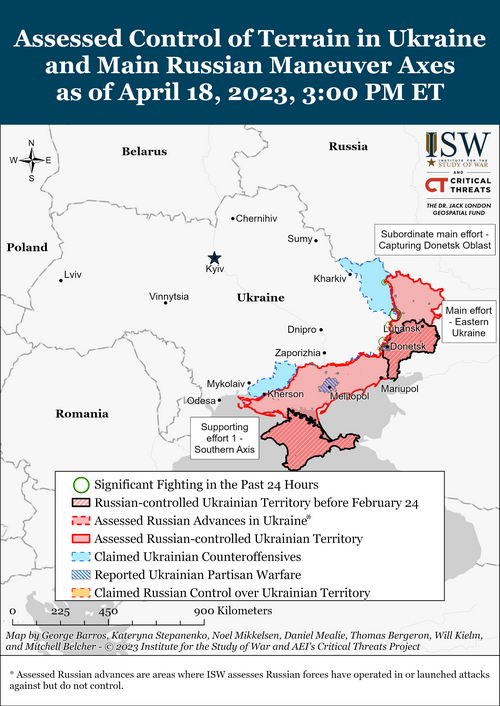
Click here to see ISW’s interactive map of the Russian invasion of Ukraine. This map is updated daily alongside the static maps present in this report.
Click here to access ISW’s archive of interactive time-lapse maps of the Russian invasion of Ukraine. These maps complement the static control-of-terrain map that ISW produces daily by showing a dynamic frontline. ISW will update this time-lapse map archive monthly.
Russian President Vladimir Putin continued to portray himself as a wartime leader in anticipation of a planned Ukrainian counteroffensive during his visit to occupied Kherson and Luhansk oblasts. The Kremlin announced on April 18 that Putin visited the headquarters of the Russian Dnepr Group of Forces in Kherson Oblast and the Vostok National Guard headquarters in occupied Luhansk Oblast.[1] Kremlin Spokesperson Dmitry Peskov claimed that Putin visited occupied territories on April 17. Putin, however, stated that Orthodox Easter holiday is “coming up” in one of the videos, which suggests that his visit occurred prior to April 16.[2] The Kremlin later edited the video to exclude Putin’s statement about the then-upcoming East holiday. Ukrainian President Volodymyr Zelensky visited the Avdiivka frontline on April 18, and it is possible the Kremlin deliberately released footage of Putin’s visit to overshadow Zelensky’s visit in the information space.[3] ISW reported on Russian milbloggers criticizing Russian officials for failing to visit the frontlines like Zelensky, and Putin had previously visited occupied Mariupol on March 19 to improve his appearance as a wartime leader.[4] Russian occupation officials and milbloggers celebrated Putin’s visit and claimed that he boosted the morale of Russian servicemen preparing to repel Ukrainian counteroffensives.[5] Geolocated footage shows that Putin visited Arabat Spit in southwestern Kherson Oblast – at least 130km from the nearest frontline.[6]
Putin’s visit likely also intended to publicly identify potential scapegoats ahead of the planned Ukrainian counteroffensives. Putin received briefings from Commander of Russian Airborne Forces (VDV) Colonel General Mikhail Teplinsky, Commander of the Dnepr Group of Forces Colonel General Oleg Makarevich, and other unnamed military commanders regarding the situation along the Kherson and Zaporizhia frontlines.[7] Putin also met with Colonel General Alexander Lapin and other unnamed top-ranking officers to discuss the situation on the Luhansk frontline. Putin likely deliberately singled out Teplinsky and Makarevich as commanders responsible for southern Ukraine, and Lapin as a commander overseeing the Luhansk direction. Putin, Kremlin sources, and milbloggers have been increasingly discussing the prospects for a Ukrainian counteroffensive, and it is likely that the Kremlin is preparing the domestic information space for either military failures or the defeat of the counteroffensive threat.[8]
Putin’s demonstrative meetings with Teplinsky, Makarevich, and Lapin likely confirm another change in military command and possibly within the Kremlin’s inner circle. A Kremlin-affiliated milblogger observed that the Chief of the Russian General Staff Army General Valery Gerasimov and Defense Minister Sergey Shoigu did not attend Putin’s meetings in occupied Ukraine.[9] The milblogger claimed that Teplinsky and Lapin – both of whom had reportedly been placed on a leave – returned to the Russian military command likely against the wishes of Gerasimov and Shoigu. Russian sources previously claimed that the Kremlin replaced Wagner-affiliated Teplinsky with Makarevich as the VDV commander on January 13, likely after the Russian MoD and Gerasimov regained Putin’s favor in the lead up of Russia’s unsuccessful winter-spring offensive operation in Donbas.[10] The meeting confirms previous Wagner Group financier Yevgeny Prigozhin’s hints at Teplinsky’s reappointment.[11] ISW previously assessed that Teplinsky’s confirmed reappointment suggests that the Kremlin is likely seeking to work with Wagner to achieve a decisive victory in Bakhmut.[12] The confirmation may further indicate that Prigozhin has at least partly regained Putin’s favor by overriding Gerasimov and Shoigu’s efforts to eliminate Wagner in Bakhmut.[13]
Putin may be attempting to balance Wagner’s influence by reappointing Lapin to command the Luhansk sector of the frontline. The Kremlin-affiliated milblogger claimed that Lapin assumed the role of the commander of the Vostok National Guard formation and noted that the Putin-Lapin meeting confirms Lapin’s return to the frontlines.[14] Prigozhin and Chechen Leader Ramzan Kadyrov had led a successful campaign to remove Lapin from his position as the commander of the “center” group of Russian forces, likely due to personal conflicts during the Severodonetsk-Lysychansk and Luhansk offensive operations in the summer of 2022.[15] The milblogger speculated that Putin reappointed Lapin to reinforce command in the area or to help Putin avoid conflicts with the Russian Defense Ministry.
Select members of the “Club of Angry Patriots” are advocating for a revolution in Russia if the Kremlin freezes the war or pursues peace negotiations with Ukraine and the West. Self-proclaimed former “People’s Governor of Donetsk Oblast” Pavel Gubarev defined the “Club of Angry Patriots” as a “potentially revolutionary power” that will prevent “betrayal” if the government decides to freeze the current frontlines in Ukraine.[16] Gubarev also noted that Russia cannot win the war without a revolution – either from within the government or in society – because oligarchs, agents, ethnic mafias, and nationalist separatists will not allow for the reformation of social-economic institutions to support the war effort. Former Russian officer and ardent nationalist Igor Girkin noted that Gubarev’s opinion does not represent the collective vision on the “Club of Angry Patriots” and noted that any revolution begins with a “coup from the top” over which he and other members of the group have no control over since they do not have connections to the Kremlin.[17]
The official “Club of Angry Patriots” Telegram account amplified a forecast regarding possible political changes within the Kremlin as a result of a Ukrainian counteroffensive, which may represent the group’s concerns over the progress of the war.[18] The group amplified a post from the leader of the Russian “Civil Solidarity” movement Georgiy Fedorov, who stated that the political situation in Russia largely depends on frontline realities. Fedorov assessed that Wagner Group financier Yevgeny Prigozhin’s recent statements about the end of the “special military operation” is the start of the campaign to freeze the war in Ukraine.
Fedorov stated that if Russians are able to defeat Ukrainian counteroffensives over the summer, then Russian President Vladimir Putin may freeze the war to avoid calling up mobilization ahead of the 2024 presidential election cycle. Fedorov claimed that Russia would likely present a suppressed Ukrainian counteroffensive as a victory and is likely intensifying volunteer recruitment efforts to generate enough contract servicemen to hold existing frontlines. Fedorov claimed that the Kremlin will continue to intensify censorship and repressions and will not replace officials in the Kremlin or within the military command under the conditions of unsuccessful counteroffensive operations. Fedorov stated that if Ukrainians are successful, then political situation within the Kremlin will lead to a deeper conflict between different parties for influence and the Kremlin will conduct personnel changes. Fedorov claimed that despite potential mobilization and disruption in society and the Kremlin, Putin’s system is capable of eliminating all threats “associated with the interception of power.” Fedorov noted that the most unlikely scenario is the imminent dissolution of Putin’s power system, but noted that different financial, regional, and industrial figures may be preparing for such an outcome.
Russian Defense Minister Sergey Shoigu and Chinese Defense Minister Li Shangfu met to discuss unspecified strategic partnership and military cooperation in Moscow on April 18. Shoigu claimed that mutual Russian-Chinese efforts aim to stabilize and reduce conflict and that each state significantly values deepening military cooperation.[19] Shoigu also claimed that Russia and China can deepen their partnership by firmly supporting each other on national security issues. Li stated that his first visit to Russia as Defense Minister demonstrates the determination to strengthen cooperation between the Russian military and the Chinese People’s Liberation Army.[20] Shoigu’s and Li’s remarks largely echoed Li’s and Russian President Vladimir Putin’s remarks on April 16.[21]
The Kremlin continued efforts to portray Russia as a respected international partner by meeting with China against the backdrop of the G7 meeting in Japan on April 18. The G7 communique condemned Russian nuclear blackmail rhetoric, Russia’s possible deployment of tactical nuclear weapons to Belarus, destabilizing Wagner Group activities in Africa, the forced deportation of Ukrainian children from occupied Ukraine, Russia’s suspension of the New START Treaty, and Iran’s provision of combat UAVs to Russia.[22] The Russian Ministry of Defense published footage of two Russian strategic bombers flying in international airspace over the Bering and Okhotsk Seas as part of the Pacific Fleet’s ongoing readiness check.[23] ISW previously assessed that the Pacific Fleet’s ongoing readiness checks are likely meant to posture that Russia supports Chinese security objectives in the Pacific ahead of the G7 meeting.[24]
Russian authorities detained Russian public relations specialist Yaroslav Shirshikov, an associate of detained Wall Street Journal reporter Evan Gershkovich, in Yekaterinburg on April 18. Russian news outlet Kommersant reported on April 18 that Russian authorities detained Shirshikov and charged him with justifying terrorism possibly for his social media posts about prominent Russian milblogger Maxim Fomin’s (alias Vladlen Tatarsky) assassination.[25] Shirshikov spoke to Gershkovich shortly before Gershkovich’s arrest and was one of the first people to report Gershkovich as missing.[26] Shirshikov previously stated that Gershkovich had traveled to Yekaterinburg to report on Wagner Group financier Yevgeny Prigozhin’s criticisms of Yekaterinburg History Museum Director Igor Pushkarev and locals’ opinions on the war.[27]
The Russian State Duma approved a series of possibly unconstitutional amendments to the Russian Criminal Code on April 18 aimed at encouraging domestic self-censorship and repressing the Russian public. The Russian State Duma approved amendments to the Russian Criminal Code that increase the maximum prison sentence for high treason from 20 years to life and authorize the revocation of Russian citizenship for discrediting the Russian military and participating in designated undesirable nongovernmental organizations.[28] The amendment also stipulates that a Russian citizen may not renounce their citizenship if the citizen has an outstanding duty to the state, such as mobilization.[29] These measures appear to violate the Russian Constitution, as Article 6 states that a Russian citizen may not be deprived of their citizenship or of the right to change citizenship status.[30] The State Duma also approved an amendment that criminalizes advising international organizations in which Russia does not belong or foreign states bodies.[31] Russian opposition media outlet OVD-Info states that this amendment would criminalize facilitating international war crimes investigations.[32] International Humanitarian Law, to which Russia is a party, stipulates that states have a duty to investigate and prosecute war crimes.[33]
The Russian Immortal Regiment Central Headquarters announced the cancellation of the annual Immortal Regiment Victory Day march, likely in an effort to reduce public discussion of deaths in the current conflict. Russian State Duma Member Deputy and Co-Chair of the Immortal Regiment Central Headquarters Elena Tsunaeva announced the cancellation of the march, which memorializes Russian war dead, on April 18, for unspecified security reasons.[34] Tsunaeva stated that citizens can instead submit photos of relatives to a centralized online database to participate in a ”virtual procession,” which Russian authorities will likely use to hide the number of Russian soldiers killed in Ukraine. Tsunaeva also invited people to share pictures of their deceased family members online, on clothes, and on cars.
Key Takeaways
- Russian President Vladimir Putin continued to portray himself as a wartime leader in anticipation of a planned Ukrainian counteroffensive during his visit to occupied Kherson and Luhansk oblasts.
- Putin’s visit likely intended to publicly identify scapegoats ahead of the planned Ukrainian counteroffensives.
- Putin’s demonstrative meetings with Teplinsky, Makarevich, and Lapin likely confirm another change in military command and possibly within the Kremlin’s inner circle.
- Select members of the “Club of Angry Patriots” are advocating for a revolution in Russia if the Kremlin freezes the war or pursue peace negotiations with Ukraine and the West.
- Russian Defense Minister Sergey Shoigu and Chinese Defense Minister Li Shangfu met to discuss on strategic partnership and military cooperation in Moscow on April 18.
- The Russian State Duma approved a series of amendments to the Russian Criminal Code on April 18 aimed at encouraging domestic self-censorship and repressing the Russian public.
- Russian authorities detained Russian public relations specialist Yaroslav Shirshikov, an associate of detained Wall Street Journal reporter Evan Gershkovich, in Yekaterinburg on April 18.
- The Russian Immortal Regiment Central Headquarters announced the cancelation of the annual Immortal Regiment Victory Day march, likely in an effort to reduce public discussion of war dead.
- Russian forces conducted limited ground attacks northeast of Kupyansk and along the Svatove-Kreminna line.
- Russian forces continued to make gains in Bakhmut and conducted ground attacks along the Avdiivka-Donetsk City line.
- Ukrainian officials reported that Russian forces continue defensive preparations in southern Ukraine.
- The Kremlin continues efforts to integrate proxy formations with conventional Russian forces.
- Russian occupation officials continue to deport Ukrainian civilians to Russia under healthcare and rehabilitation schemes.
- Belarus may begin economically supporting Russian-occupied Donetsk Oblast with a patronage system.
Go here to read the rest. Still marking time until the Ukrainian offensive.

