
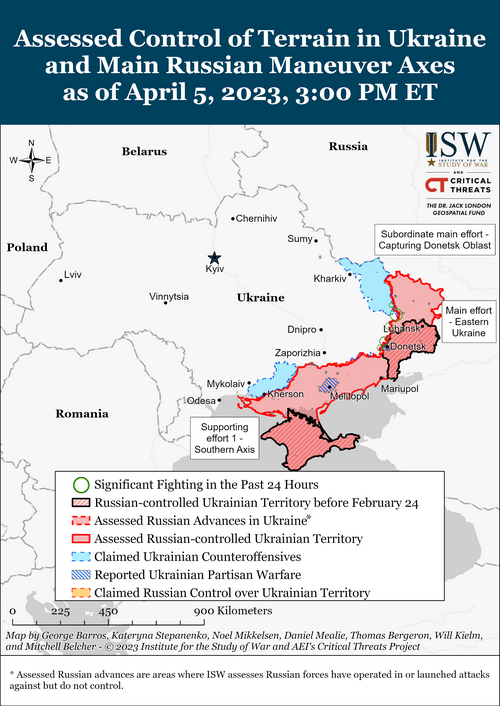
From The Institute For The Study of War:
Kateryna Stepanenko, Karolina Hird, Riley Bailey, Grace Mappes, Layne Philipson, and Mason Clark
April 5, 6:30 pm ET
Click here to see ISW’s interactive map of the Russian invasion of Ukraine. This map is updated daily alongside the static maps present in this report.
Click here to access ISW’s archive of interactive time-lapse maps of the Russian invasion of Ukraine. These maps complement the static control-of-terrain map that ISW produces daily by showing a dynamic frontline. ISW will update this time-lapse map archive monthly.
Ukrainian President Volodymyr Zelensky stated that Ukrainian forces will withdraw from Bakhmut to avoid encirclement if necessary, but do not yet assess the need to do so. Zelensky stated during a press conference in Poland on April 5 that Ukrainian troops face a very challenging situation in Bakhmut, and that Kyiv will make the “corresponding decisions” if Ukrainian troops risk encirclement by Russian forces.[1] Zelensky’s statement is in line with other recent statements by Ukrainian officials that Ukrainian military command will order a withdrawal from Bakhmut when and if they deem a withdrawal to be the most strategically appropriate option. While it remains to be seen whether Ukraine’s defense of Bakhmut and its efficacy in fixing Russian forces in the area is worth Ukrainian losses (and we will likely be unable to assess this until observing the Ukrainian spring counteroffensive), Ukrainian military leadership continues to clearly signal that Ukrainian forces are still not encircled and have the option to withdraw as necessary.[2]
Russian President Vladimir Putin framed Russia’s efforts to consolidate control of occupied territories of Ukraine as a matter of internal security and rule of law during a meeting with the Russian National Security Council on April 5. Putin called for the continued economic, legal, and social integration of occupied Donetsk, Luhansk, Kherson, and Zaporizhia oblasts into the Russian Federation and emphasized the importance of Russian “restoration” efforts in occupied areas in facilitating the integration process.[3] Putin also accused Ukraine of threatening civilians in occupied areas and highlighted recent ”terrorist attacks” against occupation officials and law enforcement agencies, referring to Ukrainian partisan attacks against occupation organs.[4] Putin emphasized the need for intensified law enforcement operations to guard against such attacks and called for the increased participation of local Ukrainian citizens in law enforcement processes, explicitly encouraging collaborators and informants in occupied areas. Putin has notably invoked the concept of “terrorism” and threats to Russian domestic security to justify domestic repressions and is likely setting conditions for further repressions and law enforcement crackdowns in occupied territories using similar framing.[5]
Putin also attempted to portray Russia as a respected world power against the backdrop of Chinese officials downplaying close relations with Russia. Putin held a televised meeting presenting ambassador credentials to the heads of 17 diplomatic missions on April 5, during which he highlighted Russia’s close relationship with Syria and cooperation with the Association of Southeast Asian Nations (ASEAN), likely as part of ongoing Russian efforts to appeal to non-Western states.[6] Putin stated that Syria is a reliable partner with whom Russia reached several unspecified agreements during Syrian President Bashar Al-Assad’s recent trip to Russia on March 14. Putin berated ambassadors from the United States and European Union (EU) states and claimed that the West is responsible for the war in Ukraine and geopolitical confrontation with Russia.
Chinese Ambassador to the EU Fu Cong stated on April 5 that the Russian–Chinese joint statement declaring there were “no limits” to their ties released in February 2022 was misrepresented, calling “no limits” a “purely rhetorical statement.”[7] Fu added that China does not support Russia’s war in Ukraine and is not providing Russia weapons. Fu’s statement is consistent with ISW’s March 21 assessment that Putin has not been able to secure the benefits from the no-limits bilateral partnership with China which he likely hoped for when meeting with Chinese President Xi Jinping in Moscow between March 20 and March 22.[8]
The Kremlin is likely increasingly struggling to maintain loyalty among lower-level regional authorities as it continues to place the onus on funding the war on Russian federal subjects. Independent Russian outlet Verstka reported on April 5 that the Kremlin is developing a “program of privileges” in regional administrations to maintain loyalty among lower-level local officials.[9] Verstka stated that the Russian presidential administration demanded that regional administrations create “initiative groups” to cater to the needs of regional civil servants, and that regional vice-governors are being encouraged in an oddly framed measure to install vending machines in administration buildings, secure preferential bank loans for employees, and offer officials free city parking.[10] Verstka reported that these measures in large part are meant to mitigate growing discontent about the continued costs of the war.[11] ISW has previously observed that the Kremlin has repeatedly placed the onus on Russian regional authorities to mobilize and fund the war, and Russian regions continue to bear the brunt of the Kremlin’s decision-making demographically and economically.[12] Such efforts are likely meant to pay lip service to the burden placed on regional entities but are unlikely to stimulate a significant increase in support for the war at the regional and local levels.
Putin dismissed Colonel-General Nikolai Grechushkin from his post as Deputy Head of the Ministry of Emergency Situations on April 5.[13] ISW has also previously reported on recent investigations into and arrests of Russian Rosgvardia leadership, including Rosgvardia’s naval department head and Deputy Commander of Rosgvardia’s Central District.[14] Rosgvardia was notably created using personnel and resources from a variety of Russian security and military services, including the Ministry of Emergency Situations (EMERCOM). The Kremlin may be attempting to oust a slate of Rosgvardia and EMERCOM officials that have fallen out of Putin’s favor in an effort to crack down on Russian domestic security control.
Belarusian President Alexander Lukashenko arrived in Moscow on April 5 to meet with Putin and will meet with the Supreme Council of the Russia-Belarus Union State on April 6. Neither the Russian nor Belarusian governments published readouts by the data collection cutoff for this publication. ISW will provide updates on the meeting in the April 6 update.
Key Takeaways
- Ukrainian President Volodymyr Zelensky stated that Ukrainian forces will withdraw from Bakhmut to avoid encirclement if necessary, but do not yet assess the need to do so.
- Russian President Vladimir Putin framed Russia’s efforts to consolidate control of occupied territories of Ukraine as a matter of internal security and rule of law during a meeting with the Russian National Security Council.
- Putin also attempted to portray Russia as a respected world power against the backdrop of Chinese officials downplaying close relations with Russia.
- Putin dismissed Colonel-General Nikolai Grechushkin from his post as Deputy Head of the Ministry of Emergency Situations on April 5.
- Russian and Ukrainian forces continued to engage in positional battles along the Kupyansk-Svatove-Kreminna line.
- Russian forces likely made gains in and around Bakhmut and continued offensive operations along the Avdiivka-Donetsk City frontline.
- Russian businessmen may be assuming a larger role in supporting the Russian MoD’s efforts to form irregular volunteer formations.
- Russian Commissioner for Children’s Rights Maria Lvova-Belova continues to deny international allegations that Russia is forcibly deporting Ukrainian children to Russia.
Go here to read the rest.
From Strategy Page:
April 5, 2023: Vladimir Putin has approved a spring conscription of 147,000 young Russian men between April and July. There is another conscription in the fall. This has been the way it is done for over a century. Conscription gives Russia some badly needed military manpower but there is a catch. Conscripts only serve for one year and nominally cannot be sent into a foreign combat zone. Repeated government efforts to evade these legal restrictions have failed. The Russian public will not tolerate tinkering with the 12 month/no-combat conscription rules and the post-communist Russian government lacks the coercive power to overcome that.
Since he ordered Ukraine invaded in February 2022, Putin has clashed with Russian attitudes towards conscription and lost. After the Soviet Union dissolved in 1991, the communist rule was replaced by democracy and frequent opinion polls. There were no professional politicians to make the new democracy work. There were former Soviet officials trying to get elected to powerful positions. More than ever before, these new political candidates had to pay close attention to public opinion. Former KGB officer Putin got elected once and managed to change the rules to keep him in office for as long as he likes. Putin also put all Russian media under state control. The catch was that successful dictators, and Putin is one, pay attention to public opinion because if too many of your subjects get too angry, it’s the end for the supreme leader. Russians experienced this in 1991 and even zealots like Putin must pay heed.
Putin’s solution is to make the most of a bad situation. Conscripts presently get a few weeks of training followed by service doing any work they can handle to allow as many nominally volunteer soldiers to go to Ukraine, where the Russian personnel situation is desperate. Training for the conscripts ties up the few remaining military training facilities all the time, as almost all the pre-war training staff were sent to the Ukraine after the war started, and became casualties themselves.
This makes it impossible to provide training for the contract (volunteer) soldiers or older men being “mobilized” into the military for as long as the government can get away with it. Few Russian men serve in Ukraine voluntarily and most are coerced or tricked into “volunteering”, with a few persuaded by offers of high pay (which they rarely get) or are convicts spending six months in Ukraine to get a full pardon. Putin’s alleged plan is to obey the law about not sending conscripts into battle, and hope to later persuade them, after their discharge, to volunteer for some form of “mobilization.” Putin lacks sufficient internal security forces to overcome a lot of public opposition to his seriously unpopular or illegal schemes so he has to be resourceful.
The fighting in Ukraine crippled the Russian ground forces and destroyed most of the modern equipment Putin had managed to manufacture over the last decade, while economic sanctions reduced the amount of money he has available for military operations. Sanctions have also increased the percentage of Russians living below the poverty line. Putin embarrassed himself in Ukrainian because he initially boasted that the victory in Ukraine would be quick and relatively painless because the Ukrainians were not willing or able to fight and most accepted the Putin view that Ukraine was actually part of Russia that got confused and lost their way. The Ukrainians were better prepared, armed and motivated to defeat the invading Russians. Putin’s response was that it was NATO forces that inflicted all those casualties on Russian troops. That fiction worked for a short while because state-controlled media had been pushing the idea that NATO was conspiring to destroy Russia. That fable faded as the months of defeats went by and Russians were told by returning wounded soldiers that Ukrainians were fighting back and simply doing more effectively than anyone expected. Many Russians have family, friends or contacts in Ukraine and that, added to what Russian soldiers who had returned Ukraine said put an end to the “blame NATO.” Putin propagandists had to come up with a new explanation for the mess in Ukraine and he came up with a reheated version of the “NATO is trying to destroy Russia” story.
Russia had a problem with the fact that for over a year Russian soldiers have been fighting in another country and getting killed or wounded in large numbers. Russia had not been invaded and Putin sought to portray it as a successful Russian defense of the homeland. Once more, Russians see through that disinformation by paying attention to Ukrainian media which makes no mention of plans to invade Russia, only efforts to get Russian soldiers out of Ukraine. Putin also tried, with some success, to persuade people in nations supporting Ukraine with weapons and money that Ukraine is not worth the expense because of a growing list of Russian short shelf-life disinformation.
Russia has few allies or foreign supporters and most of these, like Iran, North Korea, Syria and Cuba have little to give. China could provide lots of tangible support but prefers not to because China believes the Ukrainian operation was a stupid idea and does not want to get hit with sanctions for providing military support for Russia. China and India both advise Putin to just get out of Ukraine and out from under all those sanctions before long-term damage is done to Russia.
Putin is working on what he agrees are needed reforms so that the next time Russian troops are in combat they will perform better and perhaps even win. There have been several rounds of unsuccessful military reforms since the Soviet Union collapsed in 1991. One of the major causes of that collapse was their unaffordable and largely ineffective armed forces. In post-Soviet Russia there were far fewer restrictions on criticizing the military. Most Russians had a very negative attitude towards conscription and the reforms underway because of the Ukraine War disaster were seen as typical of several previous efforts to remedy problems that continue to resist any fundamental change.
The new plan calls for a massive training program to replace all the officers lost in the first few months of 2022’s fighting. The immediate problem with that is all the officer instructors were sent to the front in March and April 2022 where they too became casualties. Next is that military and political leaders are still unable to restore one crucial aspect of an improved military; NCOs (Non-Commissioned Officers, sergeants in the army, petty officers in the navy). A century ago, Russia’s new communist regime abandoned a long tradition of career NCOs. Instead, junior officers would try to do everything NCOs handled. That never worked. Providing adequate training for new combat troops is something else that never had a high priority. The new reforms are supposed to change that. There have been similar efforts in the past and none lasted long.
There is another serious problem that few want to discuss; corruption. Even in wartime, especially during the recent fighting, corruption was still a problem. Officers and other government officials continued to put their own financial gain above the need to equip the troops with what they needed to survive and win. There have been several corruption scandals in Russia since the Ukraine War began. The military’s corruption is rooted in political corruption at the highest levels (Putin and his cronies) and inevitably drifted downward until even supply sergeants routinely steal back (and sell) gear issued to new troops when they are outside their barracks just before leaving for the front. Russia is descending into a Third World state known as a resource kleptocracy, but run by a for-real gangster confederacy. Only with nuclear and biological weapons from before the Soviet Union collapsed.
All this enthusiasm for military reform was thought to have been taken care of in 2022, on the eve to the invasion of Ukraine. As before, it was discovered that previous reforms had not worked. The decision had been made to invade despite obvious defects in the training, morale and equipment of Russian units. The reality of the differences between Russian and Ukrainian forces was soon made clear as the advance was stopped short of its goals and suffered heavy casualties in the process. Copies of the attack plan, which were only distributed to a few senior commanders leading the attack, showed that the Russians believed they could quickly reach and take the Ukrainian capital Kyiv and replace the government with a pro-Russian one and declare the war over. At that point the rest of Ukraine was supposed to surrender and get used to being Russian once more.
Many Russians, especially recent veterans or parents of sons approaching conscription age, knew the truth and were perplexed at the decision to invade when so many soldiers were poorly trained and suffering from low morale. Conscripts supposedly prohibited by law from service in a war zone were sent in anyway.
Much of the Russian population continues to cope with the continuing use of conscription, something that has been unpopular since the end of World War II. The post-1991 government goal of having an all-volunteer force failed because it cost more than the government could afford and not enough young Russians were willing to voluntarily serve, even as better paid and treated contract soldiers.
By later 2022 over half of Russian military personnel were volunteers (serving on contracts) or career officers. The ability of the military to hold onto those contract (“contrakti”) soldiers was always weakened if there were a lot of casualties or too much chance of being sent to a combat zone. Volunteering to be a contract soldier used to be considered a smart move because the Russian economy had been increasingly weak over the last decade. After the fighting began in Ukraine, the contract soldiers suffered as much as the conscripts and junior officers did.
The result of this was contract troops refusing to renew contracts. Most of the combat units sent into Ukraine were composed of contract troops who were killed in large numbers. When the survivors got back to Russia, either because of wounds or because many combat battalions returned because of heavy losses, there was a sudden shortage of contract soldiers. That was because most contract troops were near the end of their two-to-three-year contracts and refused to renew. The army had signed up many soldiers for the new (since 2016) short term (six to twelve month) contracts for former soldiers, or conscripts willing to try it, and found that there were far fewer vets willing to sign these short contracts because so few recent short-term contract soldiers had survived service in Ukraine.
The government then tried to solve this reluctant contract soldier problem by changing the contracts so that contract soldiers had to remain in the army for as long as the fighting continued. Realizing that it was a death sentence if they were sent back to Ukraine, many contract soldiers simply refused to go. There were so many men refusing to go that the government backed off from threats to prosecute the reluctant contrakti.
Soldiers with time left on their contracts were a liability because they told anyone who would listen that the Ukraine “operation” had been a disaster for Russian troops Ukrainians regularly ambushed columns of Russian armored vehicles, quickly destroying most of them. While Russian troops were forbidden to take cell phones with them into Ukraine, the Ukrainians still had them to take photos and videos of the aftermath of these battles, and these were getting back to Russia where Russian veterans of the fighting confirmed they had seen the same grisly evidence of Russian losses or even survived one of these battles.
Russia played down these losses but the Ukrainian military maintained, and published daily updates of Russian losses in terms of soldiers killed, wounded or captured as well as equipment losses. After thirty days of fighting the Ukrainians were claiming that over a third of Russian troops sent into Ukraine had been killed, wounded or captured with even larger quantities of vehicles and weapons lost. After six weeks the Russian military admitted that losses were heavier than previously acknowledged but would not give exact figures. In part that was because an accurate count was not possible until most of the combat units (BTGs, or Battalion Task Groups) had returned or confirmed as down to only a few survivors.
No BTGs were wiped out but many were reduced to half or a third of their original size (500-800 troops and over a hundred vehicles). Communications, even for BTG or brigade commanders, was unreliable inside Ukraine because of defective radios. That meant senior commanders of armies, which controlled over a dozen BTGs and many support units, were always using outdated data on unit strength and capabilities. This was reported back to Russia and was declared a state secret. It didn’t help that few BTG’s sent into Ukraine actually had the numbers of enlisted men they reported they did before the war (most were seriously understrength, particularly in infantry), so the Russians’ own internal reports of troop strengths were lies piled on lies until the shattered BTG’s were pulled out of Ukraine and actual heads could be counted.
Russia made a major effort to keep Ukrainian reports on the fighting from spreading on the Russian Internet. That has been difficult because the Ukrainian after-action reports are all Russians can get as their own government refuses to release much data on casualties. Moreover, the Ukrainian data appears accurate because it often includes pictures and identities of the dead Russian troops and details on the losses individual BTGs suffered. The Ukrainians had better access to where these battles took place and proved it with photos and videos showing destroyed vehicles, some of them identifiable as belonging to a particular Russian unit.
Without a lot of contract soldiers Russia could not replace losses. Replacing lost tanks and other vehicles also proved to be more difficult than expected. On paper Russia had thousands of fully armed and equipped tanks and other armored vehicles in reserve for quickly replacing combat losses. Not surprisingly those reserve vehicles were often in bad shape, having been poorly maintained by conscripts and larcenous civilians who made a lot of money by taking key items from these vehicles and selling them on the black market. These missing items were usually not reported missing until troops received these vehicles, which were generally mobile enough to be driven onto a railroad flatcar for transportation to units needing them. Once received these reserve vehicles were found missing equipment and in need of extensive repairs to make them combat-ready.
A growing reason for fewer conscripts is that there were fewer young men to conscript because of lower birth rates and more young men who were in poor physical shape, or addicted to drugs, or had a police record and considered more trouble than they are worth if conscripted. All this was expected but since the 1990s Russia has been seeking solutions and finding none that work well enough to keep the military up to strength. For 2022, Russia has reduced its standards so it can call more men.
As early as 2012 a parliament-ordered investigation found that the army was short a third of the privates (lowest ranking enlisted troops) they were supposed to have. The Russian military (mainly the Army and Interior Ministry paramilitary units) are supposed to have a million personnel. But officials admitted in 2011, off-the-record, that the real number was closer to 800,000 and slowly but relentlessly declining. A subsequent investigation confirmed this. In 2021 it was still no more than 800,000. Since 2012 the military has come up with a growing list of solutions for the problem but all these efforts do is slow the decline of military manpower numbers, not reverse it. Current fixes involve calling up reservists (usually for a brief period to test the system) and instead of letting the reservists quickly return to civilian life the military is keeping many of the reservists for six months or more. This was one reason for the short-term (less than 12 month) contract. Doing this too often made reservists refuse to appear when recalled. The economic recession since 2014 (because of low oil prices and sanctions) was supposed to encourage more Russians to volunteer but that did not happen and there was less money for increasing the pay for contract soldiers. Recruiting foreigners had minimal impact and so the Russian military keeps fading away.
The military is unpopular for conscripts mainly because of the brutal treatment they receive. This has not been getting better and “hazing” incidents are still occurring each year. This is serious stuff. There are a lot of reasons for not wanting to be in the Russian Army but the worst of them is the hazing. One-year conscript service was supposed to solve this but new conscripts are tormented by conscripts who have been in a few months longer. It was thought that this sort of thing would speed the demise of conscription in Russia once the Cold War ended in 1991. Didn’t work out that way.
The government found that, even among the “contract” soldiers, the old abuses lived on and that most of the best contract soldiers left when their contract was up. It was because of the brutality and lack of discipline in the barracks. The hazing is most frequently committed by troops who have been in six months or so against the new recruits, but this extends to a pattern of abuse and brutality by all senior enlisted troops against junior ones. It remains out of control. The abuse continues to exist in part because of the growing animosity against troops who are not ethnic Russians and especially against those who are Moslem. Because of higher birth rates among the Moslem populations, nearly 15 percent of eligible conscripts are Moslems and that is seen as more of a problem than a solution.
Go here to read the rest. Since the fall of the Soviet Union, the Russian military has not been given the funds to become a high tech, well trained all volunteer force. Thus the Russian reliance on one year conscripts and “volunteers” who serve for a few years under contracts. The one year conscripts are out of the Army before they are well trained combat troops. The contract “volunteers”, usually ill-trained and ill-equipped, have taken immense casualties in the Ukraine, and thus that service is becoming immensely unpopular. Putin is a dictator with a weak military, and sooner or later, probably as his Ukrainian adventure crashes and burns, that will be his downfall.

