
From The Institute For The Study of War:
Russian Offensive Campaign Assessment, March 20, 2023
Riley Bailey, Angela Howard, Karolina Hird, Nicole Wolkov, Layne Philipson, George Barros, and Frederick W. Kagan
March 20, 6:45pm ET
Click here to see ISW’s interactive map of the Russian invasion of Ukraine. This map is updated daily alongside the static maps present in this report.
Click here to access ISW’s archive of interactive time-lapse maps of the Russian invasion of Ukraine. These maps complement the static control-of-terrain maps that ISW produces daily by showing a dynamic frontline. ISW will update this time-lapse map archive monthly.
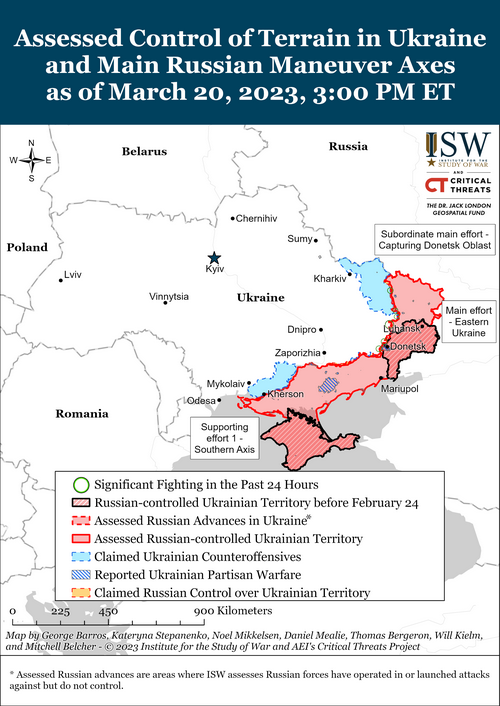
Russian forces made marginal gains in and around Bakhmut amid a reported increase in the tempo of Russian operations around Avdiivka. Russian forces likely made additional gains in southwestern and northern Bakhmut as well as northwest of Bakhmut between Bohdanivka and Khromove as of March 20.[1] The Ukrainian General Staff reported on March 19 that Russian troops attacked toward Berdychi (10km northwest of Avdiivka), which indicates that Russian forces likely advanced west of Krasnohorivka (9km north of Avdiivka) and captured Stepove (just west of Krasnohorivka).[2] Russian forces are likely increasing the tempo of operations north of Avdiivka in an effort to set conditions for the encirclement of the settlement and are reportedly employing a greater number of aviation units in the area to support these operations.[3] Avdiivka Mayor Vitaly Barabash told AFP News on March 20 that Russian forces are increasingly using Kh-59, Kh-101, Kh-555, and S-300 missiles in the Avdiivka area.[4] A Ukrainian military spokesperson stated on March 20 that Russian forces have lost about three unspecified companies (likely referring to infantry) in assaults on Avdiivka since March 19.[5] ISW previously reported that this increased tempo of Russian operations in the Avdiivka area has reportedly led to major losses and is likely a misguided effort to pull Ukrainian forces away from other areas of the front.[6] ISW has not observed Russian forces arraying substantial combat power along the outskirts of Donetsk City, and it is unlikely that Russian forces will be able to sustain this temporary increased tempo. ISW assesses that the overall Russian spring offensive is likely approaching culmination, and Russian forces may be intensifying efforts to make even marginal gains before they lose the initiative in Ukraine.[7] It remains possible that Russian advances could prompt Ukraine to withdraw from Bakhmut and/or Avdiivka although neither appears likely at this time.
Chinese President Xi Jinping met with Russian President Vladimir Putin in Moscow on March 20 and offered a more reserved vision for Russian-Chinese relations than what Putin was likely seeking. Xi and Putin touted the strength of Chinese-Russian relations in their meeting on March 20, but offered differing interpretations of the scale of future relations in articles they published on March 19.[8] Putin published an article in Chinese state media in which he argued that Russia and China are building a partnership for the formation of a multipolar world order in the face of the collective West’s seeking of domination and the United States pursuing a policy of dual containment against China and Russia.[9] Xi offered a less aggressive overarching goal for Russian-Chinese relations in his article published in Russian state media outlet Rossiskaya Gazeta, in which he noted that Russia and China are generally pursuing a multipolar world order but not specifically against an adversarial West.[10] Xi instead focused heavily on presenting China as a viable third-party mediator to the war in Ukraine whose plan for negotiations ”reflects the unity of views of the world community on overcoming the Ukrainian crisis.”[11] Putin wrote that Russia welcomes China’s willingness to ”play a constructive role in crisis management” regarding the war in Ukraine, but Putin likely was hoping for Xi to adopt a similarly aggressive rhetorical line against the West.[12]
Xi’s refusal to explicitly align China with Russia in Putin’s envisioned geopolitical conflict with the West is a notable departure from China’s declared “no limits partnership” with Russia preceding the start of the Russian invasion of Ukraine.[13] Xi’s rhetoric suggests that he is not inclined to fully give Russia the economic and political support that Russia needs to reverse setbacks in Ukraine. Putin and Xi offered somewhat similar visions for increased Chinese-Russian economic partnership, and it is likely that the two will sign bilateral trade and economic agreements during Xi’s visit, some of which will likely aim to facilitate schemes for sanctions evasion.[14] Xi will also likely offer a more concrete proposal for a negotiated settlement to the war in Ukraine, although it remains unclear what his proposal will entail and how receptive the Kremlin will be to it. The prospects of China supplying Russia with military equipment also remain unclear.
Putin is likely increasing his attempts to rhetorically rally the rest of the world against the West, although it remains unlikely that he will achieve decisive effects through this effort. Putin attended the International Parliamentary Conference “Russia-Africa in a Multipolar World” on March 20 and stated that Russia and states in Africa, Asia, the Middle East, and Latin America uphold the norms of social principles, morality, and traditions and oppose neo-colonial ideology.[15] Putin’s depiction of an envisioned Chinese-Russian axis against the West and his comments at the conference likely amount to an intensified proposal to non-aligned countries to form a defined anti-Western bloc. Putin likely hoped that Xi would offer a similar vision to augment this proposal, and Xi’s refusal to do so likely weakens the impacts of Putin’s efforts. The attractiveness of a potential anti-Western Chinese-Russian-based geopolitical bloc lies more with China’s economic and political power than with Russia’s declining economic strength and its military power badly degraded by fighting in Ukraine. Russia’s ongoing diplomatic efforts to generate support for its war in Ukraine continue to produce few tangible results, and an intensified effort to rally the rest of the world against the West will not likely be more effective.
Wagner Group Financier Yevgeny Prigozhin appears to maintain powerful political leverage and regional connections within Russia despite some officials’ attempts to distance themselves from the Wagner Group. Prigozhin claimed on March 20 that Krasnodar Krai Governor Veniamin Kondratyev personally invited a Wagner representative to Krasnodar Krai, overruled local refusals to bury Wagner mercenaries, and informed the representative that the Wagner Group will face no further obstacles burying its dead.[16] Prigozhin on March 18 claimed that authorities in Goryachiy Klyuch, Krasnodar Krai, reneged on an agreement to bury Wagner personnel.[17] A Goryachiy Klyuch official initially told a Wagner representative that Kondratyev stripped him of authority to cooperate with Wagner, which ISW assessed as an indicator of weakening connections between Prigozhin and regional officials.[18] Prigozhin’s ability to reach out to Kondratyev directly and resolve the situation suggests that his leverage in the krai remains strong. Goryachiy Klyuch officials’ initial refusal to bury Wagner mercenaries and ongoing clashes between Prigozhin and St. Petersburg officials over Wagner burials indicate that some authorities do seek to distance themselves from Wagner PMC, however. [19]
Russian authorities are likely unsure of how to redefine Wagner’s new role following Prigozhin’s overextension of Wagner resources and support. The destruction of Wagner forces near Bakhmut is likely forcing Prigozhin and Russian officials to reconsider the role of Wagner while Prigozhin works to rebuild his forces. Several news sources reported on March 20 that Russian political party “A Just Russia – for Truth” leader Sergey Mironov publicly advocated for the legalization of private military companies – such as the Wagner Group – and proposed that the Russian Ministry of Defense (MoD) take control of their oversight, which would likely be a major limitation on Prigozhin’s current freedoms as Wagner’s financier.[20] A Wagner-affiliated milblogger on March 19 accused the Russian MoD of sabotaging Wagner efforts to replenish its ranks in Ukraine with Wagner fighters from further abroad by canceling military transport flights.[21] If true, this report would suggest that the Russian MoD is attempting to prevent Wagner from regaining political leverage and rebuilding its military capabilities in Ukraine while maintaining Wagner’s role abroad. Prigozhin himself appears to be taking every opportunity to increase his media relevance and maintain the Wagner Group’s prominence in the process. Prigozhin has publicized an array of statements picking fights with local officials, amplifying disputes over Wagner burials, commenting on the expansion of Russian censorship laws, commemorating the alleged one-year anniversary of Wagner involvement in Ukraine, and more since March 18 alone.[22]
The Russian information space continues to respond to the International Criminal Court (ICC)’s issuance of arrest warrants for Russian President Vladimir Putin and Russian Commissioner on Children’s Rights Maria Lvova-Belova with ire and anxiety. Kremlin Spokesperson Dmitry Peskov claimed on March 20 that the Kremlin is “calm” about Putin’s arrest warrant and called its issuance “outrageous and unacceptable.”[23] The Russian Investigative Committee, however, opened a criminal case against ICC Prosecutor Karim Khan and several ICC judges on March 20, indicating that Russian leadership feels the need to posture proactively in its response to the ICC despite promises that the arrest warrants are meaningless in the eyes of the Russian government.[24] Russian Security Council Deputy Head Dmitry Medvedev relatedly threatened a missile strike against the ICC and suggested that ”it is quite possible to imagine the point of application of a hypersonic missile carrier from the North Sea from a Russian ship to the Hague courthouse.”[25] Medvedev has notably made continuous inflammatory and escalated threats against the collective West, and his threats should not be taken as more than aggressive informational posturing on the part of the Kremlin.[26] The range of ostensibly diverging Russian responses to the ICC arrest warrants suggests that this event will likely remain a point of neuralgia in the Russian information space and will likely lead to continued legislative and informational responses.
Ukrainian Main Intelligence Directorate (GUR) Spokesperson Andriy Yusov stated on March 20 that the frequency of large Russian missile attacks has decreased. Yusov stated that Russia does not have many Kalibr, Iskander, and Kinzhal missiles left, but still has many S-300 surface-to-air missiles.[27] ISW previously assessed that Russian forces continue to deplete their missile arsenal and may constrain how often and at what scale to conduct missile strikes but will likely continue to threaten Ukrainian critical infrastructure and civilians.[28]
Russia requested that the UN Security Council discuss Israeli airstrikes in Syria possibly in retaliation for Israel’s approval of export licenses for anti-drone jamming systems for Ukraine. Israeli news outlet The Times of Israel reported on March 18 that Russia’s UN representative told the UN Security Council that Israel’s airstrikes in Syria must stop.[29] An Israeli official claimed that Israel had not expected Russia to call for the discussion and feared that Russia would promote a resolution against Israel. Russia’s comments about Israeli airstrikes in Syria occurred after Israeli Foreign Minister Eli Cohen notified Ukrainian President Volodymyr Zelensky about the approval of the export licenses on Cohen’s visit to Ukraine on March 15.[30]
Key Takeaways
- Chinese President Xi Jinping met with Russian President Vladimir Putin in Moscow and offered a more reserved vision for Russian-Chinese relations than Putin likely desires.
- Putin is likely increasing his attempts to rally the rest of the world against the West, although it remains unlikely that he will achieve decisive effects in this effort.
- Wagner Group Financier Yevgeny Prigozhin appears to maintain powerful political leverage and regional connections despite some officials’ attempts to distance themselves. Russian authorities are likely unsure of how to redefine Wagner’s new role following Prigozhin’s overextension of Wagner resources and support.
- The Russian information space continues to respond to the International Criminal Court (ICC)’s issuance of arrest warrants for Russian President Vladimir Putin and Russian Commissioner on Children’s Rights Maria Lvova-Belova with ire and anxiety.
- Ukrainian Main Intelligence Directorate (GUR) Spokesperson Andriy Yusov stated that the frequency of large Russian missile attacks has decreased.
- Russia requested that the UN Security Council discuss Israeli airstrikes in Syria possibly in retaliation for Israel’s approval of export licenses for anti-drone jamming systems for Ukraine.
- Russian sources claimed that Ukrainian and Russian forces conducted offensive operations northeast of Kupyansk.
- Russian forces continued offensive operations near Svatove and Kreminna.
- Russian forces continued making advances in and around Bakhmut.
- Russian forces continued ground attacks along the Avdiivka-Donetsk City frontline and made marginal gains near Avdiivka.
- Russian sources claim that Russian forces are building up defensive fortifications and repelled Ukrainian reconnaissance-in-force operations in Zaporizhia Oblast.
- Russian sources accused unknown actors of planting a bomb that exploded near a gas pipeline in occupied Simferopol, Crimea.
- Russian President Vladimir Putin acknowledged Russian difficulties obtaining components for high-tech industrial production.
- Ukrainian partisans killed Russian-appointed head of the Kherson Oblast pre-detention center Serhii Moskalenko with an improvised explosive device on March 17.
Go here to read the rest. The Ukrainian guerilla war in occupied territories. They rarely make the headlines but they are exacting a steady toll and forcing the Russian to deploy troops needed at the front as rear security.


Why would Putin respond to the ICC warrant with “anxiety”? “Ire” I get, but has he some fear the warrant could be enforced?