
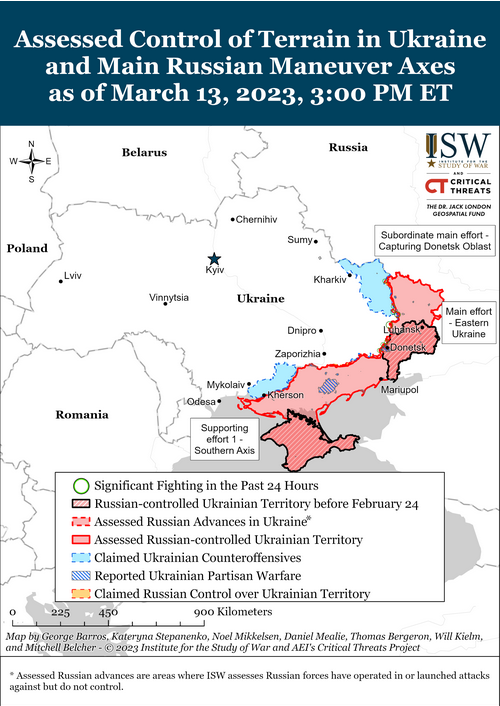
From The Institute For The Study of War:
Russian Offensive Campaign Assessment, March 13, 2023
Riley Bailey, Karolina Hird, Kateryna Stepanenko, Grace Mappes, Layne Philipson, and Frederick W. Kagan
March 13, 7:30 pm ET
Click here to see ISW’s interactive map of the Russian invasion of Ukraine. This map is updated daily alongside the static maps present in this report.
Click here to access ISW’s archive of interactive time-lapse maps of the Russian invasion of Ukraine. These maps complement the static control-of-terrain maps that ISW produces daily by showing a dynamic frontline. ISW will update this time-lapse map archive monthly.
A member of the Kremlin-affiliated Valdai Discussion Club accused Wagner Group financier Yevgeny Prigozhin of pursuing political objectives in Russia that are endangering Wagner forces in Bakhmut. Russian political scientist Aleksey Mukhin—who contributes to the Valdai Discussion Club and Russian state media—commented on Prigozhin’s March 11 sarcastic announcement that he will be running in the Ukrainian presidential election in 2024.[1] Mukhin stated on his Telegram channel that the Russian public began to interpret Prigozhin’s statement as an announcement that he will run for the Russian presidential elections, which are also scheduled for 2024. Mukhin rhetorically asked if Prigozhin notified Russian President Vladimir Putin about his “presidential ambitions.” Mukhin argued that Prigozhin’s presentation of himself as the “commander” of the Wagner private military company (PMC) “directly affects the planning and management of the assault squads’ combat operations.” Mukhin also sarcastically stated that Prigozhin is a “prospective politician” who searches for scapegoats to blame for Wagner’s high losses among personnel. Mukhin observed that everyone knows that the Russian government pays for Prigozhin’s forces and their ammunition and stated that Prigozhin’s failure to acknowledge the support from conventional Russian forces alienated him from other Russian battlefield commanders. Mukhin concluded that Prigozhin “has placed the Wagner fighters in danger of encirclement during the expected Ukrainian counterattack” as a result of his actions. Mukhin stated that Prigozhin now is demanding that Russian conventional forces “cover his flanks,” and that Russian forces may need to put aside their distaste for Prigozhin to prevent further Wagner losses in Bakhmut.
Mukhin’s attack on Prigozhin is in line with ISW’s March 12 assessment that the Russian Ministry of Defense (MoD) may be deliberately expending Wagner forces in Bakhmut in part to derail Prigozhin’s political aspirations.[2] Mukhin’s accusations also support ISW’s assessment that the Kremlin and Russian MoD may be attempting to blame Prigozhin for the slowed pace of advance in Bakhmut and for high casualties among Wagner mercenaries. Mukhin’s statement showcases how the Kremlin may be perceiving Prigozhin’s controversial statements and his threat to Putin’s regime. ISW previously observed harsh criticism towards Prigozhin from milbloggers such as disgraced Russian officer Igor Girkin, but Mukhin’s statement is notable because of his existing affiliation with the Kremlin institution that is the Valdai Club.[3]
Prigozhin likely indirectly responded to Mukhin’s accusations on March 12 but has not scaled back his hostile rhetoric towards the Russian MoD. Prigozhin responded within an hour of Mukhin’s statement, stating that the situation in Bakhmut remains “really hard” and that his “550 attempts” to procure ammunition for Wagner were ignored.[4] Prigozhin, however, emphasized that servicemen subordinated to the Russian MoD have been bringing 12 to 15 cars full of ammunition to Wagner in Bakhmut from Zaporizhia, Donetsk City, and Avdiivka frontlines. Prigozhin noted that “there is no conflict between Wagner PMC fighters and Russian MoD fighters,” and claimed that he is confident that Wagner will continue to receive such donations due to friendly relations with these units. Prigozhin doubled down on his statements on March 13 and reportedly met with an unnamed commander of an unspecified Russian brigade.[5] Prigozhin claimed that he had developed a relationship with unspecified conventional forces after they had suffered a year of “betrayal” and stated that these forces are not covering one of Wagner’s flanks—a statement that mimics Mukhin’s claim that Russian conventional forces are not interested in assisting Wagner.
A Wagner-affiliated milblogger also directly responded to Mukhin’s commentary stating that while Prigozhin was simply “trolling” about his presidential ambitions in Ukraine, he does not need to notify Putin of his political ambitions according to Russian law.[6] The milblogger further echoed Prigozhin’s claims that Wagner is on good terms with conventional forces, which further confirms that Prigozhin’s March 12 and March 13 statements were in response to Mukhin’s accusations.
Chechen Republic Head Ramzan Kadyrov continues efforts to maintain Chechnya’s relevance in the Russian political and military sphere. Kadyrov met with Putin on March 13 to discuss Chechnya’s socioeconomic achievements and domestic developments in 2022.[7] Kadyrov also used the meeting to laud the success of Chechen fighters in Ukraine and emphasized that Chechen fighters are dutifully fulfilling Putin’s orders and “aim to act to the bitter end,” to which Putin responded by acknowledging the role of Chechen fighters and thanking Kadyrov.[8] Kadyrov appeared visibly nervous during the meeting, potentially indicating that he felt considerable pressure to present Chechnya, himself, and his troops to Putin in a positive and productive light.[9] Chechen troops are currently playing a very minimal role on the frontline in Ukraine and mainly appear to be conducting offensive operations near Bilohorivka, Luhansk Oblast, and are otherwise carrying out law enforcement tasks in rear areas of occupied Ukraine.[10] Kadyrov may therefore fear that he is losing favor with Putin because he has very little to show in terms of Chechen combat gains, and likely hoped to correct and bolster his reputation over the course of this meeting. Putin, in turn, likely hopes to pressure Kadyrov into increasing the role of Chechen fighters in combat operations due to continued losses to both the Wagner Group and conventional Russian forces in ongoing offensive operations in Ukraine.
Belarusian President Alexander Lukashenko met with Iranian officials in Tehran on March 13 to expand bilateral cooperation and bolster sanctions mitigations. Iranian state media reported that Lukashenko met with Iranian President Ebrahim Raisi, Supreme Leader Ali Khamenei, and First Vice President Mohammad Mokhber.[11] Raisi and Lukashenko signed eight cooperation agreements in the spheres of comprehensive cooperation, trade, transportation, agriculture, and culture and noted that Belarus and Iran tripled bilateral trade in 2022 compared to 2021.[12] Raisi notably stated that cooperation with Belarus could be a way for both nations to counter sanctions.[13] Lukashenko has frequently acted as a Kremlin vassal in recent trips to foreign countries, and his visit to Tehran is likely a component of the Kremlin’s wider effort to secure continued Iranian support in the face of international sanctions.[14] Iranian state media notably announced on March 11 that Iran has finalized a deal to buy Su-35 combat aircraft from Russia, indicating that military, political, and economic agreements between Tehran and Moscow are continuing to prove mutually beneficial for both parties.[15] The Kremlin will likely continue to leverage Lukashenko’s influence to deepen cooperation with Tehran.
Russian milbloggers continue to speculate about a prospective Ukrainian counteroffensive in southern Ukraine, suggesting increasing concern in the Russian information space about Ukrainian combat capabilities as Russian forces pin themselves on offensive operations in Bakhmut. The milbloggers largely agreed that Ukrainian forces would prioritize an offensive in the south against Berdyansk-Melitopol in Zaporizhia Oblast or Mariupol-Volnovakha in Donetsk Oblast, but some claimed that Ukrainian forces have enough combat power to conduct a second counteroffensive either in another area of southern Ukraine or along the Kupyansk-Svatove line in northeastern Kharkiv Oblast.[16] A Wagner-affiliated milblogger agreed with ISW’s prior assessments on the Ukrainian defense of Bakhmut, claiming that Ukrainian forces are grinding Russian forces’ best available infantry around Bakhmut to reduce Russian forces’ capability to stop any Ukrainian advances.[17] The milblogger claimed that Ukrainian forces would be able to drive south and face minimal Russian resistance in southern Ukraine, unlike other areas of the front line. Another milblogger claimed that Ukrainian forces would target southern Ukraine because a “destroyed Crimea” holds strategic importance while a “destroyed Donbas” does not.[18] Russian State Duma Deputy Dmitry Kuznetsov claimed that Ukrainian forces would target the Kerch Strait Bridge in Crimea in a months-long interdiction campaign like the Antonivskyi Bridge in Kherson Oblast and called on Russian forces to quickly develop anti-drone warfare to defend the critical ground lines of communication (GLOCs) connecting Crimea to mainland Russia.[19]
A Russian State Duma bill aiming to raise the conscription age suggests that the Kremlin is not planning to conduct full mobilization in the future. The Russian State Duma received a bill for consideration on March 13 that would implement Russian Defense Minister Sergei Shoigu’s proposal for raising the conscription age.[20] The bill would raise the maximum conscription age from 27 to 30 immediately while raising the minimum conscription age from 18 to 21 with a one-year annual increase between 2024 and 2026.[21] Shoigu proposed the conscription age increase at the Russian Ministry of Defense (MoD) board meeting on December 21, 2022, and Russian officials have since offered oscillating statements on whether the increase would apply to upcoming conscription cycles in the spring and fall of 2023.[22] The bill’s immediate increase of the maximum age likely seeks to expand the conscription age range to fulfill some portion of the Russian military’s immediate manpower demands in Ukraine and then subsequently shrink the overall conscription demands on Russian society in the following years. The gradual increase of the minimum conscription age means that three-year groups of potential Russian conscripts will essentially receive deferments of three, two, and one years each, while the current year groups eligible for conscription face continued attritional fighting in Ukraine. The Kremlin may be attempting to shield a new generation of Russians from the demographic and social impacts of attritional fighting in Ukraine by siloing these impacts among one generational group of Russians. The timeline given for the contraction of the conscription age range may also suggest that the Kremlin does not expect the war in Ukraine to last longer than the next three years. This proposed expansion of the conscription age range is another incremental force generation effort well below full mobilization and indicates that the Kremlin is still highly averse to the prospect of a full mobilization.
The Russian military is reportedly employing the newly created “assault detachments” in different manners across different tactical situations. A Ukrainian reserve officer who has previously reported on a captured Russian military manual on the new “assault detachment” reported on March 12 that Russian forces are using both formalized permanent assault (“storm”) units and ad hoc temporary assault detachments in Ukraine.[23] The Ukrainian officer reported that Russian forces have integrated permanent assault units into battalion, regiment, and brigade structures and that their size ranges from that of a company to that of a reinforced battalion.[24] Russian forces reportedly assemble temporary assault detachments within a regiment or battalion for specific operations and do not give these temporary detachments a number, name, defined structure, regular commander, or specific armaments.[25] Permanent Russian assault detachments reportedly have designated commanders and are most often comprised of one or two tanks, several armored personnel carriers, and 40 to 80 personnel.[26] Russian forces reportedly will form temporary assault detachments to respond to situations as they arise, and these formations apparently often retreat after initial losses and suffer from significant communication and coordination problems.[27] Russian forces reportedly designed permanent assault units to break through Ukrainian positions and may have modeled them after the Wagner Group‘s small-scale assault tactics in the Bakhmut area.[28] Russian forces have also reportedly used some of these permanent assault units for punitive reasons and forcibly staff them with problematic and disobedient soldiers to retaliate against them for bad behavior.[29]
The Russian military is likely attempting to concentrate combat-ready forces and equipment in permanent formations trained to conduct small-scale assaults while distancing severely degraded formations from offensive operations of tactical importance. Russian forces are reportedly employing these assault formations to attack well-fortified Ukrainian positions and conduct urban warfare.[30] These non-doctrinal formations would likely struggle to conduct a mechanized advance across open country in Ukraine, and Russian forces are likely implementing them for conditions on the current frontlines and not for any wider operational goals.
Ukrainian Deputy Prime Minister and Minister of Reintegration of Temporarily Occupied Territories of Ukraine Iryna Vereshchuk confirmed that Russia has illegally deported 2,161 Ukrainian orphans to Russia.[31] The Ukrainian government previously verified the illegal deportation of a total of 16,207 children to Russia, including those deported alongside their families, and estimated that the total number of children may be closer to 150,000.[32] ISW previously reported on a Russian documentary series following Ukrainian children after adoption into Russian families that claimed that Russian officials “evacuated” over 150,000 children to Russia from Donbas alone.[33] ISW continues to assess that the forcible deportation and adoption of Ukrainian children is a violation of the Geneva Convention on the Prevention and Punishment of the Crime of Genocide and a potential constituent element of a wider ethnic cleansing campaign.[34]
Key Takeaways
- A member of the Kremlin-affiliated Valdai Discussion Club accused Wagner Group financier Yevgeny Prigozhin of pursuing political objectives in Russia that are endangering Wagner forces in Bakhmut. This attack on Prigozhin is in line with ISW’s March 12 assessment that the Russian Ministry of Defense (MoD) may be deliberately expending Wagner forces in Bakhmut to derail Prigozhin’s political aspirations.
- Chechen Republic Head Ramzan Kadyrov continues efforts to maintain Chechnya’s relevance in the Russian political and military sphere.
- Belarusian President Alexander Lukashenko met with Iranian officials in Tehran on March 13 to expand bilateral cooperation and bolster sanctions mitigations.
- Russian milbloggers continue to speculate about a prospective Ukrainian counteroffensive in southern Ukraine, suggesting increasing concern in the Russian information space about Ukrainian combat capabilities as Russian forces pin themselves on offensive operations in Bakhmut.
- A Russian State Duma bill aiming to raise the conscription age suggests that the Kremlin is not planning to conduct full mobilization in the future.
- The Russian military is reportedly employing the newly created “assault detachments” in different manners across different tactical situations.
- Ukrainian Deputy Prime Minister and Minister of Reintegration of Temporarily Occupied Territories of Ukraine Iryna Vereshchuk confirmed that Russia has illegally deported 2,161 Ukrainian orphans to Russia.
- Russian forces continued ground attacks throughout the Kupyansk-Svatove-Kreminna line and made marginal gains northeast of Kupyansk and east of Siversk.
- Russian forces continued making advances in and around Bakhmut but have not succeeded in completing a turning movement, envelopment, or encirclement of the city as of March 13.
- Russian forces continued to conduct ground attacks across the Donetsk Oblast front line.
- Ukrainian forces continue to conduct raids against areas in east (left) bank Kherson Oblast.
- Subordination of mobilized Russian military personnel to Donetsk and Luhansk People’s Republic (DNR/LNR) formations is generating increasing discontent.
- Russian occupation officials continue to introduce new provisions to discourage and restrict the use of the Ukrainian language in educational facilities.
Go here to read the rest.
From Strategy Page:
March 13, 2023: The war in Ukraine isn’t over yet but Russia is already working on needed reforms so, they hope, that the next time Russian troops are in combat they perform better and perhaps even win. There have been several rounds of unsuccessful military reforms since the Soviet Union collapsed in 1991. One of the major causes of that collapse was their unaffordable and largely ineffective armed forces. In post-Soviet Russia there were far fewer restrictions on criticizing the military. Most Russians had a very negative attitude towards conscription and the reforms underway because of the Ukraine War disaster are typical of several previous efforts to remedy problems that continue to resist any fundamental change.
The new plan calls for a massive training program to replace all the officers lost in the first few months of 2022’s fighting. The immediate problem with that is all the officer instructors were sent to the front in March and April 2022 where they too became casualties. Next is that military and political leaders are still unable to restore one crucial aspect of an improved military; NCOs (Non-Commissioned Officers, sergeants in the army, petty officers in the navy). A century ago, Russia abandoned a long tradition of NCOs. Instead, junior officers would try to do everything NCOs handled. That never worked. Providing adequate training for new combat troops is something else that never had a high priority. The new reforms are supposed to change that. There have been similar efforts in the past and none lasted long. There is another serious problem that few want to discuss; corruption. Even in wartime, especially during the recent fighting, corruption was still a problem. Officers and other government officials continued to put their own financial gain above the need to equip the troops with what they needed to survive and win. The difficulty here is that the military’s corruption is rooted in political corruption at the highest levels (Putin and his cronies) and inevitably drifted downward until even supply sergeants routinely steal back (and sell) gear issued to new troops when they are outside their barracks just before leaving for the front. Russia is descending into a Third World state known as a resource kleptocracy, but run by a for-real gangster confederacy. Only with nuclear and biological weapons from before it fell apart.
All this enthusiasm for military reform was thought to have been taken care of in 2022, on the eve to the invasion of Ukraine. As before, it was discovered that previous reforms had not worked.
Those who had followed the history of failed efforts to reform the Russian army since the 1990s were not surprised at what happened to Russian troops when they encountered their Ukrainian counterparts. Before the invasion, most Russians believed that the Ukrainian troops were no match for Russian soldiers. Russians also found it hard to believe that the Ukrainians, who were part of the Soviet Union until 1991 had managed, in less than a decade, to implement many fundamental reforms. Some of these reforms were far more ambitious than any Russia ever attempted. After a few months of fighting in Ukraine it was painfully obvious that Russian troops were no match for their Ukrainian adversaries. Before that, Russians believed that their dismal reform efforts had magically worked as nearly half their combat units assembled on the Ukrainian border.
Reports from the Russian capital, which Ukrainian military leaders believed, indicated the decision had been made to invade despite obvious defects in the training, morale and equipment of Russian units. The reality of the differences between Russian and Ukrainian forces was soon made clear as the advance was stopped short of its goals and suffered heavy casualties in the process. Copies of the attack plan, which were only distributed to a few senior commanders leading the attack, showed that the Russians believed they could quickly reach and take the Ukrainian capital Kyiv and replace the government with a pro-Russian one and declare the war over. At that point the rest of Ukraine was supposed to surrender and get used to being Russian once more.
Many Russians, especially recent veterans or parents of sons approaching conscription age, knew the truth and were perplexed at the decision to invade when so many soldiers were poorly trained and suffering from low morale. Conscripts supposedly prohibited by law from service in a war zone were sent in anyway.
Much of the Russian population continues to cope with the continuing use of conscription, something that has been unpopular since the end of World War II. The post-1991 government goal of having an all-volunteer force failed because it cost more than the government could afford and not enough young Russians were willing to voluntarily serve, even as better paid and treated contract soldiers.
Even though over half of Russian military personnel are now volunteers (serving on contracts) or career officers, the ability of the military to hold onto those contract (“contrakti”) soldiers is always weakened if there are a lot of casualties or too much chance of being sent to a combat zone. Volunteering to be a contract soldier used to be considered a smart move because the Russian economy had been increasingly weak over the last decade. After the fighting began in Ukraine, the contract soldiers suffered has much as the conscripts and junior officers did.
The result of this was contract troops refusing to renew contracts. Most of the combat units sent into Ukraine were composed of contract troops who were killed in large numbers. When the survivors got back to Russia, either because of wounds or because many combat battalions returned because of heavy losses, there was a sudden shortage of contract soldiers. That was because most contract troops were near the end of their two-to-three-year contracts and refused to renew. The army had signed up many soldiers for the new (since 2016) short term (six to twelve month) contracts for former soldiers, or conscripts willing to try it, and found that there were far fewer vets willing to sign these short contracts because so few recent short-term contract soldiers had survived service in Ukraine. The government tried to solve this reluctant contract soldier problem by changing the contracts so that contract soldiers had to remain in the army for as long as the fighting continued. Realizing that it was a death sentence if they were sent back to Ukraine, many contract soldiers simply refused to go. There were so many men refusing to go that the government backed off from threats to prosecute the reluctant contrakti.
Soldiers with time left on their contracts were a liability because they told anyone who would listen that the Ukraine “operation” had been a disaster for Russian troops because of determined and well-armed (with anti-tank weapons) Ukrainians regularly ambushing columns of Russian armored vehicles and quickly destroying most of them. While Russian troops were forbidden to take cell phones with them into Ukraine, the Ukrainians still had them to take photos and videos of the aftermath of these battles, and these were getting back to Russia where Russian veterans of the fighting confirmed they had seen the same grisly evidence of Russian losses or even survived one of these battles.
Russia played down these losses but the Ukrainian military maintained, and published daily updates of Russian losses in terms of soldiers killed, wounded or captured as well as equipment losses. After thirty days of fighting the Ukrainians were claiming that over a third of Russian troops sent into Ukraine had been killed, wounded or captured with even larger quantities of vehicles and weapons lost. After six weeks the Russian military admitted that losses were heavier than previously acknowledged but would not give exact figures. In part that was because an accurate count was not possible until most of the combat units (BTGs, or Battalion Task Groups) had returned or confirmed as destroyed.
Few BTGs were wiped out but many were reduced to half or a third of their original size (about 800 troops and several hundred vehicles). BTG survivors were assigned to other BTGs. Communications, even for BTG or brigade commanders, was unreliable inside Ukraine because of defective radios. That meant senior commanders of armies (which controlled over a dozen BTGs and many support units) were always using outdated data on unit strength and capabilities. This was reported back to Russia and was declared a state secret.
In fact, Russia is making a major effort to keep Ukrainian reports on the fighting from spreading on the Russian Internet. That has been difficult because the Ukrainian after-action reports are all Russians can get as their own government refuses to release much data on casualties. Moreover, the Ukrainian data appears accurate because it often includes pictures and identities of the dead Russian troops and details on the losses individual BTGs suffered. The Ukrainians had better access to where these battles took place and proved it with photos and videos showing destroyed vehicles, some of them identifiable as belonging to a particular Russian unit.
Without a lot of contract soldiers Russia could not replace losses. Replacing lost tanks and other vehicles also proved to be more difficult than expected. On paper Russia had thousands of fully armed and equipped tanks and other armored vehicles in reserve for quickly replacing combat losses. Not surprisingly those reserve vehicles were often in bad shape, having been poorly maintained by conscripts and larcenous civilians who made a lot of money by taking key items from these vehicles and selling them on the black market. These missing items were usually not reported missing until troops received these vehicles, which were generally mobile enough to be driven onto a railroad flatcar for transportation to units needing them. Once received these reserve vehicles were found missing equipment and in need of extensive repairs to make them combat-ready. This was nothing new and has been common since the Soviet Union dissolved in 1991 and the mighty Red Army lost 80 percent of its personnel strength but few of its ships, aircraft, vehicles and heavy weapons. Most of these were “in reserve” though many were found abandoned throughout Russia, and new groups of these resting vehicles are still being found in forests while known concentrations of these vehicles or aircraft have been picked clean of saleable parts.
Conscription was in even worse shape, with the number of conscripts available declining each year. In April 2018 the Russian military only ended up with 128,000 conscripts during the semi-annual draft call. This was the lowest since 2006, a year when there were more young men available as well as more deferments and rampant draft dodging. In the years since 2018 the decline was reversed by issuing fewer deferments, punishing more draft dodgers and enforcing laws against conscripts serving in combat zones. The one exception was if the fighting was in Russia, which was the excuse the government used as it claimed they were not invading Ukraine but reuniting Ukraine with Russia. The Ukrainians as well as Russian conscripts and their families disagreed with this interpretation of the invasion.
Another reason for fewer conscripts is that there were fewer young men to conscript because of lower birth rates and more young men who were in poor physical shape, or addicted to drugs, or had a police record and considered more trouble than they are worth if conscripted. All this was expected but since the 1990s Russia has been seeking solutions and finding none that work well enough to keep the military up to strength.
As early as 2012 a parliament-ordered investigation found that the army was short a third of the privates (lowest ranking enlisted troops) they were supposed to have. The Russian military (mainly the Army and Interior Ministry paramilitary units) are supposed to have a million personnel. But officials admitted in 2011, off-the-record, that the real number was closer to 800,000 and slowly but relentlessly declining. A subsequent investigation confirmed this. In 2021 it was still no more than 800,000. Since 2012 the military has come up with a growing list of solutions for the problem but all these efforts do is slow the decline of military manpower numbers, not reverse it. Current fixes involve calling up reservists (usually for a brief period to test the system) and instead of letting the reservists quickly return to civilian life the military is keeping many of the reservists for six months or more. This was one reason for the short-term (less than 12 month) contract. Doing this too often made reservists refuse to appear when recalled. The economic recession since 2014 (because of low oil prices and sanctions) was supposed to encourage more Russians to volunteer but that did not happen and there was less money for increasing the pay for contract soldiers. Recruiting foreigners had minimal impact and so the Russian military keeps fading away.
The military has 220,000 officers, also on contracts, and many veteran “contract personnel” who provide technical experts and other senior enlisted personnel. These are higher paid contract soldiers, some with a decade or more of service, who often become the long-absent Russian NCO (Non-Commissioned Officer, or sergeants) but there are not enough of these NCOs to make a difference. Conscripts still make up nearly half of the military and it’s getting harder and harder to find enough people to conscript or willing to sign a contract. This means there are two classes of Russian military personnel. Most (about 70 percent) are much less capable with most of them conscripts in for one year of service or new contract soldiers on two or three-year contracts. These are supervised by inexperienced junior officers, a few career NCOs and a splattering of senior contractees. A third of the military are more enthusiastic volunteers and conscripts. These staff the elite special operations, airborne, security and specialist units. In other words, while the government claims to have a million military personnel on duty, the reality is the reality is that there are only about 200,000 troops on active duty who are good at what they do and want to be in the military.
Conscripts are inducted twice a year, in April and October. In 2011, the April intake was nominally 220,000 but fewer than that actually made it into uniform. In 2018 the April draft was 128,000. In 2011 only about 75 percent of the men who showed up were considered fit to take. In 2018 standards of “fitness for military service” became much less strict and the military had to cope with a lot more recruits who are of marginal use.
By 2012 the military reluctantly accepted the fact that they would not be able to obtain more than 270,000 conscripts a year needed to reach the official strength of a million personnel. In the last six years maintaining anything close to that number meant taking less willing and able men. Senior leaders now accept that they will never command a million-man force.
Lowering their standards in order to make their annual quotas just fills the ranks with more troublesome people, who cause more of the good troops to get out. In the last few years, the military has quietly stopped accepting many volunteers or conscripts from Moslem areas, especially the Caucasus (particularly Chechnya and Dagestan). The wisdom of this was made clear when Russian intelligence reported that the most effective Russian Moslems who joined and fought for Islamic terrorist groups were military veterans. In contrast, Russian Moslems who had not served in the military were less likely to become Islamic terrorists and if they did, they were used as suicide bombers or support staff, not as long-term fighters. Moreover, commanders continued to report that if more than a few percent of their troops were Moslem there would be morale problems or worse.
The basic recruiting problem is twofold. First, military service is very unpopular, and potential conscripts are increasingly successful at dodging the draft deliberately or otherwise. The corruption of conscription officials has reached staggering levels. But the biggest problem is that the number of 18- year-olds is rapidly declining each year. By 2009 all draftees were born after the Soviet Union dissolved. That was when the birth rate went south year after year. Not so much because the Soviet Union was gone but more because of the economic collapse (caused by decades of communist misrule) that precipitated the collapse of the communist government. The number of available draftees went from 1.5 million a year in the early 1990s to less than half that today. Less than half those potential conscripts are showing up and many have criminal records or tendencies that help sustain the abuse of new recruits that have made military service so unsavory.
With conscripts now in for only a year, rather than two, the military is forced to take a lot of marginal (sickly, overweight, bad attitudes, drug users) recruits in order to keep the military and Ministry of Interior units up to strength. This worked during the cold war because conscript service was three years for elite units. With one-year conscripts, elite airborne and commando units using some conscripts find that these eager conscripts take a year to master the skills needed to be useful and then they are discharged. Few choose to remain in uniform and become career soldiers. That’s primarily because the Russian military is seen as a crippled institution and one not likely to get better any time soon. With so many of the troops now one-year conscripts, an increasing number of the best officers and NCOs get tired of coping with all the alcoholics, drug users, and petty criminals that are taken in just to make quotas. With the exodus of the best leaders and a growing proportion of ill-trained and unreliable conscripts, the Russian military is more of a mirage than an effective combat (or even police) organization.
The military is unpopular for conscripts mainly because of the brutal treatment they receive. This has not been getting better and “hazing” incidents are still increasing each year. This is serious stuff. There are a lot of reasons for not wanting to be in the Russian Army but the worst of them is the hazing. One year conscription was supposed to solve this but new conscripts are tormented by conscripts who have been in a few months longer. It was thought that this sort of thing would speed the demise of conscription in Russia once the Cold War ended in 1991. Didn’t work out that way. The government found that, even among the “contract soldiers”, the old abuses lived on and that most of the best contract soldiers left when their contract was up. It was because of the brutality and lack of discipline in the barracks. The hazing is most frequently committed by troops who have been in six months or so against the new recruits. But this extends to a pattern of abuse and brutality by all senior enlisted troops against junior ones. It remains out of control. The abuse continues to exist in part because of the growing animosity against troops who are not ethnic Russians and especially against those who are Moslem. Because of higher birth rates among the Moslem populations, nearly 15 percent of eligible conscripts are Moslems and that is seen as more of a problem than a solution.
This hazing originally developed after World War II, when Russia deliberately avoided developing professional NCOs. They preferred to have officers take care of nearly all troop supervision. The Soviets failed to note that good NCOs were the key to effective troops. The Soviets felt that officers were more politically reliable, as they were more carefully selected and monitored. The NCOs that did exist were treated as slightly more reliable enlisted men but given little real authority. Since officers did not live with the men, slack discipline in the barracks gave rise to the vicious hazing and exploitation of junior conscripts by the senior ones. This led to very low morale, and a lot of suicides, theft, sabotage, and desertions. This hazing has been one of the basic causes of crimes in the Russian armed forces, accounting for 20 to 30 percent of all soldier crimes. This caused a military suicide rate that is among the highest in the world. Poor working conditions in general also mean that Russian soldiers are nearly twice as likely to die from accidents, or suicide, then American soldiers. Long recognized as a problem, no solution to the hazing ever worked.
Conscription itself, and the prospect of being exposed to hazing, produced a massive increase in draft dodging starting during the Soviet period. Bribes and document fraud are freely used. Few parents, or potential conscripts, consider this a crime. Avoiding the draft is seen as a form of self-preservation. The government has cracked down on parent-backed draft dodging with little effect. That’s because there is still so much corruption in Russia and evading conscription is seen by many as not really criminal, especially when the parents can afford to pay a bribe to keep their only son (and often an only child) out of the Russian military.
The Russian lack of sergeants (praporshchiki) has been difficult to fix. Just promoting more troops to that rank, paying them more, and telling them to take charge, has not done the job. So going back to look at how Western armies do it, the Russians noted that those foreign armies provided a lot of professional training for new NCOs and more of it as the NCOs advanced in rank. But this is a long-term process and takes years before benefits will be felt. By 2022 there were more veteran NCOs available and they probably made a difference. But the losses were so heavy in Ukraine that it may never be known how good Russian professional NCOs had become.
All this is in sharp contrast to the old days. When the Soviet Union dissolved in 1991, it had five million troops in its armed forces. Now it’s less than 800,000 in just Russia (which has about half the population of the Soviet Union but most of the territory). Although the Russian armed forces lost over 80 percent of its strength by the end of the 1990s, a disproportionate number of officers remained. This problem was solved, after encountering much resistance from officers in general and, after a series of reforms, the number of officers was reduced by over 50 percent.
The Russian military has an image problem that just won’t go away easily. This resulted in the period of service for conscripts being lowered to one year (from two) in 2008. That was partly to placate the growing number of parents who were encouraging, and assisting, their kids in avoiding military service.
Go here to read the rest. Russia needs a mass army to conquer Ukraine, a force not less that three million, trained, equipped and well supplied. They have nothing approaching this and are not taking the steps necessary to build such a force.


Strategy Page is a good summation of recent history and present status of Russia. If they had spent more time and effort on real reform after 1991, there would be little to fear from any country on their border, including China, and would have been fully welcomed into the community of nations. The flashes of sanity that have appeared briefly over the centuries disappear rather quickly and the populace is left much the same as the status quo ante until the next cycle of despotism followed by a bit of sunlight. A vicious cycle that seems destined to repeat ad infinitum.
I’ve said before on these pages: Russia had no Nuremberg after the fall of the USSR. If in 1991 the head Reds had been rounded up, tried and hanged, like the German Nazis in 1945, and had all the truths of the gulags come forth, Russia would be less likely to be where it is. Somebody else had to force that on Germany, but Russia is too big for an outside force to take it down. Putin is too typical: the arrogance of a Byzantine Emperor and the brutality of a Mongol khan (the too-real model for historic Russian governance).
Ukraine is a threat because it recalls the old days of pre-Mongol Russia: a time of the “Russias”, independent princely states with a common culture and religion, many vibrant and prosperous, allied but not under a single supreme leader, and very friendly with the West. That history is a fascinating read, before all was crushed under the heel of Muscovy.
I checked out The Remnant today. In its website there was a blurb by Michael Matt about how the US needed to get out of Ukraine NOW.
Given the fact that the US does not have boots on the ground in Ukraine, this makes Matt come across like a crackpot.
I find it disgusting that anyone, regardless of religious or political persuasion, would support Putin and Russia.
The comboxes at Breitbart and American Greatness get filled with anti-Ukraine rhetoric. Breitbart gets anti-Polish garbage now, too. For certain there are an unknown number of Russian bots filling the comboxes with anti NATO and anti Ukraine rhetoric. The so called conservative news sites have been conspicuously silent on Russian atrocities, as these do not fit their isolationist narrative.
The Ukrainian government did crack down on Orthodox churches in Ukraine affiliated with the Moscow Patriarch, seeing them as abetting the enemy, and no doubt some of them have done just that.
Libertarian meme YouTubers trash Zelensky every chance they get. It is as if Ukraine is the sole reason there is an American budget deficit. The media even twisted Zelensky’s words about getting help…they made it sound as if Zelensky was demanding American troops to join the fight..what he said is if Ukraine falls, and Putin attacks the Baltics or Poland, America is bound by treaty to fight..if that happens, Tucker Carlson will blame the Baltics and or Poland.
The Right is almost as crazy as the Left. The Never Trumpers helped bring Biden into the White House and I am certain McConbell is in as much as Pelosi about January 6. Trump refuses to get over the election and trashes DeSantis when he should trash Biden. Only Trumpers detest DeSantis because DeSantis allegedly has communicated with the Establishment and in their feeble minds, this means they own DeSantis.
Stupid has no boundaries.
My view is that Putin will keep up the war hoping that the West will abandon Ukraine. Germany clearly does not want to help Ukraine. Protests in Czechia and France are going on against helping Ukraine. Hungary has never wanted to help Ukraine. Orban wants his energy coming from Russia unabated. Germany does, too.
The EU is more interested in gay marriage, abortion and transgenderism than solving problems.
Meanwhile, Canada has an empty headed elected dictator, the US has the worst president in history, the media and official Washington have been caught in another lie that dwarfs Watergate and the GOP does what it does best…be what Samuel Francis called them…the Stupid Party.
Oh, and as for Michael Matt and The Remnant…Matt should be invited to any Ukrainian Catholic church to run his mouth. What a phony.
I don’t think Matt is a phony. The problem is that many traditionalists are eccentrics whose worldview leaves them vulnerable to crank narratives on secular matters. The secular palaeo / Unz subculture is similar. One of the disagreeable features of the new corps of publications which have appeared to replace National Review is that they tend to trade in palaeo / Unz inanity on foreign relations. (Note, Steve Sailer’s comment boards are irritated with him for his lack of sympathy for Putin’s schemes, even though Sailer himself accepts the hooey about Victoria Nuland et al being foundationally responsible for the conflict).
Well, Art, you and I can disagree on who Matt really is, but his willful ignorance of Central and Eastern Europe at first amazed me, now I just find it disgusting. Do I like it that Ukraine is asking for weapons and money? Nope. Why people cannot understand that Russia is doing what Russia has done for centuries – grab land inhabited by its neighbors, throw them out and or kill them, then claim that the land is and always was Russian…there is no developing the state, the economy, the welfare of the people. Putin is a dictator and has been in control for the entire century and will not go away on his own.
Your points about Trads being eccentrics is not off base. I saw the Giant Meteor bumper stickers at church back in 2016. The conversations I have overheard about establishing a monarchy made my head spin. Trads are frequently unaware of the Eastern Churches, even blissfully so.
I have blabbed endlessly here about my Polish heritage. it’s a blessing and a curse. Poles don’t forget anything,,,even when we are third and fourth generation Americans. Russia has been the cause of so much suffering and death for the Polish people over the centuries…fellow Slavs but never allies or friends. We see Russia for who and what it really is and the truth is clearly exposed in its actions in Ukraine.