
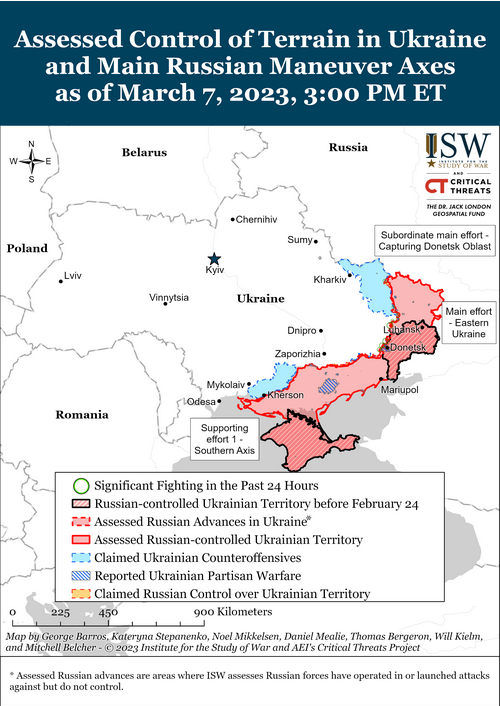
From The Institute For The Study of War:
Karolina Hird, Grace Mappes, Nicole Wolkov, George Barros, and Mason Clark
March 7, 8:15 pm ET
Click here to see ISW’s interactive map of the Russian invasion of Ukraine. This map is updated daily alongside the static maps present in this report.
Click here to access ISW’s archive of interactive time-lapse maps of the Russian invasion of Ukraine. These maps complement the static control-of-terrain maps that ISW produces daily by showing a dynamic frontline. ISW will update this time-lapse map archive monthly.
Ukrainian President Volodymyr Zelensky stated on March 7 that the hypothetical Russian capture of Bakhmut would provide Russian forces an “open road” to Kramatorsk, Slovyansk, and other critical settlements in Donetsk Oblast.[1]
ISW continues to assess, however, that Russian forces lack the capability to exploit the tactical capture of Bakhmut to generate operational effects, and will likely rapidly culminate following the capture of Bakhmut. As ISW has previously assessed, Russian forces would have to choose between two diverging lines of advance after capturing Bakhmut. Russian forces could attempt to push west along the T0504 highway towards Kostiatynivka (about 20km from Bakhmut) or could push northwest along the E40 highway towards the Slovyansk-Kramatorsk area in northwestern Donetsk Oblast (about 40km northwest of Bakhmut).[2] These two potential axes of advance are not mutually supporting, and degraded Russian forces would likely have to prioritize the pursuit of just one to have any chance of success – though Russian commanders have repeatedly stretched their forces too thin across multiple axes of advance throughout the invasion of Ukraine. Ukrainian forces have also heavily fortified both of these routes, which are supplied by numerous ground lines of communication (GLOCs) running deep into the Ukrainian rear, and any Russian attempt to advance down these roads would likely be highly costly.[3]
Russian forces additionally likely lack the mechanized forces necessary to advance beyond Bakhmut, and the tactical “assault detachments” used in assaults against Bakhmut are likely unable to conduct maneuver warfare. Recent Russian advances within urban areas of Bakhmut demonstrate that Russian forces can secure limited tactical gains with infantry-led frontal assaults.[4] Russian forces likely lack the mechanized forces necessary to exploit the roads (which are likely highly fortified) west of Bakhmut. As ISW has recently reported, Russian forces are increasingly relying on “assault detachments,” a battalion-size element optimized for frontal assaults on fortified areas, rather than for maneuver warfare.[5] These detachments are artillery-heavy, use simplified tactics, relegate tanks to a fire support role in rear areas, and would almost certainly struggle to effectively conduct operations beyond urban areas. A prominent Russian milblogger echoed this observation on March 7, noting that assault detachments are simply too small to “punch a wide and deep gap” in Ukrainian defensive formations and follow with tank and mechanized battalions, and called for the formation of “breakthrough brigades,” a change likely far beyond the current capabilities of Russian forces in the area.[6] The continuing devolution of Russian force structure towards small assault detachments using simplified tactics, combined with mounting losses among the most effective Russian troops, will likely greatly limit the ability of Russian forces to properly exploit any paths of advance opened by the capture of Bakhmut Russian forces remain unlikely to secure more than a tactical victory following 10 months of assaults.
Russian Defense Minister Sergey Shoigu reiterated boilerplate rhetoric seeking to deter further Western military aid to Ukraine during a conference call on March 7.[7] Shoigu reiterated senior Russian officials’ tired claims that Western states aim to destroy Russia by providing arms to Ukraine and have begun an information war targeting Russia. Shoigu invoked the commonly referenced historical memory of World War II to justify the war in Ukraine, calling on Russians to prevent lessons learned from defeating Nazism “to be distorted and forgotten.” Shoigu claimed that Russian forces killed over 11,000 Ukrainian military personnel in February 2023, which he claimed was a 40 percent increase from Ukrainian casualties in January. Shoigu’s speech did not craft any new rhetorical arguments that could shape the Russian information space and garner more domestic support for the war effort, continuing to rely on standard tropes in the absence of any Russian successes.
Shoigu also outlined long-term and likely aspirational efforts to restore and expand the Russian officer corps.[8] Shoigu stated that the Russian military is undergoing a phased increase and needs to recruit about 18,000 students and cadets for officer training. Shoigu noted that the Russian Ministry of Defense (MoD) needs to increase staffing at Russian universities to provide adequate training for over 280 military specialties and claimed that Russians are increasingly interested in the engineering and flight specialties. Shoigu also stated that children of Russian military personnel and students at select schools will undergo selection for military specialties before taking the necessary exams. Shoigu also noted claimed ongoing efforts by Russian forces in Ukraine to refine training processes, increase the protection of military personnel, and increase the efficiency of military operations.
Russia exchanged 130 Ukrainian prisoners-of-war (POWs) for 90 Russian POWs on March 7. The Ukrainian State Border Service reported that of the 130 Ukrainian soldiers released, 87 fought in Mariupol, including 71 Azovstal defenders.[9] The Russian Ministry of Defense (MoD) reported that 90 Russian soldiers returned to Russia, and a Russian milblogger posted footage claiming to show the released Russian soldiers receiving new boots and clothes in Belgorod Oblast.[10]
Russian independent polling organization The Levada Center released poll results that 51 percent of Russians feel negatively toward Russians who left the country due to mobilization.[11] Ten percent of Russians polled indicated that they have a positive or understanding attitude toward those that left. The Levada Center poll indicated that Russians over 55 years old and those living in rural areas and cities with fewer than 100,000 residents are most likely to have negative attitudes toward Russians who left due to mobilization. The Levada Center’s polling data demonstrates that the Kremlin retains a strong hold over the domestic information space. The poll did not ask questions regarding attitudes to the war itself, indicating at minimum negative feelings towards those that escaped mobilization, if not overt support for the war.
The New York Times (NYT) reported on March 7 that low-confidence and unverified intelligence reviewed by US officials may suggest that a pro-Ukrainian group carried out an attack on the Nord Stream pipelines in September 2022. US officials reported that they know very little about the “perpetrators or their affiliations,” but that they may be “opponents” of Russian President Vladimir Putin.[12] The NYT article emphasizes that US officials refused to disclose the nature of the intelligence and have not settled on an explanation of the Nord Stream attacks, and this leak remains low-confidence.
US Air Force General James B. Hecker, commander of US Air Forces in Europe-Air Forces Africa, and NATO Allied Air Command confirmed on March 6 that the US has provided Ukraine with Joint Direct Attack Munition Extended Range (JDAM-ER) kits.[13] Hecker noted that the JDAM-ERs arrived in Ukraine three weeks ago and have a range of 72km.[14] Russian milbloggers generally had a muted response to the announcement, with one Russian source voicing concern that JDAM-ERs will allow Ukrainian forces to launch strikes against Russian front and near rear positions without running the risk of entering Russian airspace.[15] Another Russian milblogger remarked that Russian troops are responding to the use of JDAM-ERs with their own use of guided bombs to strike Ukrainian positions.[16]
Key Takeaways
- Ukrainian President Volodymyr Zelensky stated on March 7 that Russian forces will have an “open road” to capture key cities in Donbas. ISW continues to assess, however, that Russian forces lack the capability to exploit the tactical capture of Bakhmut to generate operational effects, and will likely rapidly culminate following the capture of Bakhmut.
- Russian forces likely lack the mechanized forces necessary to advance beyond Bakhmut, and the tactical “assault detachments” used in assaults against Bakhmut are likely unable to conduct maneuver warfare.
- Russian forces have likely captured the eastern part of Bakhmut east of the Bakhmutka River following a controlled Ukrainian withdrawal from eastern Bakhmut as of March 7.
- Russian Defense Minister Sergey Shoigu reiterated boilerplate rhetoric seeking to deter further Western military aid to Ukraine.
- Shoigu additionally outlined long-term and likely aspirational efforts to restore and expand the Russian officer corps.
- Russia exchanged 130 Ukrainian prisoners-of-war (POWs) for 90 Russian POWs on March 7.
- Russian independent polling organization The Levada Center released poll results that 51 percent of Russians feel negatively toward Russians who left the country due to mobilization, indicating at minimum negative feelings towards those that escaped mobilization, if not overt support for the war.
- The New York Times (NYT) stated on March 7 that low-confidence and unverified intelligence reviewed by US officials may suggest that a pro-Ukrainian group carried out an attack on the Nord Stream pipelines in September 2022, but made clear this is a very low confidence assessment.
- US Air Force General James Hecker confirmed on March 6 that the US has provided Ukraine with Joint Direct Attack Munition Extended Range (JDAM-ER) kits.
- Russian forces conducted limited ground attacks along the Kupyansk-Svatove-Kreminna line.
- Russian forces continued ground attacks along the Avdiivka-Donetsk City line.
- A Russian source claimed that Ukrainian forces attempt to conduct operations across the Dnipro River in Kherson Oblast.
- Russian federal authorities continue to place the onus of solving mobilization issues onto Russian regional authorities who then absolve themselves of ongoing Russian command issues.
- Russian occupation authorities continue to import employees from various Russian law enforcement agencies to staff vacancies in occupation administrations.
Go here to read the rest. For Russia the War may as well not exist outside of the Don Bas. The Russians seem to lack the military strength except to take relatively minor operations for villages and towns in the Don Bas and to undertake such operations with such lack of skill that they are slow and costly in Russian lives.

