
From The Institute For The Study of War:
Karolina Hird, Riley Bailey, Angela Howard, Nicole Wolkov, George Barros, and Frederick W. Kagan
March 4, 6:00 pm ET
Click here to see ISW’s interactive map of the Russian invasion of Ukraine. This map is updated daily alongside the static maps present in this report.
Click here to access ISW’s archive of interactive time-lapse maps of the Russian invasion of Ukraine. These maps complement the static control-of-terrain maps that ISW produces daily by showing a dynamic frontline. ISW will update this time-lapse map archive monthly.
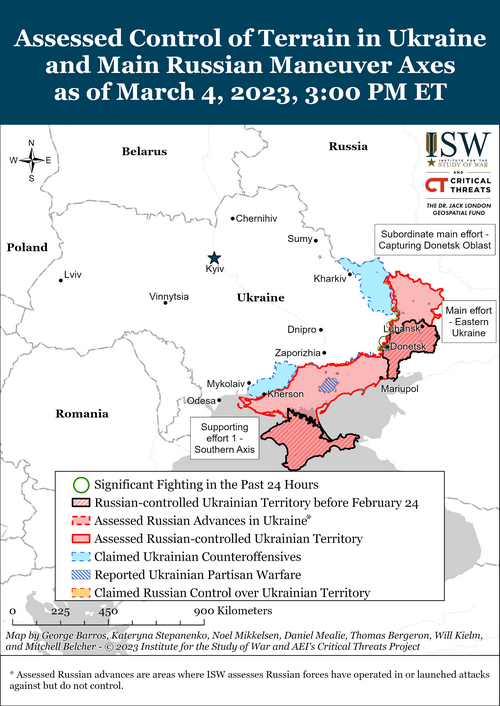
Russian forces appear to have secured a sufficient positional advantage to conduct a turning movement against certain parts of Bakhmut but have not yet forced Ukrainian forces to withdraw and will likely not be able to encircle the city soon. Russian forces made one limited confirmed advance near Bakhmut on March 4.[1] As ISW reported on March 3, Ukrainian forces are likely setting conditions for a controlled fighting withdrawal out of particularly difficult sectors of eastern Bakhmut, although it is not clear that Ukrainian commanders have decided to withdraw at this time.[2] Russian sources claim that Wagner Group elements have made gains in northeastern and eastern Bakhmut over the past few days, creating a tactically challenging turning movement in urban areas in northern Bakhmut.[3] Ukrainian officials have recently reiterated that Ukrainian forces still control the situation in Bakhmut but have noted that circumstances are increasingly complicated and that the Wagner Group has committed its most advanced and prepared elements to assault operations in the area.[4]
Russian advances in Bakhmut have been slow and gradual and do not suggest that Russian forces will be able to encircle Bakhmut soon, much less that they will be able to take the city by frontal assaults. The Russians have, rather, managed to push close enough to critical ground lines of communication from the northeast to threaten Ukrainian withdrawal routes in a classical envelopment maneuver. The purpose of a turning movement is to force the enemy to abandon prepared defensive positions and is different from the aim of an encirclement, which is to trap and destroy enemy forces. The Russians may have intended to encircle Ukrainian forces in Bakhmut, but the Ukrainian command has signaled that it will likely withdraw rather than risk an encirclement. ISW assesses that Ukrainian forces are far more likely to withdraw than to become encircled and that the Ukrainians might still be able to hold their positions in Bakhmut if they choose to try. Russian forces have been suffering high casualties in these advances, and Ukrainian commanders’ assessments of the likelihood that they can force Russian attacks to culminate near or behind their current positions balanced against the risk of losing access to essential withdrawal routes will likely guide the Ukrainian decision to stay or pull back.
Russian Defense Minister Sergei Shoigu met with Eastern Military District (EMD) Commander Colonel General Rustam Muradov in western Donetsk Oblast, likely to assess the extent of Russian losses around Vuhledar and the possibility of further offensives in this direction. The Russian Ministry of Defense (MoD) published a video on March 4 purporting to show Shoigu visiting Muradov in an unspecified area of western Donetsk Oblast and claimed that Muradov delivered a report on the current situation and actions of Russian forces in his area of responsibility.[5] Russian forces suffered catastrophic losses in a recent three-week offensive near Vuhledar, and severe personnel and equipment constraints are likely preventing Russian forces from making even marginal advances in this direction.[6] The Russian MoD may be considering whether transferring reserves of manpower and equipment to the Vuhledar area for renewed offensive operations is a worthwhile effort. The Russian MoD recently confirmed that Muradov is the EMD commander, and the substantial losses around Vuhledar have likely already caused Muradov significant reputational damage.[7] Shoigu may have therefore visited western Donetsk Oblast also to assess Muradov’s continued suitability for the position of EMD commander. Shoigu’s visit to Ukraine may suggest that the Russian MoD lacks confidence in Chief of the General Staff and theater commander of all Russian forces in Ukraine Army General Valery Gerasimov, who likely should have been the officer making this frontline visit or at least accompanying Shoigu.[8] Russia’s military district commanders report to Gerasimov on operational matters, and Shoigu’s publicized solo visit to western Donetsk appears to undermine Gerasimov.
The Chinese government is reportedly displeased with the Kremlin over the publicization of arms sales discussions. The Economist reported on March 2 that an unspecified European official claimed that the Chinese government wanted discussions of lethal aid to remain secret so that China could maintain its image as a neutral mediator.[9] CNBC News reported on March 3 that US officials have indicated that information regarding Chinese considerations to send Russia arms was an assessment ”gleaned” from Russian officials.[10]
Russian State Duma Defense Committee Head Andrey Kartapalov stated that Russian companies should purchase their own air defense systems to defend against drones. A Russian state-owned news source reported that Kartapalov claimed on March 1 that Russian Ministry of Defense (MoD) resources are focused on protecting critical state and military facilities. He argued that every “self-respecting corporation” should be able to purchase and install such systems for themselves.[11] This bizarre proposal would likely create further security issues for Russia, not resolve them, as the prospect of numerous companies fielding and presumably using their own air defense systems independent of the Russian military should alarm any sane Russian official. Kartapalov’s statements are almost certainly an extension of the domestic panic inflamed by reports of the March 2 incursion into Bryansk Oblast and accusations of recent Ukrainian drones in Russian airspace. Kartapalov may have additionally hoped to place the onus of defense on individual enterprises to frame Ukrainian activity as a direct threat to domestic Russian affairs.
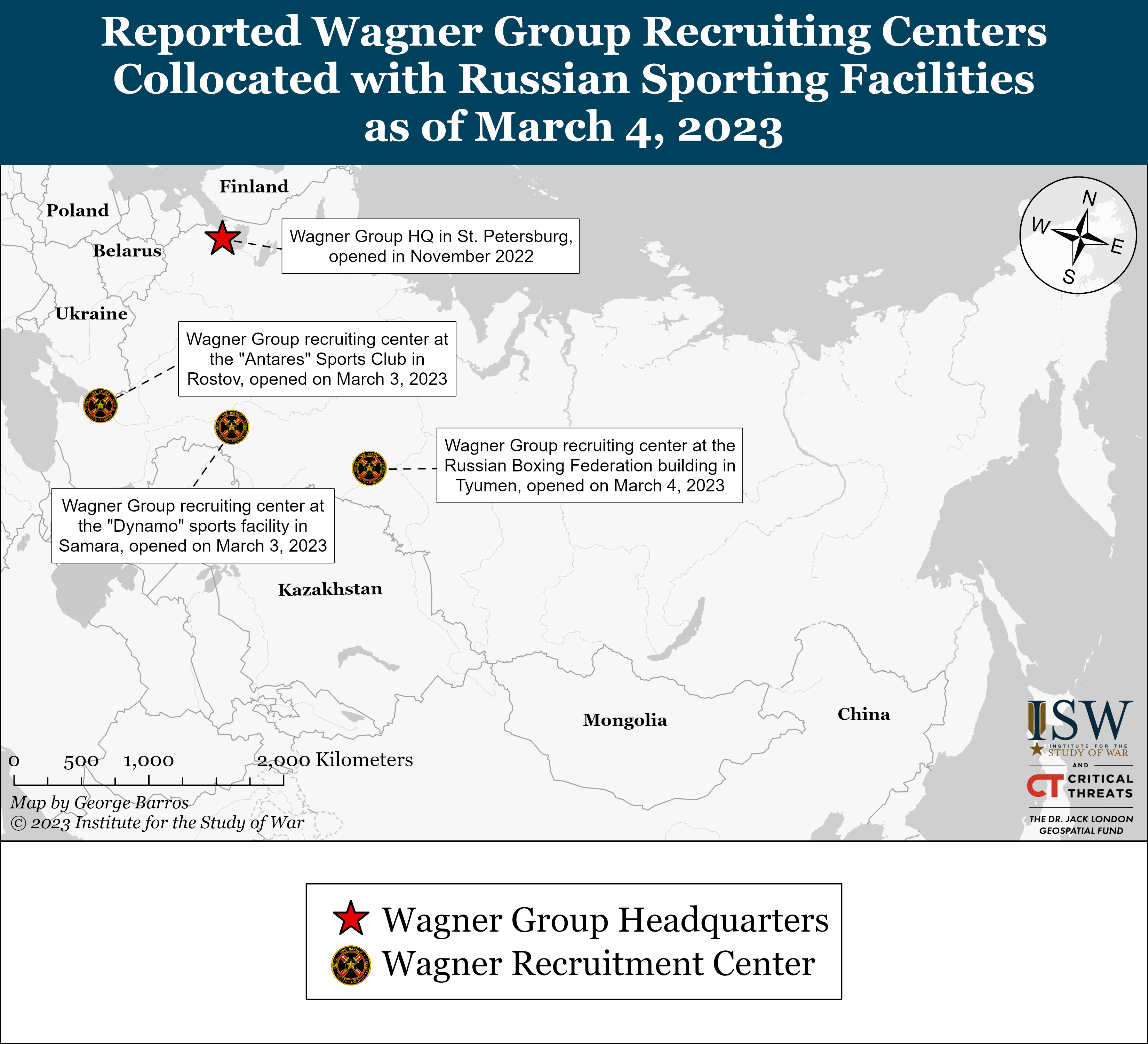
The Wagner Group reportedly opened at least three new recruitment centers at Russian sports clubs between March 2 and 4, possibly to augment Wagner’s recruitment base after losing access to prisoner recruits. The Wagner Group reportedly opened at least three new recruiting centers collocated with Russian sporting clubs since Wagner Group financier Yevgeny Prigozhin officially announced that Wagner launched recruiting efforts through Russian sports club on March 2.[12] The new Wagner recruiting centers are reportedly based at the “Dynamo” sports facility in Samara, the “Antares” Sports Club in Rostov, and the Russian Boxing Federation building in Tyumen.[13] This effort may seek to offset decreases in Wagner recruitment after the Wagner Group reportedly lost access to recruiting prisoners in early 2023. Prigozhin insinuated on March 3 that Russian government officials barred the Wagner Group from recruiting prisoners—just as the Russian Ministry of Defense sabotaged Wagner Group forces’ ammunition supplies.[14] Prigozhin announced on February 9 that Wagner had completely stopped recruiting prisoners but did not characterize it as the result of a Russian government ban at that time.[15] Russian media additionally reported that Wagner has opened a ”Wagnernyok” youth club in St. Petersburg.[16]
Key Takeaways
- Russian forces appear to have secured a sufficient positional advantage to conduct a turning action against certain parts of Bakhmut but have not yet forced Ukrainian forces to withdraw and will not likely be able to encircle the city soon.
- Russian Defense Minister Sergei Shoigu met with Eastern Military District Commander Colonel General Rustam Muradov in western Donetsk Oblast, likely to assess the extent of Russian losses around Vuhledar and the possibility of a further offensive in this direction.
- The Chinese government is reportedly angry with the Kremlin over the publicization of arms sales discussions.
- Russian State Duma Defense Committee Head Andrey Kartapalov encouraged Russian companies to purchase their own air defense systems to defend against drones.
- The Wagner Group reportedly opened at least three new recruitment centers at Russian sports clubs between March 2-4, possibly to augment Wagner’s recruitment base after losing access to prisoner recruits.
- Russian forces conducted offensive actions along the Kupyansk-Svatove-Kreminna line.
- Russian forces continued efforts to encircle Bakhmut and conduct ground attacks along the Donetsk Oblast front line.
- Ukrainian sources continue to report that Russian forces are trying to set conditions for offensive operations in southern Ukraine.
- Chechen Republic Head Ramzan Kadyrov continues apparent efforts to increase Chechen influence within Russia through promoting Chechnya’s Special Forces (SPETSNAZ) and youth policy efforts.
- Russian occupation administrations are strengthening law enforcement measures in occupied territories.
Go here to read the rest. And the Russian small war in the Don Bas continues. No evidence that the Russians are doing anything to prepare for a major offensive.

