
From The Institute For The Study of War:
Riley Bailey, Grace Mappes, Layne Philipson, Kateryna Stepanenko, Karolina Hird, George Barros, and Frederick W. Kagan
February 24, 7:00pm ET
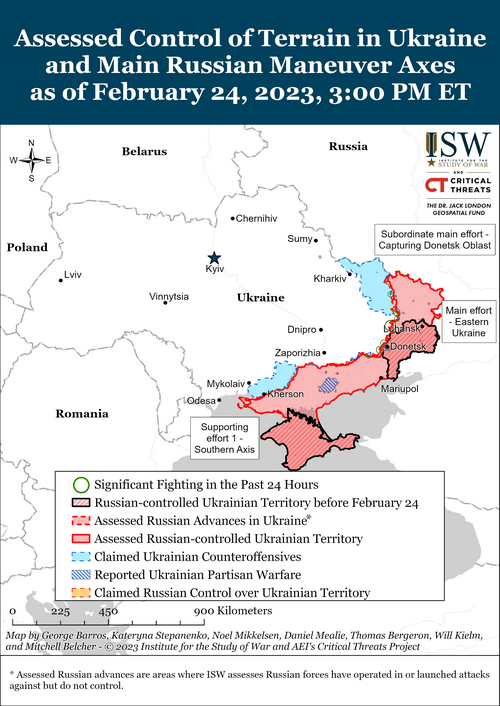
Click here to see ISW’s interactive map of the Russian invasion of Ukraine. This map is updated daily alongside the static maps present in this report.
The Kremlin did not comment on the first anniversary of Russia’s full-scale invasion of Ukraine on February 24, likely because Russia has failed to achieve any of its stated objectives and has not made significant territorial gains since July 2022. Russian President Vladimir Putin and his administration made no statements relating to the anniversary even though Putin has made numerous public appearances over the past three days.[1] Deputy Chairman of the Russian Security Council Dmitry Medvedev made inflammatory claims that Russia will win the war and reiterated that it is vital for Russia to achieve its goals to “push back the borders that threaten [Russia] as far as possible, even if they are the borders of Poland.”[2] ISW has previously assessed that the Kremlin has been using Medvedev to sustain information campaigns targeting Western military support for Ukraine and to deflect attention from Russia’s military failures.[3] Medvedev’s statements highlight the fact that the Kremlin is continuing to pursue its unrealistic maximalist goals even though it has no meaningful successes to offer the Russian people after a year of costly war in Ukraine.
Select Russian milbloggers commented on the Kremlin’s silence on the first anniversary of the war. Russian former officer and an avid Kremlin critic Igor Girkin criticized Medvedev’s statements as delusional and lamented the fact that no one remembers the severe losses Russian airborne troops suffered during the fight for Hostomel Airfield near Kyiv on February 24, 2022.[4] Girkin claimed that he had long been forecasting that Russia had embarked upon a protracted and exhausting war. He noted that it is very difficult to defeat a state that receives external support using Russia’s unmotivated forces, absent civil society, and strong brainwashing.[5] A Kremlin-affiliated milblogger attempted to downplay Russia’s military failures expressing thanks that the war revealed shortcomings but distress at the high price paid in Russian blood.[6] The milblogger also amplified the Kremlin’s false narrative that the war was necessary to stop supposed Ukrainian “aggression” in Donbas. The milblogger’s statements closely mirror comments made by unnamed Kremlin-affiliated officials to Financial Times who noted that Putin will try to frame Russia’s catastrophic military failures as a necessary learning experience that Russia will use to prepare for future supposed NATO aggression against Russia that Putin purportedly fears.[7]
A Russian source capitalized on China’s release of a 12-point peace plan to inaccurately portray China as supporting Russia’s war in Ukraine. The Chinese Ministry of Foreign Affairs released a document on February 24 titled “China’s Position on the Political Settlement of the Ukraine Crisis” that called for Ukraine and Russia to respect each other’s sovereignty, cease hostilities, resume peace talks, reduce strategic risks, and cease unilateral sanctions.[8] Advisor to the Luhansk People’s Republic (LNR) head Rodion Miroshnik falsely asserted that China’s peace plan insinuated that Ukraine and the West are the aggressors, supporting Russia’s framing of the war.[9] China’s release of the vague peace plan is likely in support of an ongoing effort balance between supporting Russia and retaining access to European markets by portraying China as a disinterested third-party mediator. The Chinese peace plan is unlikely to be a serious blueprint for a negotiated settlement to the war in Ukraine.
US intelligence reportedly assesses that China is seriously considering sending weapons to Russia amidst continued pressure from Western sanctions regimes on Russia’s defense industrial base (DIB). CNN reported on February 24 that sources familiar with the intelligence stated that Chinese officials have not made a final decision on the provision of lethal aid but are discussing the price and scope of the supply of attack drones and ammunition with Russian officials.[10] Senior US officials reportedly assess that recent intelligence suggests that China is leaning toward providing the equipment to Russia, although based on a bilateral arms sales agreement and not as security assistance.[11] German outlet Der Spiegel reported on February 23 that Russian officials are engaged in negotiations with Chinese drone manufacturer Xi’an Bingo Intelligent Aviation Technology for the mass production and delivery of 100 ZT-180 drones to Russian forces by April.[12] Der Spiegel reported that the ZT-180 drone can carry a 35-50kg warhead, suggesting that these drones may be a dual-use technology that Russian forces are seeking to acquire for reconnaissance purposes and not just as loitering munitions or high-precision weapons systems.[13] Russian and Chinese officials have reportedly developed plans for the shipment of the drones to Russia under falsified shipping documents labeling the equipment as replacement parts for civil aviation.[14]
Russian officials are likely seeking support from Chinese defense manufacturers due to restrictions that international sanctions regimes have placed on Russia’s defense industry. The United Kingdom (UK) government and the US Department of Treasury both announced new sanctions and export ban measures on February 24 specifically targeting industries, entities, and individuals supporting Russian military capabilities.[15] The UK government stated that its new package of export bans aims to block the export of every item that Russia uses on the battlefield in Ukraine and that its new sanctions package would target senior executives of Russian state-owned nuclear power company Rosatom, executives of Russian defense firms, six entities involved in the repair of Russian military equipment, four Russian banks, and Russian elite figures.[16] The US Department of Treasury stated that Treasury’s Office of Foreign Assets Control (OFAC) imposed sanctions on 22 individuals and 83 entities, 30 of which are reportedly third-country entities and individuals that help Russia evade existing sanctions measures.[17] Intensified Western sanctions regimes will likely continue to constrain Russia’s ability to acquire the technology and materiel to maintain a defense industrial base necessary for supporting its war effort in Ukraine.
Western governments made a variety of statements on the provision of military aid to Ukraine on February 24. Polish President Andzej Duda reported that Polish Prime Minister Mateusz Morawiecki delivered the first batch of Leopards to Ukraine as part of the international “tank coalition.”[18] Conversely, US Army Minister Christine Wormuth stated that it could take the United States more than a year to deliver M1 Abrams tanks to Ukraine due to the production and modernization timeline associated with such tank variants.[19] US National Security Advisory Jake Sullivan stated on February 24 that Russia has already lost its war in Ukraine, but that the provision of F-16 fighter jets, which the Ukrainian government has consistently asked the West for, “are not the key capability” that Ukraine currently needs.[20] Sullivan remarked that the provision of F-16s is not a question of the short-term and instead a question of long-term defensive capabilities.[21] As ISW has previously assessed, the West’s material support for Ukraine, particularly the provision of main battle tanks and other critical systems, is essential to enable Ukraine to conduct successful mechanized counteroffensives to liberate Ukrainian people and territory. Continued Western support for Ukraine is crucial to enabling Ukraine to regain the initiative and reengage in successive counteroffensive operations in the near future.
The Kremlin escalated its information conditions-setting for a possible false-flag operation in Russian-occupied Transnistria, Moldova. The Russian Ministry of Defense (MoD) made a second claim on February 23 that Ukrainian forces are intensifying preparations to invade Transnistria following its first such claim earlier in the day.[22] The MoD emphasized that the claimed Ukrainian plan poses a significant threat to the Russian peacekeeping contingent in Transnistria. The Russian Ministry of Foreign Affairs claimed on February 24 that Russia will consider any action that threatens Transnistrian security as an attack against Russia.[23] The Kremlin may instead aim to destabilize Moldova, however. Some Russian milbloggers amplified the Kremlin’s rhetoric by claiming that the situation along the Ukrainian-Transnistrian border is becoming increasingly tense.[24] Moldovan officials continued to deny Russian claims on February 24, characterizing the claims as “aggressive disinformation” or “a psychological operation.”[25]
Key Takeaways
- The Kremlin did not comment on the first anniversary of Russia’s full-scale invasion of Ukraine on February 24, likely because Russia has failed to achieve any of its stated objectives and has not made significant territorial gains since July 2022.
- A Russian source capitalized on China’s release of a 12-point peace plan to inaccurately portray China as supporting Russia’s war in Ukraine.
- US intelligence reportedly continues to assess that China is seriously considering sending lethal aid to Russia amid continued pressure from Western sanctions regimes on Russia’s defense industrial base.
- Western governments made a variety of statements on the provision of military aid to Ukraine on February 24.
- The Kremlin escalated its information condition-setting for a possible false-flag operation in occupied Transnistria, Moldova.
- Russian forces continued to conduct ground attacks northwest of Svatove and near Kreminna.
- Russian sources confirmed that Russian forces have split certain Airborne (VDV) force formations across at least two axes of advance.
- Russian forces made marginal territorial gains around Bakhmut and continued to conduct ground attacks across the Donetsk Oblast front line.
- Ukrainian officials suggested that Russian forces may feel insecure in east (left) bank Kherson Oblast.
- Russian authorities continue measures to expand the capacity of Russian peacekeepers.
- Russian sources likely attempted to shift the blame for scandals associated with Donetsk People’s Republic (DNR) commanders to the conventional Russian military.
- Ukrainian partisans likely blew up a railway segment near Poshtove, Crimea.
Go here to read the rest.
From Strategy Page:
February 24, 2023: A major Ukrainian advantage during the last year of fighting Russians has been logistics. Not just keeping Ukrainian troops supplied but making it difficult for the Russians to supply their own troops with munitions and much else. This became a critical problem for the Russians once the Ukrainians began receiving and using the HIMARS vehicle and the six GLMRS guided missiles each of these vehicles (a 6×6 truck with the six missiles stored in a single box-like launch container) carried and fired. The GMLRS missile used by HIMARS has a range of 85 kilometers and the Ukrainians always had good information on where Russian supplies of munitions, fuel, food and so on were. Ukraine had access to the Starlink satellite communications system as well as NATO satellite and aerial surveillance of Russian occupied Ukraine. Before HIMARS arrived the Russians could store supplies within 20 or 30 kilometers of the front like and be out of range of Ukrainian artillery. With HIMARS the Russians had to store supplies more than 80 kilometers from the fighting. GLMRS missiles are GPS guided while most Ukrainian artillery shells are not. Because of Starlink and locally produced UAVs Ukrainian forces could quickly spot Russian supply storage areas and order an artillery or GLMRS attack. This meant that the Russians were chronically short of supplies because so many of them were being destroyed with Ukrainian artillery or missiles. Russia was, and still is, less capable of attacking Ukrainian supplies for frontline troops.
A HIMARS vehicle with a full load of missiles weighs 16.2 tons. The vehicle carries the crew of three who operate and maintain the truck and the fire-control system fir the missiles. Only one crew member is needed to enter GPS target coordinates into each missile and launch it. Ukraine currently has 22 HIMARS vehicles and 16 more on the way. Neighboring Poland ordered 18 HIMARS vehicles in May 2022. Nearby NATO member Romania has 54 HIMARs vehicles on order and began receiving them in 2021. Each HIMARS vehicle has a built-in crane to enable the empty missile pod to be removed and replaced by a pod with missiles. The process takes five to ten minutes.
The latest (February 2023) American arms shipment to Ukraine includes recently developed longer-range GMLRS guided rockets. Ukraine has been asking for those since mid-2022. They were satisfied with the performance of ordinary GMLRS but found there were important targets beyond its 85-kilometer range. The U.S. has a stockpile of over 3,000 ATACMS (Army Tactical Missile System) with 300-kilometer range held in reserve for American use. The Americans were afraid that if given a longer-range missile like ATACMS the Ukrainians would attack targets inside Russia that would lead to a disastrous escalation. Ukraine demonstrated that it had other ways to strike deep inside Russia and that did not prompt another Russian escalation, even though the Russians blamed the Americans for providing the tech used in the Ukrainian improvised long-range systems. What really bothered the Russians was HIMARS. This truck mounted GLMRS system entered service in 2010 and was successfully used in Afghanistan and Iraq. Nearly 600 HIMARS vehicles have been built or are on order. The successful use of HIMARS in Ukraine has prompted more NATO nations to order it.
Ukraine was told that there would soon be a longer-range GMLRS called GLSDB (Ground-Launched Small Diameter Bomb) with a range of 150 kilometers. These will get their first combat use in Ukraine and that will take place sometime in early 2023. The Russians are already moving supplies and other key facilities farther away from the front lines.
Ukraine has been asking for the longer range (300 kilometers) version of ATACMS. It is, like GMLRS, carried and launched from the HIMARS truck but HIMARS can only carry and launch one ATACMS at a time. HIMARS can carry and use six GLSDB. Ukraine would still like the longer range ATACMS but the Americans say they need those for any military emergencies in the Pacific. There, the longer 300-kilometer range is crucial. Despite that Poland and Romania are receiving some ATACMS missiles with their HIMARS vehicles.
While Lockheed Martin developed ATACMS, Boeing developed and produced GMLRS. Boeing and Swedish firm Saab jointly developed an even longer range of GMLRS called GLSDB. The design concept is simple. Take the 227mm rocket motor that propels the GMLRS and use it to launch the latest version of the U.S. Air Force SDB (Small Diameter Bomb), the GBU-53 Stormbreaker.
Initially, the SDB was seen as the next generation of smart bombs and is a more compact design of the classic 227 kg (500-pound) unguided bomb. The streamlined shape of the SDB carried the GPS and other guidance system components internally. SDB has a hard front end that can punch through nearly three meters (eight feet) of rock or concrete and a warhead that does less damage than the usual dumb bomb (explosives in a metal casing). That’s because the SDB warhead carries only 17 kg (38 pounds) of explosives, compared to 127 kg (280 pounds) in the conventional 227 kg (500-pound) bomb. SDB can carry other types of warheads, like the high-explosive one currently found in GMLRS.
Ukraine liked GLSDB because it can be fired from HIMARS, or any other GMLRS launch vehicle, and has a range of 150 kilometers. Moreover, it is more precise than GMLRS because Stormbreaker has multiple guidance systems that enable it to hit moving targets, including ships at sea and do so at night and in any weather. This puts Russian warships in the Black Sea at risk as well as moving supply trains and vital bridges the railroads use. Because of GLSDB the Russian supply situation got much worse and normally safe rear-area bases are now subject to attack.
Stormbreaker entered service in 2018 as the latest version of the SDB II (Small Diameter Bomb also known as GBU-53) in service. This version can identify, track and hit a moving target on the ground in any weather and at night. The novel targeting system was so impressive that the GBU-53 was given an official nickname; Stormbreaker. SDB is basically an unpowered missile which can glide long distances. This makes the SDB even more compact, capable, and expensive. While the original SDB I cost about $70,000 each, that went up to $300,000 for Stormbreaker.
Small wings allow the SDB to glide up to a hundred kilometers (from high altitude). Launching Stormbreaker from the ground (or even a ship at sea) using any GMLRS launcher provides long range precision firepower at relatively low cost. In 2017 the American marines demonstrated that GMLRS rockets could be launched from the flight deck of amphibious assault ships against land targets. This concept can use GLSDB to do the same, but also against enemy ships as well as land targets. This feature enables Ukraine to keep Russian warships out of areas of the Black Sea used by Ukraine.
GLSDB has shortcomings. It achieves the longer range using Stormbreaker the second stage of the GLSDB by having the Stormbreaker glide bomb use the GLMRS rocket as a first stage to take it to a high altitude and then separate and allow Stormbreaker, as the second stage, to proceed on its own. This is done by deploying wings and control surfaces that enable the unpowered second stage to locate and hit its target. GMLRS was a single stage missile and made its final approach to the target at a higher speed than GLSDB. The HIMARS and larger tracked GMLRS carriers have to get new fire control software installed before they can use GLSDB. It is unclear how long this will take. It could be simultaneous with GLSDB delivery and will be obvious once GLSDB is first used in Ukraine. Ukrainians have long demonstrated the ability to quickly learn and use new tech.
Go here to read the rest. We are now at the one year anniversary of the Russian three day war. That was the Russian estimate of the time that it would take for them to conquer Ukraine by seizing Kiev. Their War has been a flat failure, and this year they face the possibility of being pushed out of Ukraine. Putin has destroyed the military reputation of Russia, and is presenting his country with high casualties in pursuit of the worst military defeat Russia has sustained since the Russo-Japanese War of 1904-1905.


Not sure how Chinese aid to Russia would work out. If they send new stuff, they have to send trainers, which means Russians learning things about new Chinese technology and the Chinese learning things about the Russian military. Rivals would share intel they’d ordinarily conceal from each other. If the Chinese send old stuff, it’s SOS and more losses.
Tom Byrne: Quite correct. Also, the Chinese don’t have allies. They have useful adjunct tools and always in a subordinate position. Putin will be reminded of this in ways he does not anticipate. Finally, the Chinese are fully aware of the sparsely populated Russian Far East and the portions of it that were Mongol dominated in the days of the Khans.
Russia has stepped up its scaremo gering in its state run media and in its government.
It takes Glenn Beck very little to blow anything out of proportion. My wife listens to Beck…I cannot take any amount of him anymore. Medvedev made an infetence to nuclear war, and Beck lost it.
Russia threatens and bluffs as regular practice. The Polish media knows this and treats it accordingly.