Donald R. McClarey
Cradle Catholic. Active in the pro-life movement since 1973. Father of three, one in Heaven, and happily married for 43 years. Small town lawyer and amateur historian. Former president of the board of directors of the local crisis pregnancy center for a decade.
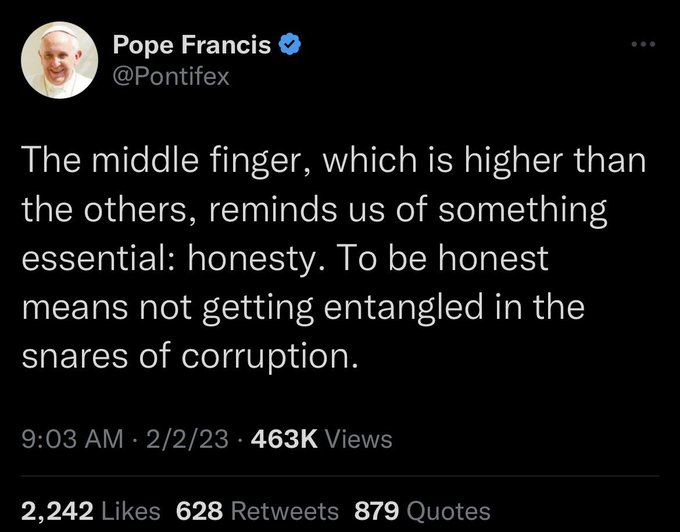



Did Pope Francis really tweet that? Unbelievable! But yes, it’s something I can imagine he would say. None of his predecessors would, however.
(It’s being reported) he did tweet praise for the middle finger, then the tweet was deleted.
It’s called flipping the tweet.
A projection? Praising his own actions against what the church has always taught on homosexuality?
Well, to be fair it was a series of 5 tweets, one for each finger. They were all stupid. They later changed this one to “The third” finger.
A devious mind might send five tweets in order to flip the middle tweet.
https://unherd.com/2023/02/inside-the-catholic-civil-war/
As if we needed more proof you don’t need to be too bright to become a jesuit.
To be fair, I think Latins have different hand signals for that.
He’s lost the plot.
When people give him the middle finger they are just being honest, not disrespectful. They are resisting corruption.
Yup, he is lost in his Jesuit fog.
Nevertheless, he must know what he is saying, Francis cannot be that naive.
Re T Shaw, I think you maybe right on Italian hand signals. Hooken Horns meaning, “Go Texas Longborns!” has a different meaning when Italians use it. Not sure what it means, but it is not polite. I get “Potso” with the twisting forefinger pointed at the head meaning crazy. The Don Matteo subtitiles don’t translate hand gestures. BTW Terrence Hill has retired at 82. Apparently the new priest rides motor cycle instead of a bicycle.
I saw this; it was some kind of mnenomic device with the five fingers. Mnemonic devices distract me, so I didn’t look any further. But this isn’t simply an ode to the middle finger.
Only PF’s neurologist knoows for sure. Mnemonics can be used in aiding patients with memory deficits that could be caused by head injuries, strokes, epilepsy, multiple sclerosisand other neurological conditions. In a study conducted by Doornhein and De Haan, the patients were treated with six different memory strategies including the mnemonics technique.