
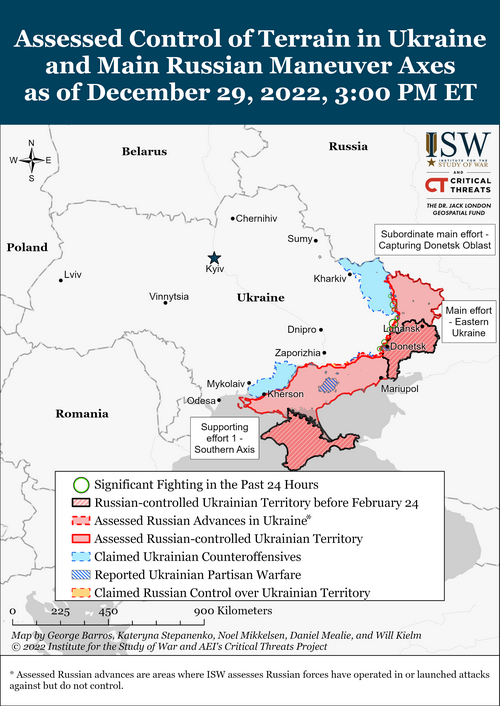
From The Institute For The Study of War:
Angela Howard, Riley Bailey, Karolina Hird, George Barros, and Frederick W. Kagan
December 29, 5:30pm ET
Click here to see ISW’s interactive map of the Russian invasion of Ukraine. This map is updated daily alongside the static maps present in this report.
Russian forces conducted another massive series of missile strikes against Ukrainian critical infrastructure on December 29. Ukrainian officials reported that Russian forces launched 69 cruise missiles and 23 drones at Ukraine and that Ukrainian air defenses shot down 54 of the missiles and at least 11 of the drones.[1] Ukrainian sources reported that Russian forces struck targets, primarily infrastructure facilities, in Lviv, Kyiv, Odesa, Kharkiv, and Donetsk oblasts causing widespread disruptions to energy, heating, and water supplies.[2] Russian sources claimed that Russian forces also struck targets in Sumy, Chernihiv, Zhytomyr, Vinnytsia, Khmelnytsky, Ternopil, Ivano-Frankivsk, Poltava, Dnipropetrovsk, and Zaporizhia oblasts.[3] The Belarusian Ministry of Defense claimed that Belarusian air defenses shot down a Ukrainian S-300 air defense missile during the wave of Russian strikes and that wreckage fell onto Belarusian territory.[4] It is currently unclear whether Ukrainian air defenses may have been responding to Russian missile launches from Belarusian territory, which Russian forces have used repeatedly in support of their campaign against Ukrainian critical infrastructure.[5]
The Russian Ministry of Defense (MoD) responded to ongoing Western assessments that it has severely depleted its stock of high-precision weapons systems amidst the massive strike against Ukraine by stating that it would never run out of Kalibr missiles.[6] ISW has previously assessed that Russian forces have significantly depleted their arsenal of high-precision weapons systems but will likely continue to threaten Ukrainian critical infrastructure at scale in the near term and cause substantial suffering to Ukrainian civilians.[7] Ukraine’s Main Military Intelligence Directorate Chief Kyrylo Budanov stated on December 26 that Russian forces had enough missiles to conduct two or three more large-scale strikes.[8] ISW assesses that the Russian campaign to break the Ukrainian will to fight through large-scale missile strikes against critical infrastructure will fail even if the Russians are able to conduct more barrages than Budanov estimated.[9]
Russian Foreign Minister Sergei Lavrov reiterated on December 29 Russia’s unwillingness to commit to genuine negotiations and to recognize Ukraine as an independent actor in negotiations. Lavrov stated in an interview with a prominent Russian news source that Russia will not accept Ukrainian President Volodymyr Zelensky’s proposed peace plan and that the Kremlin will not talk to any Ukrainian negotiators under conditions that include the withdrawal of Russian troops from occupied Ukraine, Russian payment of reparations, and Russian participation in international tribunals.[10] Lavrov declared that he cannot determine whether an “adequate,” independent politician remains in Kyiv with whom Russia can negotiate.[11] Lavrov claimed that Zelensky’s refusal to pursue negotiations with Russia in April demonstrated the complete “lack of independence of [Zelensky] in making important decisions” and the manipulation of the West to continue hostilities.[12] Lavrov questioned whether an ”acceptable” politician would emerge under the “Kyiv regime,” apparently restating the Kremlin’s position that Zelensky is not a legitimate political leader or acceptable negotiating partner and recommitting Russia to its maximalist goal to drive regime change in Ukraine.[13]
Ukraine’s Main Military Intelligence Directorate (GUR) Chief Kyrylo Budanov stated that fighting in Ukraine is in a deadlock on December 29.[14] In an interview with BBC, Budanov stated that “the situation is just stuck” and that both Russian and Ukrainian troops lack the resources or ability to move forward.[15] Budanov stressed that Ukraine cannot defeat Russian troops “in all directions comprehensively” and reiterated that Ukraine is awaiting the supply of new and more advanced weapons systems.[16] Budanov’s statement is consistent with certain elements of ISW’s December 28 assessment, which suggested that the Russian offensive around Bakhmut may be culminating and that Russian forces in this area will likely be unable to make operationally significant gains.[17] However, ISW also noted indicators that Russian forces may be preparing for a decisive effort (likely of a defensive nature) in Luhansk Oblast, which suggests that fighting writ large in Ukraine has not necessarily reached a stalemate.[18]
The Kremlin continues to manipulate Russian law to grant the state increasingly broad powers using vague language in order to eliminate dissent and threaten Ukrainian sympathizers. Russian President Vladimir Putin signed a supplement to the Russian Criminal Code on December 29 that allows Russian authorities to sentence Russians to up to life imprisonment for “assistance to subversive activities” or for “undergoing training for the purpose of carrying out sabotage activities” and for “organizing a sabotage community” and between 5- and 10-years imprisonment for “participation in such a community.”[19] Putin also signed a law enabling Russian authorities to sentence any private citizen who “desecrates” the ribbon of Saint George (a prominent Russian military symbol especially associated with the war in Ukraine) with up to 3 years imprisonment or a fine of up to three million rubles (40,541 USD).[20] These laws follow a sequence of Russian policies targeting what remains of the Russian opposition and enhancing Kremlin control of Russia’s already-limited information space under the guise of preventing Russians from “discrediting” the military.[21]
Repeated Ukrainian strikes on legitimate military targets far in the Russian rear demonstrate the ineffectiveness of Russian air defenses against drones. Ukrainian forces attacked Engels Airbase with an unmanned aerial vehicle (UAV) on December 29, within three days of reports that air defense shot down a Ukrainian UAV over Engels and killed three Russian servicemen.[22] The United Kingdom Ministry of Defense (MoD) stated on December 29 that it is “increasingly clear” that Russia “is struggling to counter air threats deep inside [its territory].”[23] The United Kingdom MoD assessed that Russian air defenses probably are struggling to meet the high demand for air defense for field headquarters near the front line in Ukraine while also protecting strategic sites, such as Engels Airbase.[24] The repeated strikes on Engels Airbase will likely exacerbate milblogger critiques that Russia cannot defend its own territory from Ukrainian strikes. A prominent Russian milblogger questioned how Ukrainian UAVs and missiles cross such distances and enter Russian territory with “such impunity” and questioned the honesty of the Russian Ministry of Defense’s response.[25] The milblogger joked that an undetected pilot landing in Red Square (referencing Matias Rust’s 1987 flight from Helsinki to Moscow) would certainly generate a response longer than a single sentence from the Russian government.[26] ISW reported on similar dissatisfaction among Russian milbloggers on December 26.[27]
Key Takeaways
- Russian forces conducted another massive series of missile strikes against Ukrainian critical infrastructure.
- Russian Foreign Minister Sergei Lavrov reiterated Russia’s unwillingness to commit to genuine negotiations with Ukraine.
- Ukraine’s Main Military Intelligence Directorate (GUR) Chief Kyrylo Budanov stated that fighting in Ukraine is in a deadlock.
- The Kremlin continues to manipulate Russian law to grant the state increasingly broad powers under ambiguous conditions in order to eliminate dissent.
- Repeated Ukrainian strikes on legitimate military targets in rear areas in the Russian Federation demonstrate the ineffectiveness of Russian air defenses against drones and exacerbate critiques that Russia cannot defend its own territory.
- Ukrainian forces continued counteroffensive operations near Kreminna while Russian forces conducted limited counterattacks along the Svatove-Kreminna line.
- Russian forces continued offensive operations in the Avdiivka area as well as around Bakhmut, where the potential culmination of the Russian offensive is likely being expedited.
- Russian forces continued to conduct defensive operations in Kherson Oblast.
- The Kremlin’s mobilization working group met for the first time on December 29. The forum for criticism of mobilization implementation will likely create friction with the Russian Ministry of Defense.
- Russian occupation authorities continue to intensify law enforcement crackdowns in unsuccessful attempts to stamp out partisan pressure in occupied territories.
Go here to read the rest.
From Strategy Page:
December 29, 2022: Russia recently announced a major expansion and reorganization of its army. The new force will have 1.5 million men, including 695.000 long-term volunteers (contract soldiers) and a larger number of conscripts. More than doubling the number of conscripts will be achieved by expanding the number of men eligible for conscription and increasing the length of service from 12 months to 18 or 24 months. The army will revert back to divisions rather than brigades full of BTGs (Battalion Task Groups). The odds of any of this happening are low.
Vladimir Putin declared that this new force would be created regardless of costs. That means less money for economic expansion and consumer goods. It’s a return to the Soviet Union era economy. The communist Soviet economy failed so badly that it caused national bankruptcy and the dissolution of the Soviet Union. Older Russians remember how bad things were during the Soviet period and so should Putin. But he was an officer in the KGB when the Soviet Union collapsed and members of the KGB were a privileged class that lived better than the average Russian. KGB officers were out of touch with the reality most Russians lived in. Most Russians enjoyed higher standards of living after 1991 and will not willingly return to the bad old days.
The new army will purportedly consist of over 30 divisions and require complete re-equipping because most of what the 2021 army had was lost in Ukraine, where many of the armored vehicles were abandoned by crews unwilling to fight in vehicles proven to be terribly vulnerable to the Western anti-tank weapons NATO had supplied Ukraine with. Some of the new divisions will be assigned to defend portions of Ukraine Russia presently occupies, but not much longer because of Ukraine’s continuing counter-offensive.
The new Russian army not only needs new weapons but also new officers. Most of the army officers the army had in 2021 have already been killed, captured or disabled in Ukraine. There were no replacements for the lost infantry officers so Russia tried calling up retired officers and transferring non-infantry officers to lead infantry units. That did not work. Another problem is the lack of NCOs. These have been a staple of Western armies for centuries and are often capable of replacing infantry officers lost in combat. Russia abolished NCOs a century ago and has not been able to rebuild that after more than a decade of trying.
Russia is currently crippled by severe economic sanctions imposed because of their Ukraine invasion. According to Ukraine and its NATO supporters, the Ukraine war won’t end until all Russian troops are gone. The New Russian Army will take years to create and currently the loss of officers and experienced soldiers has Russia depending on Belarussian instructors to train new Russian troops. This will be done in Belarus to the extent possible because Belarus’s tiny army has much smaller training than the pre 2022 Russian army. Almost all new troops in Russia get no training at all and are just given uniforms, assault rifles and transportation to Ukraine where they find few officers to lead them and not much in the way of supplies, especially food, to sustain them. Because of the dismal current situation, the announcement of a new Russian Army is seen as a morale building exercise for pro-war Russians and the few army personnel who still support the war.
Implementing this new plan implies that Putin believes he can convince Russians to make unprecedented sacrifices at a time when Russia is the aggressor, not defending the motherland (Russia). Putin believes most Russians will put up with this and he will increase border security to halt the exodus of military age Russians who prefer economic opportunity to the alternative; poverty and obedience to a former KGB officer who wants a return to the old ways. S0 far over seven million Russians have permanently left Russia because of Putin’s increasingly Soviet way of doing things. Putin believes Russians are more willing to make sacrifices to support the irrational demands of their leaders. There is some truth to this but it is also true that in the early days (before Putin) of Russia’s short-lived democracy after 1991, the people made it clear they wanted a lot less conscription and corruption.
Two decades ago, Putin began reversing the troublesome popular trends of the 1990s, especially free elections and new conscription laws limiting service to 12 months and prohibiting conscripts from being sent to combat zones outside Russia. The 1990’s conscription laws, which also expanded legal exemptions from conscription, were supposed to be temporary until Russia, like most post-1991 NATO countries, could eliminate conscription and rely on better paid volunteers (contract soldiers). Under Putin, economic growth was not sufficient to pay for an all-volunteer army. In order to gain more control over the economy, Putin has used a lot of corrupt practices to obtain the power he desired but at the cost of lower economic growth.
Putin’s neo-Soviet ways included terrorizing (intentionally or otherwise) close associates and advisors. This led to less criticism of Putin policies that were very risky and long-term implications. Such was the case with the Putin plan to take back Crimea from Ukraine along with two eastern provinces (Donbas) that Putin insisted were Russian. Ukrainians and the rest of the world disagreed. This resulted in the first round of economic sanctions plus a Ukraine that was so alarmed that it significantly expanded its armed forces and upgraded them with the help of NATO countries. Putin claimed that was proof that NATO was plotting to surround and destroy Russia. This was absurd to Russians who had spent time in the West or regularly did business with Western firms.
Putin dealt with this by using his control over Russian mass media, and most of the more specialized publications, to push the idea that the NATO plot was true. Enough Russians agreed with this, or did not see the use of opposing the official government interpretations and went along or simply kept silent.
Putin still had a problem with Ukraine and the rest of the world that did not believe his interpretation of the situation and the economic sanctions were doing some damage even though the Putin controlled media said otherwise. The only acceptable solution (for Putin) to this problem was to invade Ukraine Many of Putin’s military and economic advisors pointed out that the invasion would not succeed, but would result in more sanctions that would probably be crippling. Putin believed European dependence on Russian natural gas and oil would prevent much European support for the Ukrainians. Putin had more economic and military advisors who went along with his way of thinking and the dissidents knew it was prudent to keep quiet about their warnings.
When the invasion failed more spectacularly than anyone predicted, and Europeans both imposed really massive sanctions cut and provided massive aid to the Ukrainian war effort, a growing number of Putin advisors left Russia. So did a lot of other Russians. The former advisors gave details of the military and economic advice Putin received and ignored. Putin believed his own propaganda that Ukraine was actually part of Russia but was persuaded by NATO and other evil Westerners, to become independent in 1991 when the Soviet Union literally fell apart. This exodus cut the Russian controlled population in half but Russia lost less of the Soviet-era economy. This gave Russians the opportunity to become far more affluent than they were when the Soviet Union existed. Putin disagreed with this and openly declared that the dissolution of the Soviet Union was a great historical tragedy and he had the power to remedy it. Putin was going to re-assemble the Soviet Union. None of its newly independent nations agreed with the Putin plan. Many Russians agreed with Putin but a growing number did not after they saw what happened after 2014 when Putin first tried to force Ukraine into the new Russian Empire.
Go here to read the rest. Putin’s plans to increase the Russian Army: too little and too late. To actually win the War Putin would need an army of at least three million trained and armed in the latest technology. There are zip signs that the Russians have the will to mobilize to that extent. One of the many problems attendant in fighting an unpopular foreign war.

