
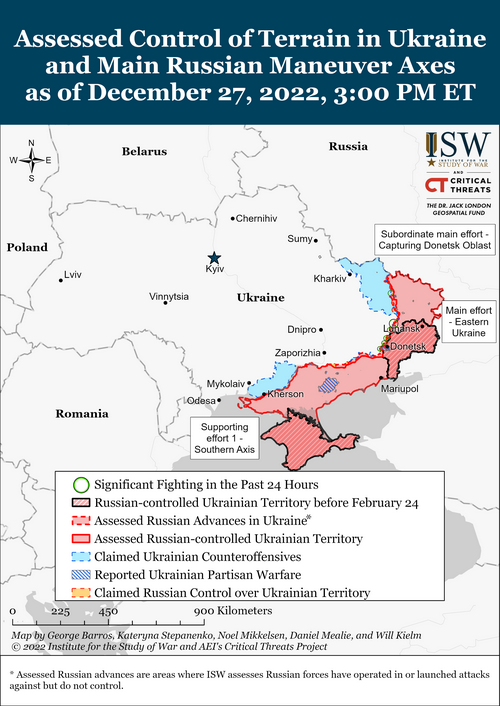
From The Institute For The Study of War:
George Barros, Riley Bailey, Karolina Hird, Kateryna Stepanenko, and Frederick W. Kagan
December 28, 8:15pm ET
Click here to see ISW’s interactive map of the Russian invasion of Ukraine. This map is updated daily alongside the static maps present in this report.
The Russian offensive against Bakhmut is likely culminating as ISW forecasted on December 27.[1] US military doctrine defines culmination as the “point at which a force no longer has the capability to continue its form of operations, offense or defense,” and “when a force cannot continue the attack and must assume a defensive posture or execute an operational pause.”[2] If Russian forces in Bakhmut have indeed culminated, they may nevertheless continue to attack aggressively. Culminated Russian forces may continue to conduct ineffective squad-sized assaults against Bakhmut, though these assaults would be very unlikely to make operationally significant gains.
Several indicators support the assessment that Russian forces around Bakhmut have culminated.
Senior Ukrainian officials are visiting frontline positions in Bakhmut unimpeded. Ukraine’s Military Intelligence Directorate (GUR) chief, Kyrylo Budanov, visited Bakhmut on December 27-28 and was geolocated to within at least 600 meters of the previously recorded Russian forward line of troops.[3] Budanov’s visit supports previous Ukrainian social media reports that Ukrainian forces conducted a tactical counterattack that repelled Russian forces from the outskirts of Bakhmut on December 21.[4] Ukrainian President Volodymyr Zelensky visited Bakhmut on December 20.[5]
Recent combat footage supports ISW’s previous assessment that Russian forces are operating in squad-sized assault groups due to combat losses.[6] Combat footage posted on December 26 shows Ukrainian fire defeating squad-sized groups of 5-10 unsupported Russian infantry attempting a disorderedly assault on Novoselivske in Luhansk Oblast.[7] This footage, while not from Bakhmut, is consistent with a senior Ukrainian official’s report that Russian forces in the Bakhmut area are no longer operating as company and battalion tactical groups but are instead operating in smaller groups of 10 to 15 servicemembers (squad-size organizations) as of December 27.[8]
Russian airborne forces (VDV) are reportedly augmenting Wagner Group operations around Bakhmut. A Russian source reported that Wagner and VDV elements conducted joint operations in Bakhmut on December 27.[9] The report, if true, marks an inflection given that the Wagner Group has been conducting information operations to assert that the Wagner Group forces exclusively are operating in Bakhmut.[10] The conventional Russian military supporting Wagner Group elements in Bakhmut—after Wagner took efforts to emphasize it exclusively is responsible for the Bakhmut sector—would be consistent with indicators for the Wagner Group forces’ culmination. ISW has previously assessed that Wagner Group forces are serving a chiefly attritional role around Bakhmut and have therefore likely become degraded to a near-debilitating extent and need reinforcement from more conventional Russian elements.[11] High rates of attrition amongst the forces responsible for the offensive on Bakhmut may expedite the culmination unless notable numbers of regular Russian military units are sent to sustain the offensive and delay or avert its culmination.
Russian forces appear to be preparing for a decisive effort in Luhansk Oblast, although it is unclear whether for defensive or offensive operations. Russian forces continue accumulating equipment and forces in Luhansk. VDV elements that were likely previously operating in Kherson Oblast appear to have redeployed to Luhansk Oblast following the Russian withdrawal from west bank Kherson Oblast in November.[12] Social media images from late December increasingly show Russian equipment in transit in Luhansk Oblast.[13] Russian forces are operating military district-level thermobaric artillery assets in the Luhansk area of operations, which may indicate a prioritization of operations in this area.[14] Ukrainian intelligence reported on December 26 that the Russian military appointed a new Western Military District (WMD) commander who is commanding Russian forces out of a command post in Boguchar, Voronezh Oblast.[15] WMD elements (such as the 144th Motorized Rifle Division) are the principal forces operating in the Luhansk sector and a command change could indicate efforts to support a new decisive effort in this area. Senior Ukrainian officials have stated that Russian forces in Belarus and Zaporizhia are not forming strike groups as of late December, but notably have not made similar statements about Russian forces in Luhansk Oblast.[16] Russian forces have been establishing extensive trenches and field fortifications in Luhansk Oblast for several months—activity that could support a planned Russian decisive effort in the vicinity of Luhansk Oblast.[17] The aforementioned indicators may suggest that Russian forces in Luhansk Oblast are preparing for an offensive operation, as ISW has previously forecasted, but may also indicate preparation for larger spoiling attacks or a defensive counterattack to take advantage of Ukrainian counteroffensive efforts in the area that the Russians expect to stop.[18]
Russian forces appear less likely to conduct a new offensive in the Zaporizhia Oblast over the winter. Russian forces are likely establishing defenses against possible Ukrainian offensive operations in Zaporizhia Oblast.[19] Russian forces likely destroyed a bridge over a river in Polohy on December 28.[20] A senior Ukrainian military official stated on December 28 that there are no signs of Russian forces in Zaporizhia Oblast forming strike groups despite some rotations and deployments there.[21] Zaporizhia Oblast Occupation Deputy Vladimir Rogov claimed on December 27 that Ukrainian forces will conduct an offensive in Zaporizhia Oblast but that the offensive is not imminent because of muddy conditions.[22] Recent Russian mining and fortification efforts in Zaporizhia Oblast and the Dnipro River coastline indicate that Russian forces do not seek to conduct an offensive there.[23]
The Kremlin continues to systematically deny Ukrainian sovereignty and reiterate that Russia has no genuine intention to engage in negotiation with Ukraine. Kremlin Spokesperson Dmitry Peskov responded to the Ukrainian proposal to prepare a peace initiative at the United Nations in February and emphasized that no peace plan can exist for Ukraine without accounting for the entry of Zaporizhia, Kherson, Donetsk, and Luhansk oblasts into the Russian Federation.[24] Peskov clearly indicated that the Kremlin has no genuine intent to compromise its demands, thus directly undermining the Kremlin’s own narrative that Russia is willing to talk but Ukraine is not.[25] ISW has continuously reported that Russia is using the discussion of negotiations as an information operation to force Ukraine into making massive concessions on Russia’s terms.[26] Russian leaders’ insistence that Ukraine enter negotiations having accepted the illegal Russian annexation of more than 100,000 square kilometers of Ukrainian land emphasizes the lack of genuine interest in negotiations on the part of the Kremlin.
The Kremlin continues to present the US transfer of Patriot air defense systems and accompanying trainers to Ukraine as an escalation in US-Russia relations, despite the fact that the transfer is if anything less escalatory than previous Western military shipments to Ukraine because Patriot is a purely defensive system. Russian Foreign Minister Sergey Lavrov claimed in a televised interview on December 28 that US officials had guaranteed to not send Patriot air defense trainers to Ukraine in an effort to refrain from participating in the war.[27] The Kremlin has previously highlighted the US transfer of Patriot air-defense systems in accusations that the United States and the West are waging a proxy war in Ukraine with the intent of weakening or destroying the Russian Federation.[28] The Kremlin uses these accusations in support of information operations that aim to frame Ukraine as a Western puppet devoid of sovereignty and to weaken Western security assistance to Ukraine by stoking fears of Russian escalation.[29] The Kremlin could use any Western transfer of military equipment to Ukraine as support for these information operations. The Kremlin’s decision to react to the transfer of the Patriot air defense systems more strongly than to previous weapons transfers indicates that the Kremlin is more concerned with the effect Western help can have on Russia’s invasion of Ukraine than with supposed Russian fears of putative Ukrainian offensive actions against the Russian Federation itself using Western systems. That observation is worth considering in the context of Western discussions of providing Ukraine with Western tanks, long-range attack systems, and other capabilities.
ISW forecasts with high confidence that Putin will not seek to engage NATO militarily at this time in response to the provision of any of the Western military systems currently under discussion. Russia is barely holding off the Ukrainian military at a fearful cost to itself and Russian forces in Ukraine could not survive a serious conflict with NATO at this time. The risks of deliberate Russian escalation to a major conflict with NATO in the foreseeable future are thus extremely low.
Key Takeaways
- The Russian offensive against Bakhmut is likely culminating.
- Russian forces appear to be preparing for a decisive effort in Luhansk Oblast and appear less likely to conduct a new offensive in Zaporizhia Oblast in the winter of 2023.
- The Kremlin continues to demonstrate that Russia has no genuine intention of engaging in negotiations with Ukraine by insisting that Ukraine accept Russia’s illegal annexations of Ukrainian land.
- The Kremlin continues to present the US transfer of Patriot air defense systems as an escalation in US-Russia relations, but ISW forecasts with high confidence that Russia will not deliberately seek to escalate to a major conflict with NATO as a result.
- Ukrainian forces continued counteroffensive operations toward Kreminna, where Russian forces continued counterattacks to regain lost positions.
- Russian forces continued offensive operations around Bakhmut, Donetsk City, and in western Donetsk Oblast.
- Russian forces continued defensive and rotational operations in Kherson and Zaporizhia oblasts.
- The Kremlin has approved additional funds for the development of defensive fortifications and is attempting to staff fortification efforts in Russian border areas and occupied Ukraine.
Go here to read the rest. The year is ending with Russia involved in a War it cannot win, and with no plan by Russia to either get out or mobilize sufficiently to win the War. Defeat beckons in the coming year along with the changes domestically that foreign defeat always has brought in Russian history.


Along with the apparent destruction of Russian military forces in the Bakhmut offensive, it was reported that retired high-level Russian military general Alexei Maslov “died unexpectedly” Dec 25th at a Russian military hospital near Moscow. This drew attention also because Maslov had been head of the massive Russian tank building facility, Uralvagonzavod, near Ekaterinburg, and had recently been bitterly criticized by Kremlin officials for failing to reequip sufficient numbers of Russian armor lost in the Ukraine war. In fact, a scheduled visit by Putin to the facility was suddenly cancelled recently.
Perhaps the best place to survive and Russia these days is NOT to be admitted to a Russian military hospital after criticism by Kremlin authorities.
Of course, the day before, 12/24, another high-level Russian military head, Alexander Budanov, who had managed the Russian admiralty shipyards producing the type of submarine used in the Black Sea to launch Kalibr missiles, was suddenly pronounced dead in Russian news sources. Like Maslov, Budanov also had come in for criticism for re-equipment failures.
Budanov had not been known to be ill prior to the obituary announcement.
Since “deaths come in threes,” another high-level Russian leader, Pavel Antov, died also according to authorities in India, “at a luxury vacation hotel in Odisha state,” in the more traditional way of death for Russians these days: he “fell” out of a hotel window.
Antov was a Russian “tycoon” operating a major food production facility (he was called “the sausage king” in Russia). Back in June, Antov had severely criticized Putin’s using missile attacks on Ukrainian civilian populations. Shortly afterwards, he walked back the statements, claiming they had been due to “an unfortunate mistranslation.”
[Antov also died on 12/24, in the city of Rayagada, Odisha province, India. It was explained in news reports that wealthy Russians, often take winter vacations at luxury resorts in India.]
The police ruled my father’s death a suicide. They said he fell down an elevator shaft … onto some bullets.
~ The Bowler (Mystery Men)