
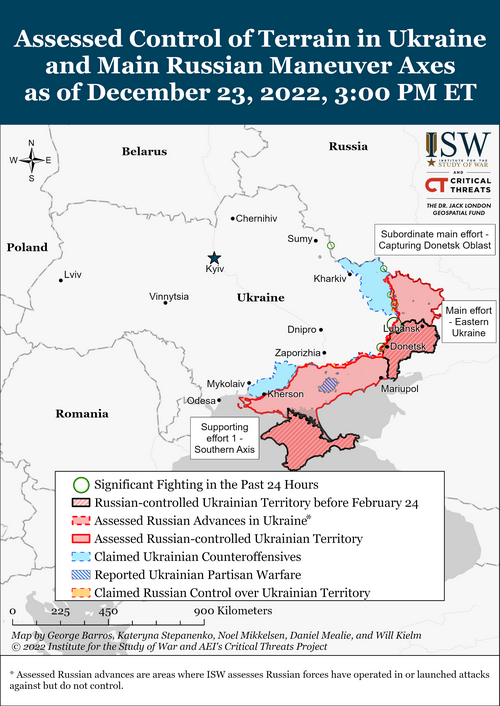
From The Institute For The Study of War:
Kateryna Stepanenko, George Barros, Layne Philipson, and Frederick W. Kagan
December 23, 9:30 pm ET
Click here to see ISW’s interactive map of the Russian invasion of Ukraine. This map is updated daily alongside the static maps present in this report.
Moscow has been setting conditions for a new most dangerous course of action (MDCOA)–a renewed invasion of northern Ukraine possibly aimed at Kyiv–since at least October 2022.[1] This MDCOA could be a Russian information operation or could reflect Russian President Vladimir Putin’s actual intentions. Currently available indicators are ambivalent—some verified evidence of a Russian buildup in Belarus makes more sense as part of preparations for a renewed offensive than as part of ongoing exercises and training practices, but there remains no evidence that Moscow is actively preparing a strike force in Belarus. Concern about the possibility that Putin might pursue this MDCOA is certainly not merely a Ukrainian information operation intended to pressure the West into supplying Kyiv with more weapons, as some Western analysts have suggested. ISW continues to assess that a renewed large-scale Russian invasion from Belarus is unlikely this winter, but it is a possibility that must be taken seriously.
Prominent Russian pro-war milbloggers are amplifying the possibility of the MDCOA over the winter-spring period. Former Russian military commander Igor Girkin, a prominent critical voice in the Russian milblogger space, responded to ongoing discussions within the Russian information space on December 23 about Russia’s capacity to renew an assault on northwestern Ukraine from Belarus to sever ground lines of communication (GLOCs) between Kyiv and Europe.[2] Girkin broke the MDCOA into two possible sub-courses of action: Russia can invade from Belarus in an effort to capture territory or could alternatively conduct a diversionary operation to draw Ukrainian forces from other parts of the theater.[3] Girkin argued that the Russian military could not effectively conduct an offensive operation to capture territory, but that a diversionary operation to support a Russian offensive elsewhere in Ukraine would make military sense. Girkin also pointed out that public discourse about this MDCOA had spread throughout the Russian-language internet and noted that other prominent milbloggers have hypothesized different scenarios for the MDCOA.[4]
Some milbloggers have been speculating about the likelihood of a renewed Russian attack on northern Ukraine since at least October 2022. Prominent Russian Telegram channel Rybar, whose author is currently part of Putin’s mobilization working group, stated on October 20 that there were rumors of an “imminent” Russian offensive operation on Lviv, Volyn, Kyiv, Chernihiv, or Kharkiv.[5] Another milblogger claimed on October 20 that joint forces in Belarus are too small to attack Kyiv but stated that he would not object if Russian forces attacked Chernihiv City.[6]
Putin’s upcoming meeting with Belarusian President Alexander Lukashenko in St. Petersburg on December 26-27 will advance the Russian information operation around the MDCOA even if it does not directly support preparations for it. Lukashenko’s office announced that Putin and Lukashenko will meet during a Commonwealth of Independent States (CIS) heads of state meeting in St. Petersburg on December 26-27.[7] This meeting will advance the Kremlin’s existing information operation about the MDCOA, as Putin’s December 19 visit to Minsk did, given the growing Russian military presence in Belarus.[8]
The Russian military continues to trip limited indicators for the MCDOA, reinforcing an information operation designed to establish the plausibility of the MDCOA or actual preparations for executing the MDCOA. The Russian Ministry of Defense ostentatiously announced on November 24 that it has a field hospital in Belarus.[9] The Ukrainian General Staff reported on December 23 that Russian forces are planning to deploy at least one more field hospital in Belarus.[10] Field hospitals are not necessary for training exercises and could indicate preparation for combat operations. The appearance of field hospitals in Belarus in early 2022 was among the final indicators observed before Russia commenced its full-scale invasion.[11] Russia continues to deploy forces to Belarus under the rubric of training. Some Russian T-90 tanks, reportedly deployed to Belarus in late December 2022, were observed with winter camouflage.[12] Equipping tanks with winter camouflage is not wholly necessary for training activity and could indicate preparation for actual winter combat operations. The deployment of field hospitals and repainting tanks could also be parts of an information operation.
The Russian military has been much more clearly setting conditions for an offensive in northwestern Luhansk Oblast, however. The Ukrainian General Staff reported observing an increased volume of railway transport of personnel, military equipment, and ammunition to combat areas on December 23.[13] Geolocated footage published on December 23 also shows a train loaded with Russian T-90M and T-62M tanks heading toward Luhansk Oblast from Rostov Oblast.[14] ISW previously observed Russian forces transferring elite airborne troops and other elements that previously operated in the Kherson and Kharkiv directions to Luhansk Oblast.[15] The Kremlin continues to prioritize committing mobilized men to stabilize the Svatove-Kremina line over other areas of the front such as Bakhmut, Avdiivka, or western Donetsk Oblast. Russian forces are unlikely to attack across the Dnipro River in Kherson Oblast after just withdrawing from western Kherson, and Russian mining and fortification efforts in Zaporizhia Oblast indicate that Russian forces do not seek to conduct an offensive there. The Kremlin could also attempt a spoiling attack on southeastern Kharkiv Oblast from Luhansk Oblast to regain lost territories west of the Oskil River. It is far from clear whether Russian forces would be able to effectively conduct such an operation since the terrain advantages the Ukrainian defenders and Russian offensive capabilities are very limited.
The Russian military may nevertheless attempt to conduct a diversionary attack on the ground or in the information space against northern Ukraine, likely in an effort to divert Ukrainian forces from defending in Donbas or in conjunction with an offensive in Luhansk or, less plausibly, elsewhere. Chief of the Ukrainian Main Military Intelligence Directorate (GUR) Kyrylo Budanov stated on December 23 that Russia is trying to divert Ukrainian forces from the southeast by setting up a feint in Belarus, noting that military activity in Belarus is an element of a disinformation campaign.[16] The success of the Russian diversionary attack, however, relies on Russia’s ability to convince Ukraine of the plausibility of the threat of a deeper offensive operation. Ukrainian military officials continue to indicate that Ukrainian forces are prepared to defend their northern borders, and Ukraine’s fierce defenses around Bakhmut demonstrate that Ukrainian forces can hold off much larger numbers of Russian attackers.[17]
ISW’s December 15 MDCOA warning forecast about a potential Russian offensive against northern Ukraine in winter 2023 remains a worst-case scenario within the forecast cone.[18] ISW currently assesses the risk of a Russian invasion of Ukraine from Belarus as low, but possible. Belarusian forces remain extremely unlikely to invade Ukraine without a Russian strike force. Ukrainian military officials noted that Russia had not created strike groups in Belarus.[19] Russian milbloggers also note that Russia has not fixed fundamental flaws in its military campaign such as the lack of new equipment, poor leadership, and insufficient forces to sustain a successful offensive operation.[20]
Ukrainian President Volodymyr Zelensky is reportedly preparing to present a peace plan in February 2023, which may be timed to exploit a failed Russian winter offensive. The Wall Street Journal, citing Ukrainian and European diplomats, reported on December 22 that Zelensky’s team is planning to present an unspecified peace plan in February 2023.[21] Zelensky laid out a 10-point peace plan at the G20 summit in November 2022 that requires Russia to make concessions, including withdrawing all its troops from Ukraine and respecting Ukraine’s sovereignty and territorial integrity under international law.[22] Zelensky may be preparing to present this peace plan around an anticipated failed Russian military offensive in early 2023.
The Kremlin continues to deflect criticism about Russia’s military failures in Ukraine by rhetorically narrowing the definitions of its initial war objectives without formally changing them. When asked about the Russian invasion’s progress, Kremlin spokesman Dmitry Peskov stated that Russian forces achieved “significant progress” in its war objective of “demilitarization” of Ukraine on December 23.[23] Girkin lambasted Peskov’s response, sarcastically noting that Ukraine’s armed forces increased from about 250,000 personnel before the war to 700,000 personnel today and that Ukrainian forces are now equipped with advanced Western anti-tank ground missiles, precision artillery, and other systems that Ukraine did not have before Russia’s invasion.[24] ISW continues to assess that Russia’s maximalist war objectives have not changed despite Peskov’s floundering to save face with the Kremlin’s Russian domestic audience.
Russian President Vladimir Putin’s renewed public appearances likely indicate that he has become more concerned about his popularity and image in Russia. Putin has been seemingly making more public appearances in Russian cities and more frequently delivering vague statements about Russia’s invasion of Ukraine in recent days compared to his marked absence from public activity outside the Kremlin throughout the first ten months of the war.[25] Putin visited the KBP Instrument Design Bureau in Tula Oblast (an arms manufacturing facility) on December 23 and reportedly also planned to visit the Uralvagonzavod machine-building factory in Nizhny Tagil on the same day before canceling the event at the last minute.[26] Such appearances are likely a part of the Kremlin’s effort to present Putin as a wartime leader and regain the dominant narrative in the domestic information space as Russia heads into the second year of the war.[27] Putin consistently relied on in-person appearances throughout his rule, which helped him to create an image of an all-seeing and ever-present ruler.[28] Putin may be attempting to set favorable conditions in the information space ahead of Russia’s next presidential elections in early 2024.
Key Takeaways
- ISW assesses that the Kremlin has been setting conditions for a new most dangerous course of action (MDCOA)—a renewed offensive from Belarus possibly aimed at Kyiv—since at least October 2022. The Kremlin may be conducting an information operation or may actually be preparing for this MDCOA, which ISW continues to assess to be unlikely but possible.
- Prominent Russian pro-war milbloggers are amplifying the possibility of the MDCOA over the winter-spring period.
- The Russian military continues to trip indicators for the MCDOA, reinforcing an information operation designed to establish the plausibility of the MDCOA or preparations to execute it.
- The Russian military has more clearly been setting conditions for an offensive in northwestern Luhansk Oblast.
- Ukrainian President Volodymyr Zelensky is reportedly preparing to present a peace plan in February 2023, which could be timed to exploit a failed Russian winter offensive.
- Russian President Vladimir Putin’s renewed public appearances likely indicate that he has become more concerned about his popularity and image in Russia.
- Russian forces conducted at least two reconnaissance-in-force operations in northern and northeastern Ukraine on December 22-23.
- Ukrainian forces likely made tactical gains east and south of Bakhmut City over the past 72 hours.
- Russian forces are continuing to establish defensive positions in left-bank Kherson and Zaporizhia oblasts and are conducting defensive operations in southern Ukraine.
- The Kremlin is intensifying its censorship efforts to silence concerns over an expansion of the Russian Armed Forces and a second mobilization wave.
- Ukrainian partisans continued to target Russian officials in occupied territories.
Go here to read the rest. I think the Russians will talk a great deal about a large winter offensive, but I doubt they have the resources to successfully conduct one.

