
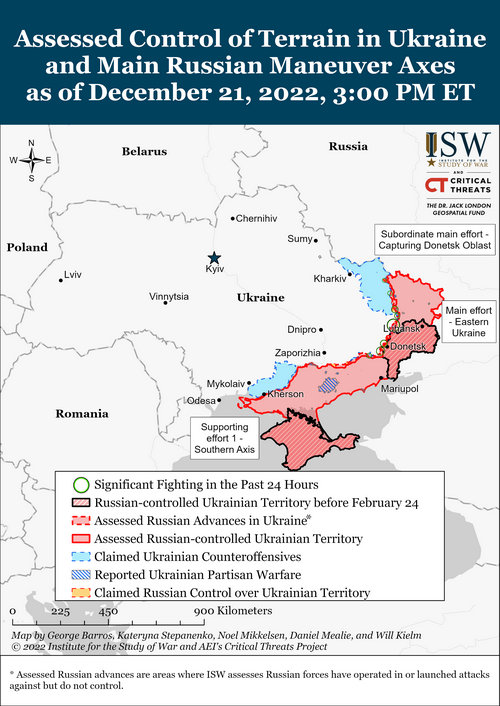
From The Institute For The Study of War:
George Barros, Kateryna Stepanenko, Riley Bailey, Angela Howard, Layne Philipson, Madison Williams, and Frederick W. Kagan
December 21, 7:00 pm ET
Click here to see ISW’s interactive map of the Russian invasion of Ukraine. This map is updated daily alongside the static maps present in this report.
Russian President Vladimir Putin and Russian Defense Minister Sergey Shoigu presided over a Russian Ministry of Defense (MoD) Collegium in Moscow on December 21 and made significant statements pertaining to Russia’s ongoing invasion of Ukraine and the strategic direction of the Russian military.
The Kremlin intensified its information operation accusing NATO expansion of presenting a military threat to Russia.[1] Shoigu stated that NATO’s military expansion near Russian borders, including Finland’s and Sweden’s NATO membership aspirations, necessitates an “appropriate” Russian response to establish a Russian force group in northwestern Russia.[2] Senior Kremlin officials said that the accession of the Nordic states to NATO would not threaten Russia in spring 2022. Kremlin Spokesman Dmitry Peskov stated that Finland and Sweden joining NATO would not present an existential threat to Russia in April 2022 and Russian Foreign Minister Sergei Lavrov stated that Finland and Sweden joining NATO would not make “much difference” in May 2022.[3]
Shoigu publicly presented a series of proposed Russian defense policy changes to significantly increase the size of the Russian military. Shoigu proposed that Russia reestablish the Moscow and Leningrad military districts, form a new army corps, and form 17 new maneuver divisions.[4] Shoigu suggested that Russia form a new army corps in Karelia, two new airborne assault divisions, three new motorized rifle divisions in occupied Kherson and Zaporizhia oblasts, and expand seven existing brigades of the Northern Fleet and Western, Central, and Eastern Military districts into seven new motorized rifle divisions while expanding five existing naval infantry brigades into five naval infantry divisions. Shoigu also proposed that Russia form five artillery divisions to support military districts.[5] He proposed increasing the strength of the Russian Armed Forces to 1.5 million servicemen, including 695,000 contract servicemen (Shoigu said in spring 2021 that 380,000 Russians were contract servicemen), gradually increasing the age of conscription for military service from 18 to 21 years and raising the age limit for conscripts from 27 to 30 years. Shoigu did not specify a timeline for these measures.
This is not the first time the Russian MoD has signaled its intention to reverse the 2008 Serdyukov reforms that largely disbanded Russian ground forces divisions in favor of independent brigades. The Russian MoD has been steadily reversing the Serdyukov reforms by restoring maneuver divisions across Russian military districts since 2013.[6]
The Kremlin is very unlikely to form such a large conventional force in a timeline that is relevant for Russia’s war in Ukraine, however. Forming divisions is costly and takes time. It took the Russian military over a year to reform the 150th Motorized Rifle Division (8th Combined Arms Army) between 2016 and 2017, for example.[7] Russia was unable to fully staff its existing brigades and regiments before the full-scale invasion and had not fully built out a new division it announced it was forming in 2020 before the start of the 2022 invasion of Ukraine.[8] Russia’s economy is in recession, and its resources to generate divisions have significantly decreased since Russia’s full-scale invasion of Ukraine.[9] Russia’s net training capacity has likely decreased since February 24, in part because the Kremlin deployed training elements to participate in combat in Ukraine and these training elements reportedly took causalities.[10] Russia is reportedly leveraging Belarusian trainers to train mobilized forces and possibly contract soldiers and conscripts, indicating the limitations of Russian training bandwidth.[11] Russia’s officer corps has been eviscerated by casualties in this war.
Shoigu’s proposals could be an overture to placate the milblogger community who have accused the Kremlin of not conducting the war seriously or taking the measures necessary to win the war. It also sets information conditions for the Kremlin to conduct future mobilization waves under the rubric of staffing these formations and/or significantly augmenting Russia’s military strength in the long run.
The Kremlin can form a large conventional military along the lines Shoigu described that would be capable of posing a renewed and serious threat to NATO if Russian President Vladimir Putin decides to fundamentally change Russia’s strategic resource allocation over the long run. Putin directly addressed Shoigu and the Chief of the General Staff Valery Gerasimov stating that Russia has no financial limitations and must provide everything the Russian Armed Forces request.[12] While Russia is unlikely to reform large divisions while continuing its invasion of Ukraine, Russia’s military defeats in Ukraine may persuade Putin to change Russia’s strategic resource allocation for the Russian military. Putin can decide to appropriate Russian state funds in such a manner that allows the Kremlin to field a large conventional military at the expense of economic growth and consumer comforts as the Soviets did. Such a course of action would cost resources and time but is possible. Shoigu’s “recommendations,” which he certainly presented to Putin privately before describing them publicly, along with Putin’s commitment to providing the Russian military with everything it needs and a number of other indicators suggest that Putin may have already decided to reconstitute a significant conventional Russian military threat to Europe once this war ends.
Putin and Shoigu demonstrated that Russia is not interested in reducing its war efforts or its war aims, despite the growing toll on Russian society. Putin reiterated that Russia will ensure the safety of all Russian territories including illegally-annexed territories in Ukraine while at the MoD Collegium.[13] Putin and Shoigu repeatedly rejected the idea of independent Ukrainian sovereignty and emphasized Russia’s need to keep Ukraine within the Kremlin’s sphere of influence and defeat the Ukrainian “Nazi” regime.[14] Putin and Shoigu’s comments further illustrate that the Kremlin retains maximalist goals for the war in Ukraine that include: the recognition of illegally annexed territories, regime change of the Ukrainian government under the pretext of “denazification,” control of Ukraine’s political and social character, and Western granting of Russia’s desired “security guarantees.”
The reiteration of Putin’s February 24 goals indicates that the Kremlin is deciding to embrace the sacrifices of the war and attempt to push on to victory. The Kremlin will need to continue to ask for and justify great sacrifices from its people to pursue these unrealistic goals. Shoigu attempted to justify the societal cost of mobilization, acknowledging that mobilization was “a serious test” for Russian society necessary to defend newly acquired territories in Ukraine.[15] Putin likely believes that if he downscaled his maximalist set of goals or defined lesser short-term objectives he would incur widespread discontent from both the wider Russian public and the ultra-nationalist pro-war community for committing Russia to a costly war in pursuit of an inadequate reward. The Kremlin will likely continue to reiterate maximalist goals as it demands further sacrifices from the Russian public to support the war effort, whether through new force generation efforts, imposing the continued long-term economic impacts of international sanctions regimes, extracting from the populace the cost of rebuilding a powerful Russian military, or forcing the Russian people to continue to accept heavy Russian casualties in Ukraine.
Putin and Shoigu maintained the Kremlin’s information operation that seeks to coerce the West into pushing Ukraine to negotiate on Russia’s terms. Shoigu claimed during his speech that the Kremlin is always open to holding constructive, peaceful negotiations.[16] Putin and Shoigu likely reiterated Russian maximalist goals at the Russian MoD Collegium at a time when Ukrainian officials are discussing the possibility of a renewed Russian large-scale offensive in the winter of 2023 and voices are rising in the West calling for Ukraine to initiate negotiations with Moscow to add further pressure on Ukraine to negotiate on Russian terms.[17] The Kremlin likely believes that it will be able to exact more preemptive concessions from Ukraine the more maximalist its stated goals for the war are as it also prepares what it is presenting as another large-scale offensive operation. The Kremlin’s effort to coerce Ukraine into negotiating or offering preemptive concessions is increasingly divorced from the battlefield reality in Ukraine where Ukrainian forces retain the initiative.[18]
Putin significantly intensified his efforts to make peace with the critical pro-war community in the past 48 hours. Putin admitted at the MoD collegium meeting that Russian forces had faced challenges with mobilization, lack of drones and new equipment, and signals.[19] Shoigu acknowledged similar concerns echoing criticism from prominent Russian milbloggers for 10 months of the war.[20] Putin then asked the Russian MoD “to be attentive” to all criticism and “hear those who do not hush up the existing problems,” noting that the ministry will be in constant dialogue with such critics.
Putin also established a working group on December 20 that will address issues with mobilization and offer social and legal support for participants of the “special military operation,” empowering some milbloggers.[21] Putin recruited several prominent milbloggers such as Mikhail Zvinchuk from Rybar, Evgeniy Poddubny, and Alexander Sladkov among others, as well as some state officials to compile a monthly report to be delivered directly to Putin. The working group has the authority to make proposals and review mobilization concerns.
Putin is likely seeking to preempt further criticism and regain control over the domestic narrative in support of a protracted war. Putin has exhibited a pattern in which he gradually grants a level of limited authority to select milbloggers following an increase in criticism. ISW observed that Putin first interacted with milbloggers in mid-June shortly following Russia’s failed crossing of the Siverskyi Donets River and general frustrations with Russia’s slow pace in Donbas.[22] Putin has since made several public statements in support of frontline and mobilization coverage and even appointed a prominent milblogger and correspondent for Komsomolskaya Pravda, Alexander (Sasha) Kots a member of the Russian Human Rights Council on November 20.[23] Kots previously operated in Kherson City, and his appointment followed Russia’s withdrawal from right-bank Kherson Oblast. Putin likely that Putin intended to coopt Kots following that withdrawal.
Putin remains unlikely to persecute Russian milbloggers due to his commitment to continue this war and is likely attempting instead to introduce a culture of self-censorship within the milblogger community. The Kremlin has historically allowed for “domesticated opposition” – or figures who criticized the Russian government for issues such as corruption instead of opposing the nature of the regime – and it is likely that Putin is using a similar approach with controllable milbloggers.[24] Putin is attempting to disincentivize milbloggers from eventually turning on him by integrating them into his circle.
Putin may also attempt to recruit additional milbloggers from other nationalist factions in the information space. Putin’s mobilization group notably did not include figures closely affiliated with the Wagner Group or Chechen leader Ramzan Kadyrov, and instead targeted a group that has already gained some prominence on Russian state outlets. Putin has notably refrained from giving Wagner Group financier Yevgeniy Prigozhin an official position within the Russian government even though Prigozhin supposedly directly reports on Russia’s military failures to Putin and is contributing his forces to Putin’s war.[25] Prigozhin remains simply the de facto head of a nominally illegal mercenary group even as milbloggers secure formal, if sometimes ad hoc, official positions.
Putin’s ability to sustain his narrative is vulnerable to his inability to deliver on his maximalist goals and promises in the long run. Putin and Shoigu assured the collegium that Russia will learn from the mistakes of the “special military operation” and promised to implement several changes to remedy problems within the war effort. Russia, however, is unlikely to efficiently address the fundamental flaws of its military structure—certainly not in any short period of time—and that failure will likely revitalize criticism. Putin will also need to continue to deflect blame from himself for failing to deliver on such promises onto the Russian MoD without destroying the credibility of the MoD and the uniformed military in the eyes of the Russian population. Putin’s consistent appeasement of the milbloggers demonstrates that he recognizes their influence on the Russian people of whom he asks such tremendous sacrifices to sustain his war effort.
Putin and Shoigu continued to use descriptions of heightened nuclear readiness to appease domestic nationalist audiences and intimidate Western audiences without enunciating new policies or any fundamental changes in Russia’s nuclear posture or capabilities.[26] Putin stated that Russian forces will continue to develop Russia’s nuclear triad as the main guarantor of Russian sovereignty and territorial integrity.[27] Putin and Shoigu claimed that modern weapons compose 91.3% of Russia’s strategic nuclear arsenal, that Russian forces are fielding Avangard hypersonic warheads, and that Russian forces will soon introduce Sarmat intercontinental ballistic missiles into active service.[28]
Such descriptions are extremely unlikely to represent enhanced Russian willingness to use nuclear weapons. The Kremlin routinely uses nuclear rhetoric to project strength to the far-right Russian community, which has accused the Russian Ministry of Defense (MoD) of failing to take sufficiently aggressive steps to support the war in Ukraine and to demand that the West reduce its “escalatory” provision of aid to Ukraine and to pursue negotiations on Russian terms by hinting at the possibility of nuclear escalation. ISW has extensively reported on previous incidents in which Russian officials have referred to nuclear weapons to influence Western and domestic audiences and assessed that Russian officials have no intention of actually using nuclear weapons on the battlefield.[29]
Ukrainian President Volodymyr Zelensky traveled to Washington, DC to meet with US leaders on December 21. This is Zelensky’s first trip outside Ukraine since the escalation of Russia’s war on February 24.[30] ISW will report on the details of Zelensky’s visit and Russian reactions to the visit on December 22. Russian officials, media sources, and milbloggers have continuously expressed concern over the closeness of the Ukraine-US relationship and demoralization over the effectiveness of US and Western aid to Ukraine. The recent finalization of US plans to provide Patriot missile defense systems to Ukraine sparked a flurry of Russian discussions over the likely significant effects that Patriots will have on the war and the attack opportunities that Russia missed before the US agreed to provide Patriot systems.[31] ISW has noted similar Russian responses to the US provision of HIMARS systems to Ukraine.[32]
Key Takeaways
- Russian Defense Minister Sergey Shoigu proposed a series of expansive reforms and goals for Russian force generation that Russia is highly unlikely to complete in time to be relevant to the current conflict.
- Putin and Shoigu reiterated maximalist Russian aims for the war in Ukraine.
- Russian President Vladimir Putin has intensified efforts to make peace with the critical pro-war nationalist community. Russian failures to achieve Putin’s stated goals jeopardize Kremlin efforts to regain control over the domestic narrative and to set conditions for the second year of the war.
- Russian nuclear rhetoric is most likely an attempt to appease domestic audiences and intimidate Western audiences and not an indicator of preparation to use nuclear weapons.
- Ukrainian President Volodymyr Zelensky traveled to Washington, DC on December 21. ISW will report on the details of Zelensky’s visit and Russian reactions to the visit on December 22.
- Russian and Ukrainian forces continued counterattacks along the Svatove-Kreminna line.
- Russian forces continued offensive operations in the Bakhmut and Donetsk City areas.
- A Ukrainian official confirmed that Russian forces unsuccessfully attempted to establish control over the Dnipro delta islands.
- Russian Defense Minister Sergei Shoigu boasted about the growing Russian Young Army Cadets National Movement (Yunarmia) movement.
- Russian officials intensified law enforcement crackdowns to deter partisan activities and target partisan sympathizers.
Go here to read the rest. As the year draws to a close the War seems to be entering a lull phase. It presents an opportunity for either side to conduct a winter offensive, although such offensives are tricky and can often end in disaster.


Russia spends much more on their military in relation to GDP than we do. By this Spring, the effect on their civilians will remind of the economy during the Soviet era. The effect on the US is getting noticeable also, mainly because we are spending more aiding Ukraine than Europe by a factor of at least five in comparison to relative GDP. Seems Europe is not so concerned about freezing in the dark after all.