
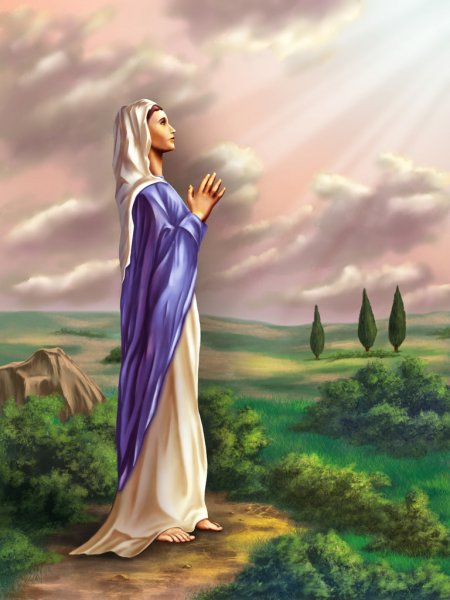
[It’s that fullofwonder time again. This was originally published in 2018]
And Mary said, Behold the handmaid of the Lord; be it done unto me according to thy word. And the angel departed from her (Luke 1:37).
With those words from Mary, the first Christmas was “on.” From that moment, God’s plan went into glorious effect for the celebration, nine months later, of His Son’s birthday. It was beginning to look a lot like Christmas.
No Mary, No Christmas
Mary’s “Yes” was incarnated in the Baby Jesus, in the flesh, conceived within her before she was even aware He was there. Only God saw that divine explosion of light that scientists have recently discovered happens within a mother’s womb at the moment of conception; but the world was being prepared to see that Light which the darkness would not comprehend, the light of “Gloria in excelsis Deo.” Mary’s “Yes” is the reason for the season. Mary’s “Yes” was yes for all of us, for all time.
What if Mary had said “No”?
This is difficult to ponder. Would there have been no salvation of all mankind? Would there have been no Christmas? Did God have a second choice in mind, a runner up? Had someone already turned God down? Was there a No. 2, an understudy in the wings? We do know that God knew Mary would say “Yes,” although His foreknowledge did not prevent her from freely agreeing to bear and birth this holy Child.
If Mary had said “No,” if there was no Christ Child, no Christmas, then, to plagiarize from a famous source and apply it to this hypothetical:
The eternal light with which childhood fills the world would be extinguished (thanks to: Yes, Virginia, There Is A Santa Claus; F. Church, 1897).
Part of our joy at Christmas is our joyful awe and thanks to Mary. Her “Yes” was yes for all God’s children. It meant as the angel of the Lord told Joseph in a dream, that – because Mary agreed to mama this Child, named “Jesus,” – we would all be saved from our sins. (Mt 1:21).
Mary Does Not Name Her Own Son
Mary and Joseph are both told by the angel of God what the Child’s name will be. (Mary: Lk 1:31 ; Joseph: Mt 1:21). Mary, the mother, and Joseph, the ostensible head of the family whose job it usually was, do not get to name Jesus; but they both, without grumbling, accept that God will name this Baby.
In Holy Scripture, naming someone is an act of power, and a name is a thing of power. Again and again, beginning in Genesis, naming is a major theme, including God naming things, God naming human beings, men and women naming things and offspring, and God re-naming men and women.
The first book of Samuel makes it clear that a person is what a name says. (1 Sam 25:25). For the Jewish people, a name was much more than a label, or a tag for distinguishing between persons. A name was the equivalent to the person himself or herself. A person’s name was his or her very person, identity, worth, character, reputation, authority, will, ownership, and power.
In Hebrew, the name God gives His Son – Jesus – literally means “Yahweh helps” or “Yahweh saves.” God is naming His Son God.
God’s naming His son Jesus is God’s announcement – His, “Yes, That’s My Boy, chip off the old [very old] block” – of the gift of this Son. The Bible does not mention God handing out cigars. Such naming is referred to in Isaiah:
Listen to me, you islands; hear this, you distant nations: Before I was born the Lord called me; from my mother’s womb he has spoken my name (Is 43:1).
By naming His Son Jesus, God makes available to all of us the power of that name, the power of His Son. For “everyone who calls on the name of the Lord will be saved.” (Rom 10:13).
Why Would God the Father Let Mary Birth His Son?
Why would God send His own Son to us? Why, after the Fall of Adam, does God want His divine Son to become a man? Man, that creature of God as Francis Thompson tells us in his poem, The Hound Of Heaven, “of all God’s clotted clay, the dingiest clot.” St. John says: “Et verbum caro factum est, et habitavit in nobis.” (Jn 1:14). It is easy to think of reasons God would not want to “pitch His tent with us” (literal translation of “habitavit”) and let His Son live on earth as a man and to guess at reasons for His not having wanted to redeem us.
Still, God saw something in us, in each of us. To paraphrase some lines from Thompson’s poem, who would love ignoble me and you enough to come here and shiver in the cold in Bethlehem so we did not burn in the eternal heat of hell? To be convinced of “how little worthy of any love though art” when we sin, all one need do is look in a mirror. I think about all the times I have been to confession, and all my sins, since that day so long ago at St. Paul’s Parish in San Antonio, going in to talk to the very priest who had baptized me six years earlier, the priest who had married my Mom and Dad, and even then and since being fully aware of my ignobility. Why would God want to redeem me? or any of us? Why would He want to ransom us from this ignobility and make us celestial nobles, His heirs, heavenly aristocrats, His princess, His prince, His Son’s sisters and brothers?
The beautiful answer is in a poem, Love Came Down At Christmas, by Christina Rosetti:
Love came down at Christmas,
Love all lovely, Love Divine,
Love was born at Christmas,
Star and Angels gave the sign.
Know Mary, Know Christmas
This embodied Christmas Love began with Mary’s love of God. But for that love, there may have been no Christmas.
So, what is there to learn from Mary’s not only talking the Christmas talk – “Yes. I’ll have this Baby” – but also her walking the Christmas walk? It’s about ninety miles from Nazareth to Bethlehem, and it would seem much longer if you were about to deliver a child. (The scope of this writing is way too limited to enter into the discussion of whether or not she rode on a donkey. The ensuing intense theological debate will not be discussed here).
Mary’s “Yes” is startling evidence of her humility, obedience, generosity, trust, and love, love not only for God but for all of us. Gabriel tells Mary her Son will be named “Jesus.” Mary knows what that name means in Hebrew, and she knows that God the Father Himself has given her Son this name.
As the angel proclaims to the shepherds, “a savior has been born for you.” (Lk 2:11). Mary says “Yes, I will have this Baby for everyone.”
Merry Mary CHRISTmas!


Mary said “Yes” to God from the very first moment of her existence when her soul was created by God. Mary asked God for perpetual virginity in body and soul. Mary did God’s will perfectly with God’s grace as did Jesus. Mary’s body was procreated sinless because God granted Mary her request for perpetual virginity in body and soul.
What is to consider is that in our examination of conscience, our souls were created in original innocence and we chose to refuse God…Mary chose to accept God.
What is miraculous is that the God of love, loves us. Jesus said: “My delight is to be among the sons of men.” The individual might ponder that for all eternity and never realize all of its significance.
God is infinite. God’s love is infinite. God loves us infinitely therefore, Mary loves us as God wills.
Merry Christmas
Our hand in her hand…
Praying the Rosary. Praying with Our mother Mary.
I just stumbled upon this;
*The rosary as “Mary’s memories”
St. John Paul described the mysteries of the rosary as “Mary’s Memories.” We know she “kept all these things, pondering them in her heart” (Lk 2:19; cf. 2:51).
St. John Paul wrote…
The memories of Jesus, impressed upon her heart, were always with her, leading her to reflect on the various moments of her life at her Son’s side. In a way, those memories were to be the “rosary” that she recited uninterruptedly throughout her earthly life.
To me, that’s another way of saying she kept a scrapbook of memories in her heart.
In her heart, I am sure she had memories that were joyful, sorrowful, and glorious… and now light-filled.*
St. Therese the Lil’ flower said that when we pray the Rosary our hand is on the beads and Mary’s hand is on our beads as well. A bridge between the realities. A participation in prayer unlike any other, since She is unlike any other creature. We go through her scrapbook contemplating each event. When we allow her to explain each scene we enter deeply into that image. We can feel the moment because She is with us describing the moment as only a mother can..a mother who was there. A mother who is here as we bridge the two worlds through the mysteries of the Holy Rosary.
Peace Mary De Voe.
I hope you don’t mind when I have used this offering…. One Hail Mary
:^)
[…] Life™ In England, Silent Prayer Can Be A Crime – Rod Dreher at The American Conservative Mary Christmas! – Guy McClung, Ph.D., J.D., at The American Catholic Only One Bishop Has the Courage to […]
Philip: ” One Hail Mary. :^)” Yours is a wonderful way to share a friendship..
Mary Christmas
I’ve used your One Hail Mary since I first visited TAC. I call it yours because of you.
I’ve always appreciated your posts..and your kindnesses.
You will always find a brother in me.
Merry Christmas Mary.
Merry Christmas Philip
and one Hail Mary :>)