
From The Institute For The Study of War:
Russian Offensive Campaign Assessment, December 10
Karolina Hird, Riley Bailey, Angela Howard, Kateryna Stepanenko, and Frederick W. Kagan
December 10, 6:40 pm ET
Click here to see ISW’s interactive map of the Russian invasion of Ukraine. This map is updated daily alongside the static maps present in this report.
An unnamed US defense source told The Times that the Pentagon is no longer insisting that Ukraine should not strike military targets within Russia.[1] The source noted that the Pentagon has changed its perspective on this matter following the recent intensification of Russian missile strikes on Ukrainian civilian infrastructure over the last few months and that the Pentagon has become less concerned regarding the risk of escalation, including nuclear escalation, with Russia.[2] The Times suggested that this development is a “green light” for Ukrainian drone strikes on Russian territory.[3] Ukrainian commitments to Western partners previously stipulated that Ukraine had the right to use force to regain all its territory, including territory seized by Russia in 2014.[4] The US has previously not made an effort to prevent Ukraine from striking legitimate military targets located on sovereign Ukrainian territory, and the alleged statement made by the undisclosed US source is an extension of the previous policy. International law allows Ukrainian forces to strike legitimate targets even in Russian territory, especially targets from which Russian forces are launching attacks on Ukrainian civilian infrastructure.
Russian forces conducted attacks against critical infrastructure targets in southern Ukraine using a significantly higher number of Iranian-made drones than in previous weeks. Ukrainian Air Force Command reported on December 10 that Russian forces conducted 15 attacks with Shahed-136 and 131 drones in Kherson, Mykolaiv, and Odesa oblasts and that Ukrainian air defenses shot down 10 of the drones.[5] Ukrainian Presidential Office Deputy Head Kyrylo Tymoshenko stated that one of the successful Russian drone strikes severely impacted critical infrastructure facilities in Odesa City and that restoration efforts would take longer than usual.[6] ISW previously assessed that Russian forces still pose a threat to the Ukrainian energy grid and civilian population despite Ukrainian air defenses’ high rates of shooting down Russian high-precision weapons systems.[7] ISW also previously assessed that Russian forces likely modified the drones for cooler weather and resumed using Iranian-made drones to strike Ukrainian cities for the first time in three weeks on December 7.[8] Russian forces have not used a higher number of Iranian-made drones in attacks on Ukrainian infrastructure since October 23.[9] The increased pace of Russian attacks using Iranian-made drones follows a December 9 NBC News report that senior US officials stated that Russia is providing an unprecedented level of military and technical support to Iran in exchange for Iranian-made weapons systems, including drones.[10] The increased pace of Russian drone attacks may indicate that Russian forces accumulated more drones over the three-week period of not using them or that Russia has recently received or expects soon to receive a new shipment of drones from Iran.
Russian President Vladimir Putin is risking the loss of support from former proxy republic leaders and veterans due to Russian forces’ failure to push Ukrainian forces further west of Donetsk City and to “defend” Donbas. A former Defense Minister of the self-proclaimed Donetsk People’s Republic (DNR), Igor Girkin, who had also led the siege of Slovyansk in 2014, directly criticized Putin for failing to push Ukrainian forces near Donetsk City out of artillery range even though Putin had identified the protection of Donbas civilians as one of the objectives of the Russian “special military operation.”[11] Girkin specifically criticized Putin’s December 9 statement, which characterized the progress of the special military operation as “stable,” stating that only Putin and the Russian Ministry of Defense (MoD) see the war as successful. Former DNR Security Minister Alexander Khodakovsky noted emerging criticism of Putin, observing that Putin’s long reign has not completely been successful.”[12] Khodakovsky also noted emerging discussions of the need to change the state of affairs, alluded to corruption schemes surrounding the reconstruction of Mariupol, and added that Putin had inherited a rather corrupt society that he cannot fix by removing Russian Chief of General Staff Valery Gerasimov (which Putin has not yet officially done). A prominent Russian milblogger also accused the Russian Armed Forces of failing to conduct counterbattery fire in defense of Donetsk City, despite never having failed to do so during the previous eight years of war.[13]
Girkin’s and Khodakovsky’s critiques are unprecedentedly direct compared with their previous attacks on the Kremlin. These explicit attacks on Putin may reflect a rift between the pro-war DNR and veteran communities and Putin. The Russian veteran and proxy community had long warned the Kremlin about the design flaws of its military campaign but had rallied behind Putin in the belief that his war – at the very least – would lead to the Russian occupation of Donbas.[14] ISW had previously also observed video footage of the Luhansk People’s Republic (LNR) refusing to fight for territory in the DNR following the Russian capture of Lysychansk, and it is likely that proxy commanders and ideologists sought to prioritize the occupation of Donbas prior to embarking on Putin’s maximalist goal of conquering all of Ukraine.[15] Putin, however, had not delivered on his February 24 rhetorical goal of “saving” people in Donbas by forcing the Kyiv government to capitulate, nor has he accomplished localized military objectives in Donbas. Putin’s conditions-setting for a protracted war may further challenge his efforts to appease the ever-growing milblogger community that represents and speaks to important nationalist factions and interests.
Russian authorities are increasingly importing Chechen elements into occupied Ukraine to shape administrative regimes of occupied areas. Chechen Republic Head Ramzan Kadyrov stated on December 8 that a Chechen delegation led by Deputy Prime Minister Ibragim Zakriev visited Kherson Oblast and met with Kherson occupation Head Vladimir Saldo.[16] Saldo praised the Chechen Republic for being an example of economic well-being, resilience, and growth following years of devastating conflicts and stressed that he hopes to learn from the Chechen experience in developing a model of administration for Kherson Oblast.[17] Ukrainian Melitopol Mayor Ivan Fedorov similarly noted that Kadyrov appointed a Chechen official to “share the experience of the formation of the [Chechen] republic.”[18] Fedorov emphasized that this official is largely meant to maintain control over local pro-Russian collaborators and terrorize the civilian population.[19] The same Chechen delegation also met with the Zaporizhia Oblast occupation administration to discuss cooperation and development measures.[20] The Chechen Republic and affiliated officials notably have a history of brutality and are not well-renowned for administrative capabilities, but Chechen detachments have played a significant law enforcement role and acted as security services in Russian rear areas in occupied portions of Ukraine throughout the war.[21] It is therefore likely that Russian occupation administrators seek to integrate Chechen officials into their occupation structures to consolidate their administrative control by capitalizing on Chechen expertise in oppression and security functions. This suggests that dissent and Ukrainian partisan activities are challenging the ability of occupation regimes to govern effectively, and the integration of Chechen models of administration is likely meant as a mitigating factor.
Key Takeaways
- The Times reported that an unnamed US Defense source stated that the Pentagon is no longer insisting that Ukraine refrain from striking military targets in Russia given the ongoing Russian campaign of systematically destroying Ukrainian critical infrastructure.
- Russian forces conducted attacks against Ukrainian infrastructure using a higher number of Iranian-made drones than in previous weeks.
- Putin risks losing support from proxy leaders in Donetsk Oblast due to Russian forces’ failure to push Ukrainian forces out of artillery range of Donetsk City.
- Russian authorities are increasingly importing Chechen officials and forces to man administrative regimes of occupied areas.
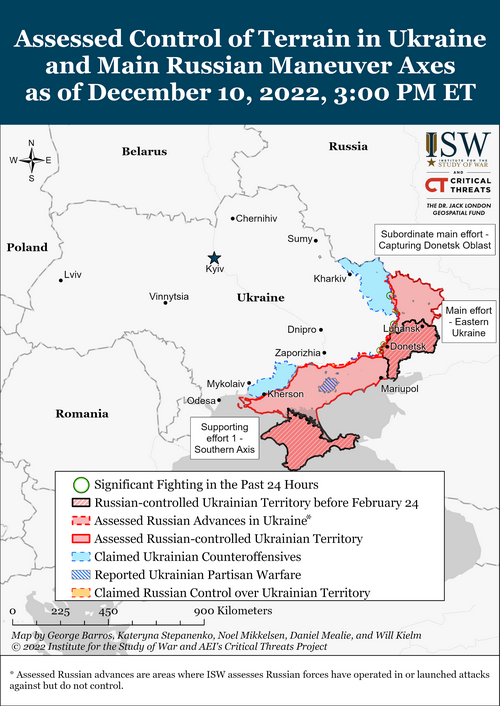
- Ukrainian forces continued counteroffensive operations toward Svatove, and Russian and Ukrainian forces conducted ground attacks near Kreminna.
- Russian forces continued attempts to advance toward Bakhmut and in the Avdiivka-Donetsk City area and to defend their positions in western Donetsk Oblast.
- Russian authorities plan to launch programs in Russia and occupied Ukrainian territories to prepare children for military service.
- Russian forces in occupied Donetsk Oblast are reportedly commandeering civilian utility equipment to construct defensive structures.
Go here to read the rest. Russia has been waging a missile and drone war as a substitute for building up the forces necessary to win the ground war in Ukraine. This is a sign of Russian military impotence.

