
From The Institute For The Study of War:
Karolina Hird, Kateryna Stepanenko, Riley Bailey, Grace Mappes, Layne Philipson, Yekaterina Klepanchuk, and Frederick W. Kagan
December 9, 6:45 pm ET
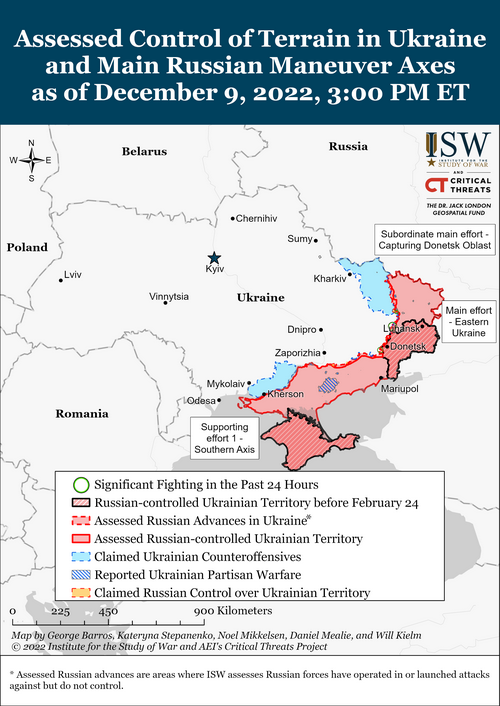
Click here to see ISW’s interactive map of the Russian invasion of Ukraine. This map is updated daily alongside the static maps present in this report.
Russian President Vladimir Putin continues to discuss negotiations with Ukraine as a means of separating Ukraine from its Western supporters by portraying Kyiv as unwilling to compromise or even to engage in serious talks. During a news conference at the Eurasian Economic Union summit in Bishkek, Kyrgyzstan, on December 9, Putin clarified his December 7 statements wherein he suggested that Russia was preparing for a “lengthy” war and stated that he meant the settlement process would be protracted.[1] Putin emphasized that the settlement process will be challenging and take time, and that all participants will need to agree with realities on the ground in Ukraine (by which he presumably means recognizing Russian control of any territories it has annexed), but that at the end of the day, Russia is open to negotiations.[2] Putin also criticized statements made by former German chancellor Angela Merkel that the 2014 Minsk Agreements were an attempt to “buy time for Ukraine” and accused Merkel and the West of propagating distrust in negotiating future settlements.[3] Putin remarked that based on this understanding of the Minsk Agreements, perhaps Russia should have begun military operations earlier.[4] Despite the constant employment of adversarial rhetoric regarding the settlement process, Putin continued to claim that Russia remains open to the possibility of negotiations.[5]
Putin has consistently weaponized invocations of the negotiation process to isolate Ukraine from partner support by framing Ukraine as refusing concessions and likely seeks to use any ceasefire and negotiation window to allow Russian troops time to reconstitute and relaunch operations, thus depriving Ukraine of the initiative. A ceasefire agreement that occurs soon enough to allow Russian forces to rest and refit this winter is extremely unlikely, however. Negotiating a protracted, theater-wide ceasefire takes time. Russia and Ukraine are extremely far apart on the terms of any such agreement, and it is almost impossible to imagine a ceasefire being agreed to, let alone implemented, for some months, which would deprive Russia of the opportunity to pause Ukrainian winter counter-offensives and reset before spring.
Putin may be overly optimistic about the prospects for a more immediate cessation of hostilities, but that is also unlikely given his rhetoric as well as statements by Ukrainian leaders and the West, of which he is well aware. It is more likely that Putin is fanning discussions of a ceasefire primarily as part of an information operation designed to expand cleavages between Ukraine and its backers by portraying Kyiv as unwilling to talk. Putin is likely secondarily setting conditions for actual negotiations sometime in 2023, presumably after Russian forces have secured more of the territory he claims to have annexed.
Putin’s positioning in the Russian information space continues to oscillate between supporting the Russian Ministry of Defense (MoD) and backing the nationalist and pro-war milblogger community. Putin stated that the Russian MoD “behaves transparently” and properly reflects the “stable” progress of the “special military operation” in its daily reports.[6] Putin, however, then proceeded to undermine the Russian MoD when responding to a question about persistent problems with supplying the army and mobilization, noting that the Russian MoD informed him that the Russian Armed Forces has solved most of its debilitating issues.[7] Putin also told journalists: “You cannot trust anyone. You can only trust me,” when responding to a question about whether Russians should trust Russian MoD or sources operating on the frontlines.[8] Putin’s statements seemingly indicate that he is distancing himself from the milblogger community, which largely reports or obtains information from the frontlines. Putin’s statement on the transparency of the Russian MoD briefs—which the Russian milblogger community heavily criticizes for its inaccuracies and censorship—may aim to blunt such critiques or could be an effort to deflect the blame for military failures in Ukraine onto the Russian MoD, or both.
Putin likely attempts to preserve the position he has tried to occupy throughout his reign, in which he is seemingly aware of all Russian problems while not being directly responsible for them. Putin has long established the Russian MoD as a scapegoat for his failures, but the quasi-official milblogger community may pose a threat to his pretense of ignorance of problems. Putin remains in a predicament in which he relies on the support of the nationalist community to rally support behind his war in Ukraine, but must also mitigate the risk of angering the nationalists by failing to deliver their unrealistic and unattainable visions for the Russian military campaign. Putin, thus, needs to continue to play the part of the ultimate arbiter of the truth to manage the prominence of the quasi-official sources while simultaneously appealing to them in critiquing his very own security institutions. He remains unlikely to shut down the independent milblogger community but equally unlikely to commit fully to supporting it or pursuing its preferred extremist courses of action.
An independent open-source investigation by BBC’s Russia service and independent Russia outlet Mediazona offered a series of observations on the nature of losses suffered by Russian troops in Ukraine. The BBC confirmed the deaths of 10,000 Russian soldiers in Ukraine based on open-source records and noted that over 400 of the deceased were soldiers called up by partial mobilization.[9] This number notably does not encapsulate the actual scale of Russian losses in Ukraine and reflects only those whose deaths are confirmable in the open source. The BBC investigation found that Russia’s Krasnodar Krai had the highest number of confirmed losses (428 dead), followed by Dagestan (363 dead), and Buryatia (356 dead).[10] In comparison, BBC only found 54 confirmed deaths from Moscow, which by itself makes up 9% of the population of Russia.[11] BBC concluded that although citizens of national republics (such as Dagestan, Buryatia, Altai, and Bashkortostan) are sent to the front and die in combat at higher rates than citizens of ethnically Russian regions, in absolute terms, ethnic Russians comprise the majority of Russian military deaths, and their proportion of the military dead is approximately equal to their proportion in the overall Russian population.[12] BBC concluded that this finding suggests that discrepancies in Russian force generation efforts therefore fall along regional and territorial lines as opposed to predominantly ethnic lines and noted that military service is seen as the only lifeline in regions on Russia‘s economic periphery where social mobility is greatly restrained.[13] As ISW has previously observed, the impacts of force generation have been firmly siloed on a regional basis, which further breaks down along overlapping ethnic and socioeconomic lines.[14] The BBC investigation partially contradicts ISW’s previous assessments that the Kremlin was attempting to shield the ethnic Russian population from the war by drawing disproportionately on minority regions. ISW has no basis for questioning this conclusion.
The BBC investigation also found that both elite units and officers have suffered substantial losses in Ukraine. The BBC reported that the Special Forces of the Main Directorate of the General Staff of the Russian Armed Forces (GRU Spetznaz) has suffered 250 confirmed losses, nearly 25% of whom were officers, which in the case of some individual Spetsnaz units exceeds cumulative losses over 10 years of Russian operations in Chechnya.[15] The BBC additionally identified 1,509 confirmed officer deaths- or 15% of the 10,002 identified losses.[16] The losses accrued by elite units and the Russian officer cadre will have significant and generational ramifications for the Russian military.
Russian officials continue efforts to place legislative controls on domestic dissent. Independent Russian outlet Meduza reported on December 9 that Russian State Duma deputies proposed a bill introducing new crimes and charges related to financing, inducing, recruiting, training for, organizing, or engaging in sabotage activities.[17] In all cases, except for complicity in sabotage, the proposed law introduces a maximum sentence of life imprisonment. Life imprisonment is currently the maximum sentence only in the case of deaths resulting from sabotage actions.[18] As ISW has recently reported, Russian officials have been taking similar measures to expand legislative oversight of domestic affairs in an attempt to further stifle domestic dissent. The Russian Ministry of Justice, for example, expanded the list of “individual foreign agents” on November 27, and Russian media began reporting that the Russian government is taking steps to broaden the definition of foreign agents, as well as imposing additional restrictions on the activities and movements of those deemed to be foreign agents.[19] Such legislative efforts suggest that the Kremlin continues to fear domestic friction resulting from the effects of its conduct of the war in Ukraine.
Senior US officials stated that Russia is providing an unprecedented level of military and technical support to Iran in exchange for Iranian-made weapons systems. NBC News reported on December 9 that senior US presidential administration officials stated that Russia may be providing Iran with advanced military equipment and components, including helicopters and air defense systems, in exchange for Iranian-made high-precision weapons systems that Russia has used and intends to use in the war in Ukraine.[20] The officials specified that Russia may send Iran Su-35 aircraft within the next year and that Russia is possibly seeking to establish a joint Russian Iranian production line for drone systems in the Russian Federation.[21] US intelligence officials stated on November 19 that Russian and Iranian officials finalized a deal in early November to manufacture Iranian drones on Russian territory.[22] A Russian milblogger claimed on December 9 that air traffic monitors show that Iranian Air Force cargo planes resumed flights to Moscow on December 8 following a short break in such flights.[23] ISW assessed that Russian Deputy Defense Minister Colonel General Alexander Fomin met with Iranian Armed Forces General Staff Chief General Mohammad Bagheri in Tehran on December 3, likely to further discuss the sale of Iranian drones and missiles to Russia for use in Ukraine.[24] ISW has previously assessed that the Russian military is increasingly reliant on Iranian-made weapons systems due to the depletion of its arsenal of high-precision weapons systems.[25]
Key Takeaways
- Russian President Vladimir Putin continues to discuss negotiations with Ukraine as a means of separating Ukraine from its Western supporters by portraying Kyiv as unwilling to compromise or even to talk seriously.
- Putin’s positioning in the Russian information space continues to oscillate between supporting the Russian Ministry of Defense (MoD) and backing the nationalist and pro-war milblogger community.
- An independent open-source investigation by the BBC’s Russia service and independent Russia outlet Mediazona found that members of Russian national republics deploy to Ukraine at disproportionately higher rates than ethnically Russian oblasts, but that ethnic Russians are dying at a rate proportional to their representation in the Russian Federation population, contrary to previous ISW assessments.
- Russian officials strengthened existing legislation to stifle domestic dissent.
- Senior US officials stated that Russia is providing an unprecedented level of military and technical support to Iran in exchange for Iranian-made weapons systems.
- Russian forces established defensive lines near Svatove, and Russian and Ukrainian forces conducted ground attacks near Kreminna.
- Russian forces continued ground attacks near Bakhmut and Avdiivka.
- Russian forces may have established positions on an island west of Kherson City in the Dnipro River.
- Ukrainian forces’ interdiction campaign against Russian military assets and logistics hubs in southern Ukraine has likely degraded Russian forces, their logistics lines, and broader Russian morale.
- Putin doubled down on claims that Russia will not conduct a second wave of mobilization amidst persistent concerns within Russian society.
- Russian occupation authorities continued to strengthen physical, legal, and social control over occupied territories.
Go here to read the rest.
From Strategy Page:
December 9, 2022: Since 2014 Ukraine has relied on a number of special operations units for key operations. In 2014 Ukraine had a Special Forces Command consisting of 4,000 troops similar to the Russian Spetsnaz, a Russian term for special purpose military units. After World War II the Russian special operations troops evolved into the spetsnaz. All participants in World War II had some form of special operations troops and such troops have existed for thousands of years. While the U.S. has united all its special operations troops into SOCOM (Special Operations Command), most nations allow special operations to exist throughout the military.
In 2016 Ukraine combined many of its special operations troops into the SSO (Special Operations Forces), an organization based on the American SOCOM. This was part of the military reforms that were turning the Ukrainian military into a NATO compatible force. The Ukrainians still created special units for special situations. For example, the Kraken Regiment was created on the same day (24 February) that the 2022 Russian invasion began. The Kraken Regiment does not belong to the Special Operations Command, and works directly for Ukrainian military intelligence. Since its formation, the regiment has grown to a force of nearly 2,000 volunteers, nearly all of them special operations veterans. Kraken exists to carry out reconnaissance missions for the Ukrainian high command and occasional combat, sabotage and internal security missions. Early in the war Kraken was a key factor in finding and capturing or killing Russian agents inside Ukraine. Kraken often worked with Ukrainian special operations forces or Ukrainian internal security operatives on these counterintelligence missions against Russian agents or Ukrainians who were working for the Russians.
Kraken was a key element in the September offensive in the northeast (Kharkiv). The army came to depend on Kraken to deal with obstacles quickly rather than having the army handle it and suffer more casualties and take longer. Six months into the war, Kraken had already established a reputation for getting things done quickly. Ukrainian troops proceeded more confidently when they found that Kraken had gone before them and Russian units were dismayed if they believed they were facing Kraken.
Kraken operations are kept secret because surprise is one of the most essential items in the Kraken toolbox. Kraken has become a major problem for Russian forces, who tell stories (many exaggerated) of Kraken operations. The Russians have spetsnaz units similar to Kraken and have personnel trained to find and eliminate Kraken operatives. Early in the war Russia found that their spetsnaz forces operating inside Ukraine were much less effective than operating in any other area outside Russia. Part of this was because many Kraken members have been fighting Russians in Ukraine since 2014. Experience matters, and in Ukraine the Russians spetsnaz are at a disadvantage and have taken heavy losses because of that. This has not removed spetsnaz operations from Ukraine but has made these operations rare and be conducted very carefully. The spetsnaz are believed to be operating in Russian-occupied areas of Ukraine where there are problems with Ukrainian partisans. These partisans have grown in number as more Ukrainian territory is cleared of Russian forces. Ukrainian special operations forces are used to help support and expand partisan operations. If Kraken is involved, they keep it quiet.
Kraken is the latest special operations force created to deal with the changing situation in Ukraine. This is a pattern that first appeared back in 2014 when the Russians sized Crimea in early 2014 and later went after two eastern provinces (Donetsk and Luhansk) collectively known as Donbas (Donets Basin). Donetsk had about two million people and Luhansk a million. Crimea had 2.3 million, including the port of Sevastopol which was leased to Russia and contained 250,000 people, including 20,000 military personnel. Ukraine had only 6,000 combat ready troops in their entire country and that made the Russian seizure of Crimea much easier.
Donbas was different. Half the population spoke only Russian while the other half spoke Ukrainian and usually Russian as well. The two languages are very similar with Ukrainian pronouncing many words differently and have many unique words. This is similar to how English is spoken in the United States and Britain as well as English speaking areas worldwide. Ukrainian and Russian are two dialects of the same language that evolved over a thousand years ago around Kyiv in the south and Moscow in the north. In the 20th Century Russia (Soviet Union) made serious efforts to suppress the teaching or use of Ukrainian. This failed and only made Ukrainians more determined to achieve permanent independence, which finally happened in 1991 when the Soviet Union dissolved. Russia decided to end that independence in 2022 with an invasion of the entire country. That failed.
The Russians should have understood this based on what happened in Crimea and Donbas after 2014. Most of the people in these three areas considered themselves Ukrainian and that pro-Ukraine attitude grew stronger after 2014. In 2014 Russia discovered that most of the Donbas Russians were loyal to Ukraine and tried to solve that problem by sending in Russians who pretended to be Donbas residents. These outsiders provided most of the armed men who comprised the separatist militias that took control of about half of the two Donbas provinces in 2014. Russia found some Donbas natives to join up too, and often served as officials in the separatist governments. There was a lot of infighting among the various Donbas separatist militias and Russian sent in spetsnaz to remove the most troublesome militia leaders. This usually meant just killing enough of them to reduce the infighting. By then (2016) Russia had signed a ceasefire with Ukraine that halted most of the fighting. Russia constantly violated the ceasefire agreement and tore it up in 2022.
One of the events that caused the Russians to accept a ceasefire was the spontaneous emergence of a Ukrainian special operations unit called the Cyborgs, who held onto the main Donetsk airport for eight months. The Cyborgs did this while surrounded and the separatists had to destroy the new airport, the second largest in Ukraine, that had recently been built at a cost of nearly a billion dollars.
The surviving Cyborgs were overwhelmed in January 2015, with only 44 of them being taken alive after running out of ammunition. The saga of the Ukrainian defenders of Donetsk airport by the “Cyborgs” inspired Ukrainians and demoralized Russian separatists in Donbas. The Cyborgs earned their nickname because of their tireless and stalwart defense of the airport for 242 days. This was a motley force consisting of Ukrainian Army soldiers, Territorial Defense soldiers, and volunteers from various paramilitary organizations. Cyborg numbers varied between 100 and 200 throughout their siege. They were periodically supported, resupplied and reinforced by nearby Ukrainian Army units. The closest Ukrainian forces got to the airport defenders was two kilometers away from the airport terminal building the Cyborgs defended. Ukrainian army support included lots of artillery fire, which was very effective thanks to the Cyborg’s forward position and excellent observation posts, especially the airfield’s air traffic control tower. There were counterattacks with small units of armor against pro-Russian rebel attempts to encircle the airfield. Separatist troops and tanks attacked the terminal building with the help of some convenient fog. On January 19 2015, after taking some parts of the control tower, the separatists used demolition charges to collapse parts of the terminal’s first floor ceiling, peppering many defenders with a rain of debris which killed and wounded many of them. The tower eventually collapsed. By the end of the 19th both sides claimed control of the airfield. By the 21tst Ukraine admitted that the rebels had overrun the area. The rebels claimed to have taken 44 of the Cyborg defenders alive. After 2015 the airport was cleared of rubble but there were no attempts to rebuild it.
The spontaneous emergence of the Cyborgs led to Ukraine encouraging similar initiatives until and after the Russians invaded in 2022. This included Ukraine officially establishing an International Legion for defending Ukraine. So far about 20,000 foreigners have enlisted, most of them veterans of their own governments’ armed forces, and some were special operations veterans. There are now international and national prohibitions against unofficially participating in another country’s war, though this has been pretty much constant for the last few thousand years. This doesn’t stop the most determined volunteers, many of them willing to fight and not just provide support (as trainers and advisors).
Ukrainian Special Operations Command, now the fifth branch of the Ukrainian military, recognized an opportunity and recruited several hundred foreign special operations veterans to serve in a branch of Ukrainian Special Operations. Russia also obtained some foreign fighters, most of them foreign mercenaries already working for the Russians in foreign wars. Ukraine attracted far more foreigners who traveled to Ukraine at their own expense and worked for nothing. The volunteers were housed, fed and otherwise supported but were not, in the classical sense, mercenaries.
Go here to read the rest. Even in special forces units the Ukrainians outclass the Russians.


The BBC estimates here of 10,000 Russian military killed seem unrealistically low.
Sir Tony Radakin, British Chief of Defence, in October of 50,000 casualties (which the standard is to assume 1/3rd of that number are dead or roughly 17,000) and the rest battlefield-incapacitated or missing. The open-site Oryx says the Russians have documented losses of 1450 tanks and 1700 of their troop carriers (BRT’s) destroyed: we know that when the Ukrainians take out these armored units, they are very efficient in covering any attempted escapes with brutal small arms fire. Those motorized unit losses alone suggest much larger battlefield fatalities.
Other reports indicate that the troop units have no field first-aid kits, and little or no field emergency medical capability. The Russian field military hospitals are few and considered to be utterly inadequate for the 21st-century. The rate of Russian wounded who die must be horrific (contrasted with the Ukrainians, who are on their own turf, and are known to have surprisingly good medical facilities, considering the conditions). It was observed by Ukrainian civilians previously around Mariupol in the early months of this war that Chechnyan units were executing, severely wounded Russians, not out of cruelty, but mercy-killing since the Chechnyans knew the wounded could never survive and were otherwise condemned only to suffer horribly in ditch’s and alongside roads til death. Additionally, the Russian MoD need to call up thousands more troops and the Putin mobilization orders point to a much larger field loss of men.
Presently, a savage World War I-like trench warfare continues to rage around the rail crossroads center of Bakhmut. Western observers estimate both sides are losing to 100 soldiers a day.
So the number of 10,000 Russian military killed just doesn’t seem to square with the other numbers suggesting enormous losses.
One thing history shows that Russians know how to do, suffer. They seem to know how to suffer quite well. Other things, not so good.
I don’t see any reason why Ukraine should be expected to make concessions. After all, they are the victims. Chamberlain had that attitude in 1939 with Czechoslovakia and look what the world got from that. It would seem that increasing the pressure on Russia would get the point across to Putin’s underlings with a view that they might handle the matter.