
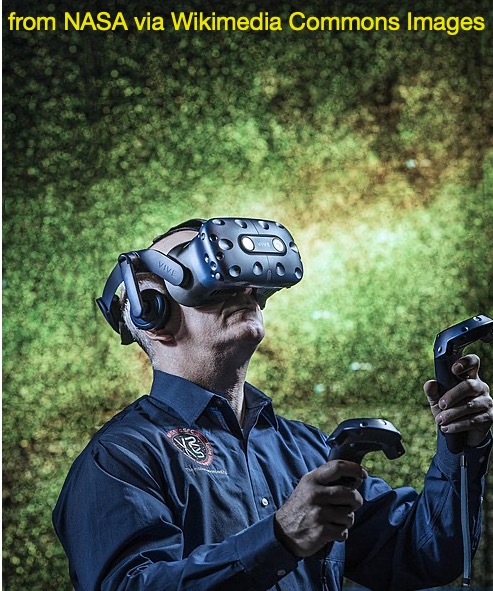
“We find ourselves in a historical moment of pervasive mediocrity. Fueled by basic human drives—flights from death and boredom—the new technologies, bright and all consuming, increasingly blur the lines between direct experience and representation. A photograph of an apple is not food and the Internet has neither scent nor texture.”
― Jonathan Simons, The Analog Sea Review: Number One
INTRODUCTION
During the covid pandemic many of us who could not go to Mass took to the internet, watching liturgies and priests that struck our fancy. We could rise very early and pick up a Mass recorded from Australia, 14 to 16 hours earlier, or wait until evening to watch a live celebration in a later time zone. But it did not satisfy. A picture of the priest raising the Body and Blood of Our Lord for us to observe is not the same as seeing that between the heads of the kneeling congregation. And certainly there is no way to receive Holy Communion online.
Those of us who fancy speculative fiction can imagine a future in which virtual reality devices would attempt to implement such deficiencies. Holographic techniques could give us images that appear to be solid. Special gloves might give us the sense of touch…and so forth. But could such an enhanced virtual Mass be equivalent to one where we are physically present? My answer is a resounding NO! Since I hope this response seems obvious to the reader, I won’t attempt to justify it further.
What I will examine in this article are less obvious cases, where the distinction between presence and virtual reality may not be as clear. Is it the case that all the sacraments require a physical presence? I could make this piece very short by citing the answer of Fr. Dominic Langevin, OP:
“As the Catechism of the Catholic Church states, ‘The sacraments are efficacious signs of grace.’ As signs, the sacraments are physical. They are driven by spiritual principles and ends, but they are rites involving physically manifested words, gestures, and things. This is how Christ instituted the sacraments and how the Church must live them”—Fr. Dominic Langevin, OP, “Why we can’t confess over zoom,” First Things, 3 April 2020.
That being said, further discussion may help us to determine how appropriate the internet (as it is now, or may be in its ultimate realization, virtual reality) might be for non-sacramental devotions.
THOSE SACRAMENTS THAT CLEARLY REQUIRE A PHYSICAL PRESENCE
Without giving justifications, I’ll list those sacraments that clearly require a physical presence:
-
Baptism
-
Confirmation
-
Matrimony
-
Holy Orders
-
Holy Communion
-
Anointing of the Sick
Although Fr. Langevin gives convincing reasons for putting Penance (Confession, the Sacrament of Reconciliation) on that list, there might be a need for virtual Confession. Let’s examine his arguments.
DOES CONFESSION REQUIRE THE PHYSICAL PRESENCE OF A PRIEST?
When I was learning about the Church and its sacraments 27 years ago, I was impressed by the role of the priest in Confession: “in persona Christi.” I was confessing my sins not to a man I knew (or didn’t know), but to our Lord, Jesus Christ. Whether I liked the priest or not, whether he was a good or bad priest, whether the penance he assigned was appropriate or not, did not matter. And certainly being face-to-face (or in front of the confessional shield) to “in persona Christi” is much more than encountering His image on a computer screen.
In his article, Fr. Langevin gives other arguments for person-to-person Confession, including the possible violation of confidentiality if electronic devices are used. However the quotation below shows the core of his reasoning:
“The sacramental rite involves four specific acts: the penitent’s contrition, confession, and satisfaction, and the priest’s absolution. It is not a monologue, but a dialogue….This salvific conversation cannot occur through electronic means because the sacrament of penance requires both joint physical presence and live, interpersonal action between the penitent and priest-confessor. The conditions for a full, natural, human conversation must exist.”—op.cit.
Although I agree with all of the above, others say the Church should offer alternatives to person-to-person confession when pandemic restrictions make person-to-person Confession difficult or impossible (see here). However, the Church has always held that when a priest is unavailable one ahas the option of perfect contrition.
Are there non-sacramental modes of worship that could employ internet techniques? I’m interested in one, in particular, Adoration, and would be grateful for reader comments that would help me to decide what to do.
ADORATION VIA THE INTERNET?
Let me give some background before addressing general issues. At 92.7 my travel options are limited. Before the pandemic I would visit the local Adoration Chapel weekly, having signed up for a regularly scheduled stint. The Chapel was closed during the pandemic. A few months after quarantine restrictions were generally removed, it opened for two days a week. Let me add that my options for driving have become limited during the last three years.
Although I attended Mass frequently during the week before the pandemic, these last two years I’ve attended only on required days and occasionally during the week. I don’t regard viewing an internet Mass as a good substitute for being there in person, but I do watch homilies given by a few priests on YouTube. One of these, Fr. Mike Schmitz, recently urged those watching to do 29 minutes of Adoration for 29 days as an Advent devotion. (See here.) I have started to do this, but can’t do it other than virtually, via YouTube videos of perpetual adoration chapels (see here, here and here).
My question: am I adoring Our Lord, by looking at an image of him? I’ll agree that the consecrated host visible in the monstrance is His Body and Blood, Soul and Divinity. But what about the computer generated image of that host? I would be most grateful for the reader’s thoughts on this and on other forms of virtual devotions.
NOTE
Featured image is from here.



My impression is that prayer using an image on a screen is equivalent to prayer using a statue or holy image. I don’t know it should properly be called “adoration”. We use the object as a symbol of what we’re revering or worshipping. I can point at a monstrance or a tabernacle and say “God is there” in a way that I can’t toward a monitor or a book.
It’s a really interesting point about Confession though. I’d assumed it could be adapted for virtual interaction.
The Catechism says:
“Religious worship is not directed to images in themselves, considered as mere things, but under their distinctive aspect as images leading us on to God incarnate. The movement toward the image does not terminate in it as image, but tends toward that whose image it is.”
It has a footnote to something from the Summa, but I don’t think it’s an exact quote. But this ties into what I was thinking about. Eucharistic adoration is something unique, not mere reverence of a representation.
I think virtual reality or internet means provide a worthwhile substitute for those who cannot physically enter a church building. It is, indeed, better than nothing.
I would not say that virtual or internet confession or Mass attendance should ever be the norm for anyone. There’s a reason why EWTN has the spiritual communion prayer while the priest is offering communion to the gathered faithful. There’s a reason why they don’t offer confession online.
Online confession has the risks with electronic interference mentioned in the article; online Mass has the detriment of being unable to receive the Sacrament in one’s mouth. You can’t eat an electronic image of the consecrated host any more than you can eat a painted apple.
I agree with JLF.
Intent.
Under unusual circumstances my thought is the the efficaciousness of spiritual communion and adoration is subject to the intent. God knows hearts. Spending an hour of adoration on line is a sign of love.
That’s my feeling…it may not be completely correct but the desire is the key. You can’t make it to adoration so this is an alternative.
Good.
Confession…nope.
The individual needs to be present and the confidently of the action needs to be absolute.
I am not going to speak on Gods behalf and cases where absolution was granted without proper form or administration because that would we ludicrous. God will do what He wants and when He wants with whom He wants in circumstances that are challenging. How many laws did the Pharisees have? 730?
Intent. Desire. Love.
I believe that they have a remarkable beautiful effect on Gods heart.
Confidentially…excuse my typo please.
Bob you are adoring Our Lord whenever your heart and mind adores Him to the genuine best of your ability.
However, I think we should always strive to be in the physical and immediate presence of Our Lord where ever possible.
Although the pandemic offered Mass online for much of the world, I felt that we lost the reverence not being present in Our Fathers house. If you had to do online Mass with children, it was difficult to get them to understand we were “at Mass” not surrounded by a congregation and not physically in the awe of the Blessed Sacrament. For others older, like yourself, it created an isolation and disconnect with the Church community.
I don’t ever seeing online Mass as being an ongoing appropriate substitute for actually physically going to Mass. Although it has proven during time of crisis as the next best thing.
Also, think about it, God became man- physically. Not symbolically or virtually. That says a lot about the actual flesh and blood which we all possess. Jesus Christ becoming Flesh and Blood connected Him Physically with mankind. The virtual will truly never, as you stated, replicate our senses.
As much as technology and society advance I hope it’s not a substitute for being in the real Presence of Our Lord. And as community we need to ensure those who require our help ie. those members who are older, are given the assistance at every opportunity to be in the real presence of Our Lord.
Mass online is not a valid Mass. You are not participating. If you’re going to watch a recorded Mass, why bother with Fr. Smith down the road, watch one from 50 or 100 years ago,then put the final blessings of a loop to play over and over. No, you must be present for Mass.
In 2020 we “watched” a few masses for about a month then stopped as was causing confusion in my children and wife that it was no different from one attending in person.
If there was a statue of the Host on display in a Church would you bow down and adore it like a real Host in a Monstrance? An image of a host on a screen is no different. Don’t do it whether or not it is a live feed or was recorded 24 hours before.
Am I adoring my Lord by looking at an image of him?
Absolutely.
Treasures in Heaven
(Matthew 13:44-46)
19Lay not up to yourselves treasures on earth: where the rust, and moth consume, and where thieves break through and steal. 20But lay up to yourselves treasures in heaven: where neither the rust nor moth doth consume, and where thieves do not break through, nor steal. 21For where thy treasure is, there is thy heart also.
In person is always the best and most efficacious way of adoration…yet under difficult circumstances, Scaredemic for example, one that longs to be with Him adores him via live feed.
Agian…He knows our hearts.
He is my treasure. He isn’t going to love me any less under those circumstances that I mentioned.
Btw….Spiritual communion is very efficacious as well. I’ll revisit as soon as I find the Saint that revisited his religious community after death. He spoke of the two filled chalices…one gold, the other silver. When the Saint asked the Lord what was its meaning, he was told that the gold was all of his holy receptions of Holy Communion. It overflowed.
So to with the Silver chalice. It overflowed and it pleased the Lord that the saint practiced this honorable heart felt devotion.
A bit off-topic, but during the first months of covid, we had drive-in Adoration in our church parking lot. I think it was Wednesday afternoon, but of course days didn’t have much meaning back then. Our pastor set up a small altar and knelt in front of the monstrance for two hours, and cars would cycle in (maybe 25 cars at any given time). It was so beautiful. I miss it. Not only was it desperately-needed time with the Lord, but I’d wager that our parish was never so close-knit as when we were sitting in our own cars during isolation.
I haven’t located the account yet..I’m at work..but i will when I go on break.
https://catholicstrength.com/2017/09/20/the-efficacious-practice-of-spiritual-communion/
“St. Catherine of Siena wondered about this herself. Then, in a vision, she saw Christ holding two chalices. He showed her a gold chalice, which held her sacramental Communions and a silver chalice, which held her spiritual communions. He told her they were both pleasing.”
https://creamcitycatholic.com/2020/04/15/seeing-the-beauty-of-spiritual-communion/?v=7516fd43adaa
Great information, thanks, Philip and Pinky.
Pinky.
During covid our two priests did a procession with our Lord in the monstrance through the village.
People came out and wondered what was taking place…except for the Catholics who knew ahead of time that it was going to happen. Beautiful way the cleanse the hamlet. :^)
It gave an opportunity for explanation and evangelization.
Peace.
Thanks Pinky…you found it!
I went from memory Pinky, which isn’t always very accurate. It was St. Cathrine of Siena, however I’m not sure where I got the idea of Jesus’ discourse.
Nonetheless, thanks for helping me out.
Bread from heaven, strengthen our souls, give us courage to witness and better memory as to not fail in witnessing your truths. Amen. :>)
During the lockdown, I quickly came to the conclusion that attending Mass on the internet was exactly the same as spending your honeymoon on Skype. The first time we Were actually allowed to attend in our church, I cried. (BTW, being sadly rather light of mind, I did begin to wonder, after several months, if all those Masses we celebrated in our parking lot would somehow turn it into a sort of giant sacramental, and, if so, what would need to be done about it. I did NOT take this concern to Father, as he has quite enough on his plate without it.)
Pinky and PN, thanks for the links. I’ve decided that virtual adoration is indeed better than nothing. We’re given a focus for praying, and I am weak-minded enough that I need that focus.
Hey, any tool to put you in the right frame of mind is great.
I agree with John Kennedy on this.
As an aid to worship, an icon or statue is much better, PARTICULARLY IF IT HAS BEEN BLESSED. Then it is a sacramental — still not a sacrament, but at least something more substantial than our mere imagination.
This is particularly problematic when dealing with an image of the Eucharist, either on a TV or computer screen or in religious art. “Godhead here in hiding whom I do adore // Masked by these bare shadows, shape and nothing more.” The image can capture the “bare shadows, shape and nothing more”, but it absolutely cannot capture the Godhead in hiding. I would argue it is better to venerate an image of Christ in, say, an icon of Christ Pantocrator, an image of the Divine Mercy, or a statue of the Sacred Heart, because in any of these Christ is portrayed as what He is, a man, rather than as what He is not, which is a piece of bread. If you receive the Eucharist, you receive the Body, Blood, Soul, and Divinity of Christ, but if you photograph the Eucharist, you only get a photo of a piece of bread; the photo captures the accidents, not the essence.
That raises a practical question. I’ve viewed Eucharistic Adoration on YouTube, but I’ve done it in the same chair / same angle / same everything as when I watch any other YouTube. I think the act of addressing a statue or icon rather than a typical screen…I don’t know the words to describe it, without sounding either fluffy-headed or misusing theological terms. It’s different for me. I think I can get taken up in an online devotion or Mass because it exists in time, but there’s a stillness in Eucharistic Adoration that doesn’t mesh with screen-viewing for me.