

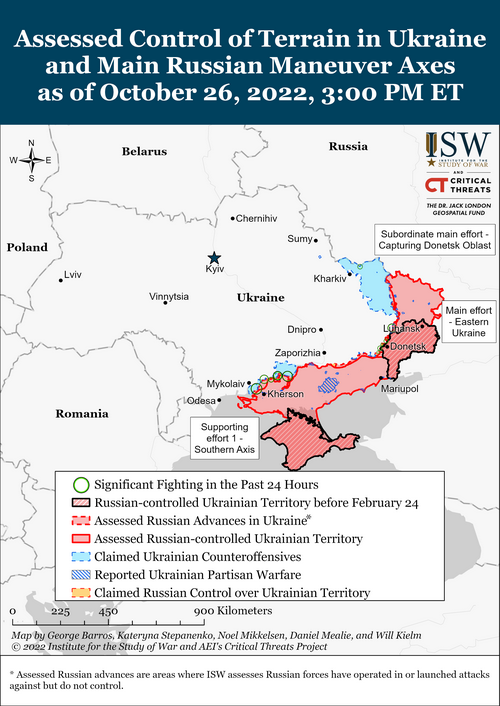
From The Institute For The Study of War:
George Barros, Karolina Hird, Riley Bailey, and Frederick W. Kagan
October 26, 7:30 pm ET
Click here to see ISW’s interactive map of the Russian invasion of Ukraine. This map is updated daily alongside the static maps present in this report.
A Reuters investigation of a document trove found in an abandoned Russian command post in Balakliya, Kharkiv Oblast, supports ISW’s longstanding assessments about the poor condition of Russian forces. ISW has long assessed that the conventional Russian military in Ukraine is severely degraded and has largely lost offensive capabilities since the summer of 2022, that Russian strategic commanders have been micromanaging operational commanders’ decisions on tactical matters, and that Russian morale is very low. Reuters’ investigation found that Russian units near Balakliya were severely understrength, with a combat battalion at 19.6-percent strength and a reserve unit at 23-percent strength.[1] The investigation found that poor morale, bad logistics, and overbearing commanders contributed to Russian forces’ poor performance.[2] The report found that the Russian Western Military District explicitly forbade a subordinate from withdrawing from an untenable position in the small village of Hrakove (which has an area of less than three square kilometers).[3] Ukrainian forces defeated Russian forces in Balakiya and routed Russian forces in eastern Kharkiv Oblast around September 8-10.[4]
Russian President Vladimir Putin’s rhetoric indicates that he is not interested in negotiating seriously with Ukraine and retains maximalist objectives for the war. Putin stated that Ukraine has “lost sovereignty” in a meeting with Commonwealth of Independent States (CIS) security officials on October 26.[5] Putin stated that the United States is using Ukraine as a “battering ram” against Russia, the Russian-Belarusian Union State, the Collective Security Treaty Organization, and the CIS. Russian State Duma Speaker Vyacheslav Volodin amplified this narrative, stating that “Ukraine has lost the ability to exist as a state,” “Ukraine is occupied by NATO,” and “[Ukraine] has become a colony of the US” on October 26.[6] This language is incompatible with negotiations on an equal basis for a ceasefire, let alone a resolution to the conflict that Russia began. It instead strongly suggests that the Kremlin still seeks a military victory in Ukraine and regime change in Kyiv that would affect the permanent reorientation of Ukraine away from the West and into Russia’s control. It also indicates that Putin’s aims transcend the territory he has claimed to have annexed, let alone the areas his forces actually control.
Russian occupation officials in Kherson Oblast are attempting to mitigate the informational consequences of the chaos of the initial Russian withdrawals from the west bank of the Dnipro River. Kherson Oblast occupation head Vladimir Saldo stated on October 26 that it would be “practically impossible” to completely destroy the dam at the Kakhovka hydroelectric power plant (HPP) and that even the destruction of the dam locks at the HPP would only cause the water level of the Dnipro River to rise less than 2 meters.[7] Saldo’s statement directly contradicts his own prior statements and the warnings made by Commander of Russian Armed Forces in Ukraine Army General Sergey Surovikin on October 18 that Ukraine is planning to strike the Kakhovka HPP and cause flood damage along the Dnipro River.[8] Saldo’s apparent retraction of his own warnings may suggest that he seeks to quell anxiety accompanying the mass movement of civilians and Russian military and occupation elements across the Dnipro in order to preserve his own ability to rule. Saldo also issued assurances about the provision of basic utilities and financial services that he claimed will continue even as evacuations to the east bank are ongoing.[9] Saldo’s statements indicate that his administration is attempting to mitigate panic in the information space, likely in order to maintain control of the population of Kherson Oblast against the backdrop of ongoing evacuations.
Russian forces conducted an assault on Ternova, Kharkiv Oblast, likely to fix Ukrainian forces there and prevent them from reinforcing Ukrainian counteroffensive operations elsewhere. The Ukrainian General Staff reported on October 26 that Ukrainian forces repelled an attack on Ternova (40km northeast of Kharkiv city) which is well removed from areas encompassed by the eastern Ukrainian counteroffensive.[10] Russian forces likely do not intend to regain limited territory in border areas of Kharkiv Oblast but instead likely hope to keep Ukrainian forces in the area that otherwise could join counteroffensive operations. Russian forces are likely hoping for a similar outcome in northwestern Ukraine with their deployment of forces to the joint grouping of forces in Belarus and the messaging around it.
Russian officials continued to admit that Russia is deporting children to Russia under the guise of adoption and vacation schemes. Russian media reported on October 26 that the Russian Commissioner for Children’s Rights, Maria Lvova-Belova, adopted a Ukrainian child who was deported from Mariupol to Russia.[11] Lvova-Belova claimed that Russian officials have brought 31 children from Mariupol to Russia and that her office is working to “rehabilitate” Ukrainian children from active combat zones. As ISW has previously reported, the forced adoption of Ukrainian children into Russian families may constitute a violation of the Convention on the Prevention and Punishment of the Crime of Genocide.[12]
Russia is also continuing to use the excuse of recreational trips to deport Ukrainian children to Russia and Russian-occupied territory. Member of the Zaporizhia occupation administration Vladimir Rogov reported on October 26 that over 500 children from Enerhodar went on “vacation” in Yevpatoria, Crimea and Anapa, Krasnodar Krai this year alone.[13] Rogov claimed that the children received “new knowledge” as part of the “educational program.”[14] Russian-appointed governor of Sevastopol Mikhail Razvozhaev similarly claimed that children from occupied Kherson City and Enerhodar took part in “excursions” in Sevastopol.[15] These reports are consistent with ISW‘s previous observations that Russian officials have used the veneer of such recreation and rehabilitation programs to justify the deportation of Ukrainian children to Russian-controlled territory and areas of the Russian Federation.[16]
On October 26, Wagner Group financier Yevgeniy Prigozhin denied ISW’s report that Prigozhin confronted Putin and other siloviki factions in the Kremlin regarding the progress of the Russian war in Ukraine.[17] Prigozhin explicitly denied ISW’s October 25 assessment and falsely insinuated that ISW receives classified intelligence. ISW does not receive any classified material from any source, uses only publicly available information, and draws extensively on Russian, Ukrainian, and Western reporting and social media as well as commercially available satellite imagery and other geospatial data as the basis for these reports. ISW specifically does not receive information from Prigozhin’s deceased mother-in-law, as he (ironically) suggested.
Key Takeaways
- A Reuters investigation of Russian documents from Balakliya supports previous ISW assessments about the poor conditions of Russian forces.
- Putin stated that Ukraine has “lost its sovereignty” in an October 26 speech indicating that Russia likely retains its maximalist objectives in Ukraine and remains resistant to negotiations.
- Russian occupation officials in Kherson Oblast are attempting to mitigate the informational consequences of the Russian withdrawal from the west bank of the Dnipro River.
- Russian forces are attempting to fix Ukrainian forces on Ukraine’s northern border.
- Russian officials continued to acknowledge that Russian authorities are deporting Ukrainian children to Russia under the guise of adoption and vacation schemes.
- Yevgeny Prigozhin denied a previous ISW assessment that stated he confronted Putin and other siloviki factions regarding the progress of the war in Ukraine.
- Russian sources claimed that Ukrainian forces conducted counteroffensive operations west of Svatove.
- Russian forces continued to prepare defensive positions on the west and east banks of the Dnipro River in Kherson Oblast.
- Russian sources claimed that Ukrainian forces continued to conduct counteroffensive operations in northwest Kherson Oblast.
- Russian forces conducted ground attacks in Donetsk Oblast.
- The Russian military is reportedly attempting to recruit foreigners to support its war effort in Ukraine.
- Russian occupation officials in Kherson Oblast continued to relocate residents from the west bank of the Dnipro River.
From Strategy Page:
The poor performance of Russian troops and weapons in Ukraine has led to more opposition to the war inside Russia. More and more men conscripted or “mobilized ” men refuse to serve. Several million have either left the country or gone into hiding. This includes a lot of essential workers in many businesses, even state-owned ones. The government admits that it has mismanaged the mobilization while also announcing even more mobilizations of Russian men. A growing number of mobilized men refuse to go to Ukraine and sometimes do so violently. The untrained mobilized recruits are usually more of a liability than an asset. Too many of them will flee from a Ukrainian attack, or surrender. Recent efforts to use large units of mobilized me to stop advancing Ukrainians failed Russian commanders in Ukraine are complaining to their superiors, not just the media and these problems have reached senior officials in the government and found that Vladimir Putin continues to order problems fixed without taking into account the months of bad decisions that have eliminated most practical solutions. What Russia needs now is for the Ukrainians to slow down their offensive. There’s no change of that because Ukraine knows it has the advantage and is willing and able to take better care of its own troops than the Russians can. Except during the first weeks of the invasion, Ukraine did not send untrained recruits into battle, even though most of these new soldiers were willing to go with minimal training. Ukraine made the effort to train and equip combat troops properly. This meant there were often not enough troops available to take advantage of battlefield opportunities. As the months went by Russian recruits got less training while their Ukrainian counterparts received more. Those two trends have reached the point where Russia faces the risk of larger units collapsing when under pressure from Ukrainian forces. This is happening on a smaller scale more frequently and Russian commanders can do the math. As the proportion of untrained combat troops increases, the units they belong to must be considered unfit for combat duty. All these untrained recruits are good for is providing security in rear areas or for manual labor. Even this doesn’t work because Russian supply problems are still critical. That means not enough food, fuel, medical care or cold-weather clothing. These shortages lead to illness among the troops. There are similar problems in Russian defense industries, where the shortages of key components for building new weapons are crippling productions. Threatening to arrest plant officials who cannot solve these problems is a sign of desperation, not determination. Russia has developed some new sources for key components or weapons, but not enough. Even the crude cruise missiles obtained from Iran are slow in arriving. This may be due to the weeks of unrest and anti-government violence in Iran. Another problem is that Iran faces more economic sanctions for supplying Russia with cruise missiles that are used mainly against civilians. All Iran could say was that they did not provide the missiles for use in Ukraine. This is obviously false because Iranian media proudly reports on Iranian weapons proving decisive in Ukraine. Less often mentioned is the need for Iran to send troops to join Russian forces and show them how to use the new missiles correctly. Most of the Iranian missiles are used against civilians, including power plants, water supply facilities and functioning businesses. Iran is having a hard time negotiating its way out of more sanctions because of this.
This is putting a lot of pressure on Russian leader Vladimir Putin, who mistakenly believed that it would be easy to seize all of Ukraine. It wasn’t and now Russia is suffering from increased economic sanctions to the degree that Russian business leaders and government economic officials are pressuring Putin to stop the war, even if it means getting out of Ukraine. The Russian economy was in trouble before 2022 because of sanctions imposed for the 2014 Russian attack on Ukraine. The new sanctions have increased unemployment and the number of Russians living below the official poverty line while Putin’s reaction to losing the war has made things even worse. Putin blames all this on “NATO aggression” but the number of Russians soldiers who have returned from Ukraine, especially the many wounded, contradict that. Russia has suffered heavy and unprecedented personnel and equipment losses in Ukraine and more Russians are realizing that and the fact that their leader has been lying to them and ignoring the economic problems he has caused.
Russian involvement in Ukraine has brought changes around the world. While Russia and Iran have become allies in Ukraine, both have reduced their operations in Syria. Iran continues to seek cooperation from the Turks, Syrians and Russians in getting Iranian IRGC (Islamic Revolutionary Guard Corps) forces close enough to the Israeli border to make attacks possible. Iran is undergoing a sustained outbreak of anti-government protests back home while Russia is suffering major military losses in Ukraine. Both nations are subject to more economic sanctions because of their troublemaking. The Syrian Assad government, a long-time client of oil-rich Iran, managed to keep the Syrian economy going after a Syrian civil war began in 2012. Aid from Iran and Russia was substantial until recently, and there was a measure of security and prosperity in areas where the Assads regained control. No more. Without Russian and Iranian aid, the security and prosperity campaign is on hold. Russian and Iranian aid has declined sharply since 2014, when Iran supplied needed foreign currency and Russia helped the Assad government reconnect with the international banking system. The best evidence of the performance of the Syrian economy is the strength of the Syrian currency. In 2014 the exchange rate for the Syrian pound was currently 140-150 pounds to the dollar. The exchange rate was 50 pounds to the dollar before the violence began in 2011. Currently it is 5,000 pounds to the dollar. The change in exchange rates also reflects the failure of the Assads to make much progress in the last few years. Aid from Russia and Iran had kept the Assad government and the Syrian Air Force going. The loss of Russian and Iranian support over the last few years was catastrophic because no one else stepped up to replace that aid.
Reduced Mobility
In the last eight months Russia has lost nearly 4,000 tanks and other armored vehicles in Ukraine as well as nearly a thousand other specialized vehicles, including towed artillery. Over a thousand military trucks have been lost, which are also specialized for military purposes and there weren’t enough of them even at the war’s beginning. Russian was further crippled by the absence of a replaceable item on all Russian railroad cars. While Russia needs its railroad less because of the many businesses shut down by sanctions, the shortage of railroad cars is growing and soon it will disrupt the movements of needed civilian and military cargo. Russia has also used more guided missiles and artillery ammunition than it can replace.
All this has crippled Russian military operations in Ukraine and enabled Ukrainian forces to go on the offensive. Since early September the Ukrainian offensive has been continuous, clearing most of north easter Ukraine of Russian forces and now driving Russian forces out of Donbas and the two provinces north of Crimea. Poor Russian leadership, tactics and training resulted in Russia losing six times as many troops as Ukraine, a country with a population 30 percent the size of Russia’s.
BTG Blues
A major casualty in Ukraine was the failure of the BTG (Battalion Task Group) system that Russia expanded since the 1980s There was an important difference between the similar Western battle groups and the Russian BTGs. The Western battle groups were kept simple (mainly infantry and tank companies) with the addition of combat engineers or artillery as needed. American infantry officers got lots of realistic training using these battle groups. Western armies had many career NCOs to make sure the troops performed well. Russia had none of this in Ukraine.
Russia expanded their BTGs after 2000 and added more support units so that each BTG had most of the support capabilities usually found in a division. These support units were smaller in the BTG, often a dozen or so specialists riding in a few trucks. The BTG commander put an officer in charge of all these non-combat support troops and the dozens of trucks they traveled in. The combat element of a BTG always consisted of a few hundred infantry and ten or twenty tanks. But now there were small (platoon sized) detachments of specialists. The only ones that were always present were a dozen or so self-propelled 152mm guns and somewhat more 82mm and 120mm mortars. There was also a medical detachment. In the last decade a detachment of fire control troops was added to coordinate all that firepower with some UAVs to scout for targets. There were also a small number of self-propelled anti-aircraft weapons in addition to the portable anti-aircraft missiles carried by individual soldiers. There were several other specialist units that could be added as needed. Total strength of a BTG varied depending on how it was assembled. Personnel strength could vary from 600 to 800 personnel.
These new BTGs became the standard for Russian divisions, which now consisted of two or three brigades. Each of these usually had just two BTGs. The division had fewer support units because most of these troops were now assigned to BTGs or brigades. By 2021 there were 170 BTGs. The combat elements (one tank company, two or three infantry companies and one or two batteries of artillery) contained contract (volunteer) troops while most of the rest of the BTG depended on conscripts. The conscripts had several shortcomings. They could not be used in a combat zone outside Russia. The Conscript’s term of service was only one year and they were not as well trained or trained at all compared to the contract troops.
This massive adoption of BTGs was a mistake that became obvious when nearly half the available BTGs were sent into Ukraine in early 2022. Many newly formed BTGs were sent to the Ukrainian border in late 2021 to threaten Ukraine and if that did not work, to invade. Most of the troops in BTGs were not aware of the invasion option.
The flaw in the BTGs was not obvious until they encountered well-armed and motivated opponents. That happened soon after they crossed the border into Ukraine. The leadership in these BTGs could not handle the complex composition of BTGs. Senior Russian leaders knew this from the performance of BTG leaders during military exercises. This was not a surprise as the quality of officers had declined in the last decade and there were still not enough experienced NCOs.
The lack of competent leadership meant the troops in the BTGs were poorly used during combat and troops increasingly abandoned their vehicles and fled if they encountered Ukrainian troops, who concentrated on hitting the very vulnerable tanks and light armored vehicles. BTG commanders failed to carry out effective reconnaissance or get the infantry out of their armored vehicles and protect their tanks from Ukrainian infantry armed with modern Western anti-tank weapons. Worse, the Ukrainians concentrated on attacking the BTG supply trucks and vehicles transporting maintenance personnel. The Ukrainian attacks on these trucks meant that the combat units could not refuel and had to stop before they reached their objectives. The Ukrainians now had stationary Russian armored vehicles to attack. The few competent or determined BTG officers were soon killed as they tried to get their troops to put up an effective fight. These young officers had no experience and many had little or no training for combat (such as a weather officer dragooned as an armored reconnaissance officer). Senior Russian officers (colonels and generals) who did have experience were under tremendous pressure from their military and political commanders to get the problem fixed. Many went to the front line BTGs to show the junior officers how it was done, often by example. Many of these senior officers were killed or wounded. This further weakened the leadership of the brigades and divisions that went into Ukraine dependent on their BTGs.
The Economy
Before the unexpected (by Russia) September military defeats, Russian GDP was expected to shrink at least 15 percent in 2022. With the growing list of battlefield losses, the GDP decline will be larger. It’s worse in Ukraine, where deliberate Russian missile and artillery attacks on economic targets are causing long-term economic damage. In Russian-occupied Ukraine there is no effort to repair economic damage and useful economic assets are shipped back to Russia. This is a Russian version of the ancient strategy of “creating a desert and calling it peace”. Russia is also trying to mobilize its economy for wartime production despite senior government economic officials pointing out that Western sanctions emphasize crippling weapons production. Russian supreme leader Putin insists Russia will find a solution, as it did during World War II. This assessment ignores how Russia lost the Cold War and its empire literally fell apart because of economic mismanagement. The last war Russia won was World War II, aka the “Great Patriotic War”. That victory was made possible by massive economic aid from the United States, Britain and Canada. In 2022 Russia is the German aggressor and Ukraine is the Russian defender. This perception is anathema to senior Russian leaders but makes unpleasant sense to Russians closer to the situation. It’s against new Russian laws to contradict the official interpretation of the war. Yet the government has not jailed any of the increasing number of critics with front line experience who assess the war more as Russian aggression than the official explanation that Russia was protecting Ukraine from NATO Nazis.
October 20, 2022: While 7.5 million Ukrainians have registered as refugees outside Ukraine, even more have not been registered because they were forcibly moved to Russia or because they failed to register for a number of reasons. Most of the refugees are inside Ukraine. These are described as IDPs (Internally Displaced Persons) and Ukrainian IDPs are currently increasing as the Russians carry out more attacks on Ukrainian cities
October 14, 2022: Russia declared that the partial mobilization would cease by the end of October. This was necessary because the upcoming twice a year conscription was supposed to take place starting at the end of October. This year 120,000 young men are getting conscription notices. In 2021 it was 127,000 and there was no war. A year later, many of the men being conscripted have fled the country or gone into hiding. The potential conscripts know they are going to Ukraine because Russia recently declared that its fake vote in occupied Ukraine “approving” annexation into Russia makes it legal for conscripts to be sent there. The potential conscripts and their families also know Putin is threatening to use nuclear weapons to defend Russian occupied Ukraine. The Ukrainians are rapidly driving Russian forces out of these areas and new conscripts will be caught in the middle of it. The government is trying to make conscription and the new mobilizations more effective by collecting more data on military-age men and organizing raids on hotels and other temporary residences where Russian men hide to avoid the conscription or mobilization notices that are delivered by mobilization personnel. Russian companies are working with their military age employees to keep them from being mobilized. If you have the money, you can bribe mobilization personnel to report you were not found. The government is aware of that dodge and schedules additional visits to “not found” men. The government has ordered mobilization personnel to keep at it until they meet their quotas. At the same time the quotas keep increasing and there’s no end to this despite president Putin implying otherwise.
October 8, 2022: Vladimir Putin put four-general Gen. Sergei Surovikin in charge of military operations in Ukraine. Surovikin has been head of the Russian Air Force and will retain that position. This will probably result in more effective use of Russian air power in Ukraine. Surovikin was recently commanding Russian operations in Syria and noted that one Assad (Syrian government) tactic that seemed to work was attacking pro-rebel civilians with artillery and air strikes in order to compel migration to neighboring countries. Surovikin helped with that while also bringing in more Russian special operations troops and aerial surveillance aircraft to find and attack the Islamic terror groups that now dominated the rebel forces. Since Surovikin took over in Ukraine there have been more attacks on Ukrainian infrastructure and the Ukrainian economy in general. That means several million Ukrainians are without electricity and other essentials needed to get through months of frigid weather. Unlike Syria, Surovikin is attacking a functioning economy and any civilians who are in the way. This is not demoralizing Ukrainians but making them angrier and more determined to drive the Russians out. UN War Crimes investigators have been in Ukraine for months documenting incidents of Russian atrocities and making a list of Russian military leaders who were directly responsible for this.
October 7, 2022: Chinese leaders are watching the Russian and Ukrainian military performance during the current war with great interest and growing alarm. That’s because current Chinese armed forces are closer to what Russia is using than to the Ukraine’s, which China would like to emulate. That would be difficult because of China’s politics and endemic corruption. That resulted in more campaigns to improve the state of their armed forces. The critics include many irate generals and admirals. Increasingly the complaints are published, so that everyone knows the problem is still seeking solutions. Initially these complaints were confined to private meetings, but so many people attend these meetings that details eventually get out to the general public. Since these leaks do not represent official policy, they do not get repeated in the Chinese media, and foreign media tends to ignore it as well. It’s more profitable for the foreign media to portray the Chinese military as scary.
October 6, 2022: The U.S. accused Russia of exploiting CARs (Central African Republic) natural resources in order to help finance Russia’s war on Ukraine. The statement specifically mentioned the Russian mercenary company the Wagner Group.
September 30, 2022: Russian forces continue t0 operate in Africa. Today the Central African nation of Burkina Faso underwent a military coup. The new government accused France of planning to intervene militarily to reinstate the ousted president. That was not true, but the Russian Wagner Group promptly stepped up and offered military assistance, for a price. Wagner Group was authorized by Vladimir Putin in 2014 with trusted associate Yevgeny Prigozhin (and self-made millionaire) in charge. Prigozhin assigned his corporate security chief, Dmitry Utkin to run the operation. Utkin is a former special operations officer who used the call sign “Wagner” while in the army. Prigozhin and Utkin report directly to Putin and Wagner Group often carries out special tasks for Putin. One of those was to increase Russian influence in Africa, where there are currently 2,400 Wagner Group contractors active (or recently were), in Mali, the Central African Republic, Libya, Madagascar and Mozambique. Prigozhin has received lots of help in the form of military intelligence and the use of Russian media manipulation organizations, one of which he founded. Wagner Group has been noted for their skill at using disinformation to shape events in foreign countries. In Africa the disinformation often works in nations that were long allied with France but are now run by a military government that gained power by blaming France for all the local problems.
September 24, 2022: Ukraine expelled the Iranian ambassador and reduced the size of the Iranian embassy staff because Ukraine had recently shot down several Iranian Shahed-136 attack UAVs that were headed for Ukrainian targets. Examining the wreckage of the downed UAVs revealed that they had been modified to appear Russian. This consisted of replacing any Iranian language markings with one in Russian. Internally, the UAVs were identifiable as Iranian made Shahed-136’s. There were media reports earlier in the year that Iran had sold many Shahed-136s to Russia in a barter deal that had Russia sending Iran Su-35 jet fighters. The Iranian embassy in Ukraine denied these reports but now Ukraine has evidence that the Iranians were lying. Saudi Arabia and the other Arab Gulf oil states were also angry about this because Su-35 jet fighters are superior to any other combat aircraft Iran has and could be used against the Arab nations, just as Iran has used Shahed-136s and similar UAVs against targets in the Gulf States and denied that they came from Iran. These UAVs fly low and use internal (GPS) navigation make these UAVs difficult to detect with radar, especially if they are used at night when even visual detection is difficult. Iran has used these UAVs against Israel, which has developed optical and radar sensors that can detect them quickly so they can be shot down at the border (usually of Lebanon). While Israel is criticized by Ukraine, and many Israelis, for not supplying Ukraine with weapons to fight the Russians, the two countries maintain diplomatic relations and Israel has quietly shared information with Ukraine about Russian weapons and cooperation with Iran in Syria. Ukraine apparently does the same for Israel about what Iran is up to in Ukraine. Israel is increasingly open about support for Ukraine and the covert aid now includes help with defeating the Iranian cruise missiles Russia has obtained. Iran also sent Iranian trainers to who the Russians how to use the Iranian guided missiles.
September 23, 2022: North Korea sees benefits from the Russian situation in Ukraine, even as things grow increasingly desperate for Russia as the Ukrainian counter-offensive has been a major success and Russia is in danger of losing all the Ukrainian territory it has occupied since 2014, Now Russia is threatening to use nuclear weapons against Ukraine. Russian allies like Iran and North Korea are watching this with keen interest because North Korea already has some crude nukes and recently declared it would use them without warning if they felt threatened. Iran doesn’t have any nukes yet but could produce them. Fear of retaliation has made the Iranians more circumspect. Both Iran and North Korea see the Russian nuclear threats as the most realistic use of nuclear blackmail yet attempted and are very much hoping the Russians will win his gamble.
September 21, 2022: Russia ordered the mobilization of 300,000 “reservists”, but that did not go as planned because a third of those summoned did not appear and those who did were often sent to Ukraine with no training and little but a combat uniform and an assault rifle many did not know how to use. Few of these new troops received any other equipment. Others did receive more training by local authorities but this usually lasted no more than a month. This made it possible for the new locally raised troops to obtain, one way or another, more equipment than most of the called-up “reservists”, notably cold-weather gear and clothing. Some new troops were sent to Belarus for training but few were receiving more than a month of preparation.
There is more resistance to mobilization. Not just from men avoiding it but from those who violently resist being forced into uniform. About ten percent of the men “mobilized” for army service during late September were Moslem. Currently about 20 percent of the Russian population consists of ethnic minorities, most of them Moslem. These “Russians” do not want to die for Russia or even live in Russia. Many Moslems were conquered and incorporated in the Russian empire over the last few centuries. Most of them formed their own nations when the Soviet Union fell apart in 1991. There was still a significant minority of Moslems remaining and most would prefer to be anywhere but Russia. During World War II the percentage of Moslems in combat units was low early in the war because Russia did not trust large groups of armed Moslems. That attitude has returned as a reaction against Moslem recruits who kill non-Moslem Russian troops.
The normally pro-Russian Internet based media, especially those who report via the encrypted Telegram app, have been covering the mobilization disaster, especially an incident in early October where hundreds of mobilized men from one city were sent to Ukraine and most were killed or wounded by Ukrainian artillery as they moved towards the front line. Their families back home discovered that many of the mobilized men were in hospitals receiving treatment and complaining that there was a shortage of personnel and supplies at the hospital. The government was reluctant to crack down on the wounded men or their families for going public with their complaints because of increasing attacks on the mobilization personnel and their local offices.
Some Russian media was reporting that many mobilized men were showing up in Ukraine and finding that the unit they were assigned to had few officers or veteran soldiers available to take charge and that troops already in Ukraine were not much better off. There were shortages of weapons, ammunition, food, medical care and shelter. The new recruits were forbidden to take their cellphones with them but, with no one supervising the new troops, it was easy to disobey the order and take their phones to Ukraine. That enabled many new soldiers to report back home that the situation was bad and there were so many of these reports from wounded soldiers in hospitals as well as those in Ukraine that news of the mess was picked up by the Russian media and there were calls for the mobilization officials and commanders in Ukraine to be held accountable.
Russian military reserves are a myth because they are simply a list of soldiers who were in the military for at least a year and their last known address. Technically these are “unorganized reserves” and not nearly as useful as reservists who are organized into units and regularly trained. In some countries the reservists are paid for the days spent training. Putin insisted that only men with military experience were being called up. That was not how it was carried out by local military recruiting personnel, including the conscripts who are called up twice a year (spring and fall). Many recruiters supplement their income by taking bribes to get men off the conscription lists. This mobilization did not yield a lot of bribe income because many of those called up simply refused to show up.
Go here to read the rest.
The intervention in Ukraine is a walking disaster for Russia which gets worse each day. It is obvious that in their evacuation of Kherson the Russians do not think they will be back. Putin’s Ukrainian Adventure will leave the Russians sadder, but I doubt wiser.
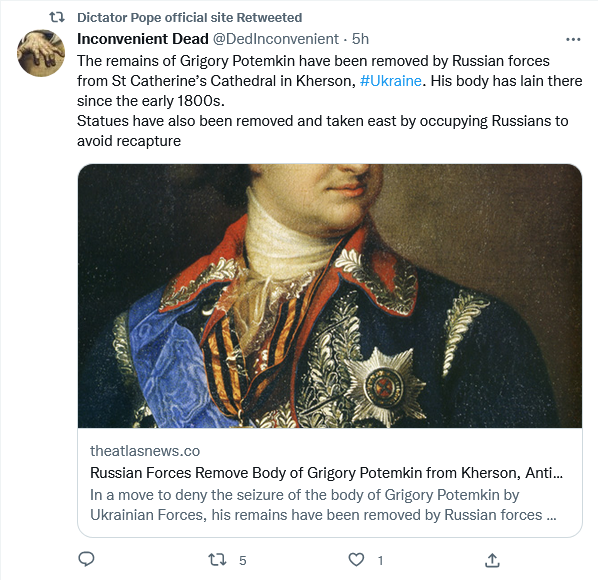





Russian troops, especially conscripts, are already feeling quite negative about this adventure. One can imagine how they will feel when winter sets full in. For reference see the story of Von Paulus and the German 6th Army in 1942-43.