
From The Institute For The Study of War:
Russian Offensive Campaign Assessment, September 26
Kateryna Stepanenko, Katherine Lawlor, George Barros, Riley Bailey, and Frederick W. Kagan
September 26, 11:25 pm ET
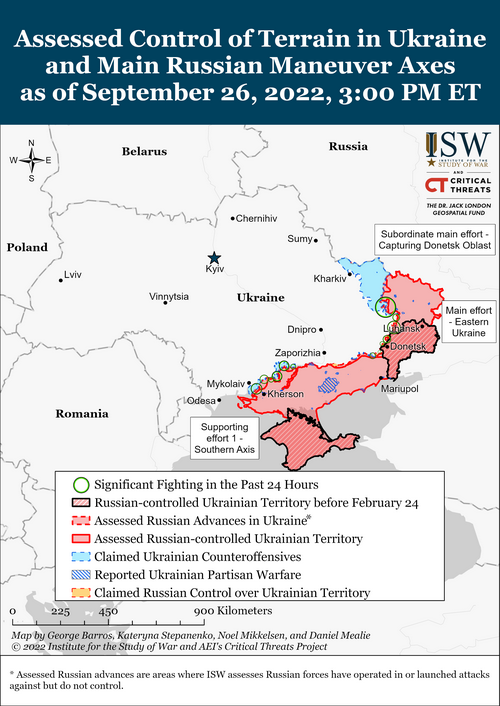
Click here to see ISW’s interactive map of the Russian invasion of Ukraine. This map is updated daily alongside the static maps present in this report.
The Kremlin is attempting to message its way out of the reality of major problems in the execution of its “partial mobilization,” but its narratives are unlikely to placate Russians who can perceive the real mistakes all around them. The Kremlin is deflecting blame for the Russian government’s failure to abide by its own stated criteria for mobilization and exemptions onto the failing bureaucratic institutions responsible for the mobilization. The Kremlin is downplaying the widespread violations of the mobilization law as individual errors of local authorities, claiming to correct these errors as citizens call attention to them. The violations are clearly too common to be merely the result of individual errors, however, and Russian citizens can see them all too clearly. Unlike Russian failures in Ukraine, which the Kremlin has been able to minimize or deflect because its citizens cannot see them directly, violations of the mobilization decree are evident to many Russians. Word of these violations does not even require access to media or social media, because they are occurring in so many locations and victims’ families can spread their anguish by word of mouth.
Russian state media has begun acknowledging social media complaints of persistent problems with the mobilization process, largely pinning the blame on the supposedly unmotivated and careless employees of the military recruitment centers.[1] Russian propagandists and heads of federal subjects are actively discussing instances of wrongful mobilization of men older than the maximum mobilizable age, those who had never served, and those who have medical conditions, as well as poor treatment of mobilized individuals. Omsk Oblast Governor Alexander Burkov declaimed that the bureaucracy is the “enemy of patriotism” and blamed bureaucrats for focusing on meeting unstated quotas rather than correctly fulfilling Russian President Vladimir Putin’s partial mobilization order.[2] One state television host threatened to punish workers of military recruitment centers if they fail to abide by the limited reservist mobilization order.[3] The Kremlin’s media outlets and voices are increasingly sharing individual stories in which military recruitment centers released some men who were unfit for service following the involvement of local officials or with the help of Kremlin state media to suggest that errors are being corrected when called to the Kremlin’s attention.[4]
The Kremlin faces a daunting task in trying to calm the Russian people while still mobilizing enough men to keep fighting. The Kremlin’s current narrative aims to assuage its distraught and panicking population with the promise of fixing and punishing bureaucratic institutions for widespread “mistakes” in the mobilization campaign, but such messaging is unlikely to solve the Kremlin’s problems. Putin will have to fix (or convincingly appear to fix) the mobilization bureaucracy sprawling across 11 time zones while simultaneously getting it to meet the mobilization quotas he has set for it to support the war effort. These imperatives are likely mutually exclusive in a short period of time. The Kremlin also risks further undermining this critical bureaucratic institution during an important period by continuously blaming it for failures that are likely not entirely of its making. Some Russians are already directing their anger onto enlistment officials; a man who opposed mobilization shot the head of the Ust-Ilimsk military recruitment office in Irkutsk Oblast on September 26.[5]
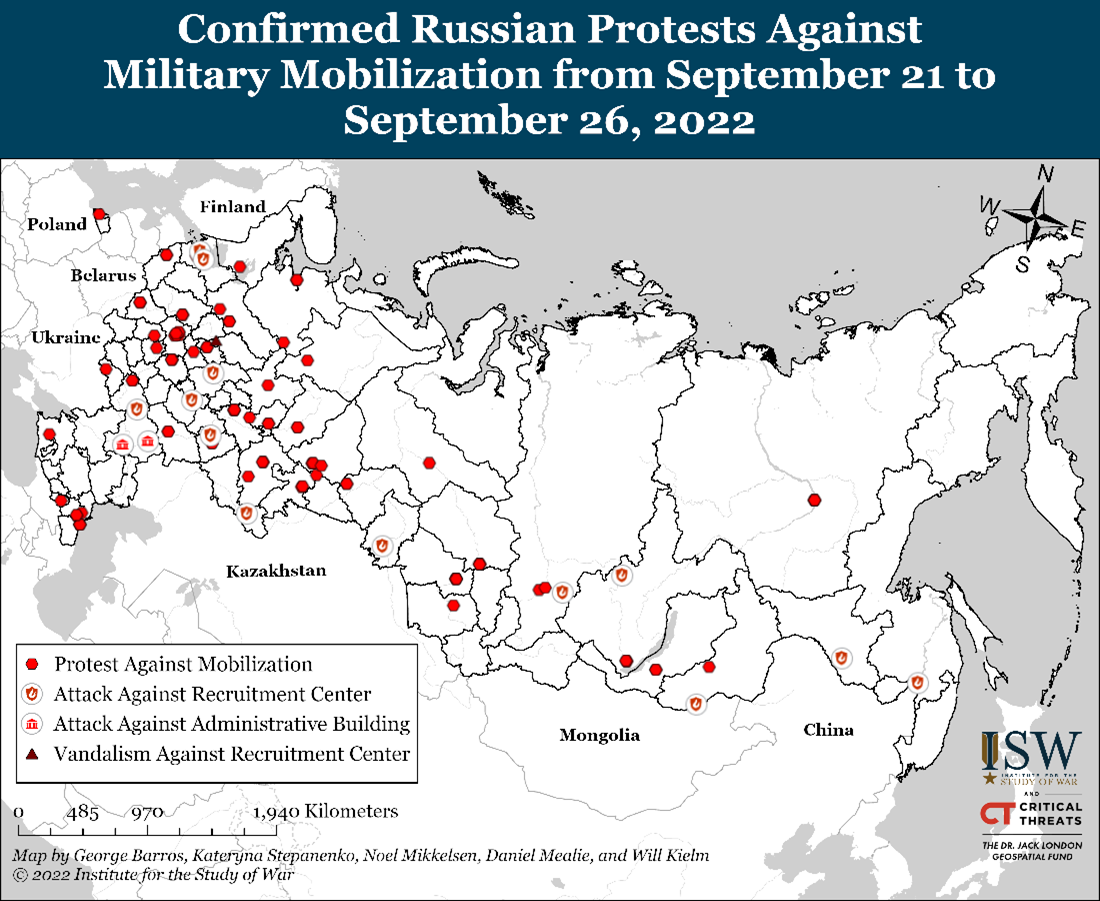
The Kremlin’s efforts to calm the Russian population are struggling so far, as protests occurred in at least 35 settlements on September 25 and at least 10 settlements on September 26.[6] Russian police continue to suppress protests, notably detaining several hundred women in Yakutsk, Republic of Sakha.[7] Russian police also fired warning shots at anti-mobilization protestors in Endirei, a village of approximately 7,900 people in the Republic of Dagestan.[8] Russians set Russian military enlistment centers on fire in Uryupinsk, Volgograd Oblast and Ruzaevka, Mordovia Republic.[9] A detained student also attempted to set on fire a building that had a military registration and enlistment office sign in St. Petersburg even though the building itself was not a military enlistment office.[10] Some mobilized men harmed themselves to protest the mobilization, with one Russian man setting himself on fire in Ryazan Oblast.[11]
The Kremlin is executing a declared reserve partial mobilization as if it were partial conscription, exacerbating societal discontent. A normal selective mobilization of reserves would have the government call up reservists based on lists of those who have military experience (the primary prerequisite for membership in Russia’s less-than-formal reserve system) and are in the correct age bracket. The Kremlin, as well as nationalist Russian milbloggers, have repeatedly claimed that military enlistment centers throughout Russia are doing just that—using such preexisting lists of known reservists to mobilize eligible men.[12] A Russian milblogger cited a Russian Ministry of Defense source on September 26, however, who claimed that all Russian citizens are responsible for pre-emptively providing documentation of their ineligibility for mobilization to the military recruitment centers.[13] If they do not provide documentation, they risk being mobilized. That process is standard for conscription, but unorthodox for an alleged selective mobilization of reserves. The Kremlin has most likely set quotas for local officials to fill and emphasized meeting those quotas over abiding by the legal guidelines for mobilization eligibility, leading to the prioritization of numbers over adherence to the law and thus to the forced mobilization of men with no military experience or with other disqualifying health conditions.
Even a competently executed call up of Russia’s reserves would be unlikely to generate significant combat power in Ukraine in the near term. Financially motivated MoD reforms that reduced the term of conscripts’ service from two years to one in 2008 mean that those conscripted since 2008 were not trained to a level of competence that would make them useful force-multipliers for Russia’s current efforts without considerable additional training.[14] The MoD does not appear to have taken steps to render these new recruits useful, however. Russian reports from a Russian training center in Sergeyevsky claimed that newly mobilized men wandered around the center without training, equipment, or officers for four days.[15]
The Kremlin’s planned annexation of occupied Ukraine may take place before or shortly after October 1, the start of Russia’s normal fall conscription cycle, to enable the forced conscription of Ukrainian civilians to fight against Ukraine. If it does, the Kremlin will likely order the Russian Ministry of Defense to include Ukrainian civilians in occupied and newly annexed Ukrainian territory in the Russian conscription cycle, broadening the forced mobilization of Ukrainian civilians to fight against Ukraine. ISW has previously assessed that one motivation for Putin to order mobilization and annexation in concert with one another is to broaden the forced mobilization of Ukrainian civilians, but those civilians do not meet the legal criteria for the Kremlin’s current partial mobilization order—almost none of them in the mobilizable age categories are likely to have experience in the Russian military.[16] As “Russian” citizens under Russian law, however, all Ukrainian men between 18 and 27 years old in annexed territories would become eligible for conscription.[17] A Russian milblogger claimed on September 26 that the Russian Ministry of Defense will build a branch of the Nakhimov Naval School in occupied Mariupol, Donetsk Oblast, demonstrating the extent to which the Russian military intends to embed itself in occupied Ukrainian territory.[18]
Russian officials have already mobilized Ukrainian citizens to fight against Ukraine. The Russian-appointed occupation governor of Russian-annexed Sevastopol, Mikhail Razvozhaev, claimed on September 25 that Russian authorities mobilized around 2,000 men in occupied Crimea and Sevastopol as part of Putin’s partial mobilization.[19] As ISW has previously reported, Russian occupation authorities have previously forcibly mobilized Ukrainian civilians from all occupied Ukrainian oblasts in smaller numbers.[20]
Russian authorities have already set conditions to mobilize Ukrainian men in larger numbers after annexation is formalized. The Ukrainian advisor to the Kherson Oblast Military Administration, Serhiy Khlan, reported on September 25 that Russian occupation authorities are not allowing men under 35 years old to leave occupied Kherson.[21] The Ukrainian mayor of occupied Melitopol, Ivan Fedorov, reported on September 26 that the Kremlin instructed the Russian Melitopol occupation administration to form a volunteer battalion of 3,000 members by October 10.[22] The Ukrainian head of the Luhansk Oblast Military Administration, Serhiy Haidai, reported on September 26 that Russian occupiers in Svatove, Luhansk Oblast issued mobilization orders to all men in the area and that Russian authorities in annexed Luhansk will similarly mobilize all Ukrainian men.[23]
Unconfirmed reports suggest Ukrainian forces may have destroyed a Russian drone control and training center that directed drone attacks against Ukraine, possibly killing Iranian trainers. Ukrainian journalist Andriiy Tsapienko claimed that Ukrainian forces avenged Russian drone attacks on Odesa by striking the Russian facility in Chulakivka on the Kinburn Spit of Kherson Oblast on September 26 and claimed that the Ukrainian strikes killed four dozen Russians and two dozen Iranian trainers teaching Russian forces how to use Iranian-made drones like the Shahed-136.[24] Russian forces have used Iranian-made Shahed-136 munitions to strike targets in Odesa in recent days, as ISW has previously reported. ISW cannot independently confirm Tsapienko’s reporting, and Ukrainian government sources did not report an attack on a drone command center. Ukraine’s Southern Operations Command reported on September 26 that Ukrainian forces conducted a strike on at least one ammunition warehouse in the Kinburn Spit but did not mention a drone center.[25] Ukraine’s Odesa Military Administration Spokesperson Serhiy Bratchuk also confirmed on September 26 that Ukrainian forces attacked unspecified targets in the Kinburn Spit.[26] The spit is the westernmost land the Russians still control in the Black Sea within 4 km of Ukrainian-controlled Ochakiv at its closest point, making it an excellent location for a drone command center from which Russia could direct attacks deep into unoccupied Ukraine.
Key Takeaways
- The Kremlin is attempting to message its way out of the reality of major problems in the execution of its “partial mobilization,” but its narratives are unlikely to placate Russians who can perceive the real mistakes all around them.
- The Kremlin’s planned annexation of occupied Ukraine may take place before or shortly after October 1, the start of Russia’s normal fall conscription cycle, to enable the forced conscription of Ukrainian civilians to fight against Ukraine.
- Ukrainian forces continued to make advances north of Lyman and on the eastern bank of the Oskil River.
- Ukrainian forces continued to target Russian ground lines of communication (GLOCs) as part of the southern counter-offensive interdiction campaign.
- Russian forces continued conducting offensive operations around Bakhmut and west of Donetsk City.
- Russian forces continued to use Iranian-made drones to strike Ukrainian forces and cities in southern Ukraine.
- The Kremlin may be considering formally closing its borders or more formally restricting the movement of fighting-age men within the country to better implement partial mobilization.
- Russian occupation authorities began to announce that the results of their sham annexation referenda, citing flagrantly falsified turnout numbers.
Go here to read the rest.
From Strategy Page:
In September Ukrainian forces launched a massive offensive against Russian forces in northeast Ukraine initially and later in eastern and southern Ukraine. As of mid-September, over 8,000 square kilometers was cleared of Russian troops. As a bonus, most of the fleeing Russian troops left behind their armored vehicles. The Russians wanted to flee as quickly as possible and that was best done using cars, trucks and busses. These troops left behind hundreds of undamaged armored vehicles, some of them the latest model tanks with few miles on them. While Ukraine had received thousands of modern anti-tank weapons and towed artillery from NATO nations, but few armored vehicles. The departing Russians solved that problem, greatly expanding Ukraine’s stocks of tanks, self-propelled artillery and mobile anti-aircraft systems. The Ukrainians also captured some of the latest Russian mobile EW (Electronic Warfare) systems. Some of the more advanced Russians systems, that NATO has little first had information about, will be sent to Poland where NATO experts can examine it. This is how Ukraine encourages NATO nations to send more aid. NATO nations have learned a lot about how Russian fights a war against a well-equipped (near-peer) opponent and this knowledge has been extremely valuable. While no NATO troops are allowed in Ukraine, as many as 20,000 foreign volunteers have served in Ukraine. Many of these are expatriate Ukrainians or the children of older expatriates. But thousands of the volunteers are former NATO troops, some of them experts in various technical fields. These men had to learn Ukrainian (which is very similar to Russian) and were used mainly to train Ukrainian volunteers. A large Ukrainian vocabulary is not needed for this. Some of those foreign volunteers are former American Special Forces, some of whom served in Ukraine after 2014, when Ukraine requested that kind of assistance from NATO.
Ukraine requested a lot of top-attack ATGMs (Anti-Tank Guided Missiles) because of a flaw in all Russian tanks built since the 1960s. Between 2015 and 2021 the Ukrainians tested a lot of portable anti-tank weapons and found that Western models, like Javelin, Carl Gustav and several others were ideal for mobile infantry (on foot after riding to the battle zone in civilian vehicles) who destroyed tanks and lighter armored vehicles as the Russians advanced into Ukraine. In the months before the Russian 2022 invasion the Ukrainian military described Russian tactics to NATO without going into detail about how they would deal with it. Anyone paying attention to what was going on in Donbas after 2015 could have figured out what the Ukrainians were planning to do. NATO countries had supplied their latest anti-tank weapons for the Donbas tests, which confirmed that Russian tanks had a fatal design flaw from their use of a main-battery autoloader, which led to the total destruction of Russian tanks hit by a top-attack ATGM. None of the Russian ATGMs used top-attack because of the additional cost and that fact that Western tanks did not use autoloader and were not automatically destroyed by top-attack ATGMs.
During World War II the Russian usually kept advancing past damaged tanks and had tank recovery and repair units restore damaged tanks to duty. That no longer worked because most of the damaged tanks in Ukraine suffered catastrophic damage as all Russian tanks built in the past fifty years used autoloaders requiring that a dozen+ shells and their propellant be exposed in the turret to feed the autoloader. The Israelis noted this flaw and pointed it out to their Western allies, which is why Israeli and Western tanks don’t use an autoloader and, when hit in the turret, do not suffer massive damage as all those exposed autoloader shells explode when the turret is penetrated. Western anti-tank weapons were designed to take advantage of this vulnerability, which was never seen on a wide scale until the 2022 invasion. That is one reason Western nations so confidently shipped so many of their latest anti-tank weapons to Ukraine in the months before the invasion.
Go here to read the rest. The attempt by Putin to raise new unwilling legions recalls this song from the animated Return of the King (1980):
Putin’s current methods of reviving the military fortunes of Russia in Ukraine strike me more as a work of gruesome fantasy rather than serious policy.


That map of Russia reminds me of one I saw describing the unrest in 1905.
This is only going to get uglier.
Yep. Foreign defeat and domestic turmoil always walk hand in hand in the Rodina.
I feel sick for the poor men getting conscripted in Russia and for those Ukrainians trapped behind Russian lines.
Even now, there are so called media types…Tucker Carlson as well as You Tubers Steve Turley and Redacted that are in Putin’s corner.