
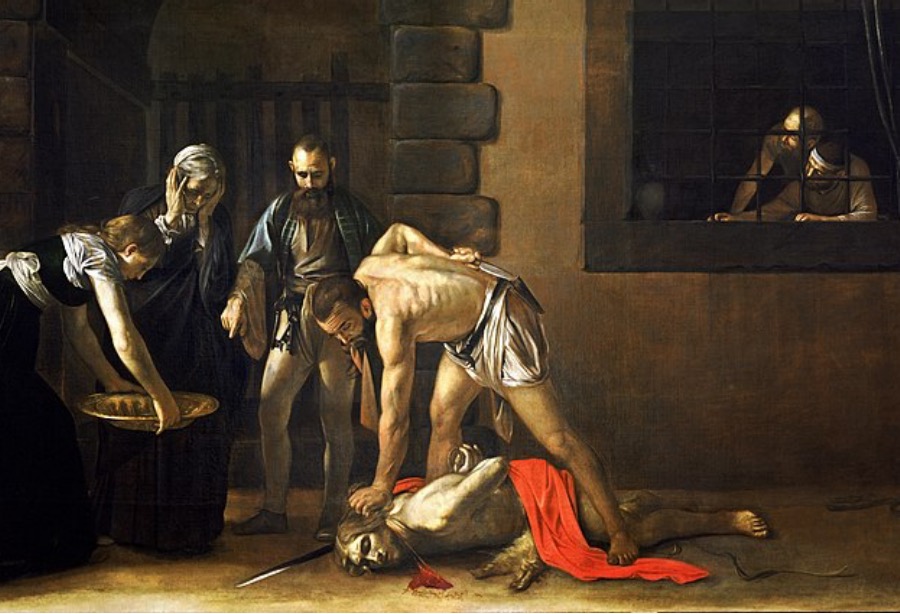
Today (29 August, 2022) we mark the anniversary of the beheading of John the Baptist. Because he told the truth to Herod, he was imprisoned and then (you all know the story) his head was given to Salome as the promised reward for her dance. What was the truth he told to Herod? “You should not have married your brother’s wife.” Surely not such a terribly consequential thing that any of us would give up his life for–a politician marrying his brother’s wife. But it was the truth, and St. John the Baptist was the prophet of the Great Truth, the truth about who Jesus was. And truths can not be disentangled into separate piles.
This was the lesson in the homily Fr. Andiy Egargo gave today on the gospel reading, Mark 6:17-29. “Silence in the face of truth can be equivalent to a great lie.
So, I ask: how many bishops are silent about the truth of what pseudo-Catholic politician say and do about abortion? How many ecclesiastic authorities are silent about attempts to suppress traditional Catholic liturgy? And I invite the reader to add their own to this list.
So, from now on, I will try not to be silent when family, friends or 12 Step associates propose that which is not true. And if they say, “Old Bob has finally got off his rocker,” that’s an easier fate than being beheaded.


What would John the Baptist have said about Hunter and Beau’s wife?
Well said, Dr. K. I fell off my rocker a long time ago, according to some. 😎
Alleluia, alleluia.
As always, Dr. K you are 100% on target.
Fatth, Hope and Love; and the greatest of these is Love.
“Blessed are those who are persecuted for the sake of righteousness, for theirs in the Kingdom of Heaven.” Matt. 5:10 – today’s Mass’ Gospel Acclamation.
In addition, the Church’s Spiritual Works of Mercy include “Admonish the Sinner,” “Counsel the Doubtful.” “Instruct the Ignorant.” Some think that a good undone is an evil.
So, I think that Love’s handservant is courage. It requires courage and love of the doubtful, ignorant, and sinner to do the above goods.
St. John the Baptist displayed both love and courage in his admonishing Herod.
God willed that St. John the Baptist should go ahead of His Son both in birth and in death.
Alleluia, alleluia.
The brother is forbidden to marry his deceased brother’s wife. This why Henry VIII had to get a dispensation from Pope Julian II to marry Katherine of Aragon. It was granted because she swore that she and Arthur had never consummated the marriage.
Is there still anything in Canon law about marriage between brother and sister-in-law?
Dr K, Look on the bright side – and I speak from experience – we now have two very powerful cards to play whenever anyone seeks an explanation or justification: 1. The “‘onset dementia” card; and 2. the “early cognitive disorder” card. They will NOT argue “but you are totally OK!” Guy, Texas
Re: silence:
”Silence in the face of evil is itself evil: God will not hold us guiltless. Not to speak is to speak. Not to act is to act.” Dietrich Bonhoeffer
“We’ve had enough exhortations to be silent. Cry out with a thousand tongues – I see the world is rotten because of silence.” St Catherine of Siena
“He who is not angry when there is just cause for anger is immoral. Why? Because anger looks to the good of justice. And if you can live amid injustice without anger, you are immoral as well as unjust.” St. Thomas Aquinas
“If I were to remain silent, I’d be guilty of complicity.” Albert Einstein
“It is not only for what we do that we are held responsible, but also for what we do not do.” Moliere
Bible
Library
Home > Summa Theologiae > Second Part of the Second Part > Question 158
Question 158. Anger
1. Is it lawful to be angry?
2. Is anger a sin?
3. Is it a mortal sin?
4. Is it the most grievous of sins?
5. Its species
6. Is anger a capital vice?
7. Its daughters
8. Does it have a contrary vice?
Article 1. Whether it is lawful to be angry?
Objection 1. It would seem that it cannot be lawful to be angry. For Jerome in his exposition on Matthew 5:22, “Whosoever is angry with his brother,” etc. says: “Some codices add ‘without cause.’ However, in the genuine codices the sentence is unqualified, and anger is forbidden altogether.” Therefore it is nowise lawful to be angry.
Objection 2. Further, according to Dionysius (Div. Nom. iv) “The soul’s evil is to be without reason.” Now anger is always without reason: for the Philosopher says (Ethic. vii, 6) that “anger does not listen perfectly to reason”; and Gregory says (Moral. v, 45) that “when anger sunders the tranquil surface of the soul, it mangles and rends it by its riot”; and Cassian says (De Inst. Caenob. viii, 6): “From whatever cause it arises, the angry passion boils over and blinds the eye of the mind.” Therefore it is always evil to be angry.
Objection 3. Further, anger is “desire for vengeance” [Aristotle, Rhet. ii, 2 according to a gloss on Leviticus 19:17, “Thou shalt not hate thy brother in thy heart.” Now it would seem unlawful to desire vengeance, since this should be left to God, according to Deuteronomy 32:35, “Revenge is Mine.” Therefore it would seem that to be angry is always an evil.
Objection 4. Further, all that makes us depart from likeness to God is evil. Now anger always makes us depart from likeness to God, since God judges with tranquillity according to Wisdom 12:18. Therefore to be angry is always an evil.
On the contrary, Chrysostom [Hom. xi in the Opus Imperfectum, falsely ascribed to St. John Chrysostom] says: “He that is angry without cause, shall be in danger; but he that is angry with cause, shall not be in danger: for without anger, teaching will be useless, judgments unstable, crimes unchecked.” Therefore to be angry is not always an evil.
I answer that, Properly speaking anger is a passion of the sensitive appetite, and gives its name to the irascible power, as stated above (I-II:46:1) when we were treating of the passions. Now with regard to the passions of the soul, it is to be observed that evil may be found in them in two ways. First by reason of the passion’s very species, which is derived from the passion’s object. Thus envy, in respect of its species, denotes an evil, since it is displeasure at another’s good, and such displeasure is in itself contrary to reason: wherefore, as the Philosopher remarks (Ethic. ii, 6), “the very mention of envy denotes something evil.” Now this does not apply to anger, which is the desire for revenge, since revenge may be desired both well and ill. Secondly, evil is found in a passion in respect of the passion’s quantity, that is in respect of its excess or deficiency; and thus evil may be found in anger, when, to wit, one is angry, more or less than right reason demands. But if one is angry in accordance with right reason, one’s anger is deserving of praise.
Reply to Objection 1. The Stoics designated anger and all the other passions as emotions opposed to the order of reason; and accordingly they deemed anger and all other passions to be evil, as stated above (I-II:24:2) when we were treating of the passions. It is in this sense that Jerome considers anger; for he speaks of the anger whereby one is angry with one’s neighbor, with the intent of doing him a wrong.—But, according to the Peripatetics, to whose opinion Augustine inclines (De Civ. Dei ix, 4), anger and the other passions of the soul are movements of the sensitive appetite, whether they be moderated or not, according to reason: and in this sense anger is not always evil.
Reply to Objection 2. Anger may stand in a twofold relation to reason. First, antecedently; in this way it withdraws reason from its rectitude, and has therefore the character of evil. Secondly, consequently, inasmuch as the movement of the sensitive appetite is directed against vice and in accordance with reason, this anger is good, and is called “zealous anger.” Wherefore Gregory says (Moral. v, 45): “We must beware lest, when we use anger as an instrument of virtue, it overrule the mind, and go before it as its mistress, instead of following in reason’s train, ever ready, as its handmaid, to obey.” This latter anger, although it hinder somewhat the judgment of reason in the execution of the act, does not destroy the rectitude of reason. Hence Gregory says (Moral. v, 45) that “zealous anger troubles the eye of reason, whereas sinful anger blinds it.” Nor is it incompatible with virtue that the deliberation of reason be interrupted in the execution of what reason has deliberated: since art also would be hindered in its act, if it were to deliberate about what has to be done, while having to act.
Reply to Objection 3. It is unlawful to desire vengeance considered as evil to the man who is to be punished, but it is praiseworthy to desire vengeance as a corrective of vice and for the good of justice; and to this the sensitive appetite can tend, in so far as it is moved thereto by the reason: and when revenge is taken in accordance with the order of judgment, it is God’s work, since he who has power to punish “is God’s minister,” as stated in Romans 13:4.
Reply to Objection 4. We can and ought to be like to God in the desire for good; but we cannot be altogether likened to Him in the mode of our desire, since in God there is no sensitive appetite, as in us, the movement of which has to obey reason. Wherefore Gregory says (Moral. v, 45) that “anger is more firmly erect in withstanding vice, when it bows to the command of reason.”
Article 2. Whether anger is a sin?
Article 3. Whether all anger is a mortal sin?
Article 4. Whether anger is the most grievous sin?
Article 5. Whether the Philosopher suitably assigns the species of anger?
Article 6. Whether anger should be reckoned among the capital vices?
Article 7. Whether six daughters are fittingly assigned to anger?
Article 8. Whether there is a vice opposed to anger resulting from lack of anger?
Objection 1. It would seem that there. is not a vice opposed to anger, resulting from lack of anger. For no vice makes us like to God. Now by being entirely without anger, a man becomes like to God, Who judges “with tranquillity” (Wisdom 12:18). Therefore seemingly it is not a vice to be altogether without anger.
Objection 2. Further, it is not a vice to lack what is altogether useless. But the movement of anger is useful for no purpose, as Seneca proves in the book he wrote on anger (De Ira i, 9, seqq.). Therefore it seems that lack of anger is not a vice.
Objection 3. Further, according to Dionysius (Div. Nom. iv), “man’s evil is to be without reason.” Now the judgment of reason remains unimpaired, if all movement of anger be done away. Therefore no lack of anger amounts to a vice.
On the contrary, Chrysostom [Hom. xi in Matth. in the Opus Imperfectum, falsely ascribed to St. John Chrysostom] says: “He who is not angry, whereas he has cause to be, sins. For unreasonable patience is the hotbed of many vices, it fosters negligence, and incites not only the wicked but even the good to do wrong.”
I answer that, Anger may be understood in two ways. On one way, as a simple movement of the will, whereby one inflicts punishment, not through passion, but in virtue of a judgment of the reason: and thus without doubt lack of anger is a sin. This is the sense in which anger is taken in the saying of Chrysostom, for he says (Hom. xi in Matth., in the Opus Imperfectum, falsely ascribed to St. John Chrysostom): “Anger, when it has a cause, is not anger but judgment. For anger, properly speaking, denotes a movement of passion”: and when a man is angry with reason, his anger is no longer from passion: wherefore he is said to judge, not to be angry. On another way anger is taken for a movement of the sensitive appetite, which is with passion resulting from a bodily transmutation. This movement is a necessary sequel, in man, to the movement of his will, since the lower appetite necessarily follows the movement of the higher appetite, unless there be an obstacle. Hence the movement of anger in the sensitive appetite cannot be lacking altogether, unless the movement of the will be altogether lacking or weak. Consequently lack of the passion of anger is also a vice, even as the lack of movement in the will directed to punishment by the judgment of reason.
Reply to Objection 1. He that is entirely without anger when he ought to be angry, imitates God as to lack of passion, but not as to God’s punishing by judgment.
Reply to Objection 2. The passion of anger, like all other movements of the sensitive appetite, is useful, as being conducive to the more prompt execution [Cf. I-II:24:3 of reason’s dictate: else, the sensitive appetite in man would be to no purpose, whereas “nature does nothing without purpose” [Aristotle, De Coelo i, 4.
Reply to Objection 3. When a man acts inordinately, the judgment of his reason is cause not only of the simple movement of the will but also of the passion in the sensitive appetite, as stated above. Wherefore just as the removal of the effect is a sign that the cause is removed, so the lack of anger is a sign that the judgment of reason is lacking.
Guy, thank you very much for the quotes and the extended lesson from St. Thomas on anger and action.
[…] C. Register Lessons of an Anglican Split – Msgr. Harry Entwistle at The Catholic Weekly Silence in the Face of Truth Is Equivalent to a Great Lie – Bob Kurland PhD/The American Catholic The Hubris of a Tax-Code System of Morality – […]
Marriage is between one man and one woman.
Abortion is murder.
Homosexuality is a disorder.
Transgenderism is a disorder.
Forcing children to sit through gender propaganda presentations is wrong.
Parents have the right and responsibility to freely participate in the education of their children without facing consequences from the state.
Bullying the public to use pronouns contrary to truth is an infraction against the freedoms of the public.
Communism has never and will never bring about the utopia that it proposes. Millions of proofs can be found in the graves.
Freedom isn’t Free.
Silence kills.
“It is not lawful” is a stronger statement than “you should not have”. For example, I knew a guy years ago who flew over to Romania and married a girl there after knowing her for less than a day. He had been a fellow graduate student, but she was immediately unhappy with the small city the university was in, so she convinced him to drop out and move to a larger city; we lost touch after that, but I’d be surprised if the marriage lasted more than a year. The marriage was a foolish decision, and he should not have done it, but it was lawful.
St. John’s beheading only magnified the truth.
I was always curious why Salome had this obsession with St John Baptist. On a side, Herod and his infatuation with Salome rings the alarm bells- he was clearly a slimeball. How humiliating for St John the Baptist to have been at the mercy of a slimeball.
Great post Bob.
Some gals have a Thing for guys who are not available.
Some gals have a Thing for guys who are not available.
Ha! 😂 True that.