
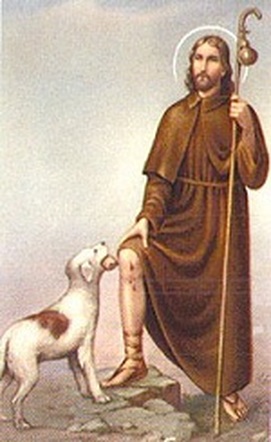
WE find this eminent servant of God honoured, especially in France and Italy, amongst the most illustrious saints in the fourteenth century, soon after his death; nevertheless, says F. Berthier, we have no authentic history of his life. All that we can affirm concerning him is, that he was born of a noble family at Montpellier, and making a pilgrimage of devotion to Rome, he devoted himself in Italy to serve the sick during a raging pestilence. Maldura says this happened at Placentia. Falling himself sick, and unable to assist others, and shunned and abandoned by the whole world, he made a shift to crawl rather than walk into a neighbouring forest, where a dog used to lick his sores. He bore incredible pains with patience and holy joy, and God was pleased to restore him to his health. He returned into France, and in the practice of austere penance, and the most fervent piety and charity, he wore out his last years at Montpellier where he died, as it is commonly said, in 1327. Some postpone his death to the decline of that century, and think he went into Italy only in 1348, when historians mention that a pestilence made dreadful havoc in that country. Many cities have been speedily delivered from the plague by imploring his intercession, in particular that of Constance during the general council held there in 1414. His body was translated from Montpellier to Venice in 1485, where it is kept with great honour in a beautiful church; but certain portions of his relics are shown at Rome, Arles, and many other places. See Pinius the Bollandist, t. 3. Augusti, p. 380. F. Berthier, the last continuator of F. Longueval’s Hist. de l’Eglise de France, t. 13, ad an. 1327, and the life of St. Roch by Maldura, translated into French by D’Andilly. Also Pagi the Younger. Bened. XIV. &c.
Butler’s Lives of the Saints
He is a patron saint of dogs.


I once paid my respects to this saint at the Church of San Rocco in Venice. I’ve thought about the “plague saints” a lot over the past 2.5 years. They say everyone wants to be a saint but nobody wants to die – well, nobody wants to be a “plague saint”.
I’ve said it before, but one of the things our country needs is a tradition of saints. We need regional pilgrimage sites, parishes in their honor, optional memorials. As Americans increasingly think of themselves as American rather than their ancestors’ heritage (there’s obviously a long conversation we could have on that subject), the connection to the saints of, say, some country in Europe is going to diminish. Our Lady of Guadalupe gave the New World its most prominent feast, but practically our only one.
Pinky, The Beaux Bridge area which is near Lafayette, Louisiana had a pilgrimage with procession from town to town with churches named for Mary around August 15. Lafayette,s Cathedral of St. John the Evangelist has sponsored candlelit processions through downstown on many occasions.. My husband and I have been impressed with the faith of the people of Acadiana.
Not much was made of the Feast of the Assumption in my diocese of Arlington. Falling on a Monday it was not a holyday of obligation.
The only mention in the bulletin was that the 2nd collection on Sunday was the Asumption of Mary envenlope. What a missed opportunity for a sermon about the Blessed Mother. Especially when the country is in bad shape and getting worse..
Speaking of St. Roch, I’m up late because there are two abandoned deer hounds whining on our property tonight. Hunting deer with dogs is allowed in Virginia. Cruel and sad. When the season is over many of these animals are “retired” turned loose.wherein they are hit by cars or starve to death. The kindess thing to do is call animal control. The dogs will be seen by a vet and possibly adopted.