
https://www.youtube.com/watch?v=cQ3eaASGwNU
From The Institute For The Study of War:
Kateryna Stepanenko, Katherine Lawlor, Karolina Hird, George Barros, and Frederick W. Kagan
August 7, 8 pm ET
Click here to see ISW’s interactive map of the Russian invasion of Ukraine. This map is updated daily alongside the static maps present in this report.
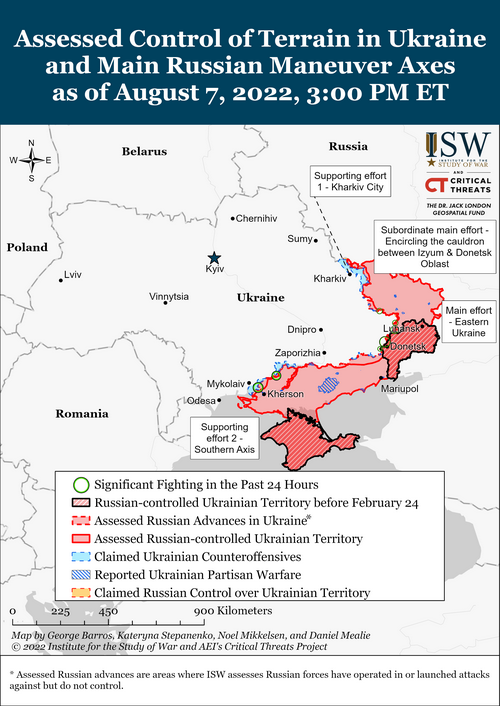
Russian occupation officials may be accelerating their preparations for illegitimate pseudo-referenda on the Russian annexation of occupied Ukrainian territory. The Ukrainian Mayor of Melitopol, Zaporizhia Oblast, Ivan Fedorov, reported on August 7 that resistance among Ukrainian residents has forced Russian authorities to “constantly” change their plans for a referendum. Fedorov claimed that occupation authorities had planned a single day of voting but are now considering seven days of “voting from home” in which armed Russian military personnel will go house to house and “interview” Melitopol residents.[1] Fedorov claimed that only about 10% of the civilians remaining in Melitopol support Russia’s occupation and warned that Russian soldiers will threaten to shoot residents who do not vote for annexation.[2] Ukrainian Kherson Administration Advisor Sergey Khlan noted that occupation authorities have not fully set conditions for a referendum as of August 7 but are accelerating their preparation after a three-week pause in preparations, which Khlan attributed to Ukrainian HIMARS attacks on Russian occupation logistics.[3] Occupation authorities could also alter the timeline of their sham referenda in response to changing realities on the ground, including a Ukrainian counteroffensive. Khlan reported that the preliminary referendum date remains September 11.
By removing in-person voting options and transitioning to house-to-house surveys, Russian occupation authorities are increasing their opportunities to directly intimidate Ukrainian civilians. This effort is unnecessary to rig the vote to the outcome the Kremlin desires but does make any independent oversight of the vote nearly impossible. Occupation authorities may also turn these “surveys” into intelligence gathering operations to weed out Ukrainian opposition in occupied areas. Removing in-person polling stations removes many requirements for bureaucrats to staff those locations. Russian forces have struggled to recruit people into these positions from occupied populations. In-home voting also limits opportunities for partisan attacks on those locations.
The Kremlin may order different types of voting in different occupied locations depending on perceived local support, perceived risk of partisan attacks, and bureaucratic capacity. For example, the Ukrainian head of the Luhansk Oblast Civil-Military Administration, Serhiy Haidai, reported on August 7 that Russian occupation authorities in Luhansk Oblast have identified venues to host their sham annexation referendum in person.[4] Haidai reported that Russian occupation authorities are actively campaigning for annexation by distributing propagandist newspapers and tying the provision of humanitarian aid including food, water, and construction materials to participate in the pseudo-referendum. Haidai said that the practice amounts to blackmail: “we [the Russians] will help you [Ukrainian civilians] meet your basic needs, while you go to the ‘referendum.’ Otherwise, die, and we will fabricate the result without you.” Russia has occupied parts of Luhansk Oblast since 2014 and likely has greater capacity to mobilize collaborators to administer polling stations than in newly occupied areas. ISW reported on August 3 that occupation authorities in Donetsk Oblast may allow in-person and online participation, providing multiple levers for Russian officials to alter the results.[5]
The Iranian Space Agency (ISA) denied reports on August 7 that Russia will use an Iranian satellite over Ukraine for several months after Russia launches the satellite on behalf of Iran. State-run Iranian news outlet IRNA cited an ISA statement on August 7 asserting that the satellite will be controlled by and from Iran “from day one, immediately upon launch.”[6] The ISA emphasized that “No other country will have access to such information, and rumors about satellite imagery being deployed in service of another country’s military objectives are untrue.” The Washington Post cited two Western intelligence officials’ claims on August 4 that Russia would retain control of the satellite after launch to surveil Ukraine and would cede control of the satellite to Iran at an indefinite future date.[7] ISW reported on August 3 that the Kremlin is likely continuing efforts to leverage its relationship with Tehran in order to receive drones for use in Ukraine.[8] ISW cannot independently confirm which state will control the satellite, which Russia plans to launch from Kazakhstan on August 9.
The UK Ministry of Defense (UK MoD) confirmed ISW’s previous assessments that Russian military leadership has experienced major turn-overs due to Russian military failures in Ukraine.[9] UK MoD reported that at least six Russian commanders have likely been dismissed from their posts since the beginning of the war in February, potentially including Eastern Military District (EMD) commander Colonel General Aleksandr Chayko and Western Military District (WMD) commander Colonel General Aleksandr Zhuravlev. UK MoD additionally stated that Army General Aleksandr Dvornikov has been removed from overall theater command of Ukraine and that Army General Sergey Surovikin has taken over the “Southern Grouping” of forces in Ukraine. UK MoD concluded that the lack of consistency in the Russian command structure and continued losses to military leadership on the battlefield are complicating command and control and the overall effectiveness of operations in Ukraine. ISW has previously reported on changes to Russian military command and continues to track the ramifications of these changes on Russian offensive capabilities.[10]
Note: ISW does not receive any classified material from any source, uses only publicly available information, and draws extensively on Russian, Ukrainian, and Western reporting and social media as well as commercially available satellite imagery and other geospatial data as the basis for these reports. References to all sources used are provided in the endnotes of each update.
Key Takeaways
- Russian military leadership continues to experience major turnover, which is likely impacting Russian command and control efforts in Ukraine.
- Russian forces conducted limited ground attacks southwest and southeast of Izyum, east of Siversk, and to the east and south of Bakhmut.
- Russian forces have likely made incremental gains in settlements on the northwestern and southwestern outskirts of Donetsk City and continued efforts to break Ukrainian defensive lines along the Avdiivka-Donetsk City line of contact.
- Russian forces unsuccessfully attempted to advance east of Mykolaiv City on August 7.
- Russian forces are forming a new 72nd Separate Motorized Rifle Brigade in Orenburg Oblast as part of the 3rd Army Corps.
Go here to read the rest.
From Strategy Page:
August 6, 2022: Russian political and military leaders seem surprised at the extent to which Russian soldiers are refusing to fight in Ukraine. Perhaps someday these leaders will realize that this should not have been a surprise. While Russian leaders earlier made much of reforming the military and upgrading its equipment, they ignored fundamentals like willingness to fight. In modern war the infantry is a minority (10 to 25 percent of troops) but comprise over 80 percent of the casualties.
After more than a century of lies, deceit, poor leadership and heavy losses, the young Russian men who end up in the infantry, as well as their families, are refusing to be killed in another unnecessary war in Ukraine.
This attitude began to develop over a century ago when Russian troops and warships were defeated in the Russo-Japanese war. The fighting was about who would control Manchuria (northeastern China) and Korea. The Russian army and navy suffered heavy losses and lost to upstart Japan. The Russian defeat was real and it forced the Russian monarchy to make concessions. That did not include staying out of major wars Russia could not win. Russia got dragged into World War I in 1914, where heavy losses led Russia to admit defeat and leave the war in 1917. Fighting did not stop inside Russia as a civil war broke out over what would replace the monarchy; a democracy or a secular dictatorship. The democracy was more popular but the communists were more ruthless and better at using propaganda to promise what they had no intention of delivering.
The new communist government sought to eliminate features of the military that might lead to another revolution. NCOs, who were often rebel leaders, were eliminated and replaced by junior officers and political officers whose job was to prevent disloyalty and report any problems in that area. General conscription was re-introduced and a separate elite force of KGB troops was organized to ensure that the conscript soldiers remained loyal, or at least pretended to be. This worked during World War II, when Russia lost ten million soldiers in combat and nearly 20 million civilians to exposure, disease and widespread violence against civilians. Russia kept the extent of those losses a secret until the end of the Cold War and the collapse of the Soviet Union. The post-Soviet collapse Russian government began as a democracy but after a decade ended up as another dictatorship.
The new dictator was Vladimir Putin, a KGB officer before the Soviet Union collapsed. Putin wanted to restore the Russian empire. He seemed surprised when the Russian people did not share his enthusiasm for such efforts. This lack of enthusiasm for another major war became painfully obvious when Putin ordered a second invasion of Ukraine in February 2022.
Putin realized there might be problems if his troops did not win a quick victory. There was no victory, quick or otherwise. The Ukrainians fought back and forced the Russian troops trying to quickly take the Ukrainian capital to withdraw to Russia and redeploy to eastern Ukraine and Crimea, areas Russia had seized in 2014 but were stopped there by unexpected Ukrainian resistance. These setbacks hurt Russian troop morale and inspired more Ukrainians to volunteer for military service to preserve their national independence.
The defeated Russian forces reacted differently to their defeat and accused their government of sending them up against a formidable enemy that they were told did not resist. Many Russian troops were angry over the fact that they were not told they were invading Ukraine, leaving them to discover that when they came under heavy fire after crossing the border they were not told about. After a few months of fighting Putin acted surprised as many Russian soldiers refused to go to Ukraine and many of those in Ukraine refused to fight.
As word spread inside Russia about what was going on in Ukraine, parents of conscripts backed their sons who were trying to stay out of the army and most definitely out of Ukraine. Putin apparently did not appreciate the fact that he was facing over a century of earlier heavy losses and bad leadership that had killed millions of Russians, in addition to those killed by enemy troops. The Rodina (the Russian people) had not forgotten because it was the Rodina that died, not their leaders. The bill for over a century of such attitudes came due on Putin’s watch.
This situation was not unique to Russia. After World War I Britain, France and other European democracies had to deal with popular resistance to another bloodbath. France was quickly (by 1940) defeated in World War II, in part because of its overreliance on static defenses and a general lack of enthusiasm for another major war. The British kept fighting but the elected government realized that the voters would not tolerate heavy losses. Measures were taken to keep casualties down. That meant less use of infantry and much more use of tanks and other armored vehicles. During World War II most tanks destroyed or disabled by enemy action resulted in most of the tank crew surviving, although some might be wounded. Because of this and an emphasis on keeping infantry losses low Britain suffered the fewest losses for any nation that was involved in the war from the beginning (1939) to the end.
Other European nations that suffered heavy World War I losses, like Germany, also had to be careful about high casualties. By 1939 the German democracy had turned into a Nazi dictatorship that still had to present its war efforts as low-casualty operations. The impact of this was noted by American (which was still neutral) journalists in Germany during September 1939. On the day the war began with the invasion of Poland, the public attitude in Berlin and the rest of Germany was somber, with a sense of dread about what was to come. By 1940, after the low German casualties during the rapid conquests of Poland and France, German attitudes changed. This only lasted for about two years. The 1941 invasion of Russia, entry of the U.S. in war and huge casualties suffered in Russia and at home because of the growing use of U.S. and British bombers to attack civilians stalled the advances and caused heavy military and civilian casualties. Because of those losses German attitudes changed by late 1942. All nations that suffered heavy losses in World War II came out of the war less confident about the use of military force.
There was one exception; Russia. Dictator Josef Stalin had been responsible for the exceptionally high Russian losses during the war. This was because of his 1930s purges of suspected disloyal officers and troops in the military. Civilians suspected of disloyalty were also killed in large numbers, or sent to labor camps that few survived. Subordinates were unwilling to tell Stalin the truth about the degraded state of the military in 1940 because Stalin tended to execute anyone delivering bad news.
Russia was victorious in World War II despite, not because of Stalin. That was a state secret in Russia until early 1953 when Stalin died. Soon after that Stalin’s key functionaries were killed or arrested. There followed a “secret speech” to key communist officials that outlined the many mistakes Stalin had made during his two decades in power. This came as a shock to many of those who heard the admissions, which did not remain secret for long. Stalin’s official reputation went from hero to zero at least until Putin gained power. Russians could now discuss, or complain about the heavy losses during and before the war because of Stalin. Unlike most other dictators (including Hitler and the military government that ran Japan during the war), most absolute rulers stay in power by paying some attention to public sentiment. Stalin did not and was one of the few to die of old age. His methods did not survive his passing as the communist dictators who succeeded him realized that their large military could not be trusted in a major war.
Russian-occupied East European nations experienced uprisings from the 1950s through the 1980s that demonstrated why the Russian reluctance to fight was real. While most of these uprisings were quickly suppressed by local security forces and some additional Russian special operations troops, there were some exceptions. In 1956 the Hungarians rebelled and the local security forces could not handle it, nor could the initial Russian use of their troops and tanks. The Russians had to retreat and come back with a larger force to put down the uprising. The Russian troops were not particularly enthusiastic about fighting the Hungarians but sheer numbers overwhelmed Hungarian resistance.
In 1969 there was a six-month long border war with China. Despite the numbers involved (650,000 Russian and over 800,000 Chinese troops) there were only a few hundred casualties and Russia refrained from using its more numerous artillery, armored vehicles and warplanes to kill a lot of Chinese. After months of negotiations the confrontation ended with China getting most of what it wanted, mainly because the Americans refused a secret Russian request to join in or at least condone a Russian plan for a major nuclear attack on China. Without the nukes, Russia could not risk heavy infantry losses from prolonged fighting with China. At the same time China was appalled when they found out about the Russian plan to go nuclear. The Chinese were pleasantly surprised by the more measured attitude of the United States in refusing Russian requests to participate in a nuclear war, even against communist China. This led to China and the U.S. resuming diplomatic relations in a few years. Russia now had another potential invader; the angry Chinese. Russia also realized its military age population was not as willing as earlier generations to tolerate a major war, especially one that did not involve an invasion of Russia. During the next twenty years Russia received more reminders of the fragility of the morale in its combat forces. There was the very real problem in 1956 Hungary and a similar situation in Poland, where the uprising was avoided by a compromise. This meant some Russian troops were withdrawn from Poland and economic reforms tolerated. The Hungarians got a larger Russian garrison and a more oppressive local government.
By the 1980s Russian occupied Eastern Europe was once more suffering from growing unrest. At the same time (1980) Russia had a large invasion force in Afghanistan. Lack of ports, railroads and few roads in Afghanistan meant Russia could not support more than 150,000 troops there and that was not enough to win. The Afghans kept resisting and often taking and distributing videos of successful attacks on Russians. Even without the Internet, the still pictures reached Russia on a wide scale, though the videos were less widely distributed. In a now (2022) familiar pattern, conscripts and their parents gradually and soon openly protested the war and the number of Russians killed. By the time the last Russian troops left Afghanistan in early 1989, about 15,000 Russian troops had died. Most enemy casualties were caused by Russian special operations troops and airpower. That suddenly declined in 1986 as the Americans supplied the Afghan irregulars with their new (since 1981) Stinger MANPADS (Man-Portable Air Defense System), which was easy to learn to use and fatal to low flying Russian helicopters and other aircraft. With the end of their airpower and special forces (which moved by air) advantage Russia withdrew.
The 2014 attack on Ukraine was carried out by special forces troops and surprise. There was also a large Russian garrison because Russia had a long-term lease for its Crimean naval base at Sevastopol. The Russian special operations effort was less successful in eastern Ukraine (Donbas) and in 2022 Putin ignored decades of experience (and some recent advice) and attempted a large-scale attack on Ukraine.
Go here to read the rest. The video above details the fairly chaotic fate of Western supplies, equipment and weaponry in Ukraine. The usual corruption which is a common feature of most of the Soviet Union successor states seems to be flourishing in Ukraine. Why the US has been putting up with this is anyone’s guess. I wonder if The Big Guy has been getting his customary ten percent. Payoffs to US officials likely has been occurring. Stay tuned for further developments.


A pro-Russian reporter, Anton Pavlushko, reported today another decorated key officer, Lt.Col. Nicolai Gorban, of “4th Dept Special Operations,” was killed “somewhere in Ukraine” Aug. 2nd. Another high-ranking elite specialist officer, Col. Vasily Kleschenko, of the 344th Aviation Combat Helicopter Brigade, an expert in sniper training also was killed with no specific date given some time about a week ago. Col. Olga “Korsa” (“She-wolf“) Kachyra, the first known Russian Army female colonel, highly decorated and at the time commanding an artillery unit, was also reported killed in a missile strike last week July 28, near Horlivka, Ukraine.
Meanwhile, at least two high-ranking generals, Gen. Aleksandr Zuravlev, of the Western Military District, and Gen. Aleksandr Chayko, of the Eastern Military District, have been dismissed for “poor performance,” this acknowledged by the Russian MoD itself. Zuravlev’s dismissal appears to have been just before the annual Navy Day July 31st, since he was notably absent. Chayko’s departure appears to have been at the end of May but just recently announced.
Not looking like a Russian victory.
Gen. Milley and Gen. Austin should be very happy to be serving in the US military where incompetency is rewarded with lifetime security and tenure.