
From The Institute For The Study of War:
Karolina Hird, Grace Mappes, Layne Phillipson, Katherine Lawlor, George Barros, and Frederick W. Kagan
July 28, 7:30 pm ET
Click here to see ISW’s interactive map of the Russian invasion of Ukraine. This map is updated daily alongside the static maps present in this report.
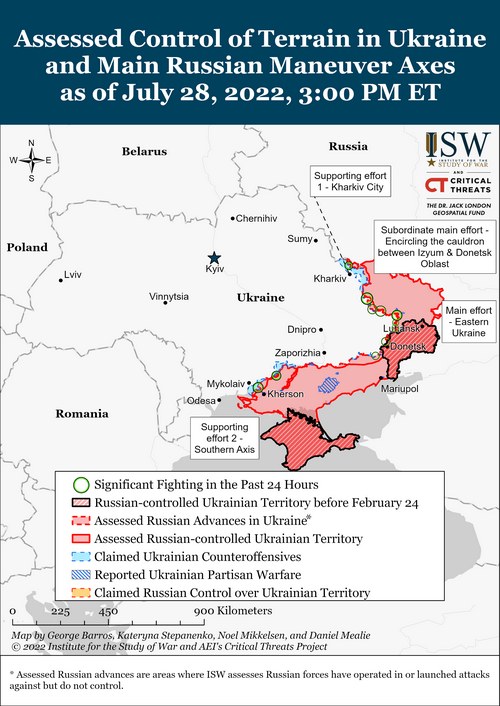
The Russian grouping in Donetsk Oblast is likely seeking to capitalize on recent marginal gains southeast of Bakhmut by continuing to attempt to advance in that area. Russian forces may be de-emphasizing attempts to take Siversk in order to concentrate on Bakhmut, but it is too soon to tell. Russian forces continued efforts to advance northward on Bakhmut from recently gained positions around Novoluhanske and the Vuhlehirska Power Plant while pursuing southwestward advances along the T1302 highway from recently captured positions in Berestove. By contrast, Russian forces have been struggling to make concrete gains around Siversk and have not made any confirmed advances toward the city since the capture of the Luhansk Oblast Administrative border in early July. Russian command is likely, therefore, seeking to maintain momentum around Bakhmut, potentially at the expense of continued pressure on Siversk. Russian forces remain unlikely to take Bakhmut itself, despite recent incremental advances in its direction.
Putin replaced Colonel-General Gennady Zhidko as deputy defense minister and head of the Main Military-Political Directorate on July 28.[1] Putin signed a decree appointing Colonel-General Viktor Goremykin to Zhidko’s position and has not publicly announced the appointment of Zhidko to a new position.[2] ISW previously reported that Zhidko would become the overall commander of Russian forces in Ukraine, a report that appears to have been incorrect.[3]
Key Takeaways
- Russian forces in Donetsk Oblast likely seek to capitalize on recent marginal territorial gains around Bakhmut and may deprioritize efforts to take Siversk.
- Russian forces conducted limited ground assaults northwest of Slovyansk and northeast and southwest of Bakhmut.
- Russian forces may be intensifying offensive operations around Avdiivka to reduce Ukrainian strikes in and around Donetsk City.
- Russian forces may be setting conditions for renewed offensive operations toward Kharkiv City.
- Russian forces attempted a limited ground offensive on the Southern Axis but are likely facing territorial losses in Kherson Oblast.
- Russian forces are attempting to preserve their ground lines of communication over the Dnipro River connecting Kherson City to rear areas in eastern Kherson Oblast.
- The Kremlin continued measures to compensate for officer and manpower losses in Ukraine.
- The Kremlin is continuing to institutionalize its occupation administrations in occupied parts of Ukraine to prepare for sham referenda, annexation, and integration into Russia.
- Russian occupation forces are continuing to pressure Ukrainian civilians in occupied areas to use Russian rubles and passports and to attend Russian-run schools, setting conditions for longer-term social control in occupied territories.
Go here to read the rest.
From Strategy Page:
July 28, 2022: Since the Russian invasion of Ukraine in February the Ukrainians have had special teams investigating sites where Russian guided missiles landed, seeking fragments of the guidance system to determine which components were imported from the West. Russia has found they could not mass-produce many Western electronic items and that it was cheaper and easier to import them from the West (which includes South Korea, Japan and sometimes even Taiwan). The 2022 economic sanctions imposed on Russia halted export of electronic components used in missiles and guided rockets.
It was noted that many Russian manufacturers did not stockpile these components but used the more efficient and less expensive “just in time” system that had needed components delivered days before they would be needed for production items. The Russian economy could not afford to maintain stockpiles of these expensive components, something that became evident after 2014, when the first and milder round of economic sanctions were imposed on Russia. After 2014 Russia had to halt production of some systems because they could no longer get key components from foreign suppliers. The 2022 sanctions took note of this and immediately halted shipment of a wide range of electronic components to Russia. As expected, a lot of Russian manufacturing operations soon halted. Russia sought to smuggle in key components via China but that did not solve the problem. This use of China as a middleman for high-tech smuggling was a known problem and China was warned that they would be added to the sanctions list if they assisted the Russians. Evidence of such smuggling could be detected via examination of the missile fragments.
Russia was more successful smuggling its oil but found it could earn more money via smuggled oil than it could spend to buy smuggled electronic components. Oil is a bulk item that is much easier to smuggle than electronic components that have identifying notations, often serial numbers, on them. Smuggling such items is much riskier and rather rare, especially on short notice. Russian ally Iran has lots of experience with this problem and over the decades developed many techniques to get around it. As the Iranian techniques became known they were added to the watch list. This makes it more difficult and expensive to smuggle such components.
Russia believed the Ukraine invasion would succeed quickly and be over within weeks. That was a major miscalculation because months of sustained combat have depleted Russian stockpiles of guided missiles and rockets as well as unguided artillery shells. That may seem odd but post-Soviet Russia could not afford to maintain manufacturing facilities capable of producing large quantities of ordinary artillery shells and unguided rockets. That was not going to be a problem if the Ukraine invasion was over quickly. It wasn’t and now the Russians have less artillery ammo to fire at the Ukrainians. This got worse when Ukraine finally began receiving American GMLRS (guided rockets) in late June. The Russians lost lots of shells when these GMLRS rockets hit Russian ammo storage sites within range. Forced to establish new ammo storage sites farther away from the front line, the Russian also discovered that they did not have enough additional trucks to transport the shells to artillery units near the fighting.
This disruption of Russian ammo supplies was immediately noticeable on the front lines where there was much less artillery fire from the Russians and fewer attacks by Russian ground troops. Those attacks were dependent on heavy artillery support to disrupt Ukrainian defenses. Russian troops either refused to attack without artillery support or did so with so much hesitation that little was achieved. The Ukrainians could attack more frequently and with more success because of the reduced Russian ammo situation. The Ukrainians are to receive longer range guided rockets that will force Russia to store ammo even further away from the front line. In some cases, this means all ammo will have to be trucked from Russia to artillery units. Meanwhile Ukrainian troops receive more trucks, weapons and ammunition from NATO nations that can outproduce the Russians.
Ukrainian military intelligence and planners realized these Russian vulnerabilities long before the Russians did. After the 2014 Russian seizure of Crimea and parts of eastern Ukraine (Donbas) the Ukrainians had to operate more effectively to defeat a larger scale Russian attack. Ukrainian intel and staff officers did the math while their Russian counterparts did not. There were some Russian production and manufacturing specialists who noted the danger but their warnings were ignored by senior Russian leaders who were more inclined to gamble than plan.
It wasn’t always like this. For example, Russia invented the use of unguided rockets in the MLRS (Multiple Launch Rocket Systems) in the 1930s, but they were late to adopt the use of guided rockets in MLRS systems. The United States finally adopted MLRS in 1983, using an unguided 227mm rocket. That changed twenty years later when the U.S. added GPS navigation to the unguided MLRS rocket to produce GMLRS (Guided MLRS) rockets.
Russia saw some innovations in the original American MLRS and incorporated these into their BM-30 MLRS system that entered service in 1989 using 300mm unguided rockets. It took the Russians a decade to duplicate the American GMLRS and the Russian version was seen operating in Syria by 2016. Russia had problems producing their GMLRS and associated (in the MLRS vehicle) electronics. By 2017 a reliable GMLRS system (Tornado-S) was in mass production and many of the “guided missiles” used by Russian forces in Ukraine have been Tornado-S. Russia was unable to find a solution to its dependence on key foreign components to turn unguided rockets into much more effective GMLRS missiles.
Go here to read the rest. With the Russians losing their artillery dominance, they have nothing to fall back upon except for hastily trained draftees who have proven very reluctant to die in Ukraine for Putin’s ambitions.
And with that, this series will be on vacation hiatus until August 8.


MI Congresswoman Elissa Slotkin (D) in an interview this past week noted that a classified briefing by the US defense department revealed that accurate US estimates of Russian casualties number75,000 killed and wounded. If the usual ratio is 2:1 or 3:1 wounded to killed, that means anywhere from approx. 20,000 to 25,000 dead Russian military, and the wounded are likely to be largely out of the fight permanently because of the abysmal state of affairs of Russian field hospitals and medical services.
As as well known now, the recruitment age has been lifted from age 40 up to age 50 or 55, at least for support military personnel, but Russian levy teams are having a very hard time recruiting soldiers between the ages of 18 to 40. There have been at least 6 Recruiting Centers attacked with Molotov cocktails, these in various parts of Russia, including in Siberia according to sofrep.com, a military analysis site.
I am not seeing how this war is heading towardf Russian victory.