
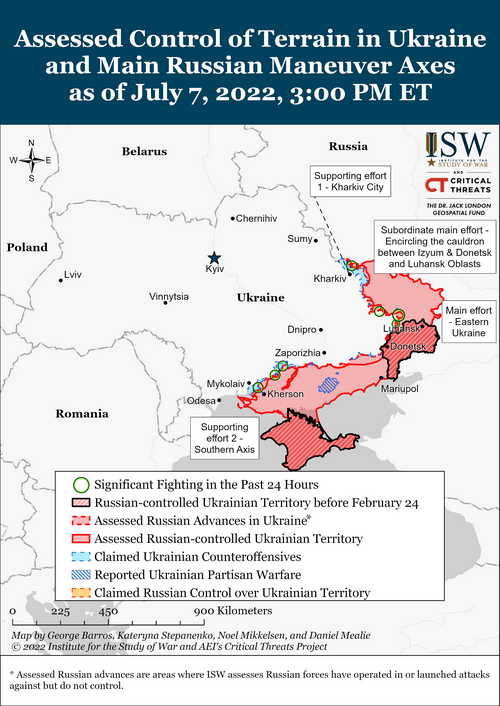
From The Institute For The Study of War:
Karolina Hird, Kateryna Stepanenko, Grace Mappes, and Frederick W. Kagan
July 7, 5:45 pm ET
Click here to see ISW’s interactive map of the Russian invasion of Ukraine. This map is updated daily alongside the static maps present in this report.
Russian Defense Ministry Spokesperson Igor Konashenkov announced on July 7 that Russian forces in Ukraine are pausing to rest and regain their combat capabilities, confirming ISW’s assessment that Russian forces have initiated an operational pause.[1] Konashenkov did not specify the intended length of Russian forces’ operational pause. As ISW previously assessed, Russian forces have not ceased active hostilities during this operational pause and are unlikely to do so.[2] Russian forces still conducted limited ground offensives and air, artillery, and missile strikes across all axes on July 7.[3] Russian forces will likely continue to confine themselves to small-scale offensive actions as they rebuild forces and set conditions for a more significant offensive in the coming weeks or months.
Key Takeaways
- The Russian Ministry of Defense announced that Russian forces are conducting an operational pause to rest and reconstitute.
- Russian forces continued efforts to advance toward Slovyansk from the southeast of Izyum and may be setting conditions to advance from the southeast of Barvinkove—either toward Slovyansk or toward Kramatorsk.
- Russian forces made marginal gains to the southeast of Siversk and continued offensive operations west of the Lysychansk area.
- Russian forces continued offensive operations to the south and east of Bakhmut.
- Russian forces conducted a limited and unsuccessful attack north of Kharkiv City.
- Ukrainian partisans are likely continuing to target Russian-controlled railways around Melitopol.
- Russian oblasts are continuing to create their own ad hoc volunteer units to compensate for personnel losses in Ukraine.
Go here to read the rest. From Strategy Page:
July 7, 2022: The U.S. military has had to cope with a lot of recruiting problems over the last few years. These include financial, suitability, leadership, communications, morale, political and ideological difficulties. Recruiters were coping, and meeting their quotas for enough new recruits to replace losses due to retirement, casualties, illness or not-reenlisting. In 2022 the recruiters are having their worst year ever. Each Recruiting Location has annual and monthly quotas for each service (army, navy, air force and marines) based on past performance. Recruits are easier to find in some parts of the country and this is reflected in the quotas. So far in 2022 monthly quotas are not being met by a large margin. It’s worse for the army, which is attracting less than half the recruits the Department of Defense analysts expected. The senior military leadership proposed offering record-high bonuses (up to $50,000) for eligible recruits. Polls indicate this will not have much impact on the current situation.
Many recruiters already realized that recruits were going to be difficult to find this year, something that was largely ignored inside the Department of Defense. Unlike Pentagon analysts, the recruiters are constantly in touch with potential recruits as well as veterans’ groups. This provides recruiters with real-time exposure to attitudes of potential recruits. Veterans, especially recent ones, provide word of mouth to family and friends about current conditions in the military. Currently the word of mouth is bad, and older veterans, including the few still around from World War II, comment that the current military is not the one that fought and won battles. The major problem is political demands. Congress makes the laws and the military follows them. The military has been all-volunteer since the 1970s so military service is not mandatory. If potential recruits, especially those influenced by word -of-mouth, are put off by current conditions, they don’t volunteer. This applies to officers as well as enlisted troops and the reserves as well. The current situation is worse because the current president and Congress have the lowest approval ratings in history. The approval levels are lowest in regions which usually provide a disproportionate number of volunteers for military service. In the next two years there will be elections for a new president and members of Congress. That is expected to help with recruiting but only after the word-of-mouth turns around and that will take another year or two, if it happens. In the meantime, recruiters are under increasing pressure to find recruits. As in the past, this is producing more burnout for recruiters. Recruiting is already seen as a hardship assignment and eligible NCOs (Non-Commissioned Officers) avoid it any way they can. Some leave the military by not reenlisting. This toxic environment was a seemingly sudden development because over the last few years recruiters have been successful at coming up with new ideas to reach a new generation (Gen Z) of recruits.
Go here to read the rest. With the operational pause Russia has ceded the initiative for the moment. Let’s see what Ukraine does with it.

