
From The Institute For The Study of War:
Kateryna Stepanenko, Karolina Hird, Mason Clark, and George Barros
June 7, 6:45 pm ET
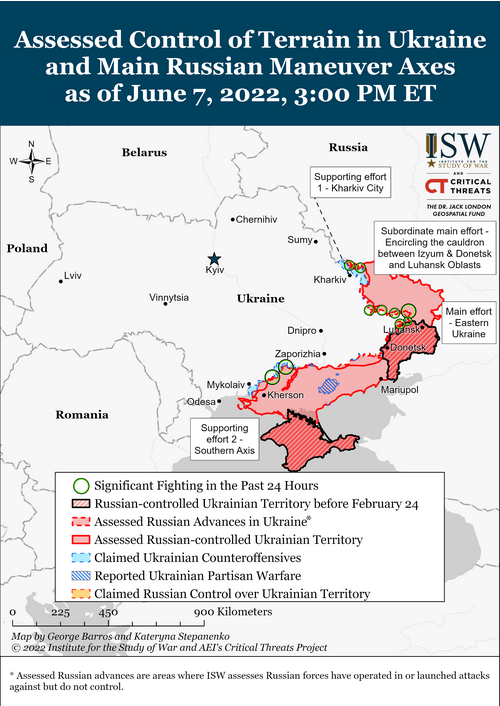
Click here to see ISW’s interactive map of the Russian invasion of Ukraine. This map is updated daily alongside the static maps present in this report.
Russian forces continued offensive operations in several locations in eastern Ukraine but did not secure any confirmed gains in ground assaults on June 7. Russian forces have likely captured most of Severodonetsk, but ISW cannot confirm the exact control of terrain within the city.[1] Russian forces additionally redeployed troops east of Bakhmut to renew offensives to secure access to highways northeast of Bakhmut and threaten Ukrainian lines of communication.[2] Russian troops north of Slovyansk will likely seek to advance toward Slovyansk and Kramatorsk from positions north of the city.[3] Russian forces on the Southern Axis are reportedly redeploying away from Zaporizhia Oblast toward Kherson Oblast, likely in order to support Russian defensive positions that have been threatened by Ukrainian counterattacks along the Mykolaiv-Kherson Oblast border south of Davydiv Brid.[4]
Members of the Russian military community are accusing Ukrainian forces of escalating artillery attacks on Russian rear areas in a likely attempt to dissuade further Western support to the Ukrainian military. Former FSB agent Igor Girkin (also known as Strelkov) accused Ukrainian troops of perpetrating “terrorist attacks” against residential areas of Donetsk City, Horlivka, and Makiivka.[5] A Russian source additionally accused Ukrainian forces of firing on Shyroka Balka, Kherson Oblast.[6] Ukrainian social media users denied the claims and stated that they are likely false-flag attempts to spoil Western opinion of the Ukrainian military and halt military aid to the Ukrainian Armed Forces.[7]
The Kremlin’s efforts to censor information about deceased military personnel and ongoing forced mobilization within the DNR and LNR are reportedly exacerbating domestic tensions and opposition to the war in Russia. The Ukrainian Military Intelligence Directorate (GUR) reported that the Kremlin assigned lawyers and psychologists to convince families of personnel of the sunken cruiser Moskva to refrain from disclosing any information regarding the deaths of their relatives in an effort to crush rising social tensions in Russia.[8] The GUR stated that the Kremlin is threatening to nullify financial compensation to the families of Moskva crew members if they publicly discuss the sinking of the cruiser, resulting in some relatives refusing to meet with Black Sesa Fleet commanders in Sevastopol in protest. Ukrainian media sources separately reported that the Donetsk People’s Republic (DNR) altered mobilization protocols and is now promising compensation for wounded and deceased personnel due to DNR servicemen rioting at the frontlines.[9]
Domestic Russian complaints about the maltreatment and lack of preparation among Russian combat forces are likely prompting the Kremlin to take rhetorical steps to curb discontent. Russian Defense Minister Sergey Shoigu stated that new conscripts during the summer training period will be trained with specific attention to lessons learned so far in Ukraine during a meeting with the National Defense Management Center (NDCC) (the supreme command center of the Russian Armed Forces and Defense Ministry) on June 7. Shoigu added that summer conscripts will learn battlefield first aid, likely responding to criticisms by members of the Russian military community of poor tactics and lack of first aid acumen among Russian soldiers.[10] However, the Russian military is unlikely to properly train and equip Russian conscripts rushed to the front as replacements and likely primarily seeks to mollify public discontent. Former DNR Security Minister and milblogger Alexander Khodakovsky claimed that he asked the DNR military command to move exhausted and demoralized proxy conscripts to auxiliary tasks away from the line of contact but to no avail.[11]
Key Takeaways
- Russian forces have likely established control over the majority of the residential sector of Severodonetsk and conducted assaults against Ukrainian positions in the industrial zone in the past 24 hours. The operational environment within the city remains fluid.
- Russian forces continued efforts to advance on Slovyansk southeast from the Izyum area and west from Lyman, attempting to break through Ukrainian defenses that have halted most direct frontal assaults from Izyum.
- Russian forces are likely attempting to reinforce their operations in the Severodonetsk-Lysychansk area from both the Toshkivka-Ustynivka area in the south and Kupyansk from the northwest.
- Russian forces began withdrawing troops from positions in Zaporizhia Oblast, likely either to rotate damaged units into rear areas or to reinforce Russian defenses in northwestern Kherson Oblast, though ISW cannot currently confirm the destination of these forces.
- Russian forces failed to regain advanced positions on the western (now Ukrainian-occupied) bank of the Ihulets River on June 7.
- Russian Defense Minister Sergei Shoigu announced that Russian forces restored transit connections between newly occupied cities and Crimea.
- Russian occupation authorities continue to face challenges suppressing Ukrainian resistance and finding partisan supporters despite increasingly draconian occupation measures and attempts to bribe Ukrainian civilians.
Go here to read the rest. The remarkable thing we are witnessing now in the War is the inability of the Russians to amass military power to do more than basically maintain the status quo. When the initial Russian drive on Kiev failed in March, some commentators predicted that the Russians would amass an overwhelming force to steamroll the Ukrainians. Three months later it is obvious that the Russians simply do not have the military strength to do this. The Russian Bear is old. toothless and arthritic, and the world is taking note of that fact.


“The Russian Bear is old. toothless and arthritic, and the world is taking note of that fact.”
An old toothless arthritic bear with nuclear ICBM claws is even more dangerous than a strong and healthy bear.
Only if they do not care becoming a dead Russian Bear. If I was them I would be concerned about ICBM’s exploding on launch pads. Maintenance of equipment has never been a Russian strong point.
Yup, I agree with that, Donald. I still am concerned about their new Belgorod nuclear submarine with its nuclear armed, nuclear propelled Poseidon Status 6 torpedo. They would do much damage before the bear dies. But from the example of the Kursk 20 years ago, your point is still valid.
It would appear that Russia is planning on outlasting the will of Ukraine and its allies in order to achieve its objectives. That tactic has been used in the past and has not always been successful. Rome and Britain come to mind in demonstrating that other problems can arise in the attacking country which make long term achievement of objectives highly problematic. Also, they may run out of Generals sooner than expected.
It would appear that Russia is planning on outlasting the will of Ukraine and its allies in order to achieve its objectives. That tactic has been used in the past and has not always been successful. Rome and Britain come to mind in demonstrating that other problems can arise in the attacking country which make long term achievement of objectives highly problematic. Also, they may run out of Generals sooner than expected.
—————-
My thoughts, as well. I also thought about Russia’s forced withdrawal from Afghanistan.
Prof. Michael Clarke, Fellow at Kings College, London in Defense Studies and occasional analyst for Sky News Australia & the BBC, states that he can’t understand the Russians investing so much military capital trying to capture Severodonetsk, not a prime tactical target in the Donbas Oblast, not the likes of Krasmatorsk nor Slovyansk: and he points out in contradiction to inferences from ISW above that Russian forces have not taken Severodonetsk. This concurs with Ukrainian blogger Denys Davidov, who has said that the Russians were driven outside the city limits on Sunday 6/5, and that it appears as if Ukrainians deliberately conducted a limited strategic withdrawal to take them out of range of Russian artillery after their counterattack. Ukrainian military forces control Lysachansk, on the other side of the river from Severodonetsk, and have heavy artillery, some of it the new weaponry from the West, situated now on high ground near the city, that significantly outranges or at least matches the range of Russian artillery now, and is inflicting heavy casualties and damage in Russian forces, according to him. At least the control of the city at present is contested.
By now, most have heard that two more Russian generals were killed, both by Ukrainian artillery bombardment, likely in the battle for Severodonetsk: Major Gen. Roman Kutuzov, whose death was confirmed by Russian-state media outlet, Rossiya 1; and Lt. Gen. Roman Berdnikov of the 29th Combined Arms Army (His predecessor, Maj. Gen. Andrei Kolesnikov, was killed Mar. 11th). Berdnikov’s death has not yet been confirmed by the Russian command. Also, a well-known rather celebrated Russian military enlisted man, a sniper known as “Putin’s Executioner,”Vladimir Andunov, from a Siberian regiment of the Trans-Baikal region, was in turn killed by a sniper shot in the Kharkhiv area a few days ago. Popular stories have circulated that he was a member of the mercenary Wagner Group, and allegedly ruthlessly killed POW’s captured in the 2015 war with Ukraine.
Davidov and other BBC and Sky News military analysts have commented that the newly supplied by the West, especially motorized artillery, is having an impact. Evidently so.