
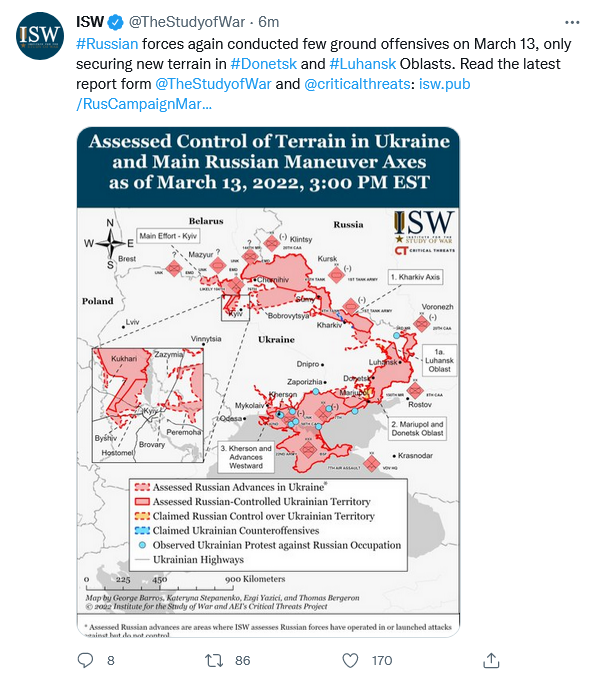
From The Institute For the Study of War:
Mason Clark, George Barros, and Kateryna Stepanenko
March 13, 4:00 pm EST
Russian forces again conducted few ground offensives on March 13, only securing new terrain in Donetsk and Luhansk Oblasts. The Ukrainian General Staff reported that Russian forces predominantly took measures to restore combat readiness and regrouped combat units as of noon local time on March 13.[1] Russian forces continue to assemble reinforcements and attempt to improve logistical support in both the Kyiv and southern operational directions. Russian forces may intend to resume larger-scale attacks on both axes of advance in the coming week, but will likely take longer to (or may never) cohere the combat power necessary to complete the encirclement of Kyiv.
Key Takeaways
- Russian forces did not conduct offensive operations northwest of Kyiv for the third day in a row.
- Russian forces did not conduct attacks toward northeastern Kyiv and prioritized reinforcing their lines of communication and logistics routes.
- Russian and proxy forces successfully captured several towns north of Mariupol in Donetsk Oblast on March 13, the only offensive ground actions of the day.
- Ukrainian protests in occupied Kherson are likely expanding.
- Russia is diluting its international deployments in Armenia and Nagorno-Karabakh to reinforce operations in Ukraine and pulling additional forces from Russia’s far east.
- Ukrainian intelligence reported Russia will deploy preexisting pro-Assad Syrian units to Ukraine, in addition to previously announced plans to recruit new Syrian and Libyan mercenaries. These forces are unlikely to enable Russia to favorably change the balance of forces around Kyiv in the next week but may provide a longer-term pool of low-quality replacements.
- Russian ballistic missiles killed 35 Ukrainians at the Yavoriv military training center near Poland in a likely effort to interdict Western aid deliveries to Ukraine—following up on the Kremlin’s March 12 announcement it will treat international aid shipments as military targets.
Russia is increasingly pulling forces from its international deployments to reinforce operations in Ukraine, though these deployments are unlikely to shift the balance of forces in the coming week. The Ukrainian General Staff reported on March 13 that 800 personnel from Russia’s 102nd Base in Armenia deployed to an unknown location in Russia on March 9-10 in preparation to deploy to Ukraine.[2] They also reported that Russia is recalling elements of its peacekeeping deployment in Nagorno-Karabakh to replenish losses in Ukraine.[3] Russia will likely draw further forces from its international deployments in Armenia, Tajikistan, and Syria to replace losses in Ukraine. The Ukrainian General Staff separately reported that Russia plans to deploy 1,500 troops from Russia’s 40th Naval Infantry Brigade (of the Pacific Fleet) to Belarus via rail at an unspecified time.[4]
Ukrainian intelligence provided further details on Russia’s initiative to deploy existing pro-Assad units to Ukraine and recruit additional Syrian and Libyan mercenaries on March 13. Ukraine’s Military Intelligence Directorate (GUR) reported that Russia is recruiting mercenaries from Syria and Libya and will pay them around $300-$600 monthly.[5] Russia reportedly opened 14 recruitment centers in Syria and will transport mercenaries to the Chkalovsky airbase in Moscow Oblast after they receive training. The GUR reported that Russia has already gathered “thousands” of Syrian troops, mainly those specialized in heavy artillery and sniper weapons, from the National Defense Forces and 5th Corps—two Russian-backed pro-Assad units. Russia can likely redeploy its established Syrian proxy forces in the National Defense Militia and 5th Corps on relatively short notice, dependent on its airlift capacity. However, even hurriedly trained Syrian and Libyan mercenaries will likely take weeks or months to deploy to Ukraine and will likely be of lower quality than the already poor Russian forces in Ukraine. Russia is unlikely to successfully mobilize the reinforcements and replacements necessary to favorably change the balance of forces around Kyiv in the next week but may successfully generate a longer-term pool of low-quality replacements.
The Kremlin may be seeking to take direct control of Belarusian units to deploy them in Ukraine but faces Belarusian resistance. Independent Ukrainian media reported on March 13 that Russian commanders are taking control of Belarusian units to suppress Belarusian soldiers’ efforts to resist going to war in Ukraine and reported “riots” in some Brest-based units.[6] ISW cannot independently confirm these reports through other sources at this time; if confirmed, the reports support ISW’s previous assessment that the Kremlin seeks to bring Belarus into the war but faces resistance from both Belarusian soldiers and Belarusian President Lukashenko. The Ukrainian General Staff additionally reported that Russian forces established a base for repairing and restoring military equipment in Kulichikha, Belarus, (17 km from the border) on March 13.[7]
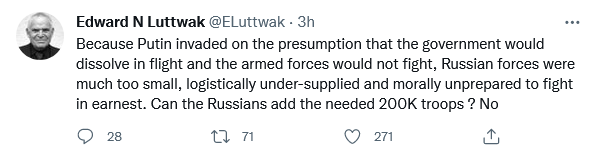
Go here to read the rest. The Russians simply lack the combat troops to restart their stalled offensives, and are acting as if they do not have a clue what to do next. Military malpractice on a huge scale.
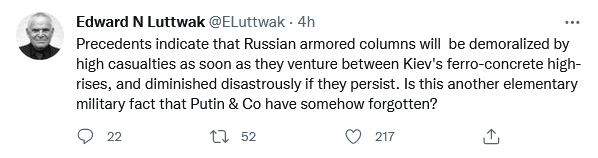


If indeed the Russian SV (non-special ops general army) were to plan to encircle Kiev, and if indeed as these aforementioned experts state that such operation would entail a 50-mile encirclement, then besides the flagging manpower and ability to concentrate it, the SV must also face the spring thaw starting in early April when 24-hour temperatures rise consistently above 32F.
Such an encirclement would require considerable “off-roading” to complete an encirclement by tracked Russian armor and mechanized field artillery (the older obsolescent T-72 tank weighs about 41 tons; the T-90, 46 tons), and tracked military equipment are known historically to struggle in the Eastern European spring as heavy rains, ground thaw, and mud converge to potentially trap them in quagmires. (There are plenty of YouTube videos of T-72’s and T-90’s completely mired and entrapped in muck—even in peacetime war games: they are known for a combination of poor maneuverability and impossible weight loads, which is why they often carry a log-like accessory on the rear designed to be thrust under the tracks to create traction in ooze conditions. Try utilizing that under small-arms fire.)
To say nothing of the fact that deploying to muddy, close-in ops mired in the Ukrainian fields and countryside will render armor completely vulnerable to portable anti tank weaponry (TOW and Javelins) (FGM148’s).
We shall see.
The quality of Russian ground combat troops also explains why they are using rockets and long range artillery to attempt to defeat the Ukrainians.
Lukashenko is pushing back?
That…is astounding.
If so, he’s reading the room correctly. It’s one thing for his military to acquiesce in a fraudulent election. It’s another for them to go die in a war on behalf of Russia. Especially if the stories about the Russian soldier bodies in Belarusian morgues are correct.
No clue if this is right or not, but it would not surprise me. If the polling I’ve seen is correct, the share of the White Russian public which favors merger with Russia fell from about 1/2 in 1994 to about 1/4 twenty years later. They do not want their own country swallowed up and they’re not on board with risking life and limb to stomp on the Ukraine.
As I expected: Lt. Gen Ben Hodges (ret) on Fox News about 2pm EDT today also says the Russians are “ten days from exhausting their ammunition supplies.”
The Ukrainians are not going to be subdued in 10 days. “Marshal Binkov’s” prediction was right.