
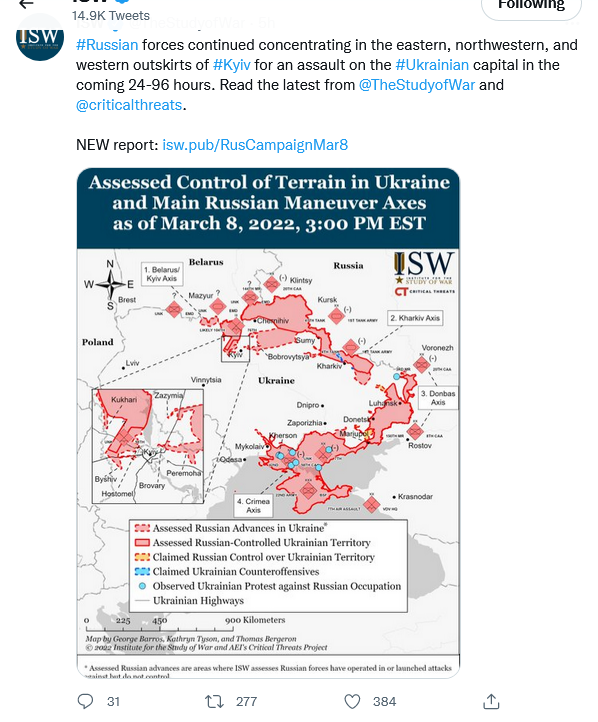
From The Institute For the Study of War:
Fredrick W. Kagan, George Barros, and Kateryna Stepanenko
March 8, 3:00 PM EST
Russian forces continued concentrating in the eastern, northwestern, and western outskirts of Kyiv for an assault on the capital in the coming 24-96 hours. The reported appearance of forces belonging to Chechen leader Ramazan Kadyrov, Russia’s Rosgvardia internal security formations, and the Liga (former Wagner) Private Military Company in the western outskirts of Kyiv may indicate that the Russian military is struggling to assemble sufficient conventional combat power to launch its assault on the capital. Russian forces near Kyiv made limited gains and prepared for limited drives to continue their attempted encirclement to the west.
Ukrainian forces have continued to challenge the lengthy Russian ground lines of communication leading from near Sumy to eastern Kyiv. Russian forces near Kharkiv have been steadily diverting to secure and extend those lines over the past few days, as we have reported. The Ukrainian General Staff reported on March 8 that Russian troops currently near Chernihiv appear to be moving east. We assess that those forces may seek to link up with troops coming from near Sumy to help them consolidate and protect their extended lines in support of the planned offensive against Kyiv.
The situation in eastern Ukraine and southwestern Ukraine remained largely unchanged in the past 24 hours. Ukrainian General Staff reporting of additional Russian efforts to advance on the city of Zaporizhya likely confirm that Russia intends to make blocking that city a priority. The forces Russia is so far moving toward Zaporizhya appear to be far too small to encircle or take it.
Key Takeaways
- Russian forces are consolidating and preparing for further operations along the western and eastern outskirts of Kyiv, especially in the Irpin area in the west and the Brovary area in the east;
- Ukrainian forces are challenging the extended Russian lines reaching from Sumy, which Russian forces have not yet taken, to the eastern outskirts of Kyiv;
- Russian troops are likely attempting to bypass Mykolayiv and cross the Southern Bug upriver of that city to permit an advance on Odesa combined with an impending amphibious operation against that city; and
- Russian forces are also driving north from Crimea toward the city of Zaporizhya.
Go here to read the rest. Yesterday we had this exercise in the game of the Puppetmasters’ Administration does not know what they are doing:
One Chinese custom little understood in the West is that China does not have allies; it has trading partners or tributary states. The latter are seen as a family-type relationship where China is the elder brother and tributary states like North Korea and Russia are younger brothers. North Korea accepts and understands this situation because Korea has been subject to it for centuries. South Korea has broken free of this relationship, which is one reason why China is so hostile to South Korea. Russia is a new member of the family, even if Russia does not officially accept that. That’s irrelevant because Russia is increasingly dependent on China economically, diplomatically and militarily. China also has claims on most of the Russian Far East (Pacific coast) and has never renounced these claims. With that in mind, China is not pleased with the behavior of its younger brother. Despite that, family is family.
Officially, China supports Russian efforts to deal with “Ukrainian aggression.” Unofficially, China is critical of the Russian war on Ukraine, if only because of the negative impact on Chinese trade and diplomacy. China was a major customer for Ukrainian military tech and wheat. That trade is disrupted and will take a while to recover, no matter who wins.
There were other problems. China was not happy with the poor performance of Russian troops in Ukraine. China was kept informed about the preparations for the invasion and asked Russia to wait until the Winter Olympics in China were over on February 23rd before invading. The invasion began before dawn on the 24th and was, according to Russia, supposed to be over in fifteen days. After about a week, China concluded that the Russian plan and the Russian military had failed. Russian troops quickly ran into trouble because of the unexpected stiff resistance by Ukrainian troops and armed civilians. China initially remained silent about the invasion and as the Ukrainian resistance increased, along with unprecedented sanctions imposed by Russia’s Western trading partners, China refused to openly support the Russian operation. China was also dismayed at the degree of European military support for the Ukrainians, despite Russian threats of nuclear retaliation. That did not dissuade the Europeans or Americans, just as it had not worked on China during their 1969 border war between Russia and China. In 1969 China had recently tested its first nuclear weapon but did not have a nuclear retaliation capability. Russia approached the Americans about joining in a nuclear attack on China. The Americans refused and criticized the Russian threats to use nukes. When China found out about that, there was a warming in the long-frosty relations with the Americans which soon (1972) led to the U.S. recognizing the Chinese communist government.
The Chinese consider themselves more astute students of history than Russia and now believe that the invasion was poorly planned and carried out. China is more willing to acknowledge problems with readiness and training in their own military, lessons that Russia appears to have forgotten. Any perceived Chinese support of this Russian disaster causes problems for China, as well as inspiring the Chinese military to pay more attention to avoiding the Russian approach.
China is not assisting Russia economically. To do so would be expensive, reward Russian bad judgment and imply Chinese approval of the Ukrainian operation. With no Chinese economic lifeline available, Russia is under more pressure to end the Ukraine operation as soon as possible. The Russian plan was to rush in and occupy key areas, like the capital Kyiv and all Ukrainian ports, and then declare the war ended and call for negotiations. Russian leader Vladimir Putin either ignored or didn’t believe reports from his military and diplomatic analysts that Ukrainian president Zelensky had a lot of popular support and since 2014 Ukraine had prepared for a Russian invasion. This is why so many prominent Russians have risked arrest by openly criticizing the invasion. China has less openly agreed with these critics by refusing to rescue Putin and the Russian economy. Putin will have to convince Big Brother that a mistake was made and that it won’t happen again because in the future Elder Brother will be kept informed and permission obtained for such risky undertakings. It’s unclear if Putin got the message or would remain the Russian leader. Over the last two decades Putin has centralized power to an extent not seen since the Soviet era. This was deliberately done to make it difficult for Putin to be removed. A nudge from Elder Brother China might be all it takes to replace Putin. With or without Putin, Russia is now weaker and less able to resist Chinese efforts to economically and diplomatically dominate the Central Asian states that used to be part of the Soviet Union. China has also been investing more money in the “lost territories” in Pacific Coast Russia. More Chinese are coming into these territories to live and do business while, since the 1990s, more Russians left. China expected to eventually take control of the lost territories economically and with a lot of Chinese residents. The Ukraine-related sanctions have sped up this process.
Go here to read the rest.


As a Vietnam War veteran, I can not remember the Russians showed in deference to Americans in that conflict. They openly supplied the Viet Cong and the North Vietnamese , manned the anti-aircraft missile sites and even flew combat missions in the North. I see little reason for us to show the Russians any deference at all in the current conflict in Ukraine.
More Chinese are coming into these territories to live and do business while, since the 1990s, more Russians left. China expected to eventually take control of the lost territories economically and with a lot of Chinese residents. The Ukraine-related sanctions have sped up this process
Not buying. The last census of the territory containing Vladivostok indicated that 0.2% of the population was Chinese.