
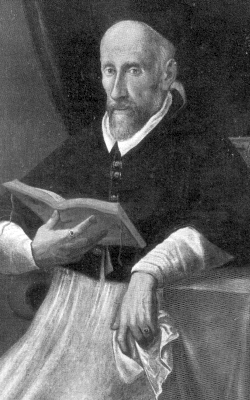
Corsica had not seen a bishop in 70 years, and in many ways had fallen into a pitiful condition. Pope Pius V had advised him to bring along to Aléria at least a dozen confreres to help him. But the community could afford only four: three priests, Vincent Corti, Thomas Gambaldi, Francis Stauli, and one Brother, John Battista.
At the end of April 1570, Sauli, his four confreres and a few servants landed in Corsica. The first impact was very harsh because the episcopal residence had been destroyed during the war. Seminaries did not yet exist, and in Corsica there were no schools or universities. Only a few priests could be educated in the main land, while the others were learned a little from those who knew a little more.
On May 18, 1570, the new Bishop wrote to Cardinal Borromeo in Milan describing the deplorable conditions:
- Most Reverend and honorable my Lord:
- It has pleased the Divine Majesty to allow me to reach safe and sound Corsica, and I feel obliged to send you, my reverend greetings and give you news about conditions of my Church of Aleria. …as I reached Bastia, I had to stop therefore ten days to get the provisions… During that time I received the visit of many of the priests of my diocese. I did not find one who knows Latin, rather many do not even know how to write. I leave to your Illustrious Lordship, to imagine the moral situation here in Corsica, where for a long time there have been wars, where the Bishops did not usually reside in their diocese. My episcopal residence had been the sea and habitation of the guerrilla fighter, Sampiero the Corso, and it has registered more tumults and rebellions than any other section of the island.
- I am still in Corte, a devastated area and in ruins. The Fathers of St. Francis have prepared for me two little rooms… Nor can I think to stay here, because the Friars have told me that my overstay would cause too much disturbance in their regular observance; and it seems to me that they are right, because there is a continuous come and go of people, and if any one wishes to come to my room, he is forced to cross through the Friars’ refectory.
- What really worries me is that the town is in such ruins and devastation that I am not able to find, what should I say, a house for eighteen people between servants and Fathers that I am taking with me by order of His Holiness, where even two can live. Nor do I have the possibility to build, myself a room, in the Capuchin style, as I have intention to do next year, if God keeps me in life, due to the many expenses I have to face.
- During the year I will take residence in Bastia, where I think to stay until harvest time, since in the present moment there is great scarcity. Then I will start the pastoral visit …I will try always to keep with me some of the priests to instruct them, in the vernacular, the most necessary things about the administration of the Sacraments, and the salvation of souls.
- …I close kissing the hands of your Lordship and declare myself a very devout servant. May the Lord God keep you.
- From Corte, May 18, 1570.
- Your Lordship and reverend devout servant, the Bishop of Aleria
He established himself in precarious and humble dwellings and started immediately the visitation of the whole Diocese, entailing great and severe sacrifices, to bring to all the Word of God “like a beneficial rain that the good Lord sends on a field for long time arid and destroyed.” By the end of August he was able to hold a synod with 150 priests present to set up rules and regulations.
The synod became an annual event of three days. Albert Grozio, the Bishop’s secretary wrote: “He took advantage of these days to live heart to heart with his priests who were invited, if they wanted, to live with him at his own expenses. He ate with them, talked with each one of them, and was generous in his charity. To instruct them he used to create cases of conscience, going over liturgical formulas, dogmatic or moral principles, and counciliar and ecclesiastical documents. At the end of the synod most of the priests had to face a most arduous trip back home, so he used to prepare for them and their laity, abundant provisions, giving them horses, wine, or whatever could be useful for the trip.”
With the passing years he provided his clergy with various booklets of instructions including a simplified edition of the Roman catechism so much praised by St. Francis de Sales.
In the following years he often changed residence to be able to have a good knowledge of his people. He founded a seminary in Bastia, and he dedicated himself to all, in spite of his sickness, like malaria and high fever, which few times brought him to the point of death. He transferred his see to escape the malaria-ridden swamplands around Aléria to Cervione, where, in 1578, he built the Cathedrale St-Erasme.
The factional enmity, the famines, and droughts very much tested Alexander’s charity. The pacification of vendettas was a significant part of his pastoral activity.[8] One individual made an attempt on his life. Due to his efforts to end the violence, the people called him “The Angel of Peace”.[7]
From letters written when Sauli was appointed a bishop, it seems that Borromeo thought that he would be wasted in Corsica, and tried on various occasions to have him transferred back to his province, always crashing against Sauli’s humility, who wanted to “leave his bones in Corsica.”
The Corsicans thought to be able to keep him for life. When the news reached them that the Republic of Genoa wanted him to be the coadjutor of the archbishop with the right of succession, they mobilized themselves. They begged the Pope and the Republic to change their decision. The letter they sent to the Pope is a long list of warm praises and Sauli was able to stay for another seven years among the Corsicans.
Go here to read the rest.

