
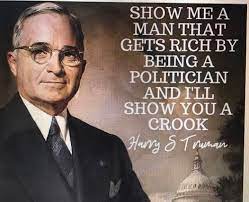
This is depressing:
But Campos brings the receipts. With the cooperation of the Harry S. Truman Presidential Library, he spent months examining the 33rd president’s financial records, many of which became available only with the 2011 release of Bess Truman’s personal papers.
“Harry Truman was a very rich man on the day he left the White House,” writes Campos, “and he became a good deal richer in the five and a half years between that day and the passage of the FPA.”
The evidence for those jolting assertions comes from none other than Truman himself. In a will drafted in his own hand and kept with Bess Truman’s papers, Truman estimated that his net worth at the end of his presidency was $650,000 — a sum comprising $250,000 in savings bonds, $150,000 in cash, and land worth an estimated $250,000. Adjusted for inflation, $650,000 in 1953 is the equivalent of $6.6 million in 2021.
Far from being one step from the poorhouse on his return to private life, Campos writes, Truman’s own private calculations show that his income was among the top 1 percent of American households. Which, in hindsight, makes sense: As president, he received one of the most generous salaries in America — in 1949, presidential pay was raised to $100,000 annually, an amount worth more than $1.1 million today.
Congress also authorized a $50,000 annual presidential expense account, on which Truman could draw at will, no questions asked. Truman stashed the money in “the little safe in the White House,” he acknowledged in the financial statement he wrote in 1953, then transferred it to a safety deposit box at the Columbia National Bank in Kansas City.
“The cash in the box . . . came out of the [yearly] $50,000 expense account that was not accountable for taxes,” Truman noted in his draft will.
Over the next five years, Truman lobbied hard for a federal pension for former presidents, even going on TV to complain that “the United States government turns its chief executives out to grass. They’re just allowed to starve.” Yet during those five years, Truman’s net worth soared. According to an accounting he made of his assets in January 1959, his wealth had climbed to $1.04 million ($9.7 million in 2021 dollars).
Go here to read the rest. Harry Truman conned us all. Time to end pensions for members of Congress and the President and Veep.


A spit in the face of the hardworking person. Every nation has its fair share of Harry Trumans.
I’d never believe a lawyer when math is involved, but it appears he’s reporting Truman’s own accounting. Most surprising.
One problem we have is that compensation for public employees is not transparent to elected officials or voters.
A. Suggest perhaps that defined contribution plans be established for public employees in general (legislators included), rather than the defined benefit programs still common in the public sector. About 15% of the employee’s total compensation would be sluiced to a retirement account which could be invested in a menu of approved financial products. For employees earning early retirement credits (uniformed protective service personnel and those in the building trades), the share withheld would be 30% and you’d earn 1 month of early retirement for every 3 months worked, so the retirement age would not fall below 55 (and you wouldn’t have postal workers and schoolteachers retiring early).
B. Agencies would be required to track expenditures on perquisites carefully, amortizing their cost over the body of eligible employees when the use of them could not be readily attributable to particular employees. Total compensation would be the sum of perquisites and salary or the sum of perquisites and wages.
C. Medical insurance programs would be financed by an assessment on the total compensation of current employees, an assessment on the Social Security check of participating vested retirees, and an assessment on the retirement account of participating vested retirees. The government in question would sort the body of insured persons into several cohorts and solicit sealed bids from insurance companies to insure a given cohort (allowing a given insurance company to submit for some but not all cohorts). It would be a standard contract (perhaps amended annually) with substantive and procedural aspects. The bid would be in the form of the schedule of deductibles the company would insist on in order to fulfill the contract, positing a deductible of $x for a single-person household, $2x for a two-person household, and $3x for a larger household. This practice could be adopted in the private sector as well.
D. Total compensation per worker in any government would by law not exceed compensation per worker in the private sector in the geographic region in question. That in any government corporation not subsidized by tax collections would not exceed compensation per worker in its industrial sector.
E. Maximum regular compensation in a given government would not exceed a sum calculated according to a formula which included compensation-per-worker in that government and the number of employees in that government as arguments, which in turn would usually not exceed 3.5x mean compensation per worker in the private sector in the region in question. Any supplementary compensation given in order to an attract an executive from the outside would have to be granted on an annual basis, granted only by a vote of the legislative body with the yeas and nays recorded, granted only with the consent of the majority of elected legislators, and come out of the hide of all the other employees in that government as the supplementary salary would enter into the computation of compensation per worker for that government.
“Mary had a little lamb,
It’s face was almost human,
Ever time it raised it tail,
It showed Harry Truman.” (Inscription from old bathroom wall-author unknown)